Here is an important writing tip: ground your writing in a sense of place, whether landscape or cityscape.
How often have you heard someone say of a book they loved: ‘I felt like I was there’?
Even if you relocate the poodle tied to a fake-cane chair, the sound of a game of tennis, the table of older men after their regular Sunday match at the café overlooking the tennis courts at Cooper Park that you drank a lemongrass and ginger tea at in Sydney into a café in a story in another state and time, the story will have originality and believability. ‘But that café was in Sydney, I can’t transport it to Adelaide.’ But you can. You can have flexibility with specific detail. The mind is able to transport details, but using actual places that you experienced will give your writing authenticity and truthfulness. It grounds your work in place, giving life and vitality to your writing, rather than a whole lot of exposition that floats in the air.
If you don’t create evocative settings, your characters seem to have their conversations in vacuums or in some beige nowhere-in-particular. – Jerome Stern
Creation of the physical world is as important to your story as action and dialogue. If your readers can be made to see the hand-knitted socks or the row of vitamins on the kitchen benchtop, the scene becomes alive. Readers pay attention. Touch, sound, taste, and smell make readers feel as if their own feet are warm under the cold sheets.
‘Place situates the story in your reader’s mind. Fiction that seems to happen in no particular place often seems not to take place at all.’ – Jerome Stern
Every once in a while, when I’m scratching around for something new to write, I make a list of the things I obsess about. Thankfully, some of them change over time, but there are always new ones to fill the gap.
Recently, of course, all I can think about is the pandemic and the changes to the world as we’ve known it.
It’s true that writers write about what they think about most of the time. Things they can’t let go: things that plague them; stories they carry around in their heads waiting to be heard.
I used to get my creative writing groups to make a list of the topics they obsess about so they can see what occupies their thoughts during their waking hours. After you write them down, you can use them for spontaneous writing before crafting them into stories. They have much power. This is where the juice is for writing. They are probably driving your life, whether you realise it or not, so you may as well use them rather than waste your energy trying to push them away. And you can come back to them repeatedly.
I’ve been working on a suite of quarantine poems. The first of the series will be published in Quadrant magazine.
One of the things I usually obsess about is relationships: relationships in families, relationships with friends, relationships with lovers. That’s what I tend to write about. I think to myself, Why not? Rather than repress my obsessions, explore them, go with the flow. And life is always changing, so new material keeps presenting itself.
We are driven by our passions. Am I the only one who thinks this? For me these compulsions contain the life force energy. We can exploit that energy. The same with writing itself. I’m always thinking and worrying about my writing, even when I’m on holidays. I’m driven.
But not all compulsions are a bad thing. Get involved with your passions, read about them, talk to other people about them and then they will naturally become ‘grist for the mill’.
What about you? Do you find yourself writing about the same things over and over again?
In the Saturday feedback group, we began talking about the ‘off with his head’ or ‘out-it-goes’ part of writing. We acknowledged that as a group we’d always been very supportive and encouraging of each others work. That was because we were all in it together. Our critiquing was not telling lies; it was from a place of open-hearted acceptance. Everything you put on the page is acceptable.
Sometimes someone says, ‘I want a rigorous no-holds-barred assessment of my work.’ But what do you say to them when the writing is dull and boring? Don’t give up your day job? It doesn’t sit comfortably with most of us to be directly critical of someone’s writing. It’s like telling someone how ugly their baby is. All of us find it hard to separate our writing from ourselves, and are prone to take criticism personally.
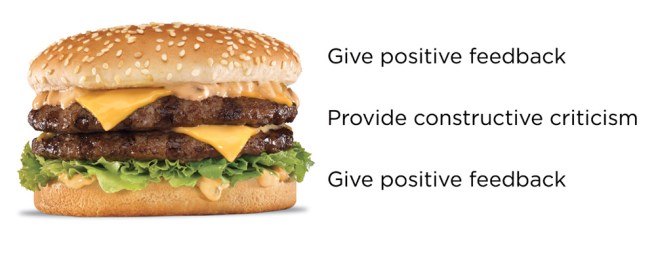
The feedback sandwich is a widely known technique for giving constructive feedback, by ‘sandwiching’ the criticism between two pieces of praise or compliments.
Yesterday, as we passed around copies of our work (just a page or two) we started to address what William Faulkner famously said:
‘In writing, you must kill all your darlings.’
First of all, we looked for the juice in each piece. Where did the writing come alive? ‘Get rid of the rest,’ we said. ‘Off with his head—out it goes.’ It’s very difficult to be this honest, and not everyone wants to hear it. ‘I simply want gentle support and a few corrections,’ some of us might say.
Be willing to have the courage to look at your work with truthfulness. It’s good to know where your writing has energy and vitality, rather than to spend a lot of time trying to make something come to life that is dead on the page. Keep writing. Something new will come up. You don’t want to put your readers to sleep by writing a lot of boring stuff.
Do you have a writing group? Do you find it useful?
Not that most of us are in a rush to sign up for a cruise any time soon … but here is my poem, BETWEEN THE ISLANDS OF THE PACIFIC, first published in Quadrant magazine June, 2018. It’s sort of relevant to the current situation. Hope you enjoy it.
Between the Islands of the Pacific
Because by now we know everything is not so blue
out here.
The cities had tipped rubbish into the sea,
and we let them without even noticing.
Not even feeling our breathing clear
as gusts reaching ten knots cleaned up our days.
Not even. Today pure blue sky, blue sea,
out there the horizon drawing a line
below the clouds, the absoluteness of it. Nights
of diesel engines shuddering beneath us.
We lounge on chairs side by side on the deck.
At dusk, we stand at the railing of the ship as the sun
slips into the ocean. In the fresh sea air, their backs turned,
some raise a selfie-stick or light a cigarette while others
It is essential to separate the creator and the editor, or inner critic when you practice writing, so that the creator has plenty of room to breathe, experiment, and tell it like it really is. If the inner critic is being too much of a problem and you can’t distinguish it from your authentic writing voice, sit down whenever you find it necessary to have some distance from it and put down on paper what the critic is saying, put a spotlight on the words—“You have nothing original to say, what made you think you could write anything anyone would want to read, your writing is crap, you’re a loser, I’m humiliated, you write a load of rubbish, your work is pathetic, and your grammar stinks …” On and on it goes!
Say to yourself, It’s OK to feel this. It’s OK to be open to this.
You can learn to cultivate compassion for yourself during this internal process by practicing Mindfulness Meditation. Sit up straight, close your eyes, bring your awareness to your inner experience. Now, redirect your attention to the physical sensations of the breath in the abdomen … expanding as the breath comes in … and falling back as the breath goes out. Use each breath to anchor yourself in the present. Continue, concentrating on the breath for several minutes. Now, expand your field of awareness to include the words of the inner critic. Turn your attention to where in your body you feel the unpleasant thoughts, so you can attend, moment by moment, to the physical reactions to your thoughts.
“Stay with the bodily sensations, accepting them, letting them be, exploring them without judgment as best you can.”—Mindfulness, Mark Williams and Danny Penman.
Every time you realise that you’re judging yourself, that realisation in itself is an indicator that you’re becoming more aware.
The thing is, the more clearly you know yourself, the more you can accept the critic in you and use it. If the voice says, “You have nothing interesting to say,” hear the words as white noise, like the churning of a washing machine. It will change to another cycle and eventually end, just like your thoughts that come and go like trains at the station. But, in the meantime, you return to your notebook and practice your writing. You put the fear and the resistance down on the page.
*
Do you struggle with an inner critic? Any words of wisdom you’d like to share?
Hello everyone. Hello to all you fellow quarantiners hanging-in-there.
I’d like to share with you my poem ELSEWHERE, first published in Quadrant magazine in December 2017. Hope you like it. The poem is relevant to today’s situation, in many ways.
Elsewhere
Hair remembers how dark a room becomes
when hair is not let loose, straw fallen from the head
of a broom, drifting onto a path,
crunched underfoot by someone who never realised
it was straw. Hair drank, jogged,
ate by itself, knew how to tick ‘Like’
on Social Media. But hair felt
out of touch with itself
unable to distinguish the difference between
fear of the unknown, and fear of something
bad. Hair remembered the ultramarine blue of sea and sky
and the hundred varieties of tuna, calamari and squid.
Hair has dreams, that’s what hair does.
Covers over a shiny scalp, frames the face.
Adventure means exploration and discovery.
And hair remembers—blankets of humidity, harsh light,
residing there in the brain’s temporal lobes.
Even now, when hair is back home,
it remembers the wanting things to remain the same
Sometimes when people read my stories they assume those stories are me. They are not me, even if I write in the first person. They were my thoughts and feelings at the time I wrote them. But every minute we are all changing. There is a great freedom in this. At any time we can let go of our old selves and start again. This is the writing process. Instead of blocking us, it gives us permission to move on. Just like in a progressive ballroom dance: you give your undivided attention to your partner—keep eye contact for the time you are dancing together—but then you move on to the next person in the circle.
The ability to express yourself on the page—to write how you feel about an old lover, a favourite pair of dance shoes, or the memory of a dance on a chilly winter’s night in the Southern Highlands—that moment you can support how you feel inside with what you say on the page. You experience a great freedom because you are not suppressing those feelings. You have accepted them, aligned yourself with them.
I have a poem titled ‘This is what it feels like’—it’s a short poem. I always think of it with gratitude because I was able to write in a powerful way how it was to be desperate and frightened. The act of self expression made me feel less of a victim. But when people read it they often say nothing. I remind myself, I am not the poem, I am not the stories I write. People react from where they are in their own lives. That’s the way things are. The strength is in the act of writing, of putting pen to paper. Write your stories and poems, show them to the world, then move on. The stories are not you. They are moments in time that pass through you.
‘Neurologists at Exeter University, using functional magnetic resonance imaging, found that reading poetry activated different brain regions to prose – even the lyrical prose we find in fiction. When the research participants read poetry, it lit up the regions of the brain variously linked to emotion, memory, making sense of music, coherence building and moral decision-making. Poetry, the study’s authors concluded, induces a more introspective, reflective mental state among readers than does prose.’ – Sarah Holland-Batt, Weekend Australian, 21–22 March 2020
If you feel you’re losing your ability to focus on a long book while confined indoors and surrounded by digital screens (as staying up to date on a global pandemic seems to command), try turning to poetry to nurse your shrinking attention span back to life.
In the Time of Pandemic
And the people stayed home.
And they read books, and listened, and rested, and exercised, and made art, and played games, and learned new ways of being, and were still.
And they listened more deeply. Some meditated, some prayed, some danced.
Some met their shadows. And the people began to think differently.
And the people healed.
And, in the absence of people living in ignorant, dangerous, mindless, and heartless ways, the earth began to heal.
And when the danger passed, and the people joined together again, they grieved their losses, and made new choices, and dreamed new images, and created new ways to live and heal the earth fully, as they had been healed.
—Kitty O’Meara
‘Poetry is the quiet music of being human and in these days and nights when our humanity is fully vulnerable and exposed, poetry takes a small step forward. In our separate isolations, a poem is like the Tardis: bigger on the inside. Like spring – to recall TS Eliot – poetry mixes memory and desire.’ – Carol Ann Duffy, The Guardian
This poem by poet Ian McMillan, reminds of us of just what we lose each time a library is closed.
Adult Fiction
I always loved libraries, the quiet of them,
The smell of the plastic covers and the paper
And the tables and the silence of them,
The silence of them that if you listened wasn’t silence,
It was the murmur of stories held for years on shelves
And the soft clicking of the date stamp,
The soft clickety-clicking of the date stamp.
I used to go down to our little library on a Friday night
In late summer, just as autumn was thinking about
Turning up, and the light outside would be the colour
Of an Everyman cover and the lights in the library
Would be soft as anything, and I’d sit at a table
And flick through a book and fall in love
With the turning of the leaves, the turning of the leaves.
And then at seven o’clock Mrs Dove would say
In a voice that wasn’t too loud so it wouldn’t
Disturb the books “Seven o’clock please …”
And as I was the only one in the library’s late summer rooms
I would be the only one to stand up and close my book
And put it back on the shelf with a sound like a kiss,
Back on the shelf with a sound like a kiss.
And I’d go out of the library and Mrs Dove would stand
For a moment silhouetted by the Adult Fiction,
And then she would turn the light off and lock the door
And go to her little car and drive off into the night
That was slowly turning the colour of ink and I would stand
For two minutes and then I’d walk over to the dark library
And just stand in front of the dark library.
‘The astronomer and poet Rebecca Elson (January 2, 1960–May 19, 1999) was twenty-nine when she was diagnosed with non-Hodgkins lymphoma — a blood cancer that typically invades people in their sixties and seventies. Throughout the bodily brutality of the treatment, throughout the haunting uncertainty of life in remission, she met reality on its own terms — reality creaturely and cosmic, terms chance-dealt by impartial laws — and made of that terrifying meeting something uncommonly beautiful.
Rebecca Elson, 1987
‘When she returned her atoms to the universe, not yet forty, Elson bequeathed to this world 56 scientific papers and a slender, stunning book of poetry titled A Responsibility to Awe (public library) — verses spare and sublime, drawn from a consciousness pulling the balloon string of the infinite through the loop of its own finitude, life-affirming the way only the most intimate contact with death — which means with nature — can be.’ – Maria Popova
Elson’s crowning achievement in verse is the poem “Antidotes to Fear of Death,”
ANTIDOTES TO FEAR OF DEATH by Rebecca Elson
Sometimes as an antidote
To fear of death,
I eat the stars.
Those nights, lying on my back,
I suck them from the quenching dark
Til they are all, all inside me,
Pepper hot and sharp.
Sometimes, instead, I stir myself
Into a universe still young,
Still warm as blood:
No outer space, just space,
The light of all the not yet stars
Drifting like a bright mist,
And all of us, and everything
Already there
But unconstrained by form.
And sometime it’s enough
To lie down here on earth
Beside our long ancestral bones:
To walk across the cobble fields
Of our discarded skulls,
Each like a treasure, like a chrysalis,
Thinking: whatever left these husks
Flew off on bright wings.
Hope you felt the positive benefits of reading these poems.
Are you finding it hard to focus on a creative project while this health pandemic is sweeping the world? It’s hard to stop thinking and worrying about the horrific consequences worldwide.
Being able to create something new though, is a wonderful way to stop obsessing and to put your thoughts on to something constructive. Creative writing is a perfect example.
For myself, I can’t write about the world around me just now. It is still too raw and I need to process what is happening. So I am concentrating on coming up with other ideas for my stories and poems and novels.
I heard someone say, “The thing to do is put the idea in your subconscious. Your brain will do the work.”
It takes time for our experience to make its way through our consciousness. For example, it is hard to write about a journey while you are still in the midst of the adventure. We have no distance from what is happening to us. The only things we seem to be able to say are “having a great time”, “the weather is good”, “wish you were here”. It is also hard to write about a place we just moved to, we haven’t absorbed it yet. We don’t really know where we are, even if we can walk to the train station without losing our way. We haven’t experienced three scorching summers in this country or seen the dolphins migrating south along the coast in the winter.
“Maybe away from Paris I could write about Paris as in Paris I could write about Michigan. I did not know it was too early for that because I did not know Paris well enough.” – Ernest Hemingway, A Moveable Feast (New York: Charles Scribner’s Sons, 1964).
So we take in experience, but we need to let things make their way through our consciousness for a while and be absorbed by our whole selves. We are bower birds, collecting experience, and from the thrown away apple skins, outer lettuce layers, tea leaves, and chicken bones of our minds come our ideas for stories and poems and songs. But this does not come any time soon. It takes a very long time (three to ten years in the case of literary fiction). We need to keep picking through those scraps until some of the thoughts together form a pattern or can be organised around a central theme, something we can shape into a narrative. We mine our hidden thoughts for ideas. But the ideas need time to percolate: to slowly filter through.
Rumi, the thirteenth-century Sufi poet, summed up what could be the creative process when he wrote “The Guest House”:
This being human is a guest house.
Each morning a new arrival.
A joy, a depression, a meanness,
some momentary awareness comes
as an unexpected visitor.
Welcome and entertain them all!
Even if they are a crowd of sorrows,
who violently sweep your house
empty of its furniture,
still, treat each guest honorably.
He may be clearing you out
for some new delight.
The dark thought, the shame, the malice,
meet them at the door laughing and invite
them in.
Be grateful for whoever comes,
because each has been sent
as a guide from beyond.
Jalaluddin Rumi, in The Essential Rumi
Translated by Coleman Barks, 1999
Our work is to keep rummaging through the rubbish bins of our minds, exercising the writing muscle, in readiness to answer that knock at the door when it comes.
As the author Vivian Gornick said, “The writers life is the pits. You live alone and you work alone, every day I have to recreate myself.” She paused and laughed. “But when the work is going well there is nothing that compares.”
What about you? Are you able to force yourself to concentrate on creative writing projects during the corona virus pandemic?
David Dale in the Sydney Morning Herald writes about Isaac Newton’s self-isolation during the plague year 1665-66 and how he passed the time.
‘Newton was 23, a student at Cambridge. When the black plague spread there from London, he retreated to his birthplace – Woolsthorpe Manor, near the town of Grantham (later the birthplace of Margaret Thatcher). During what he called his “annus mirabilis”, or wonderful year, at Woolsthorpe, Newton did three significant things:
He invented the mathematical system called calculus,
He drilled a hole in the shutter of his bedroom window and held a prism up to the beam of sunlight that came through it, discovering that white light is made up of every colour (and giving Pink Floyd an iconic album cover), and
He watched apples falling from the trees in his garden and theorised about a force called gravity, which keeps the moon revolving around planet Earth. (He later wrote: “I can calculate the movement of heavenly bodies, but not the madness of people.”)’ – Sydney Morning Herald
So what can you do while in isolation amid the corona virus outbreak to stay calm and centred and to concentrate your mind away from the current crisis? A writing project could be the answer.
What to write? If you’ve been wondering whether to write a short story or a novel, here are some thoughts on these two different forms of creative fiction:
Is a novel a short story that keeps going, or, is it a string of stories with connective tissue and padding, or, is it something else? Essayist Greg Hollingshead believes that the primary difference between the short story and the novel is not length but the larger, more conceptual weight of meaning that the longer narrative must carry on its back from page to page, scene to scene.
“It’s not baggy wordage that causes the diffusiveness of the novel. It’s this long-distance haul of meaning.” Greg Hollingshead
There is a widespread conviction among fiction writers that sooner or later one moves on from the short story to the novel. When John Cheever described himself as the world’s oldest living short story writer, everyone knew what he meant.
Greg Hollingshead says that every once in a while, to the salvation of literary fiction, there appears a mature writer of short stories—someone like Chekhov, or Munro—whose handling of the form at its best is so undulled, so poised, so capacious, so intelligent, that the short in short story is once again revealed as the silly adjective it is, for suddenly here are simply stories, spiritual histories, narratives amazingly porous yet concentrated and undiffused.
When you decide you want to write in a particular form—a novel, short story, poem—read a lot of writing in that form. Notice the rhythm of the form. How does it begin? What makes it complete? When you read a lot in a particular form, it becomes imprinted inside you, so when you sit at your desk to write, you produce that same structure. In reading novels your whole being absorbs the pace of the sentences, the setting of scenes, knowing the colour of the bedspread and how the writer gets her character to move down the hallway to the front door.
I sit at my desk thinking about form as a low-slung blanket of cloud blocks my view of the sky. Through the fly screen I inhale the sweet smell of earth after rain as another day of possibility beckons.
Self-isolation can give us an opportunity to create something new.
Good luck everyone during this horrific pandemic and please take care.









 Libby Sommer, Author