
The Writing Life – Reblog

Featured Image -- 5029

One of my favourite books on the writing process is The Writing Life by Annie Dillard. It’s a small but passionate guide to the terrain of a writer’s world.

The Writing Life by Annie Dillard book cover

Annie Dillard has written eleven books, including the memoir of her parents, An American Childhood; the Northwest pioneer epic The Living; and the nonfiction narrative Pilgrim at Tinker Creek winner of the 1975 Pullizer Prize.  A gregarious recluse, she is a member of the American Academy of Arts and Letters.


“For non-writers, The Writing Life is a glimpse into the trials and satisfactions of a life spent with words. For writers, it is a warm, rambling, conversation with a stimulating and extraordinarily talented colleague.””–Chicago Tribune””A kind of spiritual Strunk & White, a small and brilliant guidebook to the landscape of a writer’s task…Dillard brings the same passion and connective intelligence to this narrative as she has to her other work.”– “Boston Globe””For her book is…scattered with pearls. Each reader will be attracted to different bright parts…Gracefully and simply told, these little stories illuminate the writing life…Her advice to writers is encouraging and invigorating.”– “Cleveland Plain Dealer””The Writing Life is a spare volume…that has the power and force of a detonating bomb…A book bursting with metaphors and prose bristling with incident.”– “Detroit News”


Dillard begins:

When you write, you lay out a line of words. The line of words is a miner’s pick, a woodcarver’s gouge, a surgeon’s probe. You wield it, and it digs a path you follow. Soon you find yourself deep in new territory. Is it a dead end, or have you located the real subject? You will know tomorrow, or this time next year. You make the path boldly and follow it fearfully. You go where the path leads. At the end of the path, you find a box canyon. You hammer out reports, dispatch bulletins. The writing has changed, in your hands, and in a twinkling, from an expression of your notions to an epistemological tool. The new place interests you because it is not clear. You attend. In your humility, you lay down the words carefully, watching all the angles. Now the earlier writing looks soft and careless. Process is nothing; erase your tracks. The path is not the work. I hope your tracks have grown over; I hope birds ate the crumbs; I hope you will toss it all and not look back.

Which books on writing process have you found to be inspiring?
A cheque in the mail lifts the spirits of poor struggling writer.

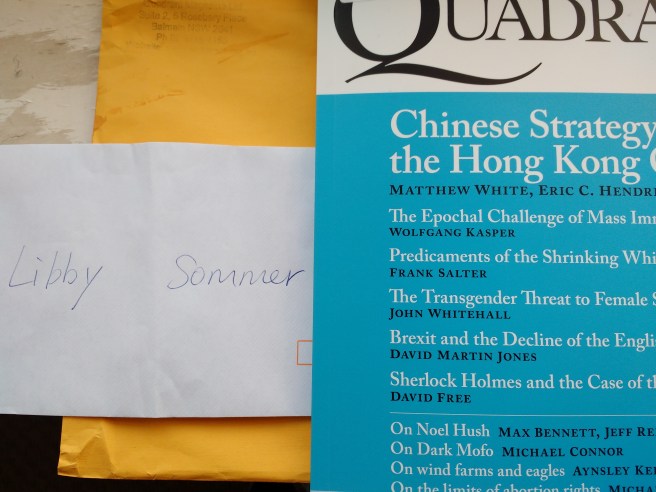
Blue Quadrant magazine with Poetry, Libby Sommer on the cover

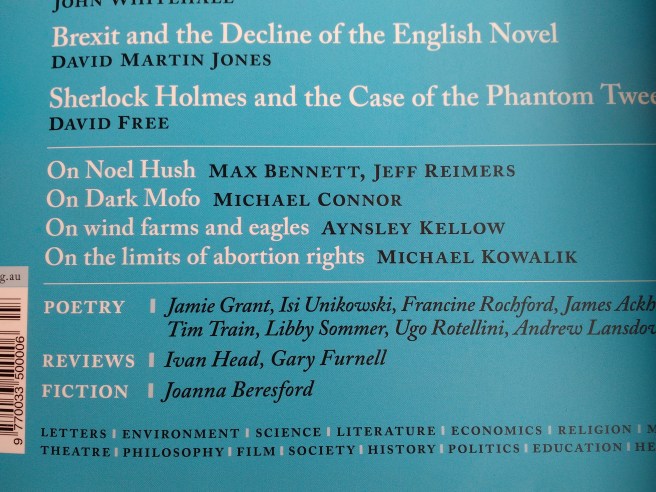
There’s my name on the cover of September Quadrant. First time I’ve made it to the cover under Poetry. This month it’s a prose poem titled AMBER PUPPY. I share the honour with poets Jamie Grant, Isi Unikowski, Francine Rochford, James Ackburst, Tim Train, Ugo Rotellini and Andrew Lansdown.

white envelope beside blue Quadrant September 2019 magazine cover

And there’s the white envelope containing my cheque. Halleluja!

So what is a prose poem?

Dictionary:  a piece of imaginative poetic writing in prose.

Poetry Foundation:  A prose composition that, while not broken into verse lines, demonstrates other traits such as symbols, metaphors, and other figures of speech common to poetry …

WikipediaProse poetry is poetry written in prose form instead of verse form, while preserving poetic qualities such as heightened imagery, parataxis, and emotional effects.

Academy of American Poets:  Though the name of the form may appear to be a contradiction, the prose poem essentially appears as prose, but reads like poetry. In the first issue of The Prose Poem: An International Journal, editor Peter Johnson explained, “Just as black humor straddles the fine line between comedy and tragedy, so the prose poem plants one foot in prose, the other in poetry, both heels resting precariously on banana peels.”  While it lacks the line breaks associated with poetry, the prose poem maintains a poetic quality, often utilizing techniques common to poetry, such as fragmentation, compression, repetition, and rhyme. The prose poem can range in length from a few lines to several pages long, and it may explore a limitless array of styles and subjects.

I love writing prose poems. They are definitely my preferred writing form just now.

Have a read of AMBER PUPPY. Quadrant magazine is available in newsagents, some book stores, online and in libraries.

Quadrant magazine cover September 2019


Things Raymond Carver has said about the short form in writing

blur book stack books bookshelves

‘My attention span had gone out on me; I no longer had the patience to try to write novels. … I know it has much to do now with why I write poems and short stories. Get in, get out. Don’t linger. Go on.’

‘Every great or even every very good writer makes the world over according to his own specifications.’

‘It is his world and no other. This is one of the things that distinguishes one writer from another. Not talent.’

‘Isak Dinesan said that she wrote a little every day, without hope and without despair.’

‘”Fundamental accuracy of statement is the ONE sole morality of writing,” Ezra Pound.’

‘It is possible to write a line of seemingly innocuous dialogue and have it send a chill along the reader’s spine – the source of artistic delight, as Nabokov would have it. That’s the kind of writing that most interests me.’

‘That’s all we have, finally, the words, and they had better be the right ones, with the punctuation in the right places so that they can best say what they are meant to say.’

‘I like it when there is some feeling of threat or sense of menace in short stories.’

‘I made the story just as I’d make a poem; one line and then the next, and the next.’

‘V.S. Pritchett’s definition of a short story is “something glimpsed from the corner of the eye, in passing.” Notice the “glimpse” part of this. First the glimpse.’

‘The short story writer’s task is to invest the glimpse with all that is in his power. He’ll bring his intelligence and literary skill to bear (his talent), his sense of proportion and sense of the fitness of things – like no one else sees them. And this is done through the use of clear and specific language, language used so as to bring to life the details that will light up the story for the reader. For the details to be concrete and convey meaning, the language must be accurate and precisely given. The words can be so precise they may even sound flat, but they can still carry, if used right, they can hit all the notes.’

Raymond Carver, Fires, Vintage 1989

So who is Raymond Carver?

Raymond Carver, in full Raymond Clevie Carver, (born May 25, 1938, Clatskanie, Oregon, U.S.—died August 2, 1988, Port Angeles, Washington), American short-story writer and poet whose realistic writings about the working poor mirrored his own life. – Encyclopedia Britannica

What is a Feedback Sandwich? Reblog

wheat bread sandwich

In the Saturday-afternoon feedback group, we began talking about the ‘off with his head’ or ‘out-it-goes’ part of writing.  We acknowledged that as a group we’d always been very supportive and encouraging of each others work.  That was because we were all in it together.  Our critiquing was not telling lies; it was from a place of open-hearted acceptance.  Everything you put on the page is acceptable.

Sometimes someone says, ‘I want a rigorous no-holds-barred assessment of my work.’  But what do you say to them when the writing is dull and boring?  Don’t give up your day job?  It doesn’t sit comfortably with most of us to be directly critical of someone’s writing.  It’s like telling someone how ugly their baby is.  All of us find it hard to separate our writing from ourselves, and are prone to take criticism personally.

The feedback sandwich is a widely known technique for giving constructive feedback, by ‘sandwiching’ the criticism between two pieces of praise or compliments.

Yesterday, as we passed around copies of our work (just a page or two) we started to address what William Faulkner famously said:

‘In writing, you must kill all your darlings.’

First of all, we looked for the juice in each piece.  Where did the writing come alive?  ‘Get rid of the rest,’ we said.  ‘Off with his head—out it goes.’   It’s very difficult to be this honest, and not everyone wants to hear it.  ‘I simply want gentle support and a few corrections,’ some of us might say.

Be willing to have the courage to look at your work with truthfulness.  It’s good to know where your writing has energy and vitality, rather than to spend a lot of time trying to make something come to life that is dead on the page.   Keep writing.  Something new will come up.    You don’t want to put your readers to sleep by writing a lot of boring material.

How is Writing Like a Sushi Roll?

close up photo of sushi served on table

Sometimes there’d be a person in one of my creative writing classes who was obviously very talented.  I can bring to mind one in particular.  You could sense people holding their breath as she read, and often her hands shook.  The writing process opened her up.  She said she had wanted to write for years.  She was so excited about writing that she straight away wanted to write a book.  I said to her, slow down.  Just practice writing for a while.  Learn what this is all about.

The journey to completing a book reminds me of training to become a sushi chef.

In Japan becoming an itamae of sushi requires years of on-the-job training and apprenticeship.  After five years spent working with a master or teacher itamae, the apprentice is given his first important task, the preparation of the sushi rice.

Writing, like becoming a Sushi Chef,  is a life’s work and takes a lot of practice.  The process is slow, and at the start you are not sure what you are making.

Futomaki  (“thick roll” – rice on inside, nori on the outside)

Uramaki   (“inside-out roll” – rice on outside, nori on the inside)

Temaki     (“hand roll” – cone-shaped roll)

That’s how it was for me.  I thought I could jump in and write a book in 6 months.  In fact, it took me 20 years to write a publishable manuscript. My debut novel,  ‘My Year With Sammy’, the story of a difficult yet sensitive child, published by Ginninderra Press in 2015 went on to be Pick of the Week in Spectrum Books and winner of the Society of Women Writers Fiction Book Award in 2016.

So cut yourself some slack before you head off on a writing marathon.

Writing is like learning to prepare the rice for sushi:  the apprenticeship is long, and in the beginning you are not sure whether a Futomaki, a Uramaki or a Temaki will be the end result.

How to Find Something New to Write About

girl learning person studying

Every once in a while, when I’m scratching around for something new to write, I make a list of the things I obsess about.  Thankfully, some of them change over time, but there are always new ones to fill the gap.

It’s true that writers write about what they think about most of the time.  Things they can’t let go: things that plague them; stories they carry around in their heads waiting to be heard.

Sometimes I used to get my creative writing groups to make a list of the topics they obsess about so they can see what occupies their thoughts during their waking hours.  After you write them down, you can use them for spontaneous writing before crafting them into stories.  They have much power.  This is where the juice is for writing.  They are probably driving your life, whether you realise it or not, so you may as well use them rather than waste your energy trying to push them away.  And you can come back to them repeatedly.

One of the things I’m always obsessing about is relationships:  relationships in families, relationships with friends, relationships with lovers.  That’s what I tend to write about.  I think to myself, Why not?  Rather than repress my obsessions, explore them, go with the flow.  And life is always changing, so new material keeps presenting  itself.

We are driven by our passions.  Am I the only one who thinks this?  For me these compulsions contain the life force energy.  We can exploit that energy.  The same with writing itself.  I’m always thinking and worrying about my writing, even when I’m on holidays.

But not all compulsions are a bad thing.  Get involved with your passions, read about them, talk to other people about them and then they will naturally become ‘grist for the mill’.

What about you?  Do you find yourself writing about the same things over and over again? 

How to Write Story Beginnings

adult book book store bookcase

I’m trying to write a good solid beginning for my new book. I don’t know yet if I’ll be able to maintain the narrative momentum necessary to complete another book length marathon because what I do best is the short form: short stories, flash fiction, prose poems. I’m a sprinter rather than a long distance runner. However, I do have an idea for the setting of the story, the main character and the situation. But that’s all.

Here are the first few paragraphs of my work in progress. My fingers are crossed that I will make it to the end of the story.

“From the window all she could see was a thick expanse of white. She imagined that beyond the bleached park, bereft of native flora, but sprouting feral Norfolk Island pines, lay the immense Pacific Ocean, its agitated waves unravelling along the distant sand of the beach. A few metres beyond that she pictured the white tower and lantern of the Harbour Light, as pictured on the hotel’s website, silently but steadily showing the way.

It was early winter. The tourists had left, the rates were cheaper, and there wasn’t much to look forward to in this sleepy seaside town. Its residents – mostly retirees – were tucked up at home or on holidays in warmer climates. The thick fog that hung low for days on end and the bitter wind from the sea would disappear in its own time to uncover a totally different scene: seagulls skimming the shore, pelicans at the pier, an outdoor craft market, the intermittent feisty spurt of water from the blowhole, formed from basalt lava 260 million years ago, named “kiarama” by Aboriginals, place where the sea makes a noise.

On the jaunty semi-rural valley to the south were dark red cows, producers of butter fat and protein milk. This was a land of dairy-farming plenty, the place where the mountains touched the sea, leaving only the weather frustratingly beyond restraint.

Kirsten Craig, a writer of crime fiction under a more testosterone-fuelled name, kept standing by the window, as if by sheer force of will she could penetrate the confusing mist. She yearned for clarity, an uncomplicated, black or white, answer. She’d find what she needed: peaceful hotel, good food, long walks by the sea, lack of stress, early nights. She would resurrect her conscientious and work-focused persona and put out of her mind the foolishness that had led to her being in this small town, at this slowly darkening time of the year, when she should have been at home.”

According to ‘How to Write a Good Hook & Start Your Novel with a Bang!’ by BookBub:

  1. Startle readers with the first line. …
  2. Begin at a life-changing moment. …
  3. Create intrigue about the characters. …
  4. Use a setting as the inciting incident. …
  5. Up the stakes within the first few pages. …
  6. Introduce something ominous right away. …
  7. Set the mood. …
  8. Make your characters sympathetic — and relatable — immediately.
  9. Draw in the reader with a strong voice
  10. Start at a moment of confusion
  11. Don’t get bogged down with exposition
  12. End the first chapter with a killer cliffhanger

Author Jerome Stern writes in ‘Making Shapely Fiction’:

‘In the first draft of a story, no rules apply. You write and write, ideas come, characters change, situations grow, dialogues take off, speeches become scenes, and surprises occur. … After this first draft exists, then you can bring to bear some of your critical faculties and see what you can see about your creation.’

‘The Art of Fiction’ author David Lodge asks:

‘When does a novel begin? The question is almost as difficult to answer as the question, when does the human embryo become a person? Certainly the creation of a novel rarely begins with the penning or typing of its first words. Most writers do some preliminary work, if it is only in their heads. Many prepare the ground carefully over weeks or months, making diagrams of the plot, compiling c.v.s for their characters, filling a notebook with ideas, settings, situations, jokes, to be drawn on in the process of composition. Every writer has his or her own way of working.

Hope you find this post useful. Let me know in the comments if there’s something you’d like to add about your own experience of writing a story beginning.

How to Turn Towards Your Inner Critic

man wearing brown suit jacket mocking on white telephone

It is essential to separate the creator and the editor, or inner critic when you practice writing, so that the creator has plenty of room to breathe, experiment, and tell it like it really is.  If the inner critic is being too much of a problem and you can’t distinguish it from your authentic writing voice, sit down whenever you find it necessary to have some distance from it and put down on paper what the critic is saying, put a spotlight on the words—“You have nothing original to say, what made you think you could write anything anyone would want to read, your writing is crap, you’re a loser, I’m humiliated, you write a load of rubbish, your work is pathetic, and your grammar stinks …”  On and on it goes!

Say to yourself, It’s OK to feel this.  It’s OK to be open to this.

You can learn to cultivate compassion for yourself  during this internal process by practicing Mindfulness Meditation.  Sit up straight, close your eyes, bring your awareness to your inner experience.  Now,  redirect your attention to the physical sensations of the breath in the abdomen … expanding as the breath comes in … and falling back as the breath goes out.  Use each breath to anchor yourself in the present.   Continue, concentrating on the breath for several minutes.  Now, expand your field of awareness to include the words of the inner critic.  Turn your attention to where in your body you feel the unpleasant thoughts, so you can attend, moment by moment, to the physical reactions to your thoughts.

 “Stay with the bodily sensations, accepting them, letting them be, exploring them without judgment as best you can.”—Mindfulness, Mark Williams and Danny Penman.

Every time you realise that you’re judging yourself, that realisation in itself is an indicator that you’re becoming more aware.

The thing is, the more clearly you know yourself, the more you can accept the critic in you and use it.  If the voice says, “You have nothing interesting to say,” hear the words as white noise, like the churning of a washing machine.  It will change to another cycle and eventually end, just like your thoughts that come and go like aeroplanes in the sky.  But, in the meantime, you return to your notebook and practice your writing.  You put the fear and the resistance down on the page.

You Are Not the Stories You Tell

woman reading book

Sometimes when people read my stories they assume those stories are me.  They are not me, even if I write in the first person.  They were my thoughts and feelings at the time I wrote them.  But every minute we are all changing.  There is a great freedom in this.  At any time we can let go of our old selves and start again.  This is the writing process.  Instead of blocking us, it gives us permission to move on.  Just like in a progressive ballroom dance:  you give your undivided attention to your partner—keep eye contact for the time you are dancing together—but then you move on to the next person in the circle.

The ability to express yourself on the page—to write how you feel about an old lover, a favourite pair of dance shoes, or the memory of a dance on a chilly winter’s night in the Southern Highlands—that moment you can support how you feel inside with what you say on the page.  You experience a great freedom because you are not suppressing those feelings.  You have accepted them, aligned yourself with them.

I have a poem titled ‘This is what it feels like’—it’s a short poem.  I always think of it with gratitude  because I was able to write in a powerful way how it was to be desperate and frightened.  The act of self expression made me feel less of a victim.  But when people read it they often say nothing.  I remind myself, I am not the poem, I am not the stories I write.  People react from where they are in their own lives.  That’s the way things are.  The strength is in the act of writing, of putting pen to paper.   Write your stories and poems, show them to the world, then move on.  The stories are not you.  They are moments in time that pass through you.

Should You Plot Or Not?

man with hand on temple looking at laptop

Plot means the story line.  When people talk about plotting, they mostly mean how to set up the situation, where to put the turning points, and what the characters will be doing in the end.  What happens.

Some fiction writers write organically, not knowing where the story they are writing is going.  These writers say it would be boring to know what’s going to happen next and they lose their enthusiasm to tell the story because they know the outcome already.  They prefer throwing themselves over the edge and into the void.  This method can be very anxiety-producing.  It means you need a lot of faith in your process.

Other writers plan the story before they begin.  In detective fiction the story definitely needs to be worked out beforehand so information can be drip-fed to the reader.

In the past, when creating my short stories, I have worked organically and not known where my stories were headed as I wrote them.  The shorter the piece of fiction, the less need for plot.  You can write an interesting story in which not very much happens.  A woman fights with her neighbour, a man quits his job, or an unhappy family goes out for a pizza.  Simple structures work better than something too complicated when the story is short.

“A plot can, like a journey, begin with a single step.   A woman making up her mind to recover her father’s oil paintings may be enough to start.  The journey begins there, as it did for Raskolnikov in Crime and Punishmentwhen he decided to commit his crime,”  Jerome Stern Making Shapely Fiction

The plot grows and develops out of what helps and what hinders the characters’ progress toward their goals.

The Writers’ Workshop   http://www.writersworkshop.co.uk/plot2.html  ask:

  • But how do you know if your draft plot has the right amount of weight to carry an entire novel?
  • What kind of structures work?
  • Is there a quick way to design your own plot template?
  • And how do you handle a book with multiple points of view?

“A good plot has a clear motivation.  It has a clear structure.  It has an outcome.  It has subplots.  A good plot looks something like the plot structure template below,” The Writers’ Workshop.


Motivation Lizzie Bennett wants to marry for love
Plot structure She meets Darcy & Wickham. She dislikes Darcy, and starts to fall for Wickham. Wickham turns out to be a bad guy; Darcy turns out to be a good guy. She now loves Darcy.
Outcome She marries Darcy
Subplot 1 Jane Bennett (Lizzie’s nice sister) loves Bingley. Bingley vanishes. He reappears. They get hitched.
Subplot 2 Lydia Bennett (Lizzie’s idiot sister) elopes with Wickham. She’s recovered.
Subplot 3 An idiot, Mr Collins, proposes marriage to Lizzie. She says no. Her friend, Charlotte, says yes.

Of course, there are a lot of things that the above plot template doesn’t tell you.  It doesn’t say where the novel is set, it doesn’t tell you anything about plot mechanics – it doesn’t say why Lizzie dislikes Mr Darcy, or how Lydia is recovered from her elopement.  It doesn’t have anything to say about character.

The Writers’ Workshop strongly advises us to build a template much like the one above before starting to write:  If you’ve already started your MS then, for heaven’s sake, get to that template right away.

So all we need is  a beginning, a middle and an end.  Aristotle defined it like this:  A beginning is what requires nothing to precede it, an end is what requires nothing to follow it, and a middle needs something both before and after it.

Easy peasy.  Not.

What about you?  Do you plot or write organically?  I’d love to hear what works for you and what sends you straight to the Writers’ Block Corner.