Autobiography in Fiction

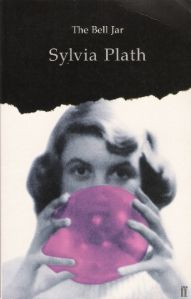
book cover, The Bell Jar by Sylvia Plath

When people ask me where I get my ideas from, I tell them I use the world around me. Life is so abundant, if you can write down the actual details of the way things were and are, you hardly need anything else. Even if you relocate the French doors, fast-spinning overhead fan, small red Dell laptop, and low kneeling-chair from your office that you work in in Sydney into an Artist’s Atelier in the south of France at another time, the story will have truth and groundedness.

In Hermione Hoby’s interview with Elizabeth Strout in the Guardian newspaper, the Pulitzer prize winner said her stories have always begun with a person, and her eyes and ears are forever open to these small but striking human moments, squirreling them away for future use. “Character, I’m just interested in character,” she said.

“You know, there’s always autobiography in all fiction,” Strout said, referring to her novel, My Name is Lucy Barton. “There are pieces of me in every single character, whether it’s a man or a woman, because that’s my starting point, I’m the only person I know.” She went on to explain:

“You can’t write fiction and be careful. You just can’t. I’ve seen it with my students over the years, and I think actually the biggest challenge a writer has is to not be careful. So many times students would say, ‘Well, I can’t write that, my boyfriend would break up with me.’ And I’d think, you have to do something that’s going to say something, and if you’re careful it’s just not going to work.”

At the launch of one of my books MC Susanne Gervay OAM said: “Libby’s level of detail creates poignant insights into character and relationships. If people know Libby they may find themselves subtly entwined in one of her stories.”

On Goodreads’ website they locate The Bell Jar by Sylvia Plath under “Autobiographical Fiction” and describe the book as Plath’s shocking, realistic, and intensely emotional novel about a woman falling into the grip of insanity:

“Esther Greenwood is brilliant, beautiful, enormously talented, and successful, but slowly going under—maybe for the last time. In her acclaimed and enduring masterwork, Sylvia Plath brilliantly draws the reader into Esther’s breakdown with such intensity that her insanity becomes palpably real, even rational—as accessible an experience as going to the movies. A deep penetration into the darkest and most harrowing corners of the human psyche, The Bell Jar is an extraordinary accomplishment and a haunting American classic.”

My advice to you, dear writer, is to be awake to the details around you, but don’t be self-conscious. “So here it is. I’m at a Valentine’s Day party. It’s 33 degrees outside. The hostess is sweltering over a hot oven in the kitchen. She is serving up cheese and spinach triangles as aperitifs.” Relax, enjoy the party, be present with your eyes and ears open. You will naturally take it all in, and later, sitting at your desk, you will be able to remember just how it was to be eating outside in the heat under a canvas umbrella, attempting to make conversation with the people on either side of you, and thinking how you can best make an early exit 🙂

In the interview with Elizabeth Strout in the Guardian, Strout said:

“I don’t want to write melodrama; I’m not interested in good and bad, I’m interested in all those little ripples that we all live with. And I think that if one gets a truthful emotion down, or a truthful something down, it is timeless.”

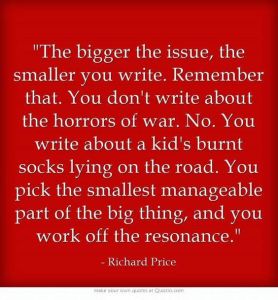
The Bigger the Issue, the Smaller You Write

pexels-photo-851213.jpeg


A quote: the bigger the issue, the smaller you write - Richard Price

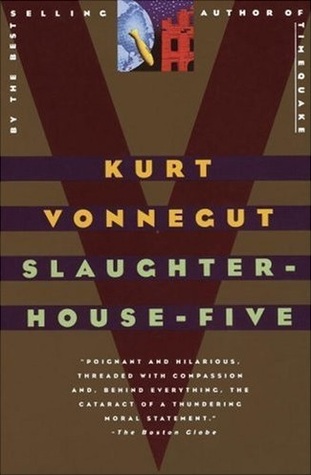
A fantastic example of this writing advice is Kurt Vonnegut’s  Slaughterhouse-Five.

Poignant and hilarious, threaded with compassion and, behind everything, the cataract of a thundering moral statement. – The Boston Globe

book cover of Kurt Vonnegut's 'Slaughterhouse-Five'

Kurt Vonnegut’s absurdist classic Slaughterhouse-Five introduces us to Billy Pilgrim, a man who becomes unstuck in time after he is abducted by aliens from the planet Tralfamadore. In a plot-scrambling display of virtuosity, we follow Pilgrim simultaneously through all phases of his life, concentrating on his (and Vonnegut’s) shattering experience as an American prisoner of war who witnesses the firebombing of Dresden.

Don’t let the ease of reading fool you – Vonnegut’s isn’t a conventional, or simple, novel. He writes, “There are almost no characters in this story, and almost no dramatic confrontations, because most of the people in it are so sick, and so much the listless playthings of enormous forces. One of the main effects of war, after all, is that people are discouraged from being characters.”

Slaughterhouse-Five is not only Vonnegut’s most powerful book, it is also as important as any written since 1945. Like Catch- 22, it fashions the author’s experiences in the Second World War into an eloquent and deeply funny plea against butchery in the service of authority. Slaughterhouse-Five boasts the same imagination, humanity, and gleeful appreciation of the absurd found in Vonnegut’s other works, but the book’s basis in rock-hard, tragic fact gives it a unique poignancy – and humor. – Goodreads

Highly recommended. A masterpiece.

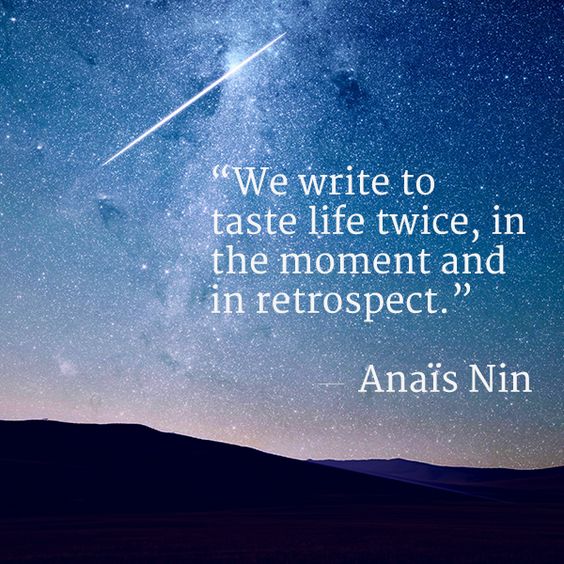
Taste Life Twice – Repost

uncapped fountain pen on page

“Writers live twice. They go along with their regular life, are as fast as anyone in the grocery store, crossing the street, getting dressed for work in the morning. But there’s another part of them that they have been training. The one that lives everything a second time. That sits down and sees their life again and goes over it. Looks at the texture and the details.”  – Natalie Goldberg

quote by Anais Nin against a night sky

What do you think? Do you taste life twice as a writer? I do. What about you?

Writing Tip: Don’t Tell, but Show – Repost

photo of a woman thinking

This is an old one, but a good one. What does it mean exactly? It means don’t tell us about loneliness (or any of those complex words like dishonesty, secrecy, jealousy, obsession, regret, death, injustice, etc) show us what loneliness is. We will read what you’ve written and feel the bite of loneliness. Don’t tell us what to feel. Show us the situation, and that feeling will be triggered in us.

When you take your child to school on their first day you may find yourself teary and relieved at the same time. Put into words what you see: the child’s face, the wave at the gate, the other mothers saying their goodbyes, another child coming up to take your son by the hand. We will get what you’re trying to say without you telling us directly.

The how-to-write books tell us to use our senses when we write stories:  sight, sound, smell, touch. Writing from the senses is a good way to penetrate your story and make friends with it. Don’t tell us about something, drop deep, enter the story and take us with you.

What about you? Do you consciously bring the senses into your creative writing?

Writing in Cafes – Repost


Featured Image -- 5029

I am sitting in a café across the road from the beach in Bronte, Sydney.  This stretch of road has a whole row of cafes side by side facing the sea.  This is my favourite kind of writing place:  one where I can sit comfortably for a long period of time and where the owners of the café know me and welcome me.  This café is owned by a Brazilian man and his wife and has comfortable upholstered bench chairs with a direct view of the Pacific Ocean.

For my two-hour writing session my choice could be a traditional Brazilian dish such as Coxinha, Feijoda or Moqueca.  Or a cocktail like Caipirinha or  Caipiroska.  I must order something and it must be more that a coffee, because I plan to be here for a long time.  I want the owners of the café to know I appreciate the time and the space they are allowing me.

Why go to all this trouble to find a place to write?  Why not just stay home and work?  Because it’s good to get out and have a change of scene.  I find I need to be happy and relaxed when I’m creating on the page and sitting in a café with a pleasant vibe works for me.  Other writers need silence in order to concentrate, but I need to feel I am out and about in a beautiful place having a good time before the creative juices flow.

Strangely, working in a café can help to increase concentration.  The busy café atmosphere keeps the sensory part of you occupied and content, so that the hidden, quieter part of you that composes and focuses is allowed to do its work.  It is something like being cunning when trying to get a spoonful of food into a resistant toddler’s mouth.  You pretend to be an aeroplane with all the sound effects and movements before landing the food-laden plane inside the child’s mouth.  Mission accomplished.

What about you?  Do you need to be at your desk in total silence to write, or do you like to experience the swell of humanity around you—to be surrounded by other human beings?  Or in your home office listening to a particular kind of music?

Use Declarative Sentences – Reblog

pexels-photo.jpg

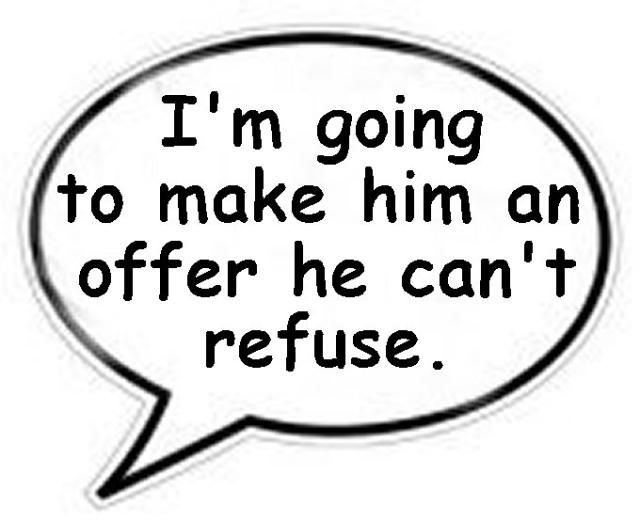
speech bubble: I'm going to make him an offer he can't refuse

This declarative sentence was spoken by Don Corleone (played by Marlon Brando) in the movie The Godfather (1972).

It is not uncommon for women and other minority groups to add qualifiers to their statements. Such as ‘Parents need to stop organising every minute of their children’s spare time, don’t you think?’ ‘I loved that movie, didn’t you?’ In our sentence structure we look for reinforcement for our thoughts and opinions. We don’t always make declarative statements. ‘This is wonderful.’ ‘This is a catastrophe.’ We look for re-enforcement from others.

Another thing we do without realising it, is use indefinite modifiers in our speech:  perhaps, maybe, somehow. ‘Maybe I’ll take a trip somewhere.’ As if the speaker has no power to make a decision. ‘Perhaps it will change.’ Again, not a clear declarative sentence like, ‘Yes, nothing stays the same.’

It is important for us as writers to express ourselves in clear assertive sentences. ‘This is excellent.’ ‘It was a red dress.’ Not ‘The thing is, I know it sounds a bit vague, but I think maybe it was a red dress.’ Speaking in declarative sentences is a good rehearsal for trusting your own ideas, in standing up for yourself, for speaking out your truth.

When I write poetry I read through early drafts with a critical eye, taking out indefinite words and modifiers. I attempt to distill each moment to its essence by peeling off the layers until the heart of the poem is exposed. We need to take risks as writers and go deep within ourselves to find our unique voices and express ourselves with clarity.

Even if you are not 100% sure about your own opinions and thoughts write as if you are sure.  Dig deep. Be clear. Don’t be vague on the page. If you keep practicing this, you will eventually reveal your own deep knowing.

Have you noticed this tendency to qualify in your conversations with others, or in your creative writing, or in blog posts? Would love to hear your thoughts.

The Writing Life – Reblog

Featured Image -- 5029

One of my favourite books on the writing process is The Writing Life by Annie Dillard. It’s a small but passionate guide to the terrain of a writer’s world.

The Writing Life by Annie Dillard book cover

Annie Dillard has written eleven books, including the memoir of her parents, An American Childhood; the Northwest pioneer epic The Living; and the nonfiction narrative Pilgrim at Tinker Creek winner of the 1975 Pullizer Prize.  A gregarious recluse, she is a member of the American Academy of Arts and Letters.


“For non-writers, The Writing Life is a glimpse into the trials and satisfactions of a life spent with words. For writers, it is a warm, rambling, conversation with a stimulating and extraordinarily talented colleague.””–Chicago Tribune””A kind of spiritual Strunk & White, a small and brilliant guidebook to the landscape of a writer’s task…Dillard brings the same passion and connective intelligence to this narrative as she has to her other work.”– “Boston Globe””For her book is…scattered with pearls. Each reader will be attracted to different bright parts…Gracefully and simply told, these little stories illuminate the writing life…Her advice to writers is encouraging and invigorating.”– “Cleveland Plain Dealer””The Writing Life is a spare volume…that has the power and force of a detonating bomb…A book bursting with metaphors and prose bristling with incident.”– “Detroit News”


Dillard begins:

When you write, you lay out a line of words. The line of words is a miner’s pick, a woodcarver’s gouge, a surgeon’s probe. You wield it, and it digs a path you follow. Soon you find yourself deep in new territory. Is it a dead end, or have you located the real subject? You will know tomorrow, or this time next year. You make the path boldly and follow it fearfully. You go where the path leads. At the end of the path, you find a box canyon. You hammer out reports, dispatch bulletins. The writing has changed, in your hands, and in a twinkling, from an expression of your notions to an epistemological tool. The new place interests you because it is not clear. You attend. In your humility, you lay down the words carefully, watching all the angles. Now the earlier writing looks soft and careless. Process is nothing; erase your tracks. The path is not the work. I hope your tracks have grown over; I hope birds ate the crumbs; I hope you will toss it all and not look back.

Which books on writing process have you found to be inspiring?

A cheque in the mail lifts the spirits of poor struggling writer.

Blue Quadrant magazine with Poetry, Libby Sommer on the cover

There’s my name on the cover of September Quadrant. First time I’ve made it to the cover under Poetry. This month it’s a prose poem titled AMBER PUPPY. I share the honour with poets Jamie Grant, Isi Unikowski, Francine Rochford, James Ackburst, Tim Train, Ugo Rotellini and Andrew Lansdown.

white envelope beside blue Quadrant September 2019 magazine cover

And there’s the white envelope containing my cheque. Halleluja!

So what is a prose poem?

Dictionary:  a piece of imaginative poetic writing in prose.

Poetry Foundation:  A prose composition that, while not broken into verse lines, demonstrates other traits such as symbols, metaphors, and other figures of speech common to poetry …

WikipediaProse poetry is poetry written in prose form instead of verse form, while preserving poetic qualities such as heightened imagery, parataxis, and emotional effects.

Academy of American Poets:  Though the name of the form may appear to be a contradiction, the prose poem essentially appears as prose, but reads like poetry. In the first issue of The Prose Poem: An International Journal, editor Peter Johnson explained, “Just as black humor straddles the fine line between comedy and tragedy, so the prose poem plants one foot in prose, the other in poetry, both heels resting precariously on banana peels.”  While it lacks the line breaks associated with poetry, the prose poem maintains a poetic quality, often utilizing techniques common to poetry, such as fragmentation, compression, repetition, and rhyme. The prose poem can range in length from a few lines to several pages long, and it may explore a limitless array of styles and subjects.

I love writing prose poems. They are definitely my preferred writing form just now.

Have a read of AMBER PUPPY. Quadrant magazine is available in newsagents, some book stores, online and in libraries.

Quadrant magazine cover September 2019


Things Raymond Carver has said about the short form in writing

blur book stack books bookshelves

‘My attention span had gone out on me; I no longer had the patience to try to write novels. … I know it has much to do now with why I write poems and short stories. Get in, get out. Don’t linger. Go on.’

‘Every great or even every very good writer makes the world over according to his own specifications.’

‘It is his world and no other. This is one of the things that distinguishes one writer from another. Not talent.’

‘Isak Dinesan said that she wrote a little every day, without hope and without despair.’

‘”Fundamental accuracy of statement is the ONE sole morality of writing,” Ezra Pound.’

‘It is possible to write a line of seemingly innocuous dialogue and have it send a chill along the reader’s spine – the source of artistic delight, as Nabokov would have it. That’s the kind of writing that most interests me.’

‘That’s all we have, finally, the words, and they had better be the right ones, with the punctuation in the right places so that they can best say what they are meant to say.’

‘I like it when there is some feeling of threat or sense of menace in short stories.’

‘I made the story just as I’d make a poem; one line and then the next, and the next.’

‘V.S. Pritchett’s definition of a short story is “something glimpsed from the corner of the eye, in passing.” Notice the “glimpse” part of this. First the glimpse.’

‘The short story writer’s task is to invest the glimpse with all that is in his power. He’ll bring his intelligence and literary skill to bear (his talent), his sense of proportion and sense of the fitness of things – like no one else sees them. And this is done through the use of clear and specific language, language used so as to bring to life the details that will light up the story for the reader. For the details to be concrete and convey meaning, the language must be accurate and precisely given. The words can be so precise they may even sound flat, but they can still carry, if used right, they can hit all the notes.’

Raymond Carver, Fires, Vintage 1989

So who is Raymond Carver?

Raymond Carver, in full Raymond Clevie Carver, (born May 25, 1938, Clatskanie, Oregon, U.S.—died August 2, 1988, Port Angeles, Washington), American short-story writer and poet whose realistic writings about the working poor mirrored his own life. – Encyclopedia Britannica

What is a Feedback Sandwich? Reblog

wheat bread sandwich

In the Saturday-afternoon feedback group, we began talking about the ‘off with his head’ or ‘out-it-goes’ part of writing.  We acknowledged that as a group we’d always been very supportive and encouraging of each others work.  That was because we were all in it together.  Our critiquing was not telling lies; it was from a place of open-hearted acceptance.  Everything you put on the page is acceptable.

Sometimes someone says, ‘I want a rigorous no-holds-barred assessment of my work.’  But what do you say to them when the writing is dull and boring?  Don’t give up your day job?  It doesn’t sit comfortably with most of us to be directly critical of someone’s writing.  It’s like telling someone how ugly their baby is.  All of us find it hard to separate our writing from ourselves, and are prone to take criticism personally.

The feedback sandwich is a widely known technique for giving constructive feedback, by ‘sandwiching’ the criticism between two pieces of praise or compliments.

Yesterday, as we passed around copies of our work (just a page or two) we started to address what William Faulkner famously said:

‘In writing, you must kill all your darlings.’

First of all, we looked for the juice in each piece.  Where did the writing come alive?  ‘Get rid of the rest,’ we said.  ‘Off with his head—out it goes.’   It’s very difficult to be this honest, and not everyone wants to hear it.  ‘I simply want gentle support and a few corrections,’ some of us might say.

Be willing to have the courage to look at your work with truthfulness.  It’s good to know where your writing has energy and vitality, rather than to spend a lot of time trying to make something come to life that is dead on the page.   Keep writing.  Something new will come up.    You don’t want to put your readers to sleep by writing a lot of boring material.