
How to Write Story Beginnings

adult book book store bookcase

I’m trying to write a good solid beginning for my new book. I don’t know yet if I’ll be able to maintain the narrative momentum necessary to complete another book length marathon because what I do best is the short form: short stories, flash fiction, prose poems. I’m a sprinter rather than a long distance runner. However, I do have an idea for the setting of the story, the main character and the situation. But that’s all.

Here are the first few paragraphs of my work in progress. My fingers are crossed that I will make it to the end of the story.

“From the window all she could see was a thick expanse of white. She imagined that beyond the bleached park, bereft of native flora, but sprouting feral Norfolk Island pines, lay the immense Pacific Ocean, its agitated waves unravelling along the distant sand of the beach. A few metres beyond that she pictured the white tower and lantern of the Harbour Light, as pictured on the hotel’s website, silently but steadily showing the way.

It was early winter. The tourists had left, the rates were cheaper, and there wasn’t much to look forward to in this sleepy seaside town. Its residents – mostly retirees – were tucked up at home or on holidays in warmer climates. The thick fog that hung low for days on end and the bitter wind from the sea would disappear in its own time to uncover a totally different scene: seagulls skimming the shore, pelicans at the pier, an outdoor craft market, the intermittent feisty spurt of water from the blowhole, formed from basalt lava 260 million years ago, named “kiarama” by Aboriginals, place where the sea makes a noise.

On the jaunty semi-rural valley to the south were dark red cows, producers of butter fat and protein milk. This was a land of dairy-farming plenty, the place where the mountains touched the sea, leaving only the weather frustratingly beyond restraint.

Kirsten Craig, a writer of crime fiction under a more testosterone-fuelled name, kept standing by the window, as if by sheer force of will she could penetrate the confusing mist. She yearned for clarity, an uncomplicated, black or white, answer. She’d find what she needed: peaceful hotel, good food, long walks by the sea, lack of stress, early nights. She would resurrect her conscientious and work-focused persona and put out of her mind the foolishness that had led to her being in this small town, at this slowly darkening time of the year, when she should have been at home.”

According to ‘How to Write a Good Hook & Start Your Novel with a Bang!’ by BookBub:

  1. Startle readers with the first line. …
  2. Begin at a life-changing moment. …
  3. Create intrigue about the characters. …
  4. Use a setting as the inciting incident. …
  5. Up the stakes within the first few pages. …
  6. Introduce something ominous right away. …
  7. Set the mood. …
  8. Make your characters sympathetic — and relatable — immediately.
  9. Draw in the reader with a strong voice
  10. Start at a moment of confusion
  11. Don’t get bogged down with exposition
  12. End the first chapter with a killer cliffhanger

Author Jerome Stern writes in ‘Making Shapely Fiction’:

‘In the first draft of a story, no rules apply. You write and write, ideas come, characters change, situations grow, dialogues take off, speeches become scenes, and surprises occur. … After this first draft exists, then you can bring to bear some of your critical faculties and see what you can see about your creation.’

‘The Art of Fiction’ author David Lodge asks:

‘When does a novel begin? The question is almost as difficult to answer as the question, when does the human embryo become a person? Certainly the creation of a novel rarely begins with the penning or typing of its first words. Most writers do some preliminary work, if it is only in their heads. Many prepare the ground carefully over weeks or months, making diagrams of the plot, compiling c.v.s for their characters, filling a notebook with ideas, settings, situations, jokes, to be drawn on in the process of composition. Every writer has his or her own way of working.

Hope you find this post useful. Let me know in the comments if there’s something you’d like to add about your own experience of writing a story beginning.

You Are Not the Stories You Tell

woman reading book

Sometimes when people read my stories they assume those stories are me.  They are not me, even if I write in the first person.  They were my thoughts and feelings at the time I wrote them.  But every minute we are all changing.  There is a great freedom in this.  At any time we can let go of our old selves and start again.  This is the writing process.  Instead of blocking us, it gives us permission to move on.  Just like in a progressive ballroom dance:  you give your undivided attention to your partner—keep eye contact for the time you are dancing together—but then you move on to the next person in the circle.

The ability to express yourself on the page—to write how you feel about an old lover, a favourite pair of dance shoes, or the memory of a dance on a chilly winter’s night in the Southern Highlands—that moment you can support how you feel inside with what you say on the page.  You experience a great freedom because you are not suppressing those feelings.  You have accepted them, aligned yourself with them.

I have a poem titled ‘This is what it feels like’—it’s a short poem.  I always think of it with gratitude  because I was able to write in a powerful way how it was to be desperate and frightened.  The act of self expression made me feel less of a victim.  But when people read it they often say nothing.  I remind myself, I am not the poem, I am not the stories I write.  People react from where they are in their own lives.  That’s the way things are.  The strength is in the act of writing, of putting pen to paper.   Write your stories and poems, show them to the world, then move on.  The stories are not you.  They are moments in time that pass through you.

What Are the Microflix Writers Awards?

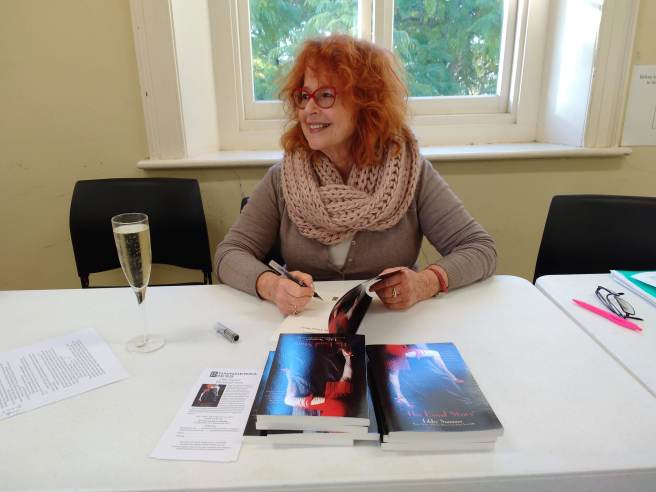
red-headed author Libby Sommer signing one of her books

I am delighted to say that my micro-fiction ‘In the Mall’ has been selected as an entry in the Microflix Writers Awards. Halleluja. I’ll find out in August if my story is chosen by filmmakers for adaptation to a short film for the 2019 Microflix Awards. My microlit on the theme of SOUND is available to view on the Microflix SOUND extracts page on the website of Australian short story publisher, Spineless Wonders.

Spineless Wonders 2019 Microflix Writers Awards

The Microflix Awards offered each year aim to reward and value the roles of both the author and the filmmaker in the adaptation process. For this reason we offer both the Microflix Film Awards and the Microflix Author Awards.

The Microflix Writers Awards consists of a $500 cash prize for Best Writing as well as range of prizes such as discounts on writers’ centre memberships and other resources for writers as well as book packages for Highly Recommended and Recommended Writers.

Our panel of jurists will select winners of the Microflix Writers Awards from the pool of finalist films screened at the Microflix Festival.


The theme for 2019 is SOUND.

This year, Microflix invites authors to submit microlit texts on the theme of SOUND for adaptation by filmmakers. The texts submitted will be reviewed by microlit specialist and Spineless Wonders’ editor Associate Professor Cassandra Atherton. Submissions will be accepted until 30 April and those selected by Cassandra will be included in the 2019 SOUND Texts section on this website.

Exploring the theme of SOUND

We are looking for prose pieces suitable for film adaptation which riff on the theme of sound. You may wish to reflect on the soundtracks of your life – be that songs and music or sounds from the built environment or the natural world. Your submission may reflect on the absence of sound or it may take us into a world without music. Your approach may be playful, witty, political, philosophical or all of the above.


My fingers are crossed.


Should You Plot Or Not?

man with hand on temple looking at laptop

Plot means the story line.  When people talk about plotting, they mostly mean how to set up the situation, where to put the turning points, and what the characters will be doing in the end.  What happens.

Some fiction writers write organically, not knowing where the story they are writing is going.  These writers say it would be boring to know what’s going to happen next and they lose their enthusiasm to tell the story because they know the outcome already.  They prefer throwing themselves over the edge and into the void.  This method can be very anxiety-producing.  It means you need a lot of faith in your process.

Other writers plan the story before they begin.  In detective fiction the story definitely needs to be worked out beforehand so information can be drip-fed to the reader.

In the past, when creating my short stories, I have worked organically and not known where my stories were headed as I wrote them.  The shorter the piece of fiction, the less need for plot.  You can write an interesting story in which not very much happens.  A woman fights with her neighbour, a man quits his job, or an unhappy family goes out for a pizza.  Simple structures work better than something too complicated when the story is short.

“A plot can, like a journey, begin with a single step.   A woman making up her mind to recover her father’s oil paintings may be enough to start.  The journey begins there, as it did for Raskolnikov in Crime and Punishmentwhen he decided to commit his crime,”  Jerome Stern Making Shapely Fiction

The plot grows and develops out of what helps and what hinders the characters’ progress toward their goals.

The Writers’ Workshop   http://www.writersworkshop.co.uk/plot2.html  ask:

  • But how do you know if your draft plot has the right amount of weight to carry an entire novel?
  • What kind of structures work?
  • Is there a quick way to design your own plot template?
  • And how do you handle a book with multiple points of view?

“A good plot has a clear motivation.  It has a clear structure.  It has an outcome.  It has subplots.  A good plot looks something like the plot structure template below,” The Writers’ Workshop.


Motivation Lizzie Bennett wants to marry for love
Plot structure She meets Darcy & Wickham. She dislikes Darcy, and starts to fall for Wickham. Wickham turns out to be a bad guy; Darcy turns out to be a good guy. She now loves Darcy.
Outcome She marries Darcy
Subplot 1 Jane Bennett (Lizzie’s nice sister) loves Bingley. Bingley vanishes. He reappears. They get hitched.
Subplot 2 Lydia Bennett (Lizzie’s idiot sister) elopes with Wickham. She’s recovered.
Subplot 3 An idiot, Mr Collins, proposes marriage to Lizzie. She says no. Her friend, Charlotte, says yes.

Of course, there are a lot of things that the above plot template doesn’t tell you.  It doesn’t say where the novel is set, it doesn’t tell you anything about plot mechanics – it doesn’t say why Lizzie dislikes Mr Darcy, or how Lydia is recovered from her elopement.  It doesn’t have anything to say about character.

The Writers’ Workshop strongly advises us to build a template much like the one above before starting to write:  If you’ve already started your MS then, for heaven’s sake, get to that template right away.

So all we need is  a beginning, a middle and an end.  Aristotle defined it like this:  A beginning is what requires nothing to precede it, an end is what requires nothing to follow it, and a middle needs something both before and after it.

Easy peasy.  Not.

What about you?  Do you plot or write organically?  I’d love to hear what works for you and what sends you straight to the Writers’ Block Corner.

Facts About The Creative Process

afterglow backlit beautiful crescent moon

At a literary event I heard someone say, “The thing to do is put the idea in your subconscious.  Your brain will do the work.”

It takes time for our experience to make its way through our consciousness.  For example, it is hard to write about a journey while you are still in the midst of the adventure.  We have no distance from what is happening to us.  The only things we seem to be able to say are “having a great time”, “the weather is good”, “wish you were here”.  It is also hard to write about a place we just moved to, we haven’t absorbed it yet.  We don’t really know where we are, even if we can walk to the train station without losing our way.  We haven’t experienced three scorching summers in this country or seen the dolphins migrating south along the  coast in the winter.

“Maybe away from Paris I could write about Paris as in Paris I could write about Michigan.  I did not know it was too early for that because I did not know Paris well enough.” – Ernest Hemingway, A Moveable Feast  (New York:  Charles Scribner’s Sons, 1964).

So we take in experience, but we need to let things make their way through our consciousness for a while and be absorbed by our whole selves.  We are bower birds, collecting experience, and from the thrown away apple skins, outer lettuce layers, tea leaves, and chicken bones of our minds come our ideas for stories and poems and songs.  But this does not come any time soon.  It takes a very long time (three to ten years in the case of literary fiction).  We need to keep picking through those scraps until some of the thoughts together form a pattern or can be organised around a central theme, something  we can shape into a narrative.  We mine our hidden thoughts for ideas.  But the ideas need time to percolate:  to slowly filter through.

Rumi, the thirteenth-century Sufi poet, summed up what could be the creative process when he wrote “The Guest House”:

This being human is a guest house.

Each morning a new arrival.

A joy, a depression, a meanness,

some momentary awareness comes

as an unexpected visitor.

Welcome and entertain them all!

Even if they are a crowd of sorrows,

who violently sweep your house

empty of its furniture,

still, treat each guest honorably.

He may be clearing you out

for some new delight.

The dark thought, the shame, the malice,

meet them at the door laughing and invite

them in.

Be grateful for whoever comes,

because each has been sent

as a guide from beyond.


Jalaluddin Rumi, in The Essential Rumi

Translated by Coleman Barks, 1999

Our work is to keep rummaging through the rubbish bins of our minds, exercising the writing muscle, in readiness to answer that knock at the door when it comes.

As the author Vivian Gornick said, “The writers life is the pits.  You live alone and you work alone, every day I have to recreate myself.”  She paused and laughed.  “But when the work is going well there is nothing that compares.”

What about you? Are you ready to answer the knock at the door?  

Best Way to Beat Writing Resistance

man in blue and brown plaid dress shirt touching his hair

How many wonderful ideas have we had in our lives that never became anything more than ideas?  What stopped them from becoming reality?  Probably lack of drive, or fear, or both.

If the idea of writing a story, writing a memoir, or writing a blog lights a spark within you, sets off a signal, causes you to drool—or fills you with unspeakable anxiety—then you are ready to write.  What is holding you back is not lack of drive, but fear.  Unadulterated, stark fear.

  • Fear of what?
  • Fear of being unable to write well and being criticized by others?
  • Fear of being unable to stay on track long enough to get to an ending?
  • Fear that you just don’t have what it takes to maintain focus to tell a good story?

Research into the way the brain operates has revealed that there are two sides to the brain, left and right.  Much of our fear of writing comes from the way these two sides do or don’t work together.

“We might term the right brain ‘the creator,’ for apparently it allows us to do creative things—make connections, manifest ideas, imagine situations, see pictures of events.  The left side analyses, categorizes, recalls words, and performs its learning functions in a step-by-step manner,”  Bernard Selling, Writing From Within.

The analytic left brain has a compartment that houses the “critic.”  He or she is the person in us who says,

  • Watch out!
  • You can’t do that!
  • You’ll fail, so don’t even try.
  • You know you’re not good at that!

“If those two voices in you want to fight, let them fight.  Meanwhile, the sane part of you should quietly get up, go over to your notebook, and begin to write from a deeper, more peaceful place.  Unfortunately, those two fighters often come with you to your notebook since they are inside your head.  So you might have to give them five or ten minutes of voice in your notebook.  Let them carry on in writing.  It is amazing that when you give those voices writing space, their complaining quickly gets boring and you get sick of them,” Natalie Goldberg, Writing Down the Bones.

It’s just resistance.

Sometimes, the harder you try, the more you become stuck in your own negativity.  It can feel like car tyres spinning in a bog and you just can’t move forward with ‘the work’.  Your resistance is actually greater than your desire to write.  That’s when you need to say ‘stop’ and put it aside for now.  Look for another outlet for your energy before starting again.  Take a break and read books by wonderful writers.  When I get stuck I turn to contemporary poetry for inspiration – thoughtful and passionate poems about living in the modern world.  Some of my favourite poets are:  Mary Oliver, Naomi Shihab Nye, Les Murray and Joanne Burns.

Sometimes I start another writing project before going back to the original one to get more perspective on things.  Other times I will study the beginning and endings of books to get inspiration for a new beginning or a new ending, or sometimes work backwards from the ending as a way to restart.

But don’t get caught in the endless cycle of guilt, avoidance, and pressure.  When it is your time to write, write.  Put yourself out of your misery and just do it.

Words to Use Instead of ‘Very’


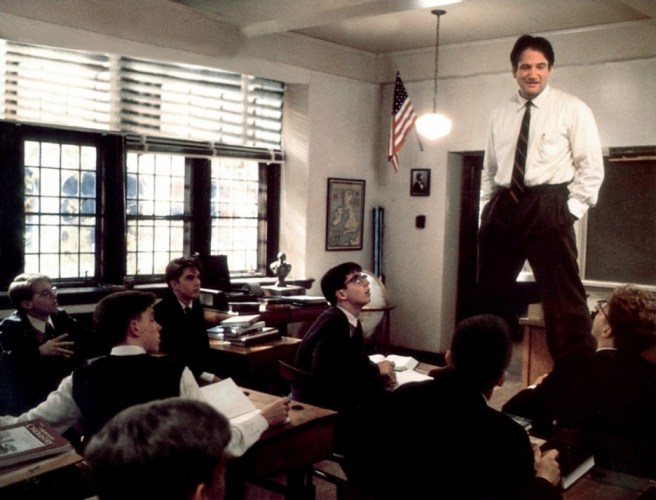
Robin Williams standing on desk in front of classroom of boys

This is the advice Robin Williams had for his classroom of boys in Dead Poet’s Society: 

“So avoid using the word ‘very’ because it’s lazy. A man is not very tired, he is exhausted. Don’t use very sad, use morose. Language was invented for one reason, boys – to woo women – and, in that endeavour, laziness will not do. It also won’t do in your essays.”

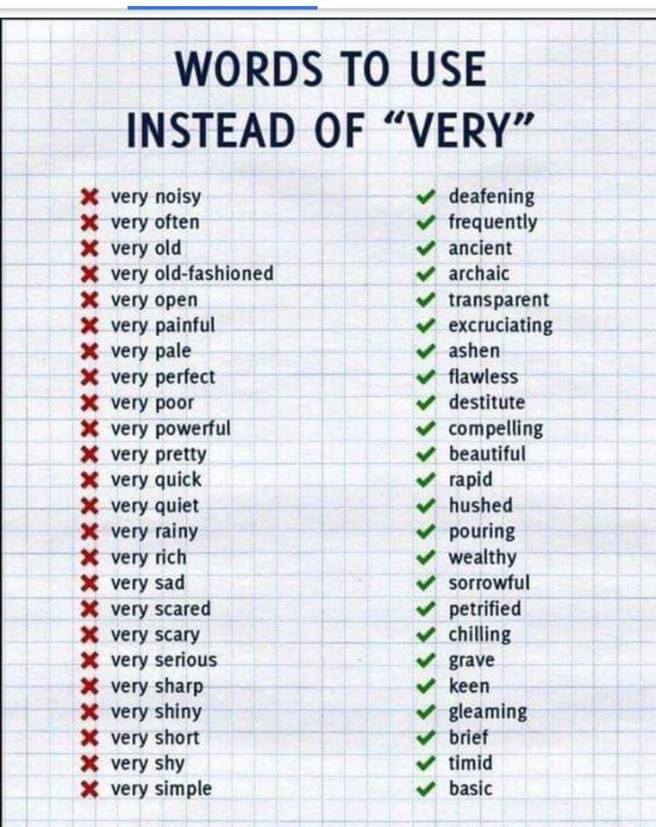
Here are some substitutes for the word ‘very’.

list of words to use instead of 'very'

Sound advice, methinks. Hope you find it useful. I know they teach all this stuff to us in Primary School, but it’s worth a reminder.

11 Tips: What Makes A Good Story?

portrait of girl wearing christmas hat

Everyone loves a good story. That’s the reason why so many people flock to the movies or spend hours reading novels – it’s because we love to get lost in a great tale. Here are 11 tips from the experts on how to write something fabulous.

1. Tension is the cornerstone of any good story. Eric Nylund

2.  A good story, just like a good sentence, does more than one job at once. That’s what literature is: a story that does more than tell a story, a story that manages to reflect in some way the multilayered texture of life itself. Karen Thompson Walker

3.  Be unpredictable, be real, be interesting. Tell a good story. James Dashner

4.  A good story cannot be devised; it has to be distilled. Raymond Chandler

5.  A good story should make you laugh, and a moment later break your heart. Chuck Palahniuk

6.  Tension is the cornerstone of any good story. Eric Nylund

7.  No, it’s not a very good story – its author was too busy listening to other voices to listen as closely as he should have to the one coming from inside. Stephen King

8.  My only conclusion about structure is that nothing works if you don’t have interesting characters and a good story to tell. Harold Ramis

9.  I do feel that if you can write one good sentence and then another good sentence and then another, you end up with a good story. Amy Hempel

10. I’m just trying to write a good story, strictly from imagination. People just think it’s random, they don’t see the rewriting, phrasing of characters, choosing the words, bringing the world to light in which the characters live in. That creates an illusion that this is real. Eric Jerome Dickey

11. I always try to tell a good story, one with a compelling plot that will keep the pages turning. That is my first and primary goal. Sometimes I can tackle an issue-homelessness, tobacco litigation, insurance fraud, the death penalty-and wrap a good story around it. John Grisham

Hope you find these tips useful. For further reading, check out my posts 3 Parts to a Great Blurb and 10 Ideas for Writing Practice  And to make sure not to miss anything from Libby Sommer Author you can follow me on Facebook  or Instagram.


Where Do We Get Our Story Ideas?

girl learning person studying


“Talking is the first voice of a writer. I always heard it, I just didn’t know you could write it. I write the voices you hear every day—it’s just that people don’t recognize how wonderfully people talk. I think every time a person tells the truth, that person is speaking beautifully.” – Grace Paley

As a writer you’re probably always on red alert looking for story ideas. Maybe you use the world around you, seeking locations and characters and situations, listening in to conversations on buses or trains or in cafes. Changing your daily routine is a way to stimulate the  imagination. Drive or walk to a different part of your suburb or home town and look for different places to write. Writing in cafes is my thing. Challenge yourself to move out of your comfort zone in order to find new ideas. It helps to stay out of routine’s boring rut. I need to be physically comfortable and relaxed when I call on the  muse. Early in my writing career, I wrote sitting up in bed. The ultimate cosy comfort zone. Now a comfy couch in a cafe is my preferred relax place. And when I sit in a cafe to write I always have a printout beside me of the previous day’s writing session. So I’m never staring at a blank page. Helps with the panic, What the hell will I write next?

There’s no better way to find out where to get our story ideas than by hearing from the experts.  Check out some of my favorite authorial quotes below:

“Every secret of a writer’s soul, every experience of his life, every quality of his mind, is written large in his works.”— Virginia Woolf
“And by the way, everything in life is writable about if you have the outgoing guts to do it, and the imagination to improvise. The worst enemy to creativity is self-doubt.”― Sylvia Plath
“Everybody walks past a thousand story ideas every day. The good writers are the ones who see five or six of them. Most people don’t see any.” – Orson Scott
“I want to tell a story, in the old-fashioned way – what happens to somebody – but I want that ‘what happens’ to be delivered with quite a bit of interruption, turnarounds, and strangeness. I want the reader to feel something is astonishing – not the ‘what happens’ but the way everything happens.” –– Alice Munro


“If you haven’t got an idea, write a story anyway.” – William Campbell Gault

Some people keep a container filled with single words and draw out a word each day and write from it. That’s a good way to exercise the writing muscle and to get into the right (rather than left) side of the brain.

Good luck on your search for story ideas. I like to tell people I use anything that moves or makes a noise 🙂

For further reading, check out my posts Writing Tip: Don’t Forget to Pause and Writing Tip: Beating Resistance.  And to make sure not to miss anything from Libby Sommer Author you can follow me on Facebook  or Instagram.

Are First Lines That Important?

toddler reading book

Opening lines are the most important part of your story.

“There are all sorts of theories and ideas about what constitutes a good opening line. It’s a tricky thing, and tough to talk about because I don’t think conceptually while I work on a first draft — I just write. To get scientific about it is a little like trying to catch moonbeams in a jar. But there’s one thing I’m sure about. An opening line should invite the reader to begin the story. It should say: Listen. Come in here. You want to know about this.” – Stephen King

Some of the best opening lines in literature according to Tony Zeoli are:

1. The Bell Jarby Sylvia Plath

“It was a queer, sultry summer, the summer they electrocuted the Rosenbergs, and I didn’t know what I was doing in New York.”

2. Gravity’s Rainbowby Thomas Pynchon

“A screaming comes across the sky.”

3. Cat’s Eyeby Margaret Atwood

“Time is not a line but a dimension, like the dimensions of space.”

4. Blue Nightsby Joan Didion

“In certain latitudes there comes a span of time approaching and following the summer solstice, some weeks in all, when the twilights turn long and blue.”

5. Fahrenheit 451by Ray Bradbury

“It was a pleasure to burn.”

6. David Copperfieldby Charles Dickens

“Whether I shall turn out to be the hero of my own life, or whether that station will be held by anybody else, these pages must show.”

7. The Book of Strange New Thingsby Michel Faber

“Forty minutes later he was up in the sky.”

8. Fear and Loathing in Las Vegasby Hunter S. Thompson

“We were somewhere around Barstow on the edge of the desert when the drugs began to take hold.”

9. Middlesexby Jeffrey Eugenides

“I was born twice: first, as a baby girl, on a remarkably smogless Detroit day in January of 1960; and then again, as a teenage boy, in an emergency room near Petoskey, Michigan, in August of 1974.”

10. The Wavesby Virginia Woolf

“The sun had not yet risen.”

11. The Time Machineby H.G. Wells

“The time traveler (for so it will be convenient to speak of him) was expounding a recondite matter to us.”

12. Lolitaby Vladimir Nabokov

“Lolita, light of my life, fire of my loins.”

13. Slaughterhouse-Fiveby Kurt Vonnegut

“All this happened, more or less.”

14. Sellevisionby Augusten Burroughs

“You exposed your penis on national television, Max.”

15. The Trialby Franz Kafka

“Someone must have slandered Josef K., for one morning, without having done anything truly wrong, he was arrested.”

16. Anna Kareninaby Leo Tolstoy

“All happy families are alike; each unhappy family is unhappy in its own way.”

17. Valley of the Dollsby Jacqueline Susann

“You’ve got to climb to the top of Mount Everest to reach the Valley of the Dolls.”

Good luck!

For further reading, check out my posts Writing Tip: A Change of Pace and Writing Tip: To Plot Or Not To Plot.  And to make sure not to miss anything from Libby Sommer Author you can follow me on Facebook  or Instagram.