
Best Way to Beat Writing Resistance

man in blue and brown plaid dress shirt touching his hair

How many wonderful ideas have we had in our lives that never became anything more than ideas?  What stopped them from becoming reality?  Probably lack of drive, or fear, or both.

If the idea of writing a story, writing a memoir, or writing a blog lights a spark within you, sets off a signal, causes you to drool—or fills you with unspeakable anxiety—then you are ready to write.  What is holding you back is not lack of drive, but fear.  Unadulterated, stark fear.

  • Fear of what?
  • Fear of being unable to write well and being criticized by others?
  • Fear of being unable to stay on track long enough to get to an ending?
  • Fear that you just don’t have what it takes to maintain focus to tell a good story?

Research into the way the brain operates has revealed that there are two sides to the brain, left and right.  Much of our fear of writing comes from the way these two sides do or don’t work together.

“We might term the right brain ‘the creator,’ for apparently it allows us to do creative things—make connections, manifest ideas, imagine situations, see pictures of events.  The left side analyses, categorizes, recalls words, and performs its learning functions in a step-by-step manner,”  Bernard Selling, Writing From Within.

The analytic left brain has a compartment that houses the “critic.”  He or she is the person in us who says,

  • Watch out!
  • You can’t do that!
  • You’ll fail, so don’t even try.
  • You know you’re not good at that!

“If those two voices in you want to fight, let them fight.  Meanwhile, the sane part of you should quietly get up, go over to your notebook, and begin to write from a deeper, more peaceful place.  Unfortunately, those two fighters often come with you to your notebook since they are inside your head.  So you might have to give them five or ten minutes of voice in your notebook.  Let them carry on in writing.  It is amazing that when you give those voices writing space, their complaining quickly gets boring and you get sick of them,” Natalie Goldberg, Writing Down the Bones.

It’s just resistance.

Sometimes, the harder you try, the more you become stuck in your own negativity.  It can feel like car tyres spinning in a bog and you just can’t move forward with ‘the work’.  Your resistance is actually greater than your desire to write.  That’s when you need to say ‘stop’ and put it aside for now.  Look for another outlet for your energy before starting again.  Take a break and read books by wonderful writers.  When I get stuck I turn to contemporary poetry for inspiration – thoughtful and passionate poems about living in the modern world.  Some of my favourite poets are:  Mary Oliver, Naomi Shihab Nye, Les Murray and Joanne Burns.

Sometimes I start another writing project before going back to the original one to get more perspective on things.  Other times I will study the beginning and endings of books to get inspiration for a new beginning or a new ending, or sometimes work backwards from the ending as a way to restart.

But don’t get caught in the endless cycle of guilt, avoidance, and pressure.  When it is your time to write, write.  Put yourself out of your misery and just do it.
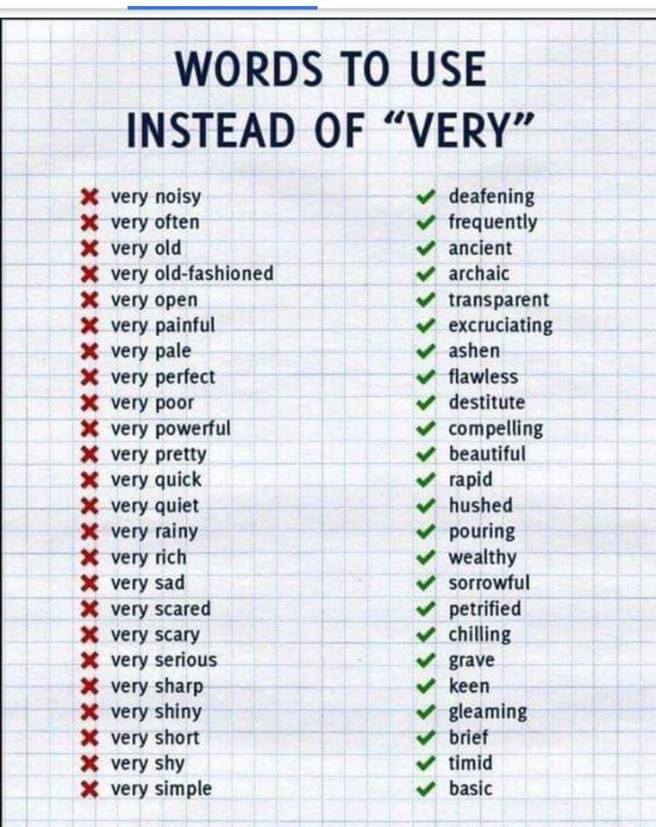
Words to Use Instead of ‘Very’


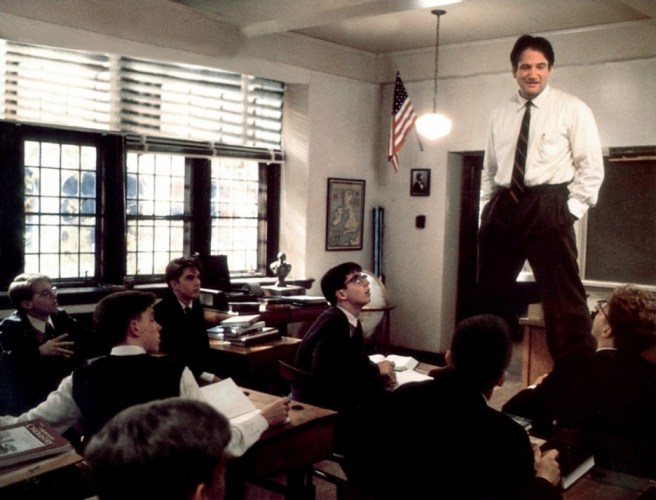
Robin Williams standing on desk in front of classroom of boys

This is the advice Robin Williams had for his classroom of boys in Dead Poet’s Society: 

“So avoid using the word ‘very’ because it’s lazy. A man is not very tired, he is exhausted. Don’t use very sad, use morose. Language was invented for one reason, boys – to woo women – and, in that endeavour, laziness will not do. It also won’t do in your essays.”

Here are some substitutes for the word ‘very’.

list of words to use instead of 'very'

Sound advice, methinks. Hope you find it useful. I know they teach all this stuff to us in Primary School, but it’s worth a reminder.

11 Tips: What Makes A Good Story?

portrait of girl wearing christmas hat

Everyone loves a good story. That’s the reason why so many people flock to the movies or spend hours reading novels – it’s because we love to get lost in a great tale. Here are 11 tips from the experts on how to write something fabulous.

1. Tension is the cornerstone of any good story. Eric Nylund

2.  A good story, just like a good sentence, does more than one job at once. That’s what literature is: a story that does more than tell a story, a story that manages to reflect in some way the multilayered texture of life itself. Karen Thompson Walker

3.  Be unpredictable, be real, be interesting. Tell a good story. James Dashner

4.  A good story cannot be devised; it has to be distilled. Raymond Chandler

5.  A good story should make you laugh, and a moment later break your heart. Chuck Palahniuk

6.  Tension is the cornerstone of any good story. Eric Nylund

7.  No, it’s not a very good story – its author was too busy listening to other voices to listen as closely as he should have to the one coming from inside. Stephen King

8.  My only conclusion about structure is that nothing works if you don’t have interesting characters and a good story to tell. Harold Ramis

9.  I do feel that if you can write one good sentence and then another good sentence and then another, you end up with a good story. Amy Hempel

10. I’m just trying to write a good story, strictly from imagination. People just think it’s random, they don’t see the rewriting, phrasing of characters, choosing the words, bringing the world to light in which the characters live in. That creates an illusion that this is real. Eric Jerome Dickey

11. I always try to tell a good story, one with a compelling plot that will keep the pages turning. That is my first and primary goal. Sometimes I can tackle an issue-homelessness, tobacco litigation, insurance fraud, the death penalty-and wrap a good story around it. John Grisham

Hope you find these tips useful. For further reading, check out my posts 3 Parts to a Great Blurb and 10 Ideas for Writing Practice  And to make sure not to miss anything from Libby Sommer Author you can follow me on Facebook  or Instagram.


Where Do We Get Our Story Ideas?

girl learning person studying


“Talking is the first voice of a writer. I always heard it, I just didn’t know you could write it. I write the voices you hear every day—it’s just that people don’t recognize how wonderfully people talk. I think every time a person tells the truth, that person is speaking beautifully.” – Grace Paley

As a writer you’re probably always on red alert looking for story ideas. Maybe you use the world around you, seeking locations and characters and situations, listening in to conversations on buses or trains or in cafes. Changing your daily routine is a way to stimulate the  imagination. Drive or walk to a different part of your suburb or home town and look for different places to write. Writing in cafes is my thing. Challenge yourself to move out of your comfort zone in order to find new ideas. It helps to stay out of routine’s boring rut. I need to be physically comfortable and relaxed when I call on the  muse. Early in my writing career, I wrote sitting up in bed. The ultimate cosy comfort zone. Now a comfy couch in a cafe is my preferred relax place. And when I sit in a cafe to write I always have a printout beside me of the previous day’s writing session. So I’m never staring at a blank page. Helps with the panic, What the hell will I write next?

There’s no better way to find out where to get our story ideas than by hearing from the experts.  Check out some of my favorite authorial quotes below:

“Every secret of a writer’s soul, every experience of his life, every quality of his mind, is written large in his works.”— Virginia Woolf
“And by the way, everything in life is writable about if you have the outgoing guts to do it, and the imagination to improvise. The worst enemy to creativity is self-doubt.”― Sylvia Plath
“Everybody walks past a thousand story ideas every day. The good writers are the ones who see five or six of them. Most people don’t see any.” – Orson Scott
“I want to tell a story, in the old-fashioned way – what happens to somebody – but I want that ‘what happens’ to be delivered with quite a bit of interruption, turnarounds, and strangeness. I want the reader to feel something is astonishing – not the ‘what happens’ but the way everything happens.” –– Alice Munro


“If you haven’t got an idea, write a story anyway.” – William Campbell Gault

Some people keep a container filled with single words and draw out a word each day and write from it. That’s a good way to exercise the writing muscle and to get into the right (rather than left) side of the brain.

Good luck on your search for story ideas. I like to tell people I use anything that moves or makes a noise 🙂

For further reading, check out my posts Writing Tip: Don’t Forget to Pause and Writing Tip: Beating Resistance.  And to make sure not to miss anything from Libby Sommer Author you can follow me on Facebook  or Instagram.

Are First Lines That Important?

toddler reading book

Opening lines are the most important part of your story.

“There are all sorts of theories and ideas about what constitutes a good opening line. It’s a tricky thing, and tough to talk about because I don’t think conceptually while I work on a first draft — I just write. To get scientific about it is a little like trying to catch moonbeams in a jar. But there’s one thing I’m sure about. An opening line should invite the reader to begin the story. It should say: Listen. Come in here. You want to know about this.” – Stephen King

Some of the best opening lines in literature according to Tony Zeoli are:

1. The Bell Jarby Sylvia Plath

“It was a queer, sultry summer, the summer they electrocuted the Rosenbergs, and I didn’t know what I was doing in New York.”

2. Gravity’s Rainbowby Thomas Pynchon

“A screaming comes across the sky.”

3. Cat’s Eyeby Margaret Atwood

“Time is not a line but a dimension, like the dimensions of space.”

4. Blue Nightsby Joan Didion

“In certain latitudes there comes a span of time approaching and following the summer solstice, some weeks in all, when the twilights turn long and blue.”

5. Fahrenheit 451by Ray Bradbury

“It was a pleasure to burn.”

6. David Copperfieldby Charles Dickens

“Whether I shall turn out to be the hero of my own life, or whether that station will be held by anybody else, these pages must show.”

7. The Book of Strange New Thingsby Michel Faber

“Forty minutes later he was up in the sky.”

8. Fear and Loathing in Las Vegasby Hunter S. Thompson

“We were somewhere around Barstow on the edge of the desert when the drugs began to take hold.”

9. Middlesexby Jeffrey Eugenides

“I was born twice: first, as a baby girl, on a remarkably smogless Detroit day in January of 1960; and then again, as a teenage boy, in an emergency room near Petoskey, Michigan, in August of 1974.”

10. The Wavesby Virginia Woolf

“The sun had not yet risen.”

11. The Time Machineby H.G. Wells

“The time traveler (for so it will be convenient to speak of him) was expounding a recondite matter to us.”

12. Lolitaby Vladimir Nabokov

“Lolita, light of my life, fire of my loins.”

13. Slaughterhouse-Fiveby Kurt Vonnegut

“All this happened, more or less.”

14. Sellevisionby Augusten Burroughs

“You exposed your penis on national television, Max.”

15. The Trialby Franz Kafka

“Someone must have slandered Josef K., for one morning, without having done anything truly wrong, he was arrested.”

16. Anna Kareninaby Leo Tolstoy

“All happy families are alike; each unhappy family is unhappy in its own way.”

17. Valley of the Dollsby Jacqueline Susann

“You’ve got to climb to the top of Mount Everest to reach the Valley of the Dolls.”

Good luck!

For further reading, check out my posts Writing Tip: A Change of Pace and Writing Tip: To Plot Or Not To Plot.  And to make sure not to miss anything from Libby Sommer Author you can follow me on Facebook  or Instagram.

Why Use Deep Third Person Limited POV?

person holding silver retractable pen in white ruled book

Why use deep third person limited POV?

Because you can insert internal thoughts from the point-of-view character so the reader can get to know them better. In deep third, you don’t have to put her/his thoughts in first person and italicize them.

I like doing this because it allows me to get deeper inside my character’s head, showing more to the reader. You can bring emotion out in your character using deep third.

Author Ann Laurel Kopchick says, because a first person narrator/character knows that they’re telling a story to the reader. When you’re deep in limited third person, that character/narrator is unaware they are telling a story. The reader is reading the unfiltered thoughts, emotions, and feelings of that character.

Here’s an example of Deep POV from ‘Acting Married’ by Victorine E. Lieske:

She set the tray down on the server against the wall. Super. She’d messed up again. If her training had drilled anything into her head, it was that she was supposed to be invisible and never speak unless spoken to. Why couldn’t she do a simple job? She needed to give them the coffee and get out of there.

Have a read of How to Do Deep POV by Ann Laurel Kopchick.
Some of the topics she writes about include:
  • Don’t just report thoughts and feelings, descend into the character
  • Thoughts and perceptions should be that of the character
  • Use terminology, phrasing, syntax, grammar that the character uses
  • Avoid Filtering

Example with filtering:  She saw the car swerve off the road and head straight for her. She dodged away. “God,” she thought, “I could have been killed!”

Example without filtering:  In a hail of gravel, the car careered off the road and bore down. She threw herself to one side as hot air and metal whooshed passed. God, she could have been killed!

Good luck!

For further reading, check out my posts The Writing Process and Writing Tip: Turn Towards the Inner Critic.  And to make sure not to miss anything from Libby Sommer Author you can follow me on Facebook  or Instagram.

Small Fictions

man walks beside train

Have you tried the short short form yet? I might have mentioned before that I am working on a book length series of small fictions – flash fictions and prose poems, some already published in literary journals.

This is one of my flash fictions, THE BACK PACK first published in Quadrant magazine in July 2011. Hope you enjoy it.

The Back Pack

What can a man who meets you at the station and offers to carry your backpack mean to a woman traveling the world alone?

I was scared, like anyone who has no sense of direction.  The journey was a series of stops and starts.  Whether to use the Eurail pass or post it back home and ask the kids to get me a refund.  Giovanni appeared one European winter, thick padded jacket, woolen beanie, scarf and gloves, tall and imposing,  I’ll carry your bag.

I was small, the backpack the length of my spine, the zip-off bag on one shoulder, the daypack positioned in front like a nine-month baby bump.  That evening, as we climbed the steps of the Corniche – the wind bitter across the Mediterranean, the metal stairs covered with slippery ice, the railing melting beneath my hand.  Soon it would become my railway platform, my steps, and Giovanni my landlord.

We walked there in the crisp night air.  My own place.  It didn’t cost much.  No-one yet knew I was here.  I could ask Giovanni if I needed any help.  I knew my children would be pleased I had a base.  I didn’t want them to worry.  It was the thing I wanted the most secretly, studying maps, absorbing travel books.  To be safe, a desire whispered to the moon that moved behind my shoulder at night.  If you guide me to a safe haven I promise to be happy.  And the moon listened.  I did my best.

The winter sky closed down and the spring began its flowering.  I took photos and painted and rang the children every week.  Watch your money, don’t talk to strangers, be careful walking at night – you know the drill.  The pebbly beach, the weekend markets, it was all there for the exploring.  A glimpse of the sea between terracotta roofs – a vision in turquoise.  The cobbled streets could show which way to follow – and none of them wrong.  A room at the top of the stairs – till June I stayed reading the English books Giovanni had left in the bookcase, shopping for food, telling my kids and friends they should come for a visit.

Where had the months gone?  Almost two years on the road.  Summer approached. The rents would go up and the tourists arrive.  Time to move on.  I could only take with me what I could carry on my back.  A Jewish gypsy they said.  One more step into the unknown.  Pack up, give away what I couldn’t manage, but keep the palette knife and miniature easel.  There was stuff happening back home.    The boys were grown and earning a living.  Their sister turned twenty-one.  People were reinventing themselves all over the place then coming back home.  A thousand train rides later, my mother nearly eighty.  I won’t be around much longer, she cried.

His was a helping hand in a world that says, but what are you doing there?  What are you doing?

Copyright © Libby Sommer 2011

For further reading, check out my posts  What Is A Prose Poem? and Writing Tip: A Sense of Place. And to make sure not to miss anything from Libby Sommer Author you can follow me on Facebook  or Instagram.

Best wishes for the festive season, dear WordPress friends.


What does ‘show don’t tell’ mean exactly?

woman sitting on chair while reading book

What does ‘show don’t tell’ mean? It means don’t tell us about loneliness (or any of those complex words like dishonesty, secrecy, jealousy, obsession, regret, death, injustice, etc) show us what loneliness is. We will read what you’ve written and feel the bite of loneliness. Don’t tell us what to feel. Show us the situation, and that feeling will be triggered in us.

When you take your child to school on their first day you may find yourself teary and relieved at the same time. Put into words what you see: the child’s face, the wave at the gate, the other mothers saying their goodbyes, another child coming up to take your son by the hand. We will get what you’re trying to say without you telling us directly.

When you write, be conscious of the senses and how they connect to the experiences you are writing about. Use sight, sound, smell, touch to create concrete pictures. The senses allow you to get as close as humanly possible in words to the wedding, the sunrise, the dog, the suitcase. It’s the best way to penetrate your story and breathe life into it. Don’t tell us about something, drop deep, enter the story and take us with you.

‘Use strong, specific verbs, and avoid overusing adverbs. Provoke emotion through character reactions and vivid writing, don’t simply tell readers how to feel. Use well-placed details to bring scenes to life. Use expressive dialogue to show characters’ emotions and attitudes.’ – Creative Writing 101, Wright State University

For further reading, check out my posts  Have You Tried Flash Fiction Yet? and Is There A Link Between Spirituality and Creativity?. And to make sure not to miss anything from Libby Sommer Author you can follow me on Facebook  or Instagram.

Writing Tip: Endings

pen writing notes studying

Beginnings and endings are the hardest part of creating a successful story and the most important. More important than plot and character, in my opinion, especially in short stories. “Conclusions are the weak points of most authors,” George Eliot remarked, “but some of the fault lies in the very nature of a conclusion, which is at best a negation.”

“As Jane Austen pointed out in a metafictional aside in Northanger Abbey, a novelist cannot conceal the timing of the end of the story (as a dramatist or film-maker can, for instance) because of the telltale compression of the pages.” – The Art of Fiction

The closer and closer you get to the ending, the more weight every word has, so that by the time you get to the last several words each one carries an enormous meaning. A single gesture or image at the end can outweigh all that has gone before. Choose each word carefully – even simple words like dark or down, light or up drastically affect the sense of the ending and therefore the entire story. Anything revelatory or portentous at the end of the story is very heavy indeed. Heavy-handed, in fact, is the way it’s likely to come out.

In beginning the story certain tensions, ideas, and characters have been launched. These themes then fly in intricate formations. The ending doesn’t have to provide a surprise. All it has to do is land safely. – Jerome Stern, Making Shapely Fiction

I’m rather proud of this ending to my short story Jean-Pierre, first published in Quadrant in July-August 2016. It’s the last page of a 5,000 word piece.

During that last day she thought of nothing but Jean-Pierre as she packed and cleaned out her little apartment.

‘What do you do, you have a stopover in Dubai?’ Jean-Pierre said, standing next to her at the taxi rank in the early morning chill.  A bitter wind blew from the mountains.  He had come over to carry her bag down the stairs.

‘I go straight through.  It’s three hours on the ground in Dubai, so I walk around the airport then read my book.’

Jean-Pierre looked directly into her eyes.  ‘I’ve bought you a little gift,’ he said.

‘You have?’

‘Don’t unwrap it until you’re on the plane.’

She smiled.  ‘Okay.”  Then she looked at his face, to place him clearly in her mind.  He was wearing a white t-shirt and blue jeans under a padded coat.  She kissed him on the lips, then got into the taxi.

‘Something to take with you,’ he said, leaning in the window.  In his hand he clasped a small gift-wrapped box.  The sun, still low on the horizon, cast an amber glow on his precious face.

‘Thank you,’ she said.  She reached for his hand through the window and then put on her seatbelt.

And she thought about this all twenty-four hours of the journey across the Indian Ocean.  She would keep opening the little box to admire the marquisite earrings he’d given her.  She would catch a taxi from the airport and at home notice the house smelt musty; she would open all the doors and windows to let the air move through, the curtains blowing and air coming in and out.  From a far-away-place, and at night, he would ring to say, resignedly, ‘My mother is living with me now.’  His gift, when she’d take the earrings out of their black box, would remind her of something that had happened to her once.

She felt like someone who she had always known, that old friend of herself, grounded in home, decisions already made, and behind her somewhere, like the shadow of an identical twin, her other self, who must remain in the far-off distance,  never to be exposed to the light.

Copyright © Libby Sommer 2016

For further reading, check out my posts  My 3 Favourite How-To-Write Books and Why Do You Write?. And to make sure not to miss anything from Libby Sommer Author you can follow me on Facebook  or Instagram.


Will my story resonate with anyone?

a man and woman dancing tango

When you write a story, you never know if it will resonate with anyone. Then a person like Dr Beatriz Copello writes a review and you find yourself dancing with joy, thinking how blessed you are.

Beatriz Copello’s review was published by The Compulsive Reader and you can read it below:

A review of The Usual Story by Libby Sommer

Reviewed by Beatriz Copello

The Usual Story 
by Libby Sommer
Ginninderra Press
Paperback, ISBN: 9781760415792, July 2018, $27.50, 80pp

The Usual Story by Libby Sommer takes the reader into the life and mind of Sofia.  Sofia is a middle-aged woman, a writer and very much involved in dancing, particularly Tango.

Tango, a dance that was born in the 1800s around the port of Buenos Aires, Argentina, was the dance of port workers and women of the night. Nowadays, this complicated and elegant dance is very much in vogue and danced around the world. Tango gives some sort of skeleton to a large part of The Usual Story. Other sections deal with relationships from the past and the present.

The reader gets to know Sofia as she dances and relates to the other dancers who participate in the Tango classes. In an interesting way Sommer mixes in her text Sofia’s tango adventures and lessons with her thoughts and love experiences, as well as evocative descriptions of her surroundings.

There is something in human beings that makes them ponder relationships. Sommer, with a very fine narrative, engages us in Sofia’s analysis of the past, particularly in her relationships with her parents and with two of her younger lovers J and Tom. The writer has the ability to create very believable characters. She handles feelings in a measured and unsentimental way. The author says about J:

Little by little, I’d learned new things about J. Once, when staying with him in that first summer, I found him lying on my bed with so pitiful a look on his face that I couldn’t see into it. It was very painful to realise how utterly defeated he looked; everything about him was different to what I’d seen before, out of sync, closed down, remote, his very guts hanging out in front of me.

Every now and again we encounter in the narrative some profound thoughts from Sofia. She reflects: “I think that when you are really stuck, when you have stood still in the same place for far too long, it’s almost as if a bomb needs to go off, to get you to move, to jump, and then to hope for the best.”

The Usual Story contains many things about the every day, the mundane, the routine of living but it is presented in such an engaging way that the story becomes real. It is impressive the ability of Sommer to fragment the narrative when we encounter Sofia’s visits to the psychiatrist. We read about her participation in Milongas, asking relatives about her past, and about love and its many facets. All of these interspersed with poetic descriptions of place. Sydneysiders will recognise many areas of the Eastern suburbs in Sommer’s vivid imagery. The following is one of those descriptions that has cinematic qualities:

The sea looks different every day. Today it’s a mid-grey tone, its surface moving in a gentle tugging motion as a container ship moves south along the horizon. A moist breeze brushes my cheek as the waves make a hushing noise as they curl into the sand of the beach. I watch the colour creep slowly into the clouds. A flock of lorikeets balances on the bare branches in front of me.

There is a certain melancholy in The Usual Story which I believe stems from the relationship of Sofia with her mother and her daughter. Relationship between parents and children can be very complicated. As sons and daughters we tend to arrive at a different view of them according to our age. As children, our parents are like gods; as adolescents they can be our enemies; as adults we tend to be more objective but we are too busy with our own children to spend time analysing these relationships. We may also depend on our parents to help with our progeny and this clouds our assessment. A different thing is when we get to that same period of life:  our third age. It is then, when we have lived and experienced life, that we can be more objective in the evaluation and appreciation of our parents. Sofia is at that stage and she can see clearly her mother’s distant and cold behaviour, but there must be in her a grain of insecurity so she wants to check what she thinks she knows. She wants to be sure. So she searches through memories, analysing them, confirming facts with other relatives.

Sofia’s relationship with her daughter is not perfect either. After seeing a mother and a daughter embrace each other with love she says: “They embrace and then walk to the door, still entwined. I feel a pang of wistfulness for my own daughter as I watch them walk away. My daughter who hadn’t wanted to spend a weekend away, just the two of us. She’d said we make each other tense if we’re together too much. But she’d said it in a kind voice.

‘You don’t mind, do you?’ she’d asked.

I did mind. ‘At least you’re honest with me,’ I said.”

As a psychologist, I found The Usual Story fascinating because the characters are so interesting and authentic. As a reviewer, I enjoyed the book’s clear narrative, perhaps a little leisurely at times, but the pace picks up engaging the reader with a beautiful text.

About the reviewer: Dr Beatriz Copello is a former member of NSW Writers Centre Management Committee, writes poetry, reviews, fiction and plays. Beatriz’s poetry has been published in literary journals such as Southerly and Australian Women’s Book Review and in many feminist publications.  She has read her poetry at events organised by the Sydney Writers Festival, the NSW Writers Centre, the Multicultural Arts Alliance, Refugee Week Committee, Humboldt University (USA), Ubud (Bali) Writers Festival.

Print and ebook editions of The Usual Story available from Ginninderra Press, Amazon, Book Depository and other online booksellers.