Publication day!


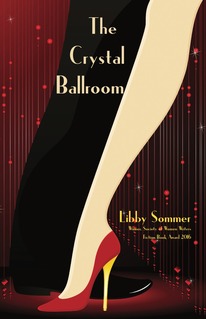
The Crystal Ballroom red and black book cover

My second novel, The Crystal Ballroom is released today! If you’re in Australia you can order a copy from your favourite bricks and mortar bookseller or directly from Ginninderra Press. Print and ebook editions are also available from Amazon, Book Depository and other online booksellers.

‘Libby Sommer lays bare the foibles of human nature in her finely observed stories of love and loss in the singles dance scene. Brilliantly drawn with wit, compassion and poignancy, the characters you meet in The Crystal Ballroom are sure to remind you of someone—maybe even yourself.’ – Jan Cornall, Writer’s Journey.

 ‘Libby Sommer exposes the secret lives of the singles who dance at The Crystal Ballroom. Authentic and powerful, this unique book will be loved by the dancers and readers.’ Frida Kotlyar, ballroom, Latin and Argentine tango dancer.

 ‘Libby Sommer’s fiction has wit but is essentially serious with a subtle but strong underlying pathos, a wry humour and accomplished satirical tone.’ – Amanda Lohrey, Australian writer, and novelist. Patrick White Award winner.

‘Sommer’s existentialism is one of the best and most articulate voices of middle age angst ever.’ –Richard English, novelist and Visiting Lecturer, Brunel University London.

The book will be launched at Collected Works Bookshop in Melbourne on 1 July. Details to follow. If you’re free, come along.

I hope you enjoy reading The Crystal Ballroom: stories of love and loss in the singles dance scene. I’m very excited that My Year With Sammy and The Crystal Ballroom are out there in the public arena – thrilled that my work has finally made it out into the world after all these years.

Fortnightly Story: Art and the Mermaid

mermaid swimming deep in the sea

I wrote this fishy tale as part of a series of stories set in Bondi:  

Once upon a time it came to pass, so it is said, that an enormous storm swept the coast of New South Wales, doing extensive damage to the ocean beaches – destroying jetties, breakwaters and washing away retaining walls.  Mountainous seas swept Bondi Beach and dashed against the cliffs carrying ruin with every roller.  At North Bondi near Ben Buckler a huge submerged block of sandstone weighing 233 tons was lifted ten feet and driven 160 feet to the edge of the cliff where it remains to this day.

One day a Sydney sculptor, Lyall Randolph, looked upon the rock and was inspired.  The sculptor was a dreamer.  Let us, he said, have two beautiful mermaids to grace the boulder.  Using two Bondi women as models he cast the two mermaids in fibreglass and painted them in gold.

Without Council approval and at his own expense he erected The Mermaids for all to see on the giant rock that had been washed up by the sea.  The Mermaids sat side by side on the rock.  One shaded her eyes as she scanned the ocean and the other leant back in a relaxed fashion with an uplifted arm sweeping her hair up at the back of her neck.  Their fishy tails complemented the curves and crevices of their bodies.

It so happened that less than a month after The Mermaids were put in place, one was stolen and damaged.  The Council held many meetings to decide if she should be replaced using ratepayers’ money.  The council had previously objected to the sculptor placing the statues there without Council permission.  The sculptor had argued that before placing The Mermaids in position he had taken all necessary steps to obtain the requisite permission.

The large boulder at Ben Buckler, upon which The Mermaids were securely bolted and concreted, he said, is not in the municipality of Waverley at all.  It is in the sea.  According to the Australian Constitution high-tide mark is the defined limit of the Waverley Council’s domain.  The Maritime Services Board and the Lands Department both advised me they had no objection to the erection of The Mermaids.

One Waverley Alderman said he wished both mermaids had been taken instead of only one.  Someone else said the sculptor didn’t need the Council’s permission to put them there in the first place and the The Mermaids had given Bondi a great attraction without any cost to the Council.  The sculptor said The Mermaids had brought great publicity to the Council.  They had been featured in films, newspapers, television and the National Geographic magazine.

The Mayor used his casting vote in favour of the mermaid and she was re-installed.

For over ten years the two beautiful golden mermaids reclined at Ben Buckler, attracting many thousands of sightseers to the beach.

Poised on the huge boulder they braved the driving storms of winter until one day one was washed off.  The Council saw its opportunity and removed the other.

Today, only the remnants of one mermaid remain – but not on the rock.  In a glass cabinet in Waverley Library at Bondi Junction all that is left of the two beautiful mermaids is a figure with half a face.  There’s a hole instead of a cheek, a dismembered torso, part of an uplifted arm, the tender groove of an armpit.  And there, down below, a complete fish’s tail.

Copyright © 2017 Libby Sommer

First published in Quadrant

Header image:  Creative Commons


Writing Tip: Exercise the Writing Muscle

writer at work at typewriter

Writing as a daily practice is a way to exercise the writing muscle. Like working out at the gym, the more you do it, the more results you get. Some days you just don’t feel like working out and you find a million reasons not to go to the gym or out for a jog, a walk, a swim, a bike ride, but you go anyway. You exercise whether you want to or not. You don’t wait around till you feel the urge to work out and have an overwhelming desire to go to the gym. It will never happen, especially if you haven’t been into health and fitness for a long time and you are pretty out of shape. But if you force yourself to exercise regularly, you’re telling your subconscious you are serious about this and it eventually releases its grip on your resistance. You just get on and do it. And in the middle of the work out, you’re actually enjoying it. You’ve felt the endorphins kick in. When you get to the end of the jog, the walk, the bike ride, the swim, the gym workout or the Pilates, Yoga or Zumba class, you don’t want it to end and you’re looking forward to the next time.

That’s how it is with writing too. Once you’ve got the flow happening, you wonder why it took you so long to turn up on the page. Bum on chair is what I used to say to my writing students. Through daily practice your writing does improve.

In The Artist’s Way, Julia Cameron’s book on discovering and recovering your creative self, she refers to daily writing practice as the morning pages. She recommends writing three pages of longhand, strictly stream-of-consciousness—moving the hand across the page and writing whatever comes to mind every day.

Author of Writing Down the Bones, Natalie Goldberg refers to writing practice as timed exercise. She says you might time yourself for ten minutes, twenty minutes, or longer. It’s up to you, but the aim is to capture first thoughts. “First thoughts have tremendous energy. It is the way the mind first flashes on something. The internal censor usually squelches them, so we live in the realm of second and third thoughts, thoughts on thought, twice and three times removed from the direct connection of the first fresh flash.”

Her rules for writing practice are:

1. Keep your hand moving.
2. Don’t cross out.
3. Don’t worry about spelling, punctuation , grammar.
4. Lose control.
5. Don’t think. Don’t get logical.
6. Go for the jugular.

In Creative Journal Writing, author Stephanie Dowrick refers to the same process as free writing; writing without judging, comparing and censoring. “Continuing to write when you don’t know what’s coming next and especially when you feel your own resistances gathering in a mob to mock you.”

Daily writing practice has been described as clearing the driveway of snow before reaching the front door. In other words, it’s what we do as a warm up before the real writing takes place.  And it’s a way to loosen up and discover our own unique writing ‘voice’.  That’s what publishers are looking for when they read through the slush pile.  The storyteller’s voice.  The authentic writing voice of the author is what engages the reader.

What about you? Are you able to carve some time out of each day to write?

Header Image:  Creative Commons

Exciting news

yoga pose at sunrise

Delighted to announce that my short story ‘Alfresco’ will be published in the May issue of Quadrant magazine. The story is set in a fictional yoga retreat in northern Queensland.

It took me two years of rewriting to finally get this story accepted. I think you’d agree that crafting a successful piece of fiction is not easy.

Header Image:  Creative Commons

Fortnightly Story: Towards the End

colourful cafe scene

He leaned back on the chrome chair, stretched his legs out under the square black table and placed his mobile phone in front of him. He looked over to the counter at the back of the cafe at the cakes and muffins on display and the Italian biscuits in jars. He turned back to the glass windows and wondered if he had the guts to tell her today. He wanted to. By Christ he wanted to. He straightened up, his elbows on the table, his hands clasped together in front of his face. There’d been some good times, that’s for sure. But what the heck. A man’s got to do what a man’s got to do.

The sliding glass door clanked open and Anny walked in. He looked over at her, first from the rear as she closed the door and then as she approached, her face flushed, her dark hair flying back from her shoulders. Not bad looking. A bit on the heavy side but not a bad looker all the same. Yes, there’d been some good times. Especially in the sack.

Continue reading

Book cover reveal

'The Crystal Ballroom' book cover

The book cover at last! My second novel, ‘The Crystal Ballroom’ will be published by Ginninderra Press in May this year. Pre-launch copies available next month. A very exciting time for me.

Here are a couple of reviews from the back cover:

‘Libby Sommer lays bare the foibles of human nature in her finely observed stories of love and loss in the singles dance scene. Brilliantly drawn with wit, compassion and poignancy, the characters you meet in The Crystal Ballroom are sure to remind you of someone—maybe even yourself.’ – Jan Cornall, Writer’s Journey.

 ‘Libby Sommer exposes the secret lives of the single men and women who dance at The Crystal Ballroom. Authentic and powerful, this unique book will be loved by the dancers and readers.’ Frida Kotlyar, Ballroom, Latin and Argentine Tango dancer.

What do you think of the cover design? I love it 🙂

Writing Tip: Obsessions

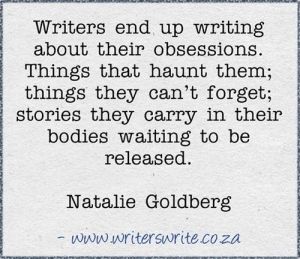
quote about obsessions

Every once in a while, when I’m scratching around for something new to write, I make a list of the things I obsess about.  Thankfully, some of them change over time, but there are always new ones to fill the gap.

It’s true that writers write about what they think about most of the time.  Things they can’t let go: things that plague them; stories they carry around in their heads waiting to be heard.

I used to get my creative writing groups to make a list of the topics they obsess about so they could see what occupied their thoughts during their waking hours.  After you write them down, you can use them for spontaneous writing before crafting them into stories.  They have much power.  This is where the juice is for writing.  They are probably driving your life, whether you realise it or not, so you may as well use them rather than waste your energy trying to push them away.  And you can come back to them repeatedly.

One of the things I’m always obsessing about is relationships:  relationships in families, relationships with friends, relationships with lovers.  That’s what I tend to write about.  I think to myself, Why not?  Rather than repress my obsessions, I explore them, go with the flow.  And life is always changing, so new material keeps presenting  itself.

We are driven by our passions.  Am I the only one who thinks this?  For me these compulsions contain the life force energy.  We can exploit that energy.  The same with writing itself.  I’m always thinking and worrying about my writing, even when I’m on holidays.  I’m driven.

But not all compulsions are a bad thing.  Get involved with your passions, read about them, talk to other people about them and then they will naturally become ‘grist for the mill’.

obsession quote in black writing on white card

What about you?  Do you find yourself writing about the same situations over and over again?


Fortnightly Story: Around the World in Fifty Steps

a man and a woman with backpacks looking at Leaning Tower of Pisa

‘Around the World In Fifty Steps’ was my first published short story. It was 2001 and I’d just graduated with an MA in Professional Writing from the University of Technology Sydney. A heady time to see my name in a prestigious literary journal like Overland, progressive culture since 1954. I’d written the story originally as a synopsis for a book. Although the book never did find a publisher, I was very happy that the synopsis was published as a short story. Not bad for a high school dropout. Continue reading

Fortnightly Story: Jean-Pierre

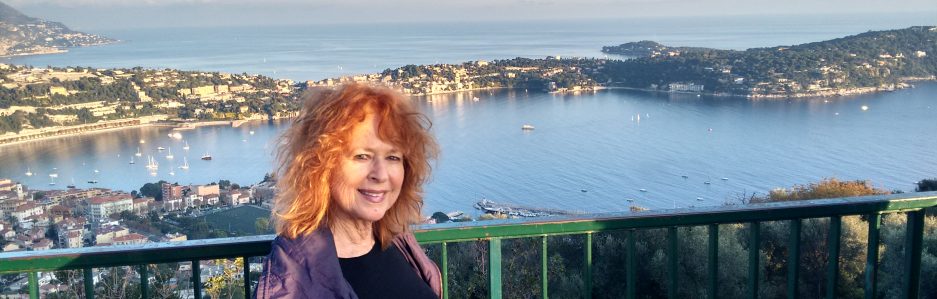
buildings and Town Clock of Villefranche sur Mer

This was in a far distant land.  There were Pilates classes but no surfing beaches or vegan restaurants.  People said to hell with low-fat diets and tiny portions.  Charles, who had wanted her to hire his friend Jean-Pierre as tour guide, had encouraged her in yoga class.    ‘Look, Zina, you’re a facilitator—you’ve been running those groups—for what—thirty years?’

‘Only twenty, for goodness sake.’  She had turned forty-nine and frowned at him upside down between the legs of a downward facing dog.  She had a face marked by the sun, a face left to wrinkle and form crevasses by years of smoking, a face made shiny by the application of six drops of jojoba oil, although the shop girl had recommended she use only three.  ‘I love that word facilitator.  It says so much.’

‘Twenty.  All right.  This guy’s not at all your type.  He’s a numbers man.  He shows tourists around in between Engineering contracts.  He can show you how to buy a bus or a train ticket, how to withdraw money out of the wall—get your bearings.  You can hire him for half a day.  Or, in your case, half a day and half the night.’

‘Very funny,’ she said, stifling a laugh.  Now they were on all fours arching their backs like cats, then flattening their spines to warm up the discs.  Indian chanting music took your mind off the fact that the person behind you was confronted with your broad derriere. ‘So what’s the story with Jean-Pierre?’ Continue reading