Writing Tip: Writing In Cafes

cafes, buses, palm trees, bright blue sky, cars on Bronte Road, Bronte

I am sitting in a café across the road from the beach in Bronte, Sydney.  This stretch of road has a whole row of cafes side by side facing the sea.  This is my favourite kind of writing place:  one where I can sit comfortably for a long period of time and where the owners of the café know me and welcome me.  This café is owned by a Brazilian man and his wife and has comfortable upholstered bench chairs with a direct view of the Pacific Ocean.  For my two-hour writing session my choice could be a traditional Brazilian dish such as Coxinha, Feijoda or Moqueca.  Or a cocktail like Caipirinha or  Caipiroska.  I must order something and it must be more that a Soy Cap, because I plan to be here for a long time.  I want the owners of the café to know I appreciate the time and the space they are allowing me.

However, today I’ll be very boring and order poached eggs on gluten-free bread 🙂

Why go to all this trouble to find a place to write?  Why not just stay home and work?  Because it’s good to get out and have a change of scene.  I find I need to be happy and relaxed when I’m creating on the page and sitting in a café with a pleasant vibe works for me.  Other writers need silence in order to concentrate, but I need to feel I am out and about in a beautiful place having a good time before the creative juices flow.

Strangely, writing in a café can help to increase concentration.  The busy café atmosphere keeps the sensory part of you occupied and content, so that the hidden, quieter part of you that composes and focuses is allowed to do its work.  It is something like being cunning when trying to get a spoonful of food into a resistant toddler’s mouth:  You pretend to be an aeroplane with all the sound effects and movements before landing the food-laden plane inside the child’s mouth.  Mission accomplished.

It is preferable not to turn up at a cafe for a cup of coffee and a writing session at the cafe’s busiest times, like breakfast or lunch. Go at the in between hours when they are pleased to see you because they don’t want the place to look deserted. The beach cafes are places I frequent in spring, autumn and winter, but not much in the summer. Far too crowded and noisy.

There is a real art to finding the right place to write. For me the best place  is one that has comfortable chairs, a pleasant outlook (preferably a view of the the sky and/or green or water). A welcoming, almost homely, atmosphere.

What about you?  Do you need to be at your desk in total silence to write, or do you like to experience the swell of humanity around you—to be surrounded by other human beings?  Or at home listening to a particular kind of music? Let me know in the comments and please share this post with a friend if you enjoyed it. 

The Writing Life


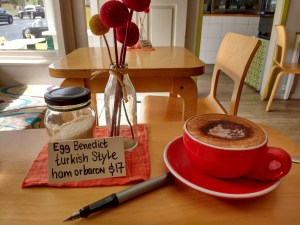
pen and cup of coffee on cafe table

It’s a tough gig being a writer. Lots of isolation, lots of intense concentration, lots of rejection from publishers and agents. Sitting in a cafe with coffee and fountain pen is one of the good bits.

Why do I write? It’s a good question to ask yourself.

  1.  Because I’m a fool.
  2.  Because I want to impress my old school friends.
  3.  So people will like me.
  4.  So my friends will hate me.
  5.  I’m no good at speaking up.
  6.  So I can invent a new way of looking at the world.
  7.  In order to write the great Australian novel and become famous.
  8.  Because I’m a nut case.
  9.  Because I’m an undiscovered literary genius.
  10.  Because I have something to tell.
  11.  Because I have nothing to tell.

Hemingway has said, ‘Not the why, but the what.’ It’s enough to know you want to write. Write.

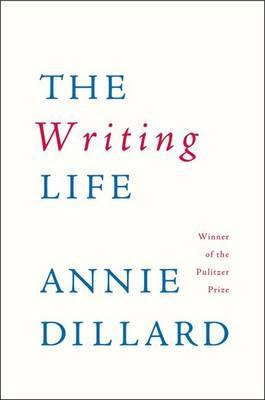
One of my favourite books on the writing process is The Writing Life by Pullitzer Prize winning Annie Dillard. It’s a small and passionate guide to the terrain of a writer’s world.

Book cover 'The Writing Life' by Annie Dillard

 Dillard begins:

When you write, you lay out a line of words. The line of words is a miner’s pick, a woodcarver’s gouge, a surgeon’s probe. You wield it, and it digs a path you follow. Soon you find yourself deep in new territory. Is it a dead end, or have you located the real subject? You will know tomorrow, or this time next year. You make the path boldly and follow it fearfully. You go where the path leads. At the end of the path, you find a box canyon. You hammer out reports, dispatch bulletins. The writing has changed, in your hands, and in a twinkling, from an expression of your notions to an epistemological tool. The new place interests you because it is not clear. You attend. In your humility, you lay down the words carefully, watching all the angles. Now the earlier writing looks soft and careless. Process is nothing; erase your tracks. The path is not the work. I hope your tracks have grown over; I hope birds ate the crumbs; I hope you will toss it all and not look back.

“A writer who waits for ideal conditions under which to work will die without putting a word on paper.” —E. B. White

There is a famous story in the Zen world:

The student, newly arrived at the monastery, asks the master, “What work will I do as I seek enlightenment?”

The master replies, “Chop wood, carry water.”

“And what work will I do once I achieve enlightenment?” asks the student.

“Chop wood, carry water,” says the master.

So how does this stay apply to the writing life? A writer writes. That’s all there is to it.

“You’ll fail only if you stop writing.” – Ray Bradbury

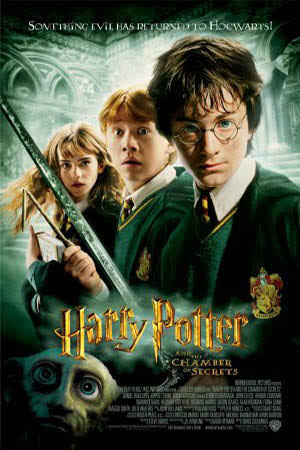
Harry Potter book cover

Rowling has said that Harry Potter “simply fell into [her] head” and “all of the details bubbled up in [her] brain.” She “[had] never felt such a huge rush of excitement and [she] knew immediately that it was going to be such fun to write.”

Sounds like a fairy tale beginning to a fairy tale ending, doesn’t it? Perhaps that’s all ordinary readers need to know about Rowling’s path to literary fame, but us writers need more.

We need to know the not-so-glamorous version of what it was like to write Harry Potter. We need to appreciate how disciplined Rowling had to be to develop her idea into seven hefty books. We have to know that she wasn’t lazily sipping mochas for two decades while jotting down a continuous stream of words like a literary Fountain of Youth.

All too often we convince ourselves that we would write more if only we were well-known, or had more money, or could find more time. But none of that is what makes a writer a writer. It’s simply that a writer writes. – The Friendly Editor

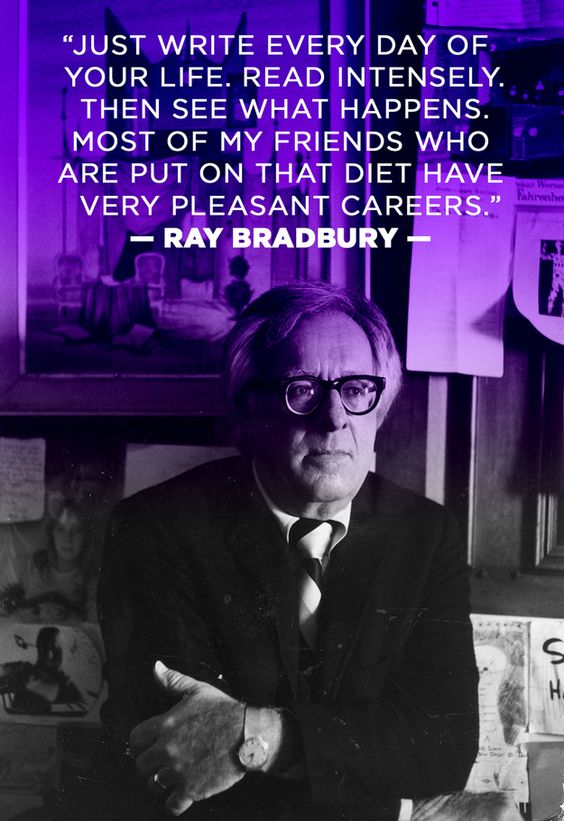
writing quote by Ray Bradbury with author pic

That’s why I write. What about you? Let me know in the comments and please share this post with a friend if you enjoyed it. 

One-Page Review of The Crystal Ballroom

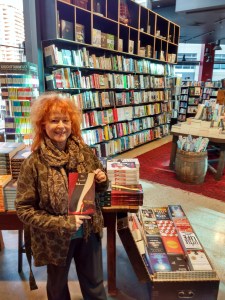
author holding copy of The Crystal Ballroom


I was delighted to see a one-page review of my novel ‘The Crystal Ballroom‘ in October Quadrant magazine (available now in newsagents or on-line).

Penelope Nelson writes:

‘Have you ever heard Latin American music coming from an upper room over a shop, and lingered briefly at the sign about dancing classes? Perhaps you have seen people–a man in built-up shoes or a woman with a surfeit of silver bangles–heading for an old town hall after dark. The world of ballroom dancing and tango lessons has its own etiquette and hierarchies. Libby Sommer’s new fiction ‘The Crystal Ballroom’ lifts the lid on the delights and pitfalls of this fascinating sub-culture …

‘Sommer has great skill in creating atmosphere. The music, the swirling scents of aftershave and sweat, the decor of ballrooms, flats, motels and shared tents are powerfully evoked …

‘Some of the best passages in the book express the joy of dancing:

We’re practising walking the length of the hall. Alberto says that in Buenos Aires students of tango spend two years just learning to walk properly.  “Extend forward,” he says, “step forward, only placing the weight on the extended leg at the last moment, toes pointed, sides of the feet staying connected on the floor.” Then backwards with a straight leg, torso pulled up, chest up and out, and with a partner again, always there’s that special connection with a partner.

Hopefully, this wonderful review by Penelope Nelson will give sales of the book a boost. ‘The Crystal Ballroom’ is available directly from Gininnderra Press, in bookstores, and online.

red and black The Crystal Ballroom book cover


Another great review for The Crystal Ballroom


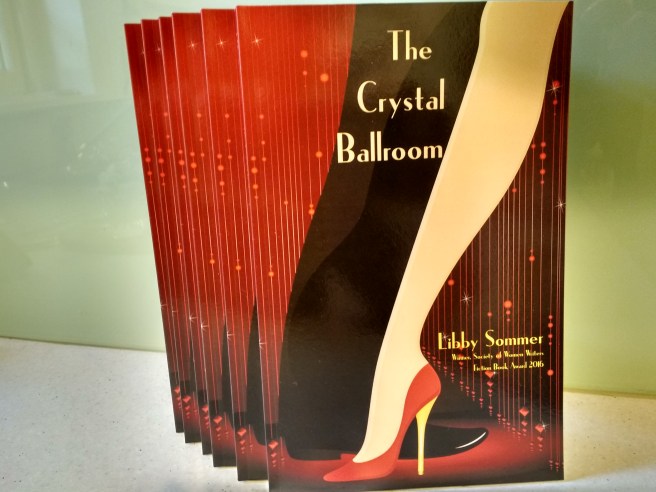
The Crystal Ballroom book covers

I was delighted to read another wonderful and insightful review of The Crystal Ballroom this morning. It’s on Goodreads.

Here’s an extract:

An intriguing book, neither a collection of short stories nor a novel, but a series of vignettes – snapshots − of women, no longer young, but who are determined to wring every drop of verve and excitement out of life. Most of the action is revealed in conversations over coffee or drinks, between the protagonist, Sofia and her friend Ingrid. The ‘glue’ holding the story – or rather stories − together is a love of ballroom dancing and the venues in which such events are held, in particular the Crystal Ballroom, which is a character in its own right. 

In this unusual book Libby Sommer puts women’s psyches under the microscope – their hopes and dreams, fears and foibles – yet always with a deft touch and a sympathetic ear. 

You can read the whole review here.

Writing Tip: A Sense of Place

writing desk with keyboard, screen and printer in front of window
My home office

I’m sitting at my writing desk this spring morning in Sydney thinking about the need to ground our writing in a sense of place, whether landscape or cityscape.

How often have you heard someone say of a book they loved:  ‘I felt like I was there.’

Even if you relocate the poodle tied to a fake-cane chair, the sound of a game of tennis, the table of older men after their regular Sunday match at the café overlooking the tennis courts at Cooper Park that you drank a lemongrass and ginger tea at in Sydney into a café in a story in another state and time, the story will have originality and believability.  ‘But that café was in Sydney, I can’t transport it to Adelaide.’  But you can.  You can have flexibility with specific detail.  The mind is able to transport details, but using actual places that you experienced will give your writing authenticity and truthfulness.  It grounds your work in place, giving life and vitality to your writing, rather than a whole lot of exposition that floats in the air.

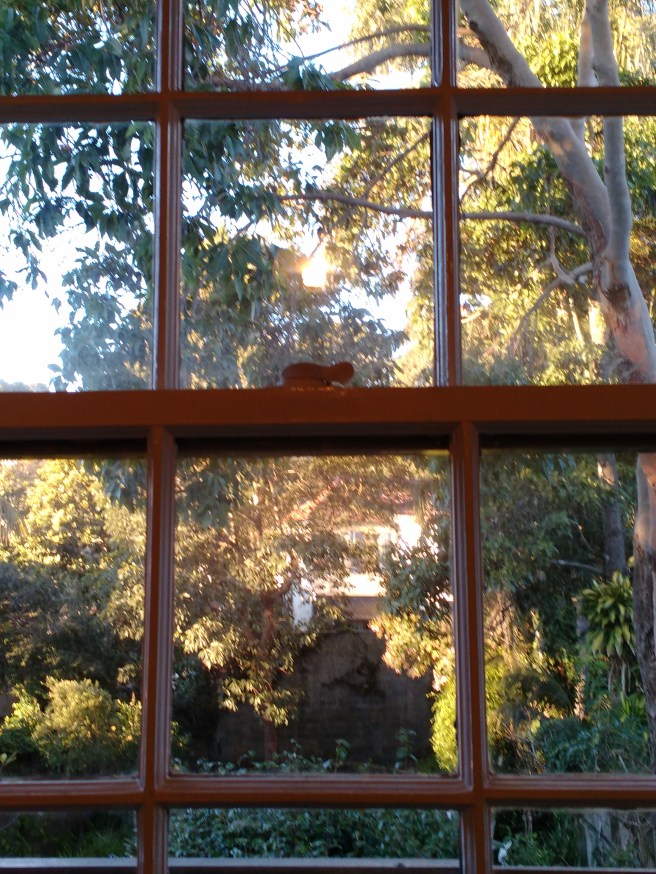
trees and house seen outside French paneled window
looking out the window from my writing desk

 If you don’t create evocative settings, your characters seem to have their conversations in vacuums or in some beige nowhere-in-particular. –  Jerome Stern

Creation of the physical world is as important to your story as action and dialogue.  If your readers can be made to see the hand-knitted socks or the row of vitamins on the kitchen benchtop, the scene becomes alive.  Readers pay attention.  Touch, sound, taste, and smell make readers feel as if their own feet are warm under the cold sheets.

Place situates the story in your reader’s mind.  Fiction that seems to happen in no particular place often seems not to take place at all. –  Jerome Stern

I hope this tip on creating a sense of place is helpful. Do you have any suggestions you would add? Let me know in the comments and please share this post with a friend if you enjoyed it.

2 Years Rewriting Short Story

close up of September Quadrant magazine cover

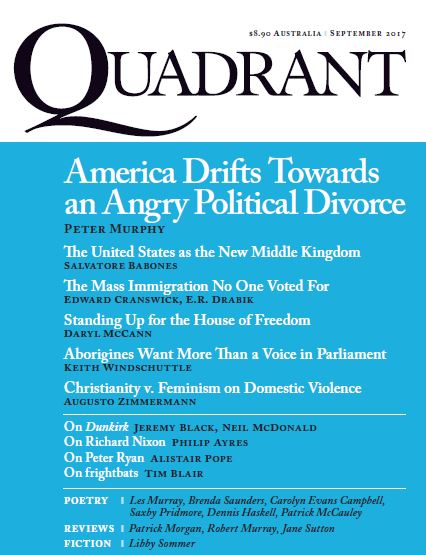
My short story On Valentine’s Day appears in the September Quadrant available now in newsagents and good book stores. It took two years of rewriting before the story was accepted for publication. In Friday’s mail I received my contributor’s copy and a generous cheque. My name is on the front cover. Always a thrill. It took many years of my stories appearing in Quadrant before my name made it to the cover 🙂

The first paragraph of On Valentine’s Day reads:

You had to get out of them occasionally, those Australian country towns with the funny names:  Wagga Wagga, Wee Waa, Woy Woy. Once, after a devastating week wiped out more than $4 trillion from the global stock exchanges, one of the local papers boasted a banner headline:  WAGGA WAGGA WOMAN WEDS WOY WOY TOY BOY. You had to make an effort from time to time to get out, even if it meant flying all the way across the Nullarbor to go to a Valentine’s Day party.


My critique group will recognize the first paragraph. We meet weekly at the New South Wales Writers Centre to give and receive feedback on two pages of our writing. I brought sections of the 4,000 word On Valentine’s Day many times to the Women Writers Network at the Centre. Two dear friends also read the  story and commented. Very much appreciated. More than once my two friends read the whole of On Valentine’s Day and offered constructive criticism. I couldn’t have got the story to a publishable standard without my writing group and my two friends. Lucky me.

Quadrant is a highly regarded literary magazine: http://quadrant.org.au/september-quadrant-now-sale/

Quadrant blue magazine cover

I can’t emphasize enough how useful it is to have a weekly writing group. I work to that deadline. We take a couple of pages each and have 12 minutes to read and receive feedback. I think of it as ‘off Broadway’ and ‘on Broadway’.  Famous comedians like Jerry Seinfeld and Woody Allen say they test their material out on an ‘off Broadway’ audience before performing ‘on Broadway’.

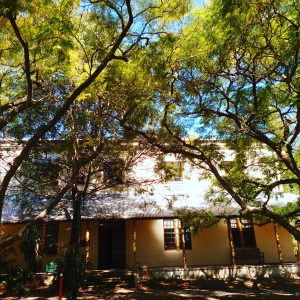
picture of the New South Wales Writers Centre with trees in foreground
New South Wales Writers Centre

What about you? Are you in a writing group? Do you find it useful?

3 Parts to the Feedback Sandwich

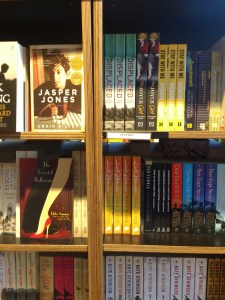
'The Crystal Ballroom' on bookshelf at bookstore

Yesterday, in the Saturday-afternoon feedback group, we began talking about the ‘off with his head’ or ‘out-it-goes’ part of writing.  We acknowledged that as a group we’d always been very supportive and encouraging of each others work.  That is because we are all in it together.  Our critiquing was not telling lies; it was from a place of open-hearted acceptance.  Everything you put on the page is acceptable.

Sometimes someone says, ‘I want a rigorous no-holds-barred assessment of my work.’  But what do you say to them when the writing is dull and boring?  Don’t give up your day job?  It doesn’t sit comfortably with most of us to be directly critical of someone’s writing.  It’s like telling someone how ugly their baby is.  All of us find it hard to separate our writing from ourselves, and are prone to take criticism personally.

The feedback sandwich is a widely known technique for giving constructive feedback, by ‘sandwiching’ the criticism between two pieces of praise or compliments.

hamburger with cheese and two beef patties

As we passed around copies of our work (just a page or two) we started to address what William Faulkner famously said:

‘In writing, you must kill all your darlings.’

First of all, we looked for the juice in each piece.  Where did the writing come alive?  ‘Get rid of the rest,’ we said.  ‘Off with his head—out it goes.’   It’s very difficult to be this honest, and not everyone wants to hear it.  ‘I simply want gentle support and a few corrections,’ some of us might say.

Be willing to have the courage to look at your work with truthfulness.  It’s good to know where your writing has energy and vitality, rather than to spend a lot of time trying to make something come to life that is dead on the page.   Keep writing.  Something new will come up.    You don’t want to put your readers to sleep by writing a lot of boring sentences.

I hope these suggestions are useful. Do you have any tips you would add? Let me know in the comments and please share this post with a friend if you enjoyed it.  

Jump Cuts: Novel-in-progress

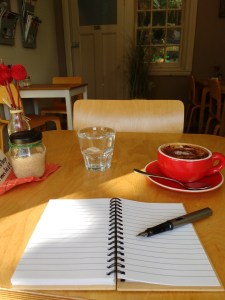
notepad, fountain pen, coffee on table

Below is the first page of my new novel-in-progress. I jump cut from scene to scene. Hopefully this technique is not too confusing. Have you read other novels that use this structure? At the front of the book I’ll be adding a Character List and a Character Map to show how the major characters are connected, to help with the confusion issue. The working title is ‘Missing in Cooper Park’.

1.

The tennis courts at Cooper Park were flooded in the night.  One and a half hours of non-stop rain and hail caused a landslide down through the gully.  Gypsy, a Golden Labrador came along and splashed in fast-flowing Cooper Creek.  Later, the sight of the ruined courts covered in mud and stones, leaves and tree branches like a murky swamp was to shatter Steve’s morning.

2.

Kingston (Carol’s ex) turned up again on the morning after the storm.  He stood on the doorstep looking unbalanced.  His cigarette was burned down to the filter.  His unshaven face was flecked with grey and white.  Carol wouldn’t let him in.  She’d taken his key back.

Carol didn’t tell Steve about Kingston being back but Steve told Carol about the flooded tennis courts.

3.

The moon was high in the darkening dusk as Rosemary puffed past the tennis courts at Cooper Park and continued on up through the steep incline of the gulley swinging a curved stick with tennis ball.

‘Gypsy,’ cried Rosemary.  ‘Gypsy, Gypsy, Gypsy!  Come here.’

Rosemary had purchased Gypsy after overcoming her husband’s resistance.  They were still in mourning over having to put Buddy down.

She’d promised Philip she’d make sure Gypsy didn’t jump up on the newly-cleaned couches.

He knew Rosemary slipped into depression if she didn’t have a dog to love, even though she was the mother of three children.

They’d bought a puppy who looked just like a baby Buddy.  Rosemary would have liked to say it was Buddy re-incarnated but didn’t.  This was precisely the kind of talk that made her husband go red with anger.

It was he who had named the Golden Labrador Gypsy.         The day would soon be night.

4.

Steve lay in bed waiting for Carol’s alarm to go off.  Outside someone had slept all night in a car.

‘Don’t let anyone in,’ demanded Carol in a dream.

Jump Cuts on the Page


close up head & shoulders golden Labrador with pink tongue hanging out

by Libby Sommer:

After a big storm, a golden Labrador goes missing in Sydney’s Cooper Park. This is the scene that begins my new novel-in-progress. I use the search for the dog as a linking device for my characters who are all at a turning point in their lives. I jump cut between discreet scenes (not a continuous narrative) which, unfortunately, is very confusing to the readers in my weekly feedback group.

Transitions are important in fiction because you can’t possibly show or account for every moment in a character’s day, week, or life. A story may stretch over years—readers don’t need to know what happened every minute of those years. A scene transition takes characters and readers to a new location, a new time, or a new point of view.

Scene transitions in movies are easy. The screen fades to black at just the right moment, and when it lights up again, you’re watching a new scene. But how do you write transitions on the page? How does your character get from Point A to Point B without too much boring detail and telling description?

One way to write scene transitions in novels is to Jump Cut. The term usually refers to Cinema.

‘When Jean-Luc Godard popularized the jump cut in 1959 when he made his breakthrough movie Breathless, it has since become a useful and intriguing editing tool. For those of you who don’t know what a jump cut is: (per Wikipedia): “A jump cut is a cut in film editing in which two sequential shots of the same subject are taken from camera positions that vary only slightly. This type of edit causes the subject of the shots to appear to “jump” position in a discontinuous way.”’ – posted by Tyler on Southern Vision

‘The quick-paced German thriller throbs with jump cuts, zoom shots and the speedy sense of an instinctual filmmaker.’ – Charles Taylor, reviewing Run Lola Run

If you want to keep the narrative moving at a fast pace, you can jump cut on the page from scene to scene. But each scene needs to have a beginning a middle and an end.

This technique can be confusing at times, but effective and very readable.

One way to make Jump Cuts on the Page less confusing is to have a strong sense of place. The place is the setting of the story, where the action is located. Setting can be the connective tissue. For me it’s Cooper Park with its cafe, tennis courts, children’s playground, etc.  So, the missing dog, the park and the cafe lessen the confusion, make the transitions smoother – hopefully.

golden Labrador and black and white cat on black leather couch

What about you? Do you find writing scene transitions to be one of the most challenging aspects of writing a novel?

I Am Not the Stories I Tell

two book covers: 'My Year With Sammy' and 'The Crystal Ballroom'

by Libby Sommer:

Sometimes when people read my stories they assume those stories are me.  They are not me, even if I write in the first person.  They were my thoughts and feelings at the time I wrote them.  But every minute we are all changing.  There is a great freedom in this.  At any time we can let go of our old selves and start again.  This is the writing process.  Instead of blocking us, it gives us permission to move on.  Just like in a progressive ballroom dance:  you give your undivided attention to your partner—keep eye contact for the time you are dancing together—but then you move on to the next person in the circle.

The ability to express yourself on the page—to write how you feel about an old lover, a favourite pair of dance shoes, or the memory of a dance on a chilly winter’s night in the Southern Highlands—that moment you can support how you feel inside with what you say on the page.  You experience a great freedom because you are not suppressing those feelings.  You have accepted them, aligned yourself with them.

I have a poem titled ‘This is what it feels like’. It’s a short poem.  I always think of it with gratitude  because I was able to write in a powerful way how it was to be desperate and frightened.  The act of self expression made me feel less of a victim.  But when people read it they often say nothing. I remind myself, I am not the poem, I am not the stories I write.  People react from where they are in their own lives.  That’s the way things are.  The strength is in the act of writing, of putting pen to paper.   Write your stories and poems, show them to the world, then move on.  The stories are not you.  They are moments in time that pass through you.

What is your experience?