Autobiography in Fiction

stacks of books on shelves of bookcase

When people ask me where I get my ideas from, I tell them I use the world around me. Life is so abundant, if you can write down the actual details of the way things were and are, you hardly need anything else. Even if you relocate the French doors, fast-spinning overhead fan, small red laptop, and low kneeling-chair from your office that you work in in Sydney into an Artist’s Atelier in the south of France at another time, the story will have truth and groundedness.

In Hermione Hoby’s interview with Elizabeth Strout in the Guardian newspaper the Pulitzer prize winner said her stories have always begun with a person, and her eyes and ears are forever open to these small but striking human moments, squirreling them away for future use. “Character, I’m just interested in character,” she said.

“You know, there’s always autobiography in all fiction,” Strout said, referring to her new novel, My Name is Lucy Barton. “There are pieces of me in every single character, whether it’s a man or a woman, because that’s my starting point, I’m the only person I know.” She went on to explain: “You can’t write fiction and be careful. You just can’t. I’ve seen it with my students over the years, and I think actually the biggest challenge a writer has is to not be careful. So many times students would say, ‘Well, I can’t write that, my boyfriend would break up with me.’ And I’d think, you have to do something that’s going to say something, and if you’re careful it’s just not going to work.”

In 2016 at the launch of my debut novel My Year With Sammy the launcher said: “Libby’s level of detail creates poignant insights into character and relationships. If people know Libby they may find themselves subtly entwined in one of her stories.”

On Goodreads’ website they locate The Bell Jar by Sylvia Plath under “Autobiographical Fiction” and describe the book as Plath’s shocking, realistic, and intensely emotional novel about a woman falling into the grip of insanity:

“Esther Greenwood is brilliant, beautiful, enormously talented, and successful, but slowly going under—maybe for the last time. In her acclaimed and enduring masterwork, Sylvia Plath brilliantly draws the reader into Esther’s breakdown with such intensity that her insanity becomes palpably real, even rational—as accessible an experience as going to the movies. A deep penetration into the darkest and most harrowing corners of the human psyche, The Bell Jar is an extraordinary accomplishment and a haunting American classic.” – Goodreads

My advice to you is to be awake to the details around you, but don’t be self-conscious. So here it is. I’m at a Valentine’s Day party. It’s 33 degrees outside. The hostess is sweltering over a hot oven in the kitchen. She is serving up cheese and spinach triangles as aperitifs. Relax, enjoy the party, be present with your eyes and ears open. You will naturally take it all in, and later, sitting at your desk, you will be able to remember just how it was to be eating outside in the heat under a canvas umbrella, attempting to make conversation with the people on either side of you, and thinking how you can best make an early exit.

“I don’t want to write melodrama; I’m not interested in good and bad, I’m interested in all those little ripples that we all live with. And I think that if one gets a truthful emotion down, or a truthful something down, it is timeless.” – Elizabeth Strout, the Guardian

What about you? Is there autobiography in your fiction?
Writing Tip: Don’t Tell, but Show

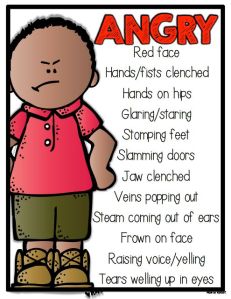
cartoon illustrating angry boy with red face


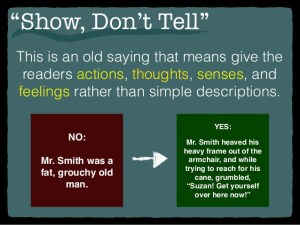
An old one but a good one: don’t tell, but show.

What does it mean exactly? It means don’t tell us about loneliness (or any of those complex words like dishonesty, secrecy, jealousy, obsession, regret, death, injustice, etc) show us what loneliness is. We will read what you’ve written and feel the bite of loneliness. Don’t tell us what to feel. Show us the situation, and that feeling will be triggered in us.

don't tell, but show

When you take your child to school on their first day you may find yourself teary and relieved at the same time. Put into words what you see: the child’s face, the wave at the gate, the other mothers saying their goodbyes, another child coming up to take your son by the hand. We will get what you’re trying to say without you telling us directly.

don't tell, but show 2

When you write, be conscious of the senses and how they connect to the experiences you are writing about. Use sight, sound, smell, touch to create concrete pictures. The senses allow you to get as close as humanly possible in words to the wedding, the sunrise, the dog, the suitcase. It’s the best way to penetrate your story and breathe life into it. Don’t tell us about something, drop deep, enter the story and take us with you.

I hope this post on show, don’t tell is useful. Do you have any tips you would add? Let me know in the comments and please share with a friend if you enjoyed it. 

I Wrote 5 Books Before Publication

fountain pen on page of writing

I wrote five book length manuscripts before one was finally accepted for publication by Ginninderra Press, a small but prestigious publisher. Rejection didn’t stop me from writing.

‘You write, you re-write, you edit, you tweak and when it’s perfect, you submit. And then you get rejected. Many times, maybe by a person who didn’t even read it. Rejection is painful because it instantly devalues your creation. Someone says this isn’t worth publishing. Rejectees, take heart. Many now-famous writers have been rejected before they made it big. Stephen King wrote his first novel, “Carrie,” and it was rejected 30 times. Rejections were so devastating that he threw the manuscript in the trash. “Chicken Soup for the Soul” was rejected 140 times. Margaret Mitchell’s “Gone With The Wind” was rejected by 38 publishers (and she did give a damn). James Joyce’s “Dubliner” was rejected 18 times and took nine years before it reached publication.’ – Ronald H. Balson

There are days when you feel like giving up and is seems that you are not making any progress. It’s during days like these, that sheer determination and persistence is all that’s left.

“Nothing in this world can take the place of persistence. Talent will not; nothing is more common than unsuccessful people with talent. Genius will not; unrewarded genius is almost a proverb. Education will not; the world is full of educated derelicts. Persistence and determination alone are omnipotent. The slogan “press on” has solved and always will solve the problems of the human race.” – Calvin Coolidge

Some writers continually submit the same manuscript until it is accepted. Others chose to do a more polished draft before sending it out again. A few learn from the lessons of submissions, to write a completely new book. What we all have in common is a persistence to never give up on our dream. Some decide to self-publish.

I’m very happy to say that persistence has paid off for me, and a third manuscript has now been accepted for publication by Ginninderra Press . ‘The Usual Story’ will be available in bookstores and online in July 2018.

As the saying goes: a writer writes. Writers continue to write.

A dear friend, who is also a former mentor, wrote this to me recently:  Libby, I’m not sure how you found your way to Ginninderra, but what a blessing for you and for readers! I was thinking the other day of your commitment for so many years when the door to publishing a book just wouldn’t open, and how much I admire your resolve and, of course, your amazing talent! Wonderful that the books are in the world now.

I hope this reminder about persistence is helpful. Do you have any tips you would add? Let me know in the comments and please share this post with a friend if you enjoyed it.


Obsession is Essential to Creativity

coffee cup, water, writing pad, pen on wooden table in cafe

Every once in a while, when I’m scratching around for something new to write, I make a list of the things I obsess about.  Thankfully, some of them change over time, but there are always new ones to fill the gap.

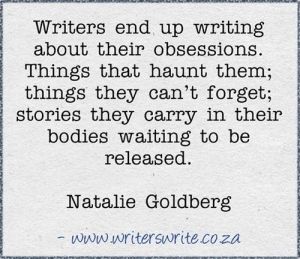
It’s true that writers write about what they think about most of the time.  Things they can’t let go: things that plague them; stories they carry around in their heads waiting to be heard.

Sometimes I get my creative writing groups to make a list of the topics they obsess about so they can see what occupies their thoughts during their waking hours.  After you write them down, you can use them for spontaneous writing before crafting them into stories.  They have much power.  This is where the juice is for writing.  They are probably driving your life, whether you realise it or not, so you may as well use them rather than waste your energy trying to push them away.  And you can come back to them repeatedly.

One of the things I’m always obsessing about is relationships:  relationships in families, relationships with friends, relationships with lovers.  That’s what I tend to write about.  I think to myself, Why not?  Rather than repress my obsessions, explore them, go with the flow.  And life is always changing, so new material keeps presenting  itself.

We are driven by our passions.  Am I the only one who thinks this?  For me these compulsions contain the life force energy.  We can exploit that energy.  The same with writing itself.  I’m always thinking and worrying about my writing, even when I’m on holidays.  I’m driven.

Not all compulsions are a bad thing.  Get involved with your passions, read about them, talk to other people about them and then they will naturally become ‘grist for the mill’.

quote about obsessions

What about you?  Do you find yourself writing about the same topics over and over again?

I Am Not the Stories I Tell

two book covers: 'My Year With Sammy' and 'The Crystal Ballroom'

by Libby Sommer:

Sometimes when people read my stories they assume those stories are me.  They are not me, even if I write in the first person.  They were my thoughts and feelings at the time I wrote them.  But every minute we are all changing.  There is a great freedom in this.  At any time we can let go of our old selves and start again.  This is the writing process.  Instead of blocking us, it gives us permission to move on.  Just like in a progressive ballroom dance:  you give your undivided attention to your partner—keep eye contact for the time you are dancing together—but then you move on to the next person in the circle.

The ability to express yourself on the page—to write how you feel about an old lover, a favourite pair of dance shoes, or the memory of a dance on a chilly winter’s night in the Southern Highlands—that moment you can support how you feel inside with what you say on the page.  You experience a great freedom because you are not suppressing those feelings.  You have accepted them, aligned yourself with them.

I have a poem titled ‘This is what it feels like’. It’s a short poem.  I always think of it with gratitude  because I was able to write in a powerful way how it was to be desperate and frightened.  The act of self expression made me feel less of a victim.  But when people read it they often say nothing. I remind myself, I am not the poem, I am not the stories I write.  People react from where they are in their own lives.  That’s the way things are.  The strength is in the act of writing, of putting pen to paper.   Write your stories and poems, show them to the world, then move on.  The stories are not you.  They are moments in time that pass through you.

What is your experience? 

Plotter or Pantser?

man in business suit flying

Do you plot your stories, or fly by the seat of your pants?

Plot means the story line.  When people talk about plotting, they mostly mean how to set up the situation, where to put the turning points, and what the characters will be doing in the end.  What happens.

Some fiction writers write organically, not knowing where the story they are writing is going.  These writers say it would be boring to know what’s going to happen next and they lose their enthusiasm to tell the story because they know the outcome already.  They prefer throwing themselves over the edge and into the void.  This method can be very anxiety-producing.  It means you need a lot of faith in your process.

Other writers plan the story before they begin.  In detective fiction the story definitely needs to be worked out beforehand so information can be drip-fed to the reader.

In the past, when creating my short stories, I have worked organically and not known where my stories were headed as I wrote them.  The shorter the piece of fiction, the less need for plot.  You can write an interesting story in which not very much happens.  A woman fights with her neighbour, a man quits his job, or an unhappy family goes out for a pizza.  Simple structures work better than something too complicated when the story is short.

Now that I’m working on a new novel, I feel the need to plot.

“A plot can, like a journey, begin with a single step.   A woman making up her mind to recover her father’s oil paintings may be enough to start.  The journey begins there, as it did for Raskolnikov in Crime and Punishment when he decided to commit his crime,”  Jerome Stern Making Shapely Fiction

The plot grows and develops out of what helps and what hinders the characters’ progress toward their goals.

The Writers’ Workshop   http://www.writersworkshop.co.uk/plot2.html  ask:

  • But how do you know if your draft plot has the right amount of weight to carry an entire novel?
  • What kind of structures work?
  • Is there a quick way to design your own plot template?
  • And how do you handle a book with multiple points of view?

“A good plot has a clear motivation.  It has a clear structure.  It has an outcome.  It has subplots.  A good plot looks something like the plot structure template below,” The Writers’ Workshop.


Motivation Lizzie Bennett wants to marry for love
Plot structure She meets Darcy & Wickham. She dislikes Darcy, and starts to fall for Wickham. Wickham turns out to be a bad guy; Darcy turns out to be a good guy. She now loves Darcy.
Outcome She marries Darcy
Subplot 1 Jane Bennett (Lizzie’s nice sister) loves Bingley. Bingley vanishes. He reappears. They get hitched.
Subplot 2 Lydia Bennett (Lizzie’s idiot sister) elopes with Wickham. She’s recovered.
Subplot 3 An idiot, Mr Collins, proposes marriage to Lizzie. She says no. Her friend, Charlotte, says yes.

Of course, there are a lot of things that the above plot template doesn’t tell you.  It doesn’t say where the novel is set, it doesn’t tell you anything about plot mechanics – it doesn’t say why Lizzie dislikes Mr Darcy, or how Lydia is recovered from her elopement.  It doesn’t have anything to say about character.

The Writers’ Workshop strongly advises us to build a template much like the one above before starting to write.  “If you’ve already started your MS then, for heaven’s sake, get to that template right away.”

So I’ve decided to put myself out of my misery and create a Plot Template for my new novel.  I already had my characters in place and knew what each character wanted.  But now I’m forced into planning an ending, which isn’t a bad thing.  Some writers don’t find the real beginning to their stories until they’ve written the ending.

So that’s all we need:  a beginning, a middle and an end.  Aristotle defined it like this:  a beginning is what requires nothing to precede it, an end is what requires nothing to follow it, and a middle needs something both before and after it.

Easy peasy.  Not.

What about you?  Do you plot or write organically?  What works and what sends you straight to the Writers Block Corner?

Header image:  Creative Commons

Fortnightly Story: Painstaking Progress

painting of two lovers
Credit: Creative Commons

‘Painstaking Progress’

by Libby Sommer

first published in Quadrant


One can never change the past, only the hold it has on you.  And while nothing in your life is reversible, you can reverse it nevertheless – Merle Shain.

1.

I’m imagining a cloudy autumn morning.  There’s a room.  Half office, half bedroom.  Not too large and not too small.  The windows of the room face east and look out towards the ocean across the expanse of a green gully.

I picture a woman sitting on a bed with pillows behind her back.  The windows are open.  Perhaps it is Saturday morning.  On the bedside table is a mug of tea and a photograph of the woman’s daughter on her wedding day.

Continue reading

I Am Not the Stories I Tell

Creative Commons picture

Sometimes when people read my stories they assume those stories are me.  They are not me, even if I write in the first person.  They were my thoughts and feelings at the time I wrote them.  But every minute we are all changing.  There is a great freedom in this.  At any time we can let go of our old selves and start again.  This is the writing process.  Instead of blocking us, it gives us permission to move on.  Just like in a progressive ballroom dance:  you give your undivided attention to your partner—keep eye contact for the time you are dancing together—but then you move on to the next person in the circle. Continue reading