In terms of creating new material during a pandemic, poetry is where I turn for inspiration. What about you?
According to Edward Mallinckrodt Distinguished Professor of English, Washington University, St. Louis, Missouri, 1976–90. Poet Laureate of the U.S., 1988–90, Poetry is literature that evokes a concentrated imaginative awareness of experience or a specific emotional response through language chosen and arranged for its meaning, sound, and rhythm.
Do you find reading and writing poetry right now is how you are able to express yourself during a troubling time?
Phyllis Klein from Women’s Therapy Services puts it this way: “Turning to poetry, poetry gives rhythm to silence, light to darkness. In poetry we find the magic of metaphor, compactness of expression, use of the five senses, and simplicity or complexity of meaning in a few lines.”
This is my pre-pandemic poem ‘Taste‘ first published in Quadrant magazine May 2019. Have a read. Hope you enjoy it.
Taste:
I rather like poems about minor calamities, bursts of tiny delights, the sun warming the tender skin of the elderly. Also, the way palm fronds conduct themselves during a southerly, dishevelled, exposing the softness of their billowing arms. Pastries in display cases do something for me too. Even cupcakes iced in gelato colours, adorned with miniature decorations … Can you see my preference for the words ‘miniature’ and ‘tiny’, an inclination towards the distilled in a world favouring often the big and the overwhelming? People with the patience to follow a complex recipe – well, that’s not me, but I like to taste what they cook. Babies in prams kicking chubby legs make me hover – how difficult not to take a bite. If you write something about a paper straw, I will be fascinated. You could try a ladybird, a pocket-size umbrella. The generalised angst of the human condition, however, may be hard for me to get a handle on. Watch that man with the disabled daughter moisten his finger after her cupcake is eaten and relish the last crumbs. Consider the rainbow-coloured wristband tied to a letterbox on the way to the park or the miniature plastic bucket and spade we found half-hidden on the beach at Bronte and packed with us for years on every visit to the sea.
Have a read of my latest prose poem, Someone I Don’t Know Side-Swiped My Car, first published in Quadrant magazine April 2021, Hope you enjoy it:
Someone I Don’t Know Side-Swiped My Car
Bad luck recently, you could say, after surviving some extremely unfortunate luck. For hours I sat across from you in the Emergency Bay: your face dripping with blood. They gave you a compress to stop the flow of red from your cheekbones and your nose. Every time you touched your face, it opened up the wound. Punched in both eyes and the nose. A robbery as you walked home, I hear you tell your girlfriend on the mobile. And then you’re telling the emergency nurse you can’t wait any longer to see a doctor. ‘You may have concussion,’ she cautioned.
Did you find your way home?
For days I wonder how you are. I sniff the first spring jasmine hanging over the fence and your girlfriend whom I’ve never met crowds my thoughts, till one day, peering out my bedroom window, I notice someone has side-swiped my car. Not exactly what I’d expected to see but, man, the wisteria are showing their purple blooms. A nervous possum balances on the telephone line above the road and there’s a newspaper article about an elderly cyclist who died after a freak bike accident caused by a swooping magpie. Bad luck that a second vehicle crashed into my car while it waited at the smash repair place. Look up, take care, someone or something you don’t know may sideswipe you or punch you in the nose.
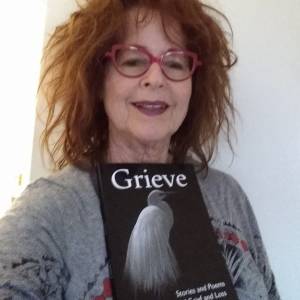
I received my contributor’s copy of the 2020 Grieve anthology from the Hunter Writer’s Centre today. Stories and Poems of Grief and Loss. My short story ‘Sober Sixty’ is part of the collection.
The back cover reads,
‘2020 is the 8th year of the Grieve Project. Since 2013, Australians have submitted poems and stories about their experience with parental grief, sibling grief, loss of a home and numerous other forms of grief and loss.
‘2020 was a year of collective grief for Australia and the world. Yet the telling of grief here is much the same as in previous years. While tales of devastating bushfires and the crippling consequences of the coronavirus do feature in this anthology, its core remains unchanged: grief is universal arising from a multitude of experiences and we express it in myriad ways.
‘Writing about grief is a most notable expression. This anthology exposes that nobility and humility. It also gives us, the readers, hope.’
I feel honored to be part of this book.
Available from Hunters Writer’s Centre website or Booktopia
My prose poem ‘Amber Puppy’ was first published in Quadrant magazine in September 2019. Have a read. I do enjoy this short form of writing, a cross between a poem and a prose piece, although, according to Wikipedia, prose poetry is poetry written in prose form instead of verse form, while preserving poetic qualities such as heightened imagery, parataxis, and emotional effects.
Have a look and tell me what you think:
Amber Puppy:
What can an amber puppy mean in a world of Siris and driverless cars?
I was older, one of the Baby Boomers. Life was a series of warnings: Don’t fall over rugs or loose cords, don’t overeat, don’t go to bed before nine, drink coffee after midday, watch too much Netflix. When the new puppy arrived one birthday, rich brown as a raisin, I heard it shadowing me: Don’t trip on the dog’s lead.
There was much to be anxious about. One day, walking through the park – the rain had eased, spring waterfalls spilled into the creek, soon we would cool off under the trees – I lost my grip on the lead. Into the bushes he fled, disappearing into green. Since when did parks swallow small dogs? I drove home in a frantic car. My best friend. I’d loved him and he’d loved me.
The days staggered past like drunks. I prayed silently, absorbed sunshine, climbed steps, wrote Letters to the Editor. Don’t panic, don’t shallow breathe, don’t think the worst – you could hear it all around. A reclining Buddha could show you how to deepen the breath. A bird call at first light could tell you when to get up. A storm could remember to fill the dams and the water tanks – I was meandering between the trees when I saw him scampering through the creek. Splashing around then shaking himself dry. A muddy escapee. A barking survivor.
Where had he been these three long days? I could wash him, wrap him in a towel, take him home. Unexpected good news could still happen. Dogs off-the-leash need to stay close to their mistresses. Trees shed their leaves in winter and dogs run away, but find their way back. Seventy-two hours later, what can an amber puppy tell you in a world of Botox and identity theft?
See the difference between holding on and losing your grip.
So what is a prose poem? According to the Poetry Foundation, a prose poem is a prose composition that, while not broken into verse lines, demonstrates other traits such as symbols,metaphors, and otherfigures of speech common to poetry.
If you are able to distill meaning in a very short form, you may enjoy writing prose poetry.
Have a read of my prose poem Sixteen Is A Very Difficult Age, You Know, first published in Quadrant magazine September 2018.
Sixteen Is a Very Difficult Age, You Know
Well yes it is. This time of year isn’t easy either. It has most of us by the neck. You don’t want to get sick at Christmas. They said he needs six weeks of intensive therapy then they’ll decide about medication. How – when everything’s closed till February? Yes, he’s up and down. Better some days, but hardly ever. They said hide all the tablets and remove the kitchen knives. I ring or text to see how he’s going. He doesn’t always pick up. Don’t refer to the incident. Wait for him to say something. Well, he doesn’t say much though he’ll let me give him a hug – sometimes. So here I am trying to gather his forgotten dreams from the air. They’re drifting just outside my reach.
Not that most of us are in a rush to sign up for a cruise any time soon … but here is my poem, BETWEEN THE ISLANDS OF THE PACIFIC, first published in Quadrant magazine June, 2018. It’s sort of relevant to the current situation. Hope you enjoy it.
Between the Islands of the Pacific
Because by now we know everything is not so blue
out here.
The cities had tipped rubbish into the sea,
and we let them without even noticing.
Not even feeling our breathing clear
as gusts reaching ten knots cleaned up our days.
Not even. Today pure blue sky, blue sea,
out there the horizon drawing a line
below the clouds, the absoluteness of it. Nights
of diesel engines shuddering beneath us.
We lounge on chairs side by side on the deck.
At dusk, we stand at the railing of the ship as the sun
slips into the ocean. In the fresh sea air, their backs turned,
some raise a selfie-stick or light a cigarette while others
Hello everyone. Hello to all you fellow quarantiners hanging-in-there.
I’d like to share with you my poem ELSEWHERE, first published in Quadrant magazine in December 2017. Hope you like it. The poem is relevant to today’s situation, in many ways.
Elsewhere
Hair remembers how dark a room becomes
when hair is not let loose, straw fallen from the head
of a broom, drifting onto a path,
crunched underfoot by someone who never realised
it was straw. Hair drank, jogged,
ate by itself, knew how to tick ‘Like’
on Social Media. But hair felt
out of touch with itself
unable to distinguish the difference between
fear of the unknown, and fear of something
bad. Hair remembered the ultramarine blue of sea and sky
and the hundred varieties of tuna, calamari and squid.
Hair has dreams, that’s what hair does.
Covers over a shiny scalp, frames the face.
Adventure means exploration and discovery.
And hair remembers—blankets of humidity, harsh light,
residing there in the brain’s temporal lobes.
Even now, when hair is back home,
it remembers the wanting things to remain the same