Fortnightly Story: The Backpack


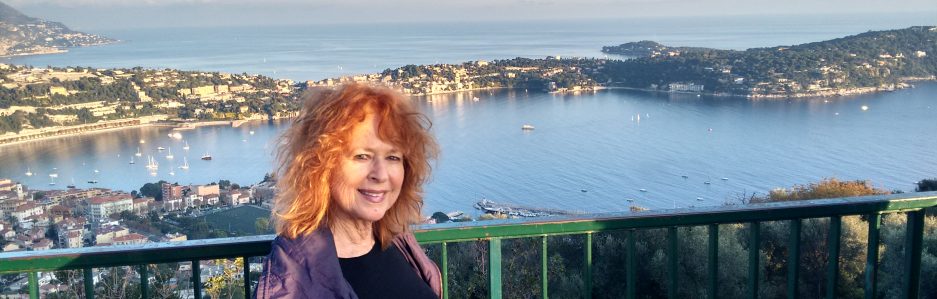
view of Villefranche sur Mer harbour from Mt Baron

What can a man who meets you at the station and offers to carry your backpack mean to a woman traveling the world alone?

I was scared, like anyone who has no sense of direction.  The journey was a series of stops and starts.  Whether to use the Eurail pass or post it back home and ask the kids to get me a refund.  Giovanni appeared one European winter, thick padded jacket, woolen beanie, scarf and gloves, tall and imposing,  I’ll carry your bag.

I was small, the backpack the length of my spine, the zip-off bag on one shoulder, the daypack positioned in front like a nine-month baby bump.  That evening, as we climbed the steps of the Corniche – the wind bitter across the Mediterranean, the metal stairs covered with slippery ice, the railing melting beneath my hand.  Soon it would become my railway platform, my steps, and Giovanni my landlord.

We walked there in the crisp night air.  My own place.  It didn’t cost much.  No-one yet knew I was here.  I could ask Giovanni if I needed any help.  I knew my children would be pleased I had a base.  I didn’t want them to worry.  It was the thing I wanted the most secretly, studying maps, absorbing travel books.  To be safe, a desire whispered to the moon that moved behind my shoulder at night.  If you guide me to a safe haven I promise to be happy.  And the moon listened.  I did my best.

The winter sky closed down and the spring began its flowering.  I took photos and painted and rang the children every week.  Watch your money, don’t talk to strangers, be careful walking at night – you know the drill.  The pebbly beach, the weekend markets, it was all there for the exploring.  A glimpse of the sea between terracotta roofs – a vision in turquoise.  The cobbled streets could show which way to follow – and none of them wrong.  A room at the top of the stairs – till June I stayed reading the English books Giovanni had left in the bookcase, shopping for food, telling my kids and friends they should come for a visit.

Where had the months gone?  Almost two years on the road.  Summer approached. The rents would go up and the tourists arrive.  Time to move on.  I could only take with me what I could carry on my back.  A Jewish gypsy they said.  One more step into the unknown.  Pack up, give away what I couldn’t manage, but keep the palette knife and miniature easel.  There was stuff happening back home.    The boys were grown and earning a living.  Their sister turned twenty-one.  People were reinventing themselves all over the place then coming back home.  A thousand train rides later, my mother nearly eighty.  I won’t be around much longer, she cried.

His was a helping hand in a world that says, but what are you doing there?  What are you doing?

First published in Quadrant

Copyright © Libby Sommer 2016
 

Fortnightly Story: Tom

man in black wetsuit riding a wave

May Ling steps across the skipping rope.  I’m waiting for her with her baby brother, outside the school hall, but she hasn’t seen me yet.   Every Thursday when she finishes her Hip Hop class I hang about with the other mothers and grandmothers and carers.  It’s a routine I enjoy—walking up here with the baby in the stroller and then chatting with May Ling as we walk home. Continue reading

Fortnightly Story: Mother

an adult and two children walking along a beach

The day is softening into night, my desk in shadow as the sun moves behind the building.  Birds hover in the trees as the wind blows across the surface of the sea.  It’s hard to know which way to go.  Every day I fear that I can’t do it.  So I’m watching as it gets dark.

Tonight I’m thinking about the saddest bits.  Thinking, for example, that the night was alight with thunder.  Lightening cracked the sky.  Just a flash and then darkness again.

That I loved him, and sometimes he loved me too. Continue reading

Ground Your Writing in Place

woman in blue tennis dress position to hit big forehand

Here is an important writing tip:  ground your writing in a sense of place, whether landscape or cityscape.

How often have you heard someone say of a book they loved:  ‘I felt like I was there.’


Even if you relocate the poodle tied to a fake-cane chair, the sound of a game of tennis, the table of older men after their regular Sunday match at the café overlooking the tennis courts at Cooper Park that you drank a lemongrass and ginger tea at in Sydney into a café in a story in another state and time, the story will have originality and believability.  ‘But that café was in Sydney, I can’t transport it to Adelaide.’  But you can.  You can have flexibility with specific detail.  The mind is able to transport details, but using actual places that you experienced will give your writing authenticity and truthfulness.  It grounds your work in place, giving life and vitality to your writing, rather than a whole lot of exposition that floats in the air.

 If you don’t create evocative settings, your characters seem to have their conversations in vacuums or in some beige nowhere-in-particular. –  Jerome Stern

Creation of the physical world is as important to your story as action and dialogue.  If your readers can be made to see the hand-knitted socks or the row of vitamins on the kitchen benchtop, the scene becomes alive.  Readers pay attention.  Touch, sound, taste, and smell make readers feel as if their own feet are warm under the cold sheets.

Place situates the story in your reader’s mind.  Fiction that seems to happen in no particular place often seems not to take place at all.’ –  Jerome Stern


Header Image:  Creative Commons


Fortnightly Story: Michael

black and white photo of the back of a man as he stares into distance

He’s waiting at the bottom of the ramp, just inside the steel fence that cordons off the entry to the station.  He said to give him a ring from her mobile when the train passed Gosford.  She quickens her pace, adjusts the overnight bag on her shoulder. She is close enough to see the soft fold of his graying hair, the clear smooth glow of his skin.  In his white socks and slip-on loafers he looks very English. Continue reading

Autobiography in Fiction

Post4pic

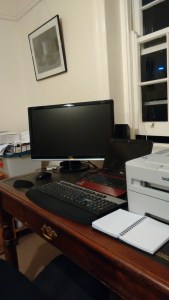
When people ask me where I get my ideas from, I tell them I use the world around me. Life is so abundant, if you can write down the actual details of the way things were and are, you hardly need anything else. Even if you relocate the French doors, fast-spinning overhead fan, small red Dell laptop, and low black kneeling chair from your office that you work in in Sydney into an Artist’s Atelier in the south of France at another time, the story will have truth and groundedness.

In Hermione Hoby’s interview with Elizabeth Strout in last Saturday’s Guardian newspaper the Pulitzer prize winner said her stories have always begun with a person, and her eyes and ears are forever open to these small but striking human moments, squirreling them away for future use. “Character, I’m just interested in character,” she said.

Continue reading