
Writing Tip: Use Declarative Sentences


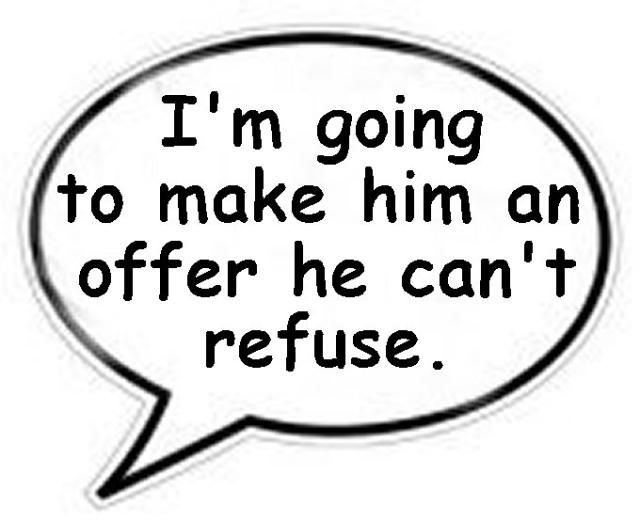
speech bubble: I'm going to make him an offer he can't refuse

This declarative sentence was spoken by Don Corleone (played by Marlon Brando) in the movie The Godfather (1972).

We don’t always make declarative statements. It is not uncommon for women and other minority groups to add qualifiers to their statements. Such as ‘Parents need to stop organising every minute of their children’s spare time, don’t you think?’ ‘I loved that movie, didn’t you?’ In our sentence structure we look for reinforcement for our thoughts and opinions. We don’t always make declarative statements such as:  ‘This is wonderful.’ ‘This is a catastrophe.’ We look for re-enforcement from others.

Another thing we do without realising it, is use indefinite modifiers in our speech:  perhaps, maybe, somehow. ‘Maybe I’ll take a trip somewhere.’ As if the speaker has no power to make a decision. ‘Perhaps it will change.’ Again, not a clear declarative sentence like, ‘Yes, nothing stays the same.’

It is important for us as writers to express ourselves in clear assertive sentences. ‘This is excellent.’ ‘It was a red dress.’ Not ‘The thing is, I know it sounds a bit vague, but I think maybe it was a red dress.’ Speaking in declarative sentences is a good rehearsal for trusting your own ideas, in standing up for yourself, for speaking out your truth.

When I write poetry I read through early drafts with a critical eye, taking out indefinite words and modifiers. I attempt to distill each moment to its essence by peeling off the layers until the heart of the poem is exposed. We need to take risks as writers and go deep within ourselves to find our unique voices and express ourselves with clarity.

Even if you are not 100% sure about your own opinions and thoughts write as if you are sure.  Dig deep. Be clear. Don’t be vague on the page. If you keep practicing this, you will eventually reveal your own deep knowing.

What about you? Have you noticed this tendency to qualify in your conversations with others, or in your creative writing, or in your blog posts?

My Prose Poem: ‘Taste’

woman sitting on chair while reading book

In terms of creating new material during a pandemic, poetry is where I turn for inspiration.  What about you?

According to Edward Mallinckrodt Distinguished Professor of English, Washington University, St. Louis, Missouri, 1976–90. Poet Laureate of the U.S., 1988–90,  Poetry is literature that evokes a concentrated imaginative awareness of experience or a specific emotional response through language chosen and arranged for its meaning, sound, and rhythm.

Do you find reading and writing poetry right now is how you are able to express yourself during a troubling time?

Phyllis Klein from Women’s Therapy Services puts it this way:  “Turning to poetry, poetry gives rhythm to silence, light to darkness. In poetry we find the magic of metaphor, compactness of expression, use of the five senses, and simplicity or complexity of meaning in a few lines.”

This is my pre-pandemic poem ‘Taste‘ first published in Quadrant magazine May 2019. Have a read. Hope you enjoy it.

Taste:

I rather like poems about minor calamities, bursts of tiny delights, the sun warming the tender skin of the elderly. Also, the way palm fronds conduct themselves during a southerly, dishevelled, exposing the softness of their billowing arms. Pastries in display cases do something for me too. Even cupcakes iced in gelato colours, adorned with miniature decorations … Can you see my preference for the words ‘miniature’ and ‘tiny’, an inclination towards the distilled in a world favouring often the big and the overwhelming? People with the patience to follow a complex recipe – well, that’s not me, but I like to taste what they cook.  Babies in prams kicking chubby legs make me hover – how difficult not to take a bite. If you write something about a paper straw, I will be fascinated. You could try a ladybird, a pocket-size umbrella. The generalised angst of the human condition, however, may be hard for me to get a handle on.  Watch that man with the disabled daughter moisten his finger after her cupcake is eaten and relish the last crumbs. Consider the rainbow-coloured wristband tied to a letterbox on the way to the park or the miniature plastic bucket and spade we found half-hidden on the beach at Bronte and packed with us for years on every visit to the sea.

Copyright © 2019 Libby Sommer


Writing Tip: Use Your Obsessions

woman reading a book in the bed

Every once in a while, when I’m scratching around for something new to write, I make a list of the things I obsess about.  Thankfully, some of them change over time, but there are always new ones to fill the gap.

Recently, of course, all I can think about is the pandemic and the changes to the world as we’ve known it.

It’s true that writers write about what they think about most of the time.  Things they can’t let go: things that plague them; stories they carry around in their heads waiting to be heard.

I used to get my creative writing groups to make a list of the topics they obsess about so they can see what occupies their thoughts during their waking hours.  After you write them down, you can use them for spontaneous writing before crafting them into stories.  They have much power.  This is where the juice is for writing.  They are probably driving your life, whether you realise it or not, so you may as well use them rather than waste your energy trying to push them away.  And you can come back to them repeatedly.

I’ve been working on a suite of quarantine poems. The first of the series will be published in Quadrant magazine.

One of the things I usually obsess about is relationships:  relationships in families, relationships with friends, relationships with lovers.  That’s what I tend to write about.  I think to myself, Why not?  Rather than repress my obsessions, explore them, go with the flow.  And life is always changing, so new material keeps presenting  itself.

We are driven by our passions.  Am I the only one who thinks this?  For me these compulsions contain the life force energy.  We can exploit that energy.  The same with writing itself.  I’m always thinking and worrying about my writing, even when I’m on holidays.  I’m driven.

But not all compulsions are a bad thing.  Get involved with your passions, read about them, talk to other people about them and then they will naturally become ‘grist for the mill’.

What about you?  Do you find yourself writing about the same things over and over again?

Writing Tip: Critiquing

woman lying on green grass while holding pencil

In the Saturday feedback group, we began talking about the ‘off with his head’ or ‘out-it-goes’ part of writing.  We acknowledged that as a group we’d always been very supportive and encouraging of each others work.  That was because we were all in it together.  Our critiquing was not telling lies; it was from a place of open-hearted acceptance.  Everything you put on the page is acceptable.

Sometimes someone says, ‘I want a rigorous no-holds-barred assessment of my work.’  But what do you say to them when the writing is dull and boring?  Don’t give up your day job?  It doesn’t sit comfortably with most of us to be directly critical of someone’s writing.  It’s like telling someone how ugly their baby is.  All of us find it hard to separate our writing from ourselves, and are prone to take criticism personally.

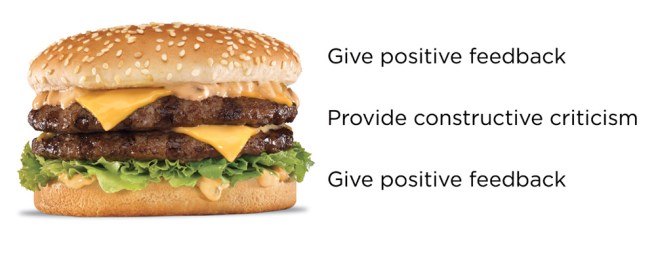
The feedback sandwich is a widely known technique for giving constructive feedback, by ‘sandwiching’ the criticism between two pieces of praise or compliments.


hamburger with cheese and two beef patties

Yesterday, as we passed around copies of our work (just a page or two) we started to address what William Faulkner famously said:

‘In writing, you must kill all your darlings.’

First of all, we looked for the juice in each piece.  Where did the writing come alive?  ‘Get rid of the rest,’ we said.  ‘Off with his head—out it goes.’   It’s very difficult to be this honest, and not everyone wants to hear it.  ‘I simply want gentle support and a few corrections,’ some of us might say.

Be willing to have the courage to look at your work with truthfulness.  It’s good to know where your writing has energy and vitality, rather than to spend a lot of time trying to make something come to life that is dead on the page.   Keep writing.  Something new will come up.    You don’t want to put your readers to sleep by writing a lot of boring stuff.

Do you have a writing group? Do you find it useful?

Poem: Between the Islands of the Pacific

sky, clouds, rising sun over Pacific Ocean

Not that most of us are in a rush to sign up for a cruise any time soon … but here is my poem, BETWEEN THE ISLANDS OF THE PACIFIC, first published in Quadrant magazine June, 2018. It’s sort of relevant to the current situation. Hope you enjoy it.


Between the Islands of the Pacific


Because by now we know everything is not so blue

out here.


The cities had tipped rubbish into the sea,

and we let them without even noticing.


Not even feeling our breathing clear

as gusts reaching ten knots cleaned up our days.


Not even. Today pure blue sky, blue sea,

out there the horizon drawing a line

below the clouds, the absoluteness of it. Nights

of diesel engines shuddering beneath us.


We lounge on chairs side by side on the deck.

At dusk, we stand at the railing of the ship as the sun

slips into the ocean. In the fresh sea air, their backs turned,

some raise a selfie-stick or light a cigarette while others

stand holding their breath.


Where can we go from here, and how?


Copyright © Libby Sommer 2018


Writing Tip: The Inner Critic

man with hand on temple looking at laptop

It is essential to separate the creator and the editor, or inner critic when you practice writing, so that the creator has plenty of room to breathe, experiment, and tell it like it really is.  If the inner critic is being too much of a problem and you can’t distinguish it from your authentic writing voice, sit down whenever you find it necessary to have some distance from it and put down on paper what the critic is saying, put a spotlight on the words—“You have nothing original to say, what made you think you could write anything anyone would want to read, your writing is crap, you’re a loser, I’m humiliated, you write a load of rubbish, your work is pathetic, and your grammar stinks …”  On and on it goes!

Say to yourself, It’s OK to feel this.  It’s OK to be open to this.

You can learn to cultivate compassion for yourself  during this internal process by practicing Mindfulness Meditation.  Sit up straight, close your eyes, bring your awareness to your inner experience.  Now,  redirect your attention to the physical sensations of the breath in the abdomen … expanding as the breath comes in … and falling back as the breath goes out.  Use each breath to anchor yourself in the present.   Continue, concentrating on the breath for several minutes.  Now, expand your field of awareness to include the words of the inner critic.  Turn your attention to where in your body you feel the unpleasant thoughts, so you can attend, moment by moment, to the physical reactions to your thoughts.

 “Stay with the bodily sensations, accepting them, letting them be, exploring them without judgment as best you can.”—Mindfulness, Mark Williams and Danny Penman.

Every time you realise that you’re judging yourself, that realisation in itself is an indicator that you’re becoming more aware.

The thing is, the more clearly you know yourself, the more you can accept the critic in you and use it.  If the voice says, “You have nothing interesting to say,” hear the words as white noise, like the churning of a washing machine.  It will change to another cycle and eventually end, just like your thoughts that come and go like trains at the station.  But, in the meantime, you return to your notebook and practice your writing.  You put the fear and the resistance down on the page.

*

Do you struggle with an inner critic?  Any words of wisdom you’d like to share?

I Am Not the Stories I Tell

pexels-photo.jpg

Sometimes when people read my stories they assume those stories are me.  They are not me, even if I write in the first person.  They were my thoughts and feelings at the time I wrote them.  But every minute we are all changing.  There is a great freedom in this.  At any time we can let go of our old selves and start again.  This is the writing process.  Instead of blocking us, it gives us permission to move on.  Just like in a progressive ballroom dance:  you give your undivided attention to your partner—keep eye contact for the time you are dancing together—but then you move on to the next person in the circle.

The ability to express yourself on the page—to write how you feel about an old lover, a favourite pair of dance shoes, or the memory of a dance on a chilly winter’s night in the Southern Highlands—that moment you can support how you feel inside with what you say on the page.  You experience a great freedom because you are not suppressing those feelings.  You have accepted them, aligned yourself with them.

I have a poem titled ‘This is what it feels like’—it’s a short poem.  I always think of it with gratitude  because I was able to write in a powerful way how it was to be desperate and frightened.  The act of self expression made me feel less of a victim.  But when people read it they often say nothing.  I remind myself, I am not the poem, I am not the stories I write.  People react from where they are in their own lives.  That’s the way things are.  The strength is in the act of writing, of putting pen to paper.   Write your stories and poems, show them to the world, then move on.  The stories are not you.  They are moments in time that pass through you.

My Poem: ‘Lying On A Harbour Beach at Noon’

painting of girl lying on beach in torquoise bikini reading a book

During the pandemic I find myself turning more and more to poetry, the reading and the writing of poetry.

Here is my poem Lying On A Harbour Beach At Noon, first published in Quadrant magazine January 2017.

Hope you enjoy it.


Lying On A Harbour Beach At Noon


There is an opening out of the self which happens

when the sun is high in a cloudless blue

and its warmth sinks into the body.


It occurs on a gentle beach.

It is a slow opening,

like waking up in

your own cosy apartment.

When all the tenants wake up

and the blinds snap

the windows open wide.

If you are in bed you struggle to open to the bright light.

If you are elsewhere, feeling your separateness, alienated,

you long for home and think you’re falling apart.


You are not falling apart.

You could open into your own particular self,

feel your skin move away from the bone,

your belly like an open wound tightening

then opening with everything exposed.

You know you can stop the empty grasping if you want to

because you have a deep knowing,

you open to it, and for now

it holds you gently.


Copyright 2017 Libby Sommer


Stay safe everyone, and be well.

The Creative Process

woman in white shirt and blue denim short shorts sitting

Are you finding it hard to focus on a creative project while this health pandemic is sweeping the world? It’s hard to stop thinking and worrying about the horrific consequences worldwide.

Being able to create something new though, is a wonderful way to stop obsessing and to put your thoughts on to something constructive. Creative writing is a perfect example.

For myself, I can’t write about the world around me just now. It is still too raw and I need to process what is happening. So I am concentrating on coming up with other ideas for my stories and poems and novels.

I heard someone say, “The thing to do is put the idea in your subconscious.  Your brain will do the work.”

It takes time for our experience to make its way through our consciousness.  For example, it is hard to write about a journey while you are still in the midst of the adventure.  We have no distance from what is happening to us.  The only things we seem to be able to say are “having a great time”, “the weather is good”, “wish you were here”.  It is also hard to write about a place we just moved to, we haven’t absorbed it yet.  We don’t really know where we are, even if we can walk to the train station without losing our way.  We haven’t experienced three scorching summers in this country or seen the dolphins migrating south along the  coast in the winter.

“Maybe away from Paris I could write about Paris as in Paris I could write about Michigan.  I did not know it was too early for that because I did not know Paris well enough.” – Ernest Hemingway, A Moveable Feast  (New York:  Charles Scribner’s Sons, 1964).

So we take in experience, but we need to let things make their way through our consciousness for a while and be absorbed by our whole selves.  We are bower birds, collecting experience, and from the thrown away apple skins, outer lettuce layers, tea leaves, and chicken bones of our minds come our ideas for stories and poems and songs.  But this does not come any time soon.  It takes a very long time (three to ten years in the case of literary fiction).  We need to keep picking through those scraps until some of the thoughts together form a pattern or can be organised around a central theme, something  we can shape into a narrative.  We mine our hidden thoughts for ideas.  But the ideas need time to percolate:  to slowly filter through.

Rumi, the thirteenth-century Sufi poet, summed up what could be the creative process when he wrote “The Guest House”:

This being human is a guest house.

Each morning a new arrival.

A joy, a depression, a meanness,

some momentary awareness comes

as an unexpected visitor.

Welcome and entertain them all!

Even if they are a crowd of sorrows,

who violently sweep your house

empty of its furniture,

still, treat each guest honorably.

He may be clearing you out

for some new delight.

The dark thought, the shame, the malice,

meet them at the door laughing and invite

them in.

Be grateful for whoever comes,

because each has been sent

as a guide from beyond.


Jalaluddin Rumi, in The Essential Rumi

Translated by Coleman Barks, 1999

Our work is to keep rummaging through the rubbish bins of our minds, exercising the writing muscle, in readiness to answer that knock at the door when it comes.

As the author Vivian Gornick said, “The writers life is the pits.  You live alone and you work alone, every day I have to recreate myself.”  She paused and laughed.  “But when the work is going well there is nothing that compares.”

What about you? Are you able to force yourself to concentrate on creative writing projects during the corona virus pandemic?

What can you do while in isolation?

photo of a woman thinking

David Dale in the Sydney Morning Herald writes about Isaac Newton’s self-isolation during the plague year 1665-66 and how he passed the time.


‘Newton was 23, a student at Cambridge. When the black plague spread there from London, he retreated to his birthplace – Woolsthorpe Manor, near the town of Grantham (later the birthplace of Margaret Thatcher). During what he called his “annus mirabilis”, or wonderful year, at Woolsthorpe, Newton did three significant things:

He invented the mathematical system called calculus,

He drilled a hole in the shutter of his bedroom window and held a prism up to the beam of sunlight that came through it, discovering that white light is made up of every colour (and giving Pink Floyd an iconic album cover), and

He watched apples falling from the trees in his garden and theorised about a force called gravity, which keeps the moon revolving around planet Earth. (He later wrote: “I can calculate the movement of heavenly bodies, but not the madness of people.”)’ – Sydney Morning Herald 


So what can you do while in isolation amid the corona virus outbreak to stay calm and centred and to concentrate your mind away from the current crisis? A writing project could be the answer.

What to write? If you’ve been wondering whether to write a short story or a novel, here are some thoughts on these two different forms of creative fiction:

Is a novel a short story that keeps going, or, is it a string of stories with connective tissue and padding, or, is it something else?  Essayist Greg Hollingshead believes that the primary difference between the short story and the novel is not length but the larger, more conceptual weight of meaning that the longer narrative must carry on its back from page to page, scene to scene.

“It’s not baggy wordage that causes the diffusiveness of the novel.  It’s this long-distance haul of meaning.”  Greg Hollingshead

There is a widespread conviction among fiction writers that sooner or later one moves on from the short story to the novel.  When John Cheever described himself as the world’s oldest living short story writer, everyone knew what he meant.

Greg Hollingshead says that every once in a while, to the salvation of literary fiction, there appears a mature writer of short stories—someone like Chekhov, or Munro—whose handling of the form at its best is so undulled, so poised, so capacious, so intelligent, that the short in short story is once again revealed as the silly adjective it is, for suddenly here are simply stories, spiritual histories, narratives amazingly porous yet concentrated and undiffused.

When you decide you want to write in a particular form—a novel, short story, poem—read a lot of writing in that form.  Notice the rhythm of the form.  How does it begin?  What makes it complete?  When you read a lot in a particular form, it becomes imprinted inside you, so when you sit at your desk to write, you produce that same structure.  In reading novels your whole being absorbs the pace of the sentences, the setting of scenes, knowing the colour of the bedspread and how the writer gets her character to move down the hallway to the front door.

I sit at my desk thinking about form as a low-slung blanket of cloud blocks my view of the sky.  Through the fly screen I inhale the sweet smell of earth after rain as another day of possibility beckons.

Self-isolation can give us an opportunity to create something new.

Good luck everyone during this horrific pandemic and please take care.