
Writing Tip: The Writing Process

At a literary event I heard someone say, “The thing to do is put the idea in your subconscious.  Your brain will do the work.”

It takes time for our experience to make its way through our consciousness.  For example, it is hard to write about a journey while you are still in the midst of the adventure.  We have no distance from what is happening to us.  The only things we seem to be able to say are “having a great time”, “the weather is good”, “wish you were here”.  It is also hard to write about a place we just moved to, we haven’t absorbed it yet.  We don’t really know where we are, even if we can walk to the train station without losing our way.  We haven’t experienced three scorching summers in this country or seen the dolphins migrating south along the  coast in the winter.

“Maybe away from Paris I could write about Paris as in Paris I could write about Michigan.  I did not know it was too early for that because I did not know Paris well enough.” – Ernest Hemingway, A Moveable Feast  (New York:  Charles Scribner’s Sons, 1964).

So we take in experience, but we need to let things make their way through our consciousness for a while and be absorbed by our whole selves.  We are bower birds, collecting experience, and from the thrown away apple skins, outer lettuce layers, tea leaves, and chicken bones of our minds come our ideas for stories and poems and songs.  But this does not come any time soon.  It takes a very long time (three to ten years in the case of literary fiction).  We need to keep picking through those scraps until some of the thoughts together form a pattern or can be organised around a central theme, something  we can shape into a narrative.  We mine our hidden thoughts for ideas.  But the ideas need time to percolate:  to slowly filter through.

Rumi, the thirteenth-century Sufi poet, summed up what could be the creative process when he wrote “The Guest House”:

This being human is a guest house.

Each morning a new arrival.

A joy, a depression, a meanness,

some momentary awareness comes

as an unexpected visitor.

Welcome and entertain them all!

Even if they are a crowd of sorrows,

who violently sweep your house

empty of its furniture,

still, treat each guest honorably.

He may be clearing you out

for some new delight.

The dark thought, the shame, the malice,

meet them at the door laughing and invite

them in.

Be grateful for whoever comes,

because each has been sent

as a guide from beyond.

Jalaluddin Rumi, in The Essential Rumi

Translated by Coleman Barks, 1999

Our work is to keep rummaging through the rubbish bins of our minds, exercising the writing muscle, in readiness to answer that knock at the door when it comes.

As the author Vivian Gornick said, “The writers life is the pits.  You live alone and you work alone, every day I have to recreate myself.”  She paused and laughed.  “But when the work is going well there is nothing that compares.”

What about you? Are you ready to answer the knock at the door?  

Writing Tip: Use Your Inner Critic


It is essential to separate the creator and the editor, or inner critic when you practice writing, so that the creator has plenty of room to breathe, experiment, and tell it like it really is.  If the inner critic is being too much of a problem and you can’t distinguish it from your authentic writing voice, sit down whenever you find it necessary to have some distance from it and put down on paper what the critic is saying, put a spotlight on the words—“You have nothing original to say, what made you think you could write anything anyone would want to read, your writing is crap, you’re a loser, I’m humiliated, you write a load of rubbish, your work is pathetic, and your grammar stinks …”  On and on it goes!
Say to yourself, It’s OK to feel this.  It’s OK to be open to this.
You can learn to cultivate compassion for yourself  during this internal process by practicing Mindfulness Meditation.  Sit up straight, close your eyes, bring your awareness to your inner experience.  Now,  redirect your attention to the physical sensations of the breath in the abdomen … expanding as the breath comes in … and falling back as the breath goes out.  Use each breath to anchor yourself in the present.   Continue, concentrating on the breath for several minutes.  Now, expand your field of awareness to include the words of the inner critic.  Turn your attention to where in your body you feel the unpleasant thoughts, so you can attend, moment by moment, to the physical reactions to your thoughts.
 “Stay with the bodily sensations, accepting them, letting them be, exploring them without judgment as best you can.”—Mindfulness, Mark Williams and Danny Penman.
Every time you realise that you’re judging yourself, that realisation in itself is an indicator that you’re becoming more aware.
The thing is, the more clearly you know yourself, the more you can accept the critic in you and use it.  If the voice says, “You have nothing interesting to say,” hear the words as white noise, like the churning of a washing machine.  It will change to another cycle and eventually end, just like your thoughts that come and go like trains at the station.  But, in the meantime, you return to your notebook and practice your writing.  You put the fear and the resistance down on the page.
*
Do you struggle with an inner critic?  Any words of wisdom you’d like to share?

Writing Tip: Spirituality and Creativity

What is the relationship between spirituality and creativity? The discipline and focused attention cultivated through meditation help us do one thing at a time, totally and absolutely, which greatly enhances our writing.

‘Contemplative practice, daily nature walks, and still, silent listening can be among the best natural meditations. They help clarify our minds and uplift the heart, dissolving our ordinary preoccupations and mental states that dissipate the fertile spirit within. Such daily disciplines are also excellent tonics for our agitated, febrile brains and weary bodies. When we ease into the realm of non-doing–what Chinese Buddhists called wu wei–there is more room for our mysterious, unfabricated inner self to naturally emerge.’ – Lama Surya Das

It’s tough being a writer. Very tough. As Thomas Mann says, A writer is someone for whom writing is more difficult than it is for other people.

Dinty Moore, in his book The Mindful Writer, Noble Truths of the Writing Life, says his lifelong pursuit of writing and creativity has helped to open him to the path of Buddhism:

‘Find inspiration and insight on writing as a spiritual practice through astute quotes, thoughtful advice, and productive exercises on both mindfulness and craft.  This isn’t your typical “how to write” book. Author Dinty W. Moore, a well-respected writing coach and teacher, thoughtfully illuminates the creative process: where writing and creativity originate, how mindfulness plays into work, how to cultivate good writing habits and grow as a person, and what it means to live a life dedicated to writing.’ – The Mindful Writer

Here’s to Mindfulness and Meditation to help us on our way through our roller coaster lives as creative writers.

Writing Tip: Use the Senses

Sounds, sights, and smells are all part of  creating an atmosphere.

‘The creation of the physical world is as crucial to your story as action and dialogue. If your readers can be made to see the glove without fingers or the crumpled yellow tissue, the scene becomes vivid. Readers become present. Touch, sound, taste and smell make readers feel as if their own fingers are pressing the sticky windowsill.

‘If you don’t create evocative settings, your characters seem to have their conversations in vacuums or in some beige nowhere-in-particular. Some writers love description too much. They go on and on as if they were setting places at the table for an elaborate dinner that will begin later on. Beautiful language or detailed scenery does not generate momentum. Long descriptions can dissipate tension or seem self-indulgent. Don’t paint pictures. Paint action.’ – Jerome Stern, Making Shapely Fiction

Bringing in sensory detail is a way to enrich a story with texture to create the fullness of experience, to make the reader be there.

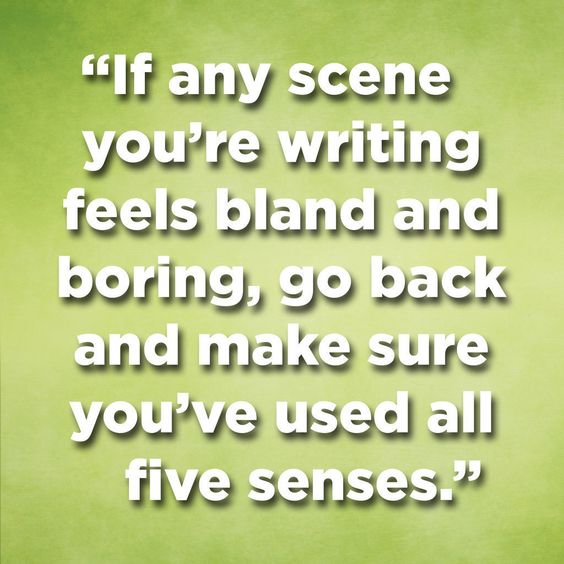
using all five senses quote on green board

What about you? Do you use the senses, apart from sight, to create atmosphere?

Writing Tip: Start Writing

When I used to teach classes to beginning writers, it was good.  It forced me to think back to the beginning to when I first put pen to paper.  The thing is, every time we sit down and face the blank page, it’s the same.  Every time we start a new piece of writing, we doubt that we can do it again.  A new journey with no map – like setting off towards the horizon alone in a boat and the only thing another person can do to help is to wave from the shore.

So when I used to teach a creative writing class, I had to tell them the story all over again and remember that this is the first time my students are hearing it.  I had to start at the very beginning.

First up, there’s the pen on the page.  You need this intimate relationship between the pen and the paper to get the flow of words happening.  A fountain pen is best because the ink flows quickly.  We think faster than we can write.  It needs to be a “fat” pen to avoid RSI.

Consider, too, your notebook.  It is important.  The pen and paper are your basic tools, your equipment, and they need to be with you at all times.  Choose a notebook that allows you plenty of space to write big and loose.  A plain cheap thick spiral notepad is good.

After that comes the typing up on the computer and printing out a hard copy.  It’s a right and left brain thing.  You engage the right side of the brain, the creative side when you put pen to paper, then bring in the left side, the analytic side, when you edit the print out as you settle back comfortably with a drink (a cup of tea, even) and read what you’ve written.

Patrick White said that writing is really like shitting; and then, reading the letters of Pushkin a little later, he found Pushkin said exactly the same thing.  Writing is something you have to get out of you.

typing writing on a pink background

Whether writing a story or writing a blog, start writing, no matter what.

Story Mosaic

Famous in India! That’s me holding my book, ‘The Crystal Ballroom’. My stories ‘Aravind’ and ‘Aravind Again’, included in Agathokakological Aussie Summer story mosaic, are self-contained chapters from ‘The Crystal Ballroom’. A great review of the story mosaic is in Indian national newspaper, News Mania. Well done to editors Sharon Rundle and Indranil Bengal Halder

Agathokakological Aussie Summer is an Australia – India collaborative online story mosaic. All free! Enjoy the stories at:

www.sharonrundle.com.au/aussiesummer/start or

https://aussiesummer.com.au

Just press a star to begin.

Back Cover Blurb: ‘Lost in Cooper Park’

I’ve been slaving away trying to write a good blurb for my soon to be released by Ginninderra Press new book, ‘Lost in Cooper Park’.

Writing a blurb is hard hard work. There are no shortcuts or easy answers. Anyway, after a chat with a close writing friend, this is what I’ve put together for the back cover.

The story begins when, after a fierce storm, Gypsy, a golden Labrador, goes missing in Sydney’s Cooper Park.

A bittersweet comedic account of mistakes, misconceptions and reconciliations in the lives of a disparate group of urban men and women.

There’s Crystal, who wants stability with her eight-year-old daughter and new partner.  

Crystal’s ex, searching for the meaning of existence.

Doctor Sarah wanting a new beginning in France.

Rosemary and Philip who want their daughter to walk again.

Crystal’s high school sweetheart who wants another chance.

And the Homeless Girl hiding in Cooper parklands.

And then there’s the cruelty, unpredictability and beauty of life.

Back cover blurb: ‘Lost in Cooper Park’ by Libby Sommer

Tell me what you think? Would you be interested in reading this book?

My Poem ‘Quarantine’

My poem ‘Quarantine’ was published in September 2020 Quadrant magazine.

Have a read. Hope you enjoy it.

As mentioned previously, I really enjoy writing in a super-short form. I’ve been told I have the ability to distil. So … prose poems and poetry have been added to my repertoire. I’m currently working on a new collection of poetry, prose poems and flash fiction titled ‘Love & A Search for Meaning’. What do you think of this working title for a collection? Any comments much appreciated.

Quarantine:

But there still are the other things –

water’s rhythmic tumble

over rocks,

the gentle hush of wind through leaves –

we celebrate

in solitude.

Copyright © 2020 Libby Sommer

Writing Tip: Show Don’t Tell

cartoon illustrating angry boy with red face

Show don’t tell is an old writing tip, but a good one.

What does it mean exactly?

It means don’t tell us about loneliness (or any of those complex words like dishonesty, secrecy, jealousy, obsession, regret, death, injustice, etc) show us what loneliness is. We will read what you’ve written and feel the bite of loneliness. Don’t tell us what to feel. Show us the situation, and that feeling will be triggered in us.

When you take your child to school on their first day you may find yourself teary and relieved at the same time. Put into words what you see: the child’s face, the wave at the gate, the other mothers saying their goodbyes, another child coming up to take your son by the hand. We will get what you’re trying to say without you telling us directly.

The how-to-write books tell us to use our senses when we write stories:  sight, sound, smell, touch. Writing from the senses is a good way to penetrate your story and make friends with it. Don’t tell us about something, drop deep, enter the story and take us with you.

What about you? Do you consciously bring the senses into your creative writing?

Writing Tip: How to Slow Things Down

So, here’s the thing:  choose something in particular to write about. For example, what it feels like having a tennis lesson after a twenty year break. Give us the specifics. Dig deep for the details, but at the same time be aware of the world around you. As you focus on what you’re writing, at the same time stay conscious of your surroundings:  the white painted cane Bentwood chairs in the café, the cool breeze from under the door on your sandaled feet, the hum of the traffic outside. Just add a sentence every now and then about the trees that overlooked the tennis courts while you were having a tennis lesson. When we focus on our writing it is good. Seeing the colour of the sky when you toss the ball gives breathing space to your story.

If you are sitting in Meditation you calm the butterfly mind by paying attention to your thoughts, giving them space by acknowledging them before returning to the breath, in and out through the nostrils. In the act of slowing down your breathing, as best you can, you remain open so that you are receptive to awareness of sounds as they arise: sounds near, sounds far, sounds in front, behind, to the side, above or below.

With every breath you take, you feel the air, the sound of the ball as it hits the racket, the  players on the other courts.

We should always be living in the present, not by ignoring the world around us, but by paying close attention. It is not easy to stay alive to ‘what is’. When we slow things down in our writing, it is good practice.

What about you? Do you find a daily meditation practice assists your writing practice?