Writing Tip: How to Beat Resistance

How many wonderful ideas have we had in our lives that never became anything more than ideas?  What stopped them from becoming reality?  Probably lack of drive, or fear, or both.

If the idea of writing a story, writing a memoir, or writing a blog lights a spark within you, sets off a signal, causes you to drool—or fills you with unspeakable anxiety—then you are ready to write.  What is holding you back is not lack of drive, but fear.  Unadulterated, stark fear.

  • Fear of what?
  • Fear of being unable to write well and being criticized by others?
  • Fear of being unable to stay on track long enough to get to an ending?
  • Fear that you just don’t have what it takes to maintain focus to tell a good story?

Research into the way the brain operates has revealed that there are two sides to the brain, left and right.  Much of our fear of writing comes from the way these two sides do or don’t work together.

“We might term the right brain ‘the creator,’ for apparently it allows us to do creative things—make connections, manifest ideas, imagine situations, see pictures of events.  The left side analyses, categorizes, recalls words, and performs its learning functions in a step-by-step manner,”  Bernard Selling, Writing From Within.

The analytic left brain has a compartment that houses the “critic.”  He or she is the person in us who says,

  • Watch out!
  • You can’t do that!
  • You’ll fail, so don’t even try.
  • You know you’re not good at that!

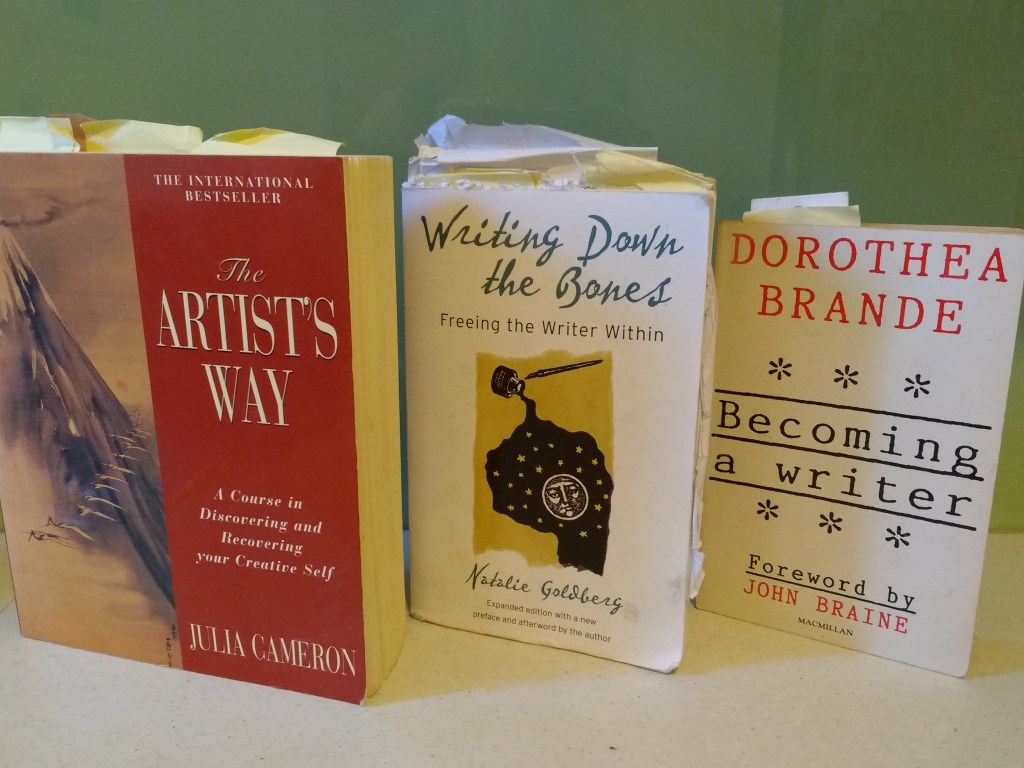
“If those two voices in you want to fight, let them fight.  Meanwhile, the sane part of you should quietly get up, go over to your notebook, and begin to write from a deeper, more peaceful place.  Unfortunately, those two fighters often come with you to your notebook since they are inside your head.  So you might have to give them five or ten minutes of voice in your notebook.  Let them carry on in writing.  It is amazing that when you give those voices writing space, their complaining quickly gets boring and you get sick of them,” Natalie Goldberg, Writing Down the Bones.

It’s just resistance.

Sometimes, the harder you try, the more you become stuck in your own negativity.  It can feel like car tyres spinning in a bog and you just can’t move forward with ‘the work’.  Your resistance is actually greater than your desire to write.  That’s when you need to say ‘stop’ and put it aside for now.  Look for another outlet for your energy before starting again.  Take a break and read books by wonderful writers.  When I get stuck I turn to contemporary poetry for inspiration – thoughtful and passionate poems about living in the modern world.  Some of my favourite poets are:  Mary Oliver, Naomi Shihab Nye, Les Murray and Joanne Burns.

Sometimes I start another writing project before going back to the original one to get more perspective on things.  Other times I will study the beginning and endings of books to get inspiration for a new beginning or a new ending, or sometimes work backwards from the ending as a way to restart.

But don’t get caught in the endless cycle of guilt, avoidance, and pressure.  When it is your time to write, write.  Put yourself out of your misery and just do it.

Writing Tip: The Creative Process

At a literary event I heard someone say, “The thing to do is put the idea in your subconscious.  Your brain will do the work.”

It takes time for our experience to make its way through our consciousness.  For example, it is hard to write about a journey while you are still in the midst of the adventure.  We have no distance from what is happening to us.  The only things we seem to be able to say are “having a great time”, “the weather is good”, “wish you were here”.  It is also hard to write about a place we just moved to, we haven’t absorbed it yet.  We don’t really know where we are, even if we can walk to the train station without losing our way.  We haven’t experienced three scorching summers in this country or seen the dolphins migrating south along the  coast in the winter.

“Maybe away from Paris I could write about Paris as in Paris I could write about Michigan.  I did not know it was too early for that because I did not know Paris well enough.” – Ernest Hemingway, A Moveable Feast  (New York:  Charles Scribner’s Sons, 1964).

So we take in experience, but we need to let things make their way through our consciousness for a while and be absorbed by our whole selves.  We are bower birds, collecting experience, and from the thrown away apple skins, outer lettuce layers, tea leaves, and chicken bones of our minds come our ideas for stories and poems and songs.  But this does not come any time soon.  It takes a very long time (three to ten years in the case of literary fiction).  We need to keep picking through those scraps until some of the thoughts together form a pattern or can be organised around a central theme, something  we can shape into a narrative.  We mine our hidden thoughts for ideas.  But the ideas need time to percolate:  to slowly filter through.

Our work is to keep rummaging through the rubbish bins of our minds, exercising the writing muscle, in readiness to answer that knock at the door when it comes.

Rumi, the thirteenth-century Sufi poet, summed up what could be the creative process when he wrote “The Guest House”:

This being human is a guest house.

Each morning a new arrival.

A joy, a depression, a meanness,

some momentary awareness comes

as an unexpected visitor.

Welcome and entertain them all!

Even if they are a crowd of sorrows,

who violently sweep your house

empty of its furniture,

still, treat each guest honorably.

He may be clearing you out

for some new delight.

The dark thought, the shame, the malice,

meet them at the door laughing and invite

them in.

Be grateful for whoever comes,

because each has been sent

as a guide from beyond.

Jalaluddin Rumi, in The Essential Rumi
Translated by Coleman Barks, 1999

As the author Vivian Gornick said, “The writers life is the pits.  You live alone and you work alone, every day I have to recreate myself.”  She paused and laughed.  “But when the work is going well there is nothing that compares.”

What about you? Are you ready to answer the knock at the door?  

Writing Tip: Use the Inner Critic


It is essential to separate the creator and the editor, or inner critic when you practice writing, so that the creator has plenty of room to breathe, experiment, and tell it like it really is.  If the inner critic is being too much of a problem and you can’t distinguish it from your authentic writing voice, sit down whenever you find it necessary to have some distance from it and put down on paper what the critic is saying, put a spotlight on the words—“You have nothing original to say, what made you think you could write anything anyone would want to read, your writing is crap, you’re a loser, I’m humiliated, you write a load of rubbish, your work is pathetic, and your grammar stinks …”  On and on it goes!

Say to yourself, It’s OK to feel this.  It’s OK to be open to this.

You can learn to cultivate compassion for yourself  during this internal process by practicing Mindfulness Meditation.  Sit up straight, close your eyes, bring your awareness to your inner experience.  Now,  redirect your attention to the physical sensations of the breath in the abdomen … expanding as the breath comes in … and falling back as the breath goes out.  Use each breath to anchor yourself in the present.   Continue, concentrating on the breath for several minutes.  Now, expand your field of awareness to include the words of the inner critic.  Turn your attention to where in your body you feel the unpleasant thoughts, so you can attend, moment by moment, to the physical reactions to your thoughts.

 “Stay with the bodily sensations, accepting them, letting them be, exploring them without judgment as best you can.”—Mindfulness, Mark Williams and Danny Penman.

Every time you realise that you’re judging yourself, that realisation in itself is an indicator that you’re becoming more aware.

The thing is, the more clearly you know yourself, the more you can accept the critic in you and use it.  If the voice says, “You have nothing interesting to say,” hear the words as white noise, like the churning of a washing machine.  It will change to another cycle and eventually end, just like your thoughts that come and go like trains at the station.  But, in the meantime, you return to your notebook and practice your writing.  You put the fear and the resistance down on the page.


Do you struggle with an inner critic?  Any words of wisdom you’d like to share?

Writing Tip: Flash Fiction

Have you tried flash fiction yet? What does flash fiction mean?

‘A flash fiction piece is a self-contained story (beginning/middle/end), 1,000 words or less, that can entertain, intrigue, and satisfy a reader during an F5 tornado. That’s it. No genre restrictions, age requirements, or prior experience needed. Just quick, clean stories.’ – Writer’s Digest

‘Part poetry, part narrative, flash fiction–also known as sudden fictionmicro fiction, short short stories, and quick fiction—is a genre that is deceptively complex.’ – The Review Review

‘Flash fiction is a fictional work of extreme brevity that still offers character and plot development. Identified varieties, many of them defined by word count, include the six-word story, the 280-character story, the “dribble”, the “drabble”, “sudden fiction”, flash fiction, nanotale, and “micro-story”.’ – Wikipedia

I like writing in a short form. I’ve been told I have the sensibility of a poet because I have the ability to distill, so the short form suits me. You may be more of a long distance runner, rather than a sprinter, and prefer the long form of a novel.

Have a read of my flash fiction titled It’s Pot Luck When You Move Into A Unit, winner of the short short fiction UTS Alumni Competition a few years ago. Hope you enjoy it.

It’s Pot Luck When You Move Into a Unit

A nice quiet weekend? the woman downstairs said.  What do you mean? I said, through the open back door, a bag of rubbish in each hand.  She smoothed her ironing on the board and said, They weren’t around over the weekend—with the baby.  She looked happy.  I’m lucky living on the top floor, I said.  She nodded towards the other side of the building.  Jim isn’t so luckyhe’s got the woman upstairs, she said, When he plays the piano and she thumps on the floor.   She put the iron back on its stand.  She’s heavy-footed, that woman.  Bang, bang, bang.   I hear her coming down the stairs every morning at six, and the slam of the front door. 

That night the wind knocked my vase off the window ledge.  I lay awake wondering if the noise of the smash had woken up the people underneath—the ones whose barbecuing sends smoke and disgusting meat smells into my unit.  Nothing clings to your furniture like the stink from last week’s burnt fat.   Sorry about the crash, I muttered to the floor, It was the wind.

Copyright 2018 Libby Sommer

Why not try your hand at writing in this short form and enter a flash fiction competition. Good luck.

My Micro Fiction: When the New Boyfriend Nearly Died

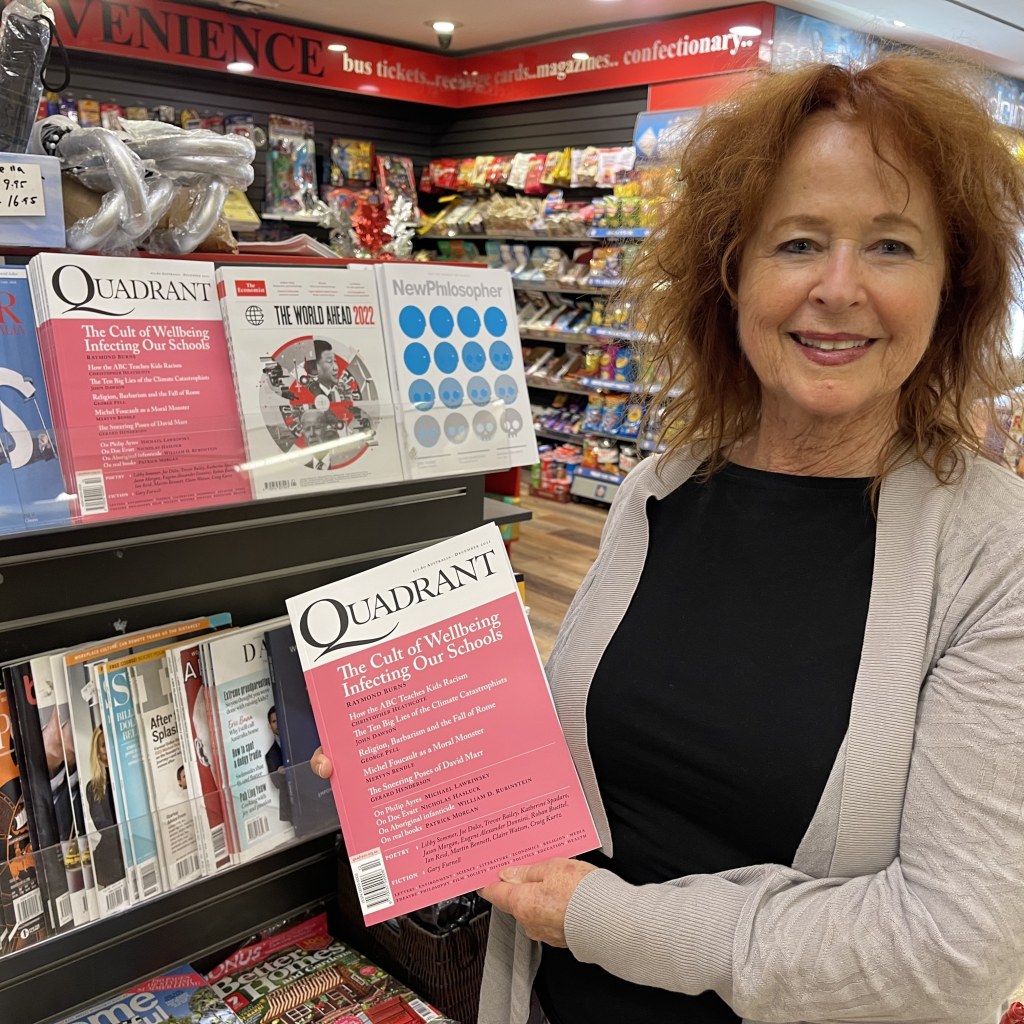
My micro fiction ‘When the New Boyfriend Nearly Died’ was first published in Quadrant magazine in December 2021.

Have a read. Hope you enjoy it.

When the New Boyfriend Nearly Died:

In the hospital’s public toilet, your face pleads back at you, white and worried. Far as you know, your new boyfriend had a heart attack while bouncing between your child-bearing hips. Too much of a strain. It’s not your fault. When he was admitted to Emergency you didn’t know if you’d ever see him again.

After five hours of waiting, you ask the receptionist if you can go in. When she asks you, you can’t pronounce his Polish surname. You spell out the letters. She considers you through the gap in the partition. You tell her you’re his new girlfriend. So you’re the one, she must be thinking before pressing the red button that lets you in.

He is lying in bed, a canula in his arm. His eyes are closed. You sit in a chair beside him and hold his hand. This would never have happened if it weren’t for you. Nurses and doctors hurry past clutching clipboards.

Don’t die on me, you plead.

If he dies, what you will miss are his text messages of love, the thwack of his body, and the pots of Japanese tea you shared. In bed you’d sip from tiny ceramic mugs.

You make a mental list of your strengths and weaknesses: you’re good at hedonistic pleasures, bad at Cryptics, bad at lonely Sundays, good at making new friends, bad at staying in touch, good at making loose-leaf tea after sex with an addict, good at falling for men who can’t stop swallowing uppers and downers. Good at loving your new boyfriend who took too many pills and now you’re worried he’ll die.

Are you dreaming, or did he just squeeze your hand?

Copyright 2021 Libby Sommer

Spirituality & Creativity

What is the relationship between spirituality and creativity? The discipline and focused attention cultivated through meditation help us do one thing at a time, totally and absolutely, which greatly enhances our writing.

Contemplative practice, daily nature walks, and still, silent listening can be among the best natural meditations. They help clarify our minds and uplift the heart, dissolving our ordinary preoccupations and mental states that dissipate the fertile spirit within. Such daily disciplines are also excellent tonics for our agitated, febrile brains and weary bodies. When we ease into the realm of non-doing–what Chinese Buddhists called wu wei–there is more room for our mysterious, unfabricated inner self to naturally emerge.’ – Lama Surya Das

It’s tough being a writer. Very tough. As Thomas Mann says, A writer is someone for whom writing is more difficult than it is for other people.

Dinty Moore, in his book The Mindful Writer, Noble Truths of the Writing Life, says his lifelong pursuit of writing and creativity has helped to open him to the path of Buddhism:

‘Find inspiration and insight on writing as a spiritual practice through astute quotes, thoughtful advice, and productive exercises on both mindfulness and craft.  This isn’t your typical “how to write” book. Author Dinty W. Moore, a well-respected writing coach and teacher, thoughtfully illuminates the creative process: where writing and creativity originate, how mindfulness plays into work, how to cultivate good writing habits and grow as a person, and what it means to live a life dedicated to writing.’ – The Mindful Writer

Here’s to Mindfulness and Meditation to help us on our way through our roller coaster lives as creative writers.

Writing Tip: Pen and Paper

When I used to teach classes to beginning writers, it was good.  It forced me to think back to the beginning to when I first put pen to paper.  The thing is, every time we sit down and face the blank page, it’s the same.  Every time we start a new piece of writing, we doubt that we can do it again.  A new voyage with no map.  As people say, it is like setting off towards the horizon, alone in a boat, and the only thing another person can do to help us, is to wave from the shore.

So when I used to teach a creative writing class, I had to tell them the story all over again and remember that this is the first time my students are hearing it.  I had to start at the very beginning.

First up, there’s the pen on the page.  You need this intimate relationship between the pen and the paper to get the flow of words happening.  A fountain pen is best because the ink flows quickly.  We think faster than we can write.  It needs to be a “fat” pen to avoid RSI.

Consider, too, your notebook.  It is important.  The pen and paper are your basic tools, your equipment, and they need to be with you at all times.  Choose a notebook that allows you plenty of space to write big and loose.  A plain cheap thick spiral notepad is good.

After that comes the typing up on the computer and printing out a hard copy.  It’s a right and left brain thing.  You engage the right side of the brain, the creative side, when you put pen to paper, then bring in the left side, the analytic side, when you look at the print out.  You can settle back comfortably with a drink (a cup of tea even) and read what you’ve written.  Then edit and rewrite.

Patrick White said that writing is really like shitting; and then, reading the letters of Pushkin a little later, he found Pushkin said exactly the same thing.  Writing is something you have to get out of you.

I hope this Writing Tip is helpful. Do you have any tips you would add? Let me know in the comments and please share this post with a friend if you enjoyed it.

Writing Tip: Start Writing

typing writing on a pink background

When I used to teach classes to beginning writers, it was good.  It forced me to think back to the beginning to when I first put pen to paper.  The thing is, every time we sit down and face the blank page, it’s the same.  Every time we start a new piece of writing, we doubt that we can do it again.  A new journey with no map – like setting off towards the horizon alone in a boat and the only thing another person can do to help is to wave from the shore.

So when I used to teach a creative writing class, I had to tell them the story all over again and remember that this is the first time my students are hearing it.  I had to start at the very beginning.

First up, there’s the pen on the page.  You need this intimate relationship between the pen and the paper to get the flow of words happening.  A fountain pen is best because the ink flows quickly.  We think faster than we can write.  It needs to be a “fat” pen to avoid RSI.

Consider, too, your notebook.  It is important.  The pen and paper are your basic tools, your equipment, and they need to be with you at all times.  Choose a notebook that allows you plenty of space to write big and loose.  A plain cheap thick spiral notepad is good.

After that comes the typing up on the computer and printing out a hard copy.  It’s a right and left brain thing.  You engage the right side of the brain, the creative side when you put pen to paper, then bring in the left side, the analytic side, when you edit the print out as you settle back comfortably with a drink (a cup of tea, even) and read what you’ve written.

Patrick White said that writing is really like shitting; and then, reading the letters of Pushkin a little later, he found Pushkin said exactly the same thing.  Writing is something you have to get out of you.

Whether writing a story or writing a blog, start writing, no matter what.

Writing Tip: The Bigger the Issue, the Smaller You Write

A quote: the bigger the issue, the smaller you write - Richard Price

A fantastic example of this writing advice is Kurt Vonnegut’s  Slaughterhouse-Five.

Poignant and hilarious, threaded with compassion and, behind everything, the cataract of a thundering moral statement. – The Boston Globe

book cover of Kurt Vonnegut's 'Slaughterhouse-Five'

Kurt Vonnegut’s absurdist classic Slaughterhouse-Five introduces us to Billy Pilgrim, a man who becomes unstuck in time after he is abducted by aliens from the planet Tralfamadore. In a plot-scrambling display of virtuosity, we follow Pilgrim simultaneously through all phases of his life, concentrating on his (and Vonnegut’s) shattering experience as an American prisoner of war who witnesses the firebombing of Dresden.

Don’t let the ease of reading fool you – Vonnegut’s isn’t a conventional, or simple, novel. He writes, “There are almost no characters in this story, and almost no dramatic confrontations, because most of the people in it are so sick, and so much the listless playthings of enormous forces. One of the main effects of war, after all, is that people are discouraged from being characters.”

Slaughterhouse-Five is not only Vonnegut’s most powerful book, it is also as important as any written since 1945. Like Catch- 22, it fashions the author’s experiences in the Second World War into an eloquent and deeply funny plea against butchery in the service of authority. Slaughterhouse-Five boasts the same imagination, humanity, and gleeful appreciation of the absurd found in Vonnegut’s other works, but the book’s basis in rock-hard, tragic fact gives it a unique poignancy – and humor. – Goodreads

Highly recommended. A masterpiece.