Path to Publication

Libby Sommer holding a copy of The Crystal Ballroom in book store

Interviewer: I would like you to tell me about your Path to Publication from first idea to finished book. I’d like to know your inspirations and how The Crystal Ballroom became more than an idea. I also want to know about your writing process. Do you sit at a desk 9-5 or at a cafe during snatched lunches? Did you write the book in a spurt of three months … how long did it take from start to finish? Did you have cold readers, send it to an agent or to a publisher? Were you accepted straight away? How many rewrites and drafts?

Me:  I usually write stories about places and people that I know well. I take real events and characters but change things around and shake them all about and make things up. So, for The Crystal Ballroom, I had been dancing Argentine tango, rock and roll, jive, swing, Latin American and ballroom dancing for many many years. I used to dance five nights a week. I’d drive all over Sydney for technique classes and to dance at different venues. The place, ‘The Crystal Ballroom’, is a fiction but this dance hall becomes a character in the novel. I was inspired by the people I met at the dances and the politics of the ‘dance scene’.

I don’t sit at a desk 9-5 but I am extremely disciplined with my writing. I write 7 days a week. I treat my manuscript like an old friend, someone I need to stay in touch with regularly. I also exercise 7 days a week. So my routine is to go to a cafe before the gym with a print out of the previous day’s work. I edit from this hard copy and write the next scene. After the gym I walk home, type out the revisions, print out, go to another cafe in the afternoon. Repeat the process. I only work in the AM on a Sunday 🙂

It took me 4 years to write The Crystal Ballroom. The chapters are self-contained, so I was able to send some of the discreet episodes out to Quadrant magazine for publication.

I belong to a weekly feedback writing group where we critique each others’ work. So I write to that weekly deadline. In the early years, when I’d finish a manuscript I’d pay an editor or mentor to read it and give me feedback. I’d also ask a couple of friends to read it and give feedback. I never send a manuscript to an agent or a publisher that hasn’t been reworked 20 to 100 times – that includes the rewriting along the way.

My Year With Sammy was my first published book. It was accepted straight away by Ginninderra Press, a small but prestigious publisher (thought-provoking books for inquiring readers). It was my fifth book length manuscript. I had sent the previous books to agents and large publishers. All my confidence had been knocked out of me by all the rejections leading up to the fifth manuscript. Now though, I have Ginninderra Press who seem to like my work. They also published The Crystal Ballroom this year. The Usual Story will be published by Ginninderra Press next year.

It’s an extremely difficult road to publication and some people decide to self-publish rather than continue to be rejected. But other people are able to write a best-seller, an airport book that sells lots of copies, so big publishers like their work very much. Unfortunately, or fortunately, my books are classified as literary fiction, so a very small market. Big publishers are not interested in books that do not conform to the norm. Not enough money in it for them.

I am very grateful to have my small but prestigious publisher.
Writing from Within

Trees and shrubs leading to glass door of Brahma Kumaris Centre
Brahma Kumaris Centre for Spiritual Learning

I’m running a writing workshop this Saturday at the Brahma Kumaris Centre for Spiritual Learning in Wilton, New South Wales. It is part of the Society of Women Writers Retreat weekend. I’ve titled my course ‘Writing from Within’ because the aim is to tap into the right side of the brain, leaving aside that nasty critical left side, and really getting to the heart of what you want to write. I’ve run workshops like this before. Usually I use a combination of meditation techniques, and a guided colour exercise for relaxation and then spontaneous writing, or timed writing. It’s truly amazing what people write when they are able to get into the zone and not be held back by negative thinking.

These are the rules of timed writing according to Natalie Goldberg in ‘Writing Down the Bones’:

  1. Keep your hand moving. (Don’t pause to reread the line you have just written. That’s stalling and trying to get control of what you’re saying.)

  2. Don’t cross out. (That is editing as you write. Even if you write something you didn’t mean to write, leave it.)

  3. Don’t worry about spelling, punctuation, grammar. (Don’t even care about staying within the margins and lines on the page.)

  4. Lose control.

  5. Don’t think. Don’t get logical.

  6. Go for the jugular. (If something comes up in your writing that is scary or naked, dive right into it. It probably has lots of energy.)

Should be a excellent weekend featuring publisher Catherine Milne and presentations from authors Emily Maguire, Susanne Gervay, Kathryn Heyman, Libby Hathorn, Beverley George.

book cover of Writing Down the Bones by Natalie Goldberg

I Wrote 5 Books Before Publication

fountain pen on page of writing

I wrote five book length manuscripts before one was finally accepted for publication by Ginninderra Press, a small but prestigious publisher. Rejection didn’t stop me from writing.

‘You write, you re-write, you edit, you tweak and when it’s perfect, you submit. And then you get rejected. Many times, maybe by a person who didn’t even read it. Rejection is painful because it instantly devalues your creation. Someone says this isn’t worth publishing. Rejectees, take heart. Many now-famous writers have been rejected before they made it big. Stephen King wrote his first novel, “Carrie,” and it was rejected 30 times. Rejections were so devastating that he threw the manuscript in the trash. “Chicken Soup for the Soul” was rejected 140 times. Margaret Mitchell’s “Gone With The Wind” was rejected by 38 publishers (and she did give a damn). James Joyce’s “Dubliner” was rejected 18 times and took nine years before it reached publication.’ – Ronald H. Balson

There are days when you feel like giving up and is seems that you are not making any progress. It’s during days like these, that sheer determination and persistence is all that’s left.

“Nothing in this world can take the place of persistence. Talent will not; nothing is more common than unsuccessful people with talent. Genius will not; unrewarded genius is almost a proverb. Education will not; the world is full of educated derelicts. Persistence and determination alone are omnipotent. The slogan “press on” has solved and always will solve the problems of the human race.” – Calvin Coolidge

Some writers continually submit the same manuscript until it is accepted. Others chose to do a more polished draft before sending it out again. A few learn from the lessons of submissions, to write a completely new book. What we all have in common is a persistence to never give up on our dream. Some decide to self-publish.

I’m very happy to say that persistence has paid off for me, and a third manuscript has now been accepted for publication by Ginninderra Press . ‘The Usual Story’ will be available in bookstores and online in July 2018.

As the saying goes: a writer writes. Writers continue to write.

A dear friend, who is also a former mentor, wrote this to me recently:  Libby, I’m not sure how you found your way to Ginninderra, but what a blessing for you and for readers! I was thinking the other day of your commitment for so many years when the door to publishing a book just wouldn’t open, and how much I admire your resolve and, of course, your amazing talent! Wonderful that the books are in the world now.

I hope this reminder about persistence is helpful. Do you have any tips you would add? Let me know in the comments and please share this post with a friend if you enjoyed it.


Jump Cuts: Novel-in-progress

notepad, fountain pen, coffee on table

Below is the first page of my new novel-in-progress. I jump cut from scene to scene. Hopefully this technique is not too confusing. Have you read other novels that use this structure? At the front of the book I’ll be adding a Character List and a Character Map to show how the major characters are connected, to help with the confusion issue. The working title is ‘Missing in Cooper Park’.

1.

The tennis courts at Cooper Park were flooded in the night.  One and a half hours of non-stop rain and hail caused a landslide down through the gully.  Gypsy, a Golden Labrador came along and splashed in fast-flowing Cooper Creek.  Later, the sight of the ruined courts covered in mud and stones, leaves and tree branches like a murky swamp was to shatter Steve’s morning.

2.

Kingston (Carol’s ex) turned up again on the morning after the storm.  He stood on the doorstep looking unbalanced.  His cigarette was burned down to the filter.  His unshaven face was flecked with grey and white.  Carol wouldn’t let him in.  She’d taken his key back.

Carol didn’t tell Steve about Kingston being back but Steve told Carol about the flooded tennis courts.

3.

The moon was high in the darkening dusk as Rosemary puffed past the tennis courts at Cooper Park and continued on up through the steep incline of the gulley swinging a curved stick with tennis ball.

‘Gypsy,’ cried Rosemary.  ‘Gypsy, Gypsy, Gypsy!  Come here.’

Rosemary had purchased Gypsy after overcoming her husband’s resistance.  They were still in mourning over having to put Buddy down.

She’d promised Philip she’d make sure Gypsy didn’t jump up on the newly-cleaned couches.

He knew Rosemary slipped into depression if she didn’t have a dog to love, even though she was the mother of three children.

They’d bought a puppy who looked just like a baby Buddy.  Rosemary would have liked to say it was Buddy re-incarnated but didn’t.  This was precisely the kind of talk that made her husband go red with anger.

It was he who had named the Golden Labrador Gypsy.         The day would soon be night.

4.

Steve lay in bed waiting for Carol’s alarm to go off.  Outside someone had slept all night in a car.

‘Don’t let anyone in,’ demanded Carol in a dream.

Jump Cuts on the Page


close up head & shoulders golden Labrador with pink tongue hanging out

by Libby Sommer:

After a big storm, a golden Labrador goes missing in Sydney’s Cooper Park. This is the scene that begins my new novel-in-progress. I use the search for the dog as a linking device for my characters who are all at a turning point in their lives. I jump cut between discreet scenes (not a continuous narrative) which, unfortunately, is very confusing to the readers in my weekly feedback group.

Transitions are important in fiction because you can’t possibly show or account for every moment in a character’s day, week, or life. A story may stretch over years—readers don’t need to know what happened every minute of those years. A scene transition takes characters and readers to a new location, a new time, or a new point of view.

Scene transitions in movies are easy. The screen fades to black at just the right moment, and when it lights up again, you’re watching a new scene. But how do you write transitions on the page? How does your character get from Point A to Point B without too much boring detail and telling description?

One way to write scene transitions in novels is to Jump Cut. The term usually refers to Cinema.

‘When Jean-Luc Godard popularized the jump cut in 1959 when he made his breakthrough movie Breathless, it has since become a useful and intriguing editing tool. For those of you who don’t know what a jump cut is: (per Wikipedia): “A jump cut is a cut in film editing in which two sequential shots of the same subject are taken from camera positions that vary only slightly. This type of edit causes the subject of the shots to appear to “jump” position in a discontinuous way.”’ – posted by Tyler on Southern Vision

‘The quick-paced German thriller throbs with jump cuts, zoom shots and the speedy sense of an instinctual filmmaker.’ – Charles Taylor, reviewing Run Lola Run

If you want to keep the narrative moving at a fast pace, you can jump cut on the page from scene to scene. But each scene needs to have a beginning a middle and an end.

This technique can be confusing at times, but effective and very readable.

One way to make Jump Cuts on the Page less confusing is to have a strong sense of place. The place is the setting of the story, where the action is located. Setting can be the connective tissue. For me it’s Cooper Park with its cafe, tennis courts, children’s playground, etc.  So, the missing dog, the park and the cafe lessen the confusion, make the transitions smoother – hopefully.

golden Labrador and black and white cat on black leather couch

What about you? Do you find writing scene transitions to be one of the most challenging aspects of writing a novel?

I Am Not the Stories I Tell

two book covers: 'My Year With Sammy' and 'The Crystal Ballroom'

by Libby Sommer:

Sometimes when people read my stories they assume those stories are me.  They are not me, even if I write in the first person.  They were my thoughts and feelings at the time I wrote them.  But every minute we are all changing.  There is a great freedom in this.  At any time we can let go of our old selves and start again.  This is the writing process.  Instead of blocking us, it gives us permission to move on.  Just like in a progressive ballroom dance:  you give your undivided attention to your partner—keep eye contact for the time you are dancing together—but then you move on to the next person in the circle.

The ability to express yourself on the page—to write how you feel about an old lover, a favourite pair of dance shoes, or the memory of a dance on a chilly winter’s night in the Southern Highlands—that moment you can support how you feel inside with what you say on the page.  You experience a great freedom because you are not suppressing those feelings.  You have accepted them, aligned yourself with them.

I have a poem titled ‘This is what it feels like’. It’s a short poem.  I always think of it with gratitude  because I was able to write in a powerful way how it was to be desperate and frightened.  The act of self expression made me feel less of a victim.  But when people read it they often say nothing. I remind myself, I am not the poem, I am not the stories I write.  People react from where they are in their own lives.  That’s the way things are.  The strength is in the act of writing, of putting pen to paper.   Write your stories and poems, show them to the world, then move on.  The stories are not you.  They are moments in time that pass through you.

What is your experience? 

A Fabulous Celebration

Libby Sommer reading from her book while Stephen Matthews listensNicholas Building, Melbourne

A big thank you to my publisher Stephen Matthews, Ginninderra Press for a wonderful afternoon of celebration last Saturday at Collected Works Bookshop in the historic Nicholas Building, Melbourne.

Ginninderra Press celebrated 21 years of independent publishing and Stephen Matthews launched my second book, ‘The Crystal Ballroom’. That’s him looking on as I read the first couple of pages of the story. The room was jam-packed full of people. Hopefully, the audience were enthralled and wanted to read the rest of my book.

Other Ginninderra Press writers from all over Australia attended the event and many read a poem or a story including my new friend, the award-winning Melissa Bruce.

We all enjoyed ourselves drinking wine and eating cheese and other tasty bits and telling each other about our work.

There was a long queue at the cash register at the end of the day 🙂


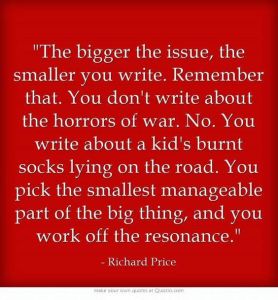
The bigger the issue, the smaller you write.

A quote: the bigger the issue, the smaller you write - Richard Price

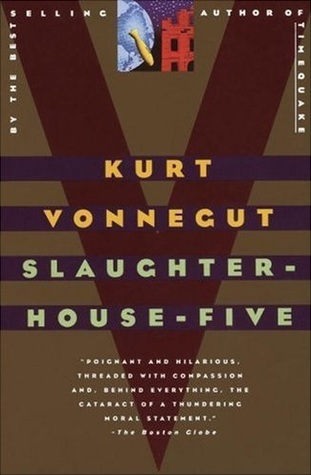
A fantastic example of this writing advice is Kurt Vonnegut’s  Slaughterhouse-Five.

Poignant and hilarious, threaded with compassion and, behind everything, the cataract of a thundering moral statement. – The Boston Globe

book cover of Kurt Vonnegut's 'Slaughterhouse-Five'

Kurt Vonnegut’s absurdist classic Slaughterhouse-Five introduces us to Billy Pilgrim, a man who becomes unstuck in time after he is abducted by aliens from the planet Tralfamadore. In a plot-scrambling display of virtuosity, we follow Pilgrim simultaneously through all phases of his life, concentrating on his (and Vonnegut’s) shattering experience as an American prisoner of war who witnesses the firebombing of Dresden.

Don’t let the ease of reading fool you – Vonnegut’s isn’t a conventional, or simple, novel. He writes, “There are almost no characters in this story, and almost no dramatic confrontations, because most of the people in it are so sick, and so much the listless playthings of enormous forces. One of the main effects of war, after all, is that people are discouraged from being characters.”

Slaughterhouse-Five is not only Vonnegut’s most powerful book, it is also as important as any written since 1945. Like Catch- 22, it fashions the author’s experiences in the Second World War into an eloquent and deeply funny plea against butchery in the service of authority. Slaughterhouse-Five boasts the same imagination, humanity, and gleeful appreciation of the absurd found in Vonnegut’s other works, but the book’s basis in rock-hard, tragic fact gives it a unique poignancy – and humor. – Goodreads

Highly recommended. A masterpiece.


The Writing Life

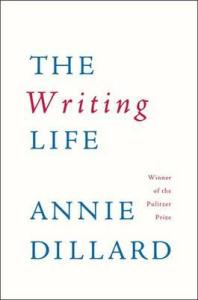
Book cover 'The Writing Life' by Annie Dillard

Another of my favourite books on the writing process is The Writing Life by Annie Dillard, a small and passionate guide to the terrain of a writer’s world.

Annie Dillard has written eleven books, including the memoir of her parents, An American Childhood; the Northwest pioneer epic The Living; and the nonfiction narrative Pilgrim at Tinker Creek winner of the 1975 Pullizer Prize.  A gregarious recluse, she is a member of the American Academy of Arts and Letters.

Continue reading

Becoming A Writer

yellow sunflower bookcover of Becoming A Writer by Dorothea Brande

I highly recommend this book a friend from London gave me many years ago at the beginning of my writing journey.

‘A reissue of a classic work published in 1934 on writing and the creative process, Becoming a Writer recaptures the excitement of Dorothea Brande’s creative writing classroom of the 1920s. Decades before brain research “discovered” the role of the right and left brain in all human endeavor, Dorothea Brande was teaching students how to see again, how to hold their minds still, how to call forth the inner writer.’ – Amazon

‘Refreshingly slim, beautifully written and deliciously elegant, Dorothea Brande’s Becoming a Writer remains evergreen decades after it was first written. Brande believed passionately that although people have varying amounts of talent, anyone can write. It’s just a question of finding the “writer’s magic”–a degree of which is in us all. She also insists that writing can be both taught and learned. So she is enraged by the pessimistic authors of so many writing books who rejoice in trying to put off the aspiring writer by constantly stressing how difficult it all is.

With close reference to the great writers of her day–Wolfe, Forster, Wharton and so on–Brande gives practical but inspirational advice about finding the right time of day to write and being very self disciplined about it–“You have decided to write at four o’clock, and at four o’clock you must write.” She’s strong on confidence building and there’s a lot about cheating your unconscious which will constantly try to stop you writing by coming up with excuses. Then there are exercises to help you get into the right frame of mind and to build up writing stamina. She also shows how to harness the unconscious, how to fall into the “artistic coma,” then how to re-emerge and be your own critic.

This is Dorothea Brande’s legacy to all those who have ever wanted to express their ideas in written form. A sound, practical, inspirational and charming approach to writing, it fulfills on finding “the writer’s magic.”‘ – John Gardner