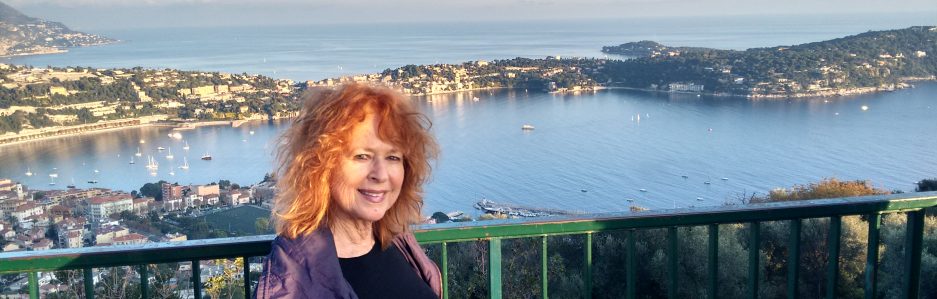
3 Parts to a Great Blurb

pexels-photo-325924.jpeg

Your book’s blurb is crucially important. But writing a blurb is harder than we think. A great blurb is short and sweet, gives away enough of what’s inside the book without giving any plot spoilers. It draws the reader in.

‘A three-act structure. You want to catch the reader’s attention, give them the content, and then give them a reason to care.’ – Author Unlimited

Have a look at this YouTube video by international best-selling self-published Romance writer Alessandra Torre. She tells a terrific story of how she went from 3 book sales a day to thousands by changing her blurb:  The Blurb Equation – How to Write a Kick-Butt Blurb.


The Blurb Equation (Alessandra Torre)

INTRO + HINT + CLIFFY


1. PART 1 INTRO:           the characters or situation is introduced.

2. PART 2 THE HINT:     what the story is about, the conflict or climax.

3. PART 3 THE CLIFFY:  what’s going to happen? Hooks the reader.

Alessandra says to keep the blurb short. More than four paragraphs is too long . Three paragraphs of two to three sentences is best. Don’t give away the plot.

Keeping all this excellent advice in mind (although I’m not a Romance writer), I’m continuing to sweat over the draft blurb for my new book THE USUAL STORY, due for  July release by Ginninderra Press. Please use the comments section to give any constructive feedback. I’d love to know what you think.

It’s especially difficult for me to write a satisfactory blurb for THE USUAL STORY because it is really a collection of connected short stories. I’ve linked the stories by using the tango dances and dancers, the painful ending of a brief romance, and the main character’s search in her past for answers.

Tango is the dance of passion, forcing partners into an intimate relationship. Sofia loves the tango, but at the dances she must face the truth of her ageing in our society that has very little use for anyone who is not young.

In the painful aftermath of a brief affair, Sofia goes in search of what she actually knows about herself and the past. As she looks for answers in dark corners, we begin to see, as does Sofia, the elusiveness of understanding and memory – the psychological space where recollection and loss collide.

If you liked The Crystal Ballroom you’ll love this book: a story of memory, intrigue and passion.


I hope this Blurb info is helpful. Do you have any tips you would add? Let me know in the comments and please share this post with a friend if you enjoyed it.




10 Ideas for Writing Practice

pexels-photo-237447.jpeg

Sometimes we sit at our desks to write and can’t think of anything to write about.  We face the blank page.  We sit there until blood pours from our foreheads, as one famous author was heard to say.

Making a list can be good.  It makes you start noticing material for writing in your daily life, and your writing comes out of a relationship with your life in all its richness.

10 topics for writing practice:

  • Begin with “I don’t remember”. If you get stumped, just repeat the words “I don’t remember” on the page again and keep going.
  • Tell about sound as it arises. Be aware of sounds from all directions as they arise:  sounds near, sounds far, sounds in front, behind, to the side, above or below.  Notice any spaces between sounds.
  • Tell me about last evening. Dinner, sitting on the couch, preparing for bed.  Be as detailed as you can.  Take your time to locate the specifics and relive your evening on the page.
  • Tell me what boredom feels like.
  • See in your mind a place you’ve always loved. Visualise the colours, the sounds, the smells, the tastes.
  • Write about “saying goodbye”. Tackle it any way you like.  Write about your marriage breakup, leaving home, the death of a loved one.
  • What was your first job?
  • Write about the most scared you’ve ever been.
  • Write in cafes. Write what is going on around you.
  • Describe a parent or a child.

Some people have a jar full of words written on pieces of paper and select one piece of paper at random each day and write from that.  Others use a line of a poem to start them off.  Then every time they get stuck they rewrite that line and keep going.

Be honest.  Cut through the crap and get to the real heart of things.

Zen Buddhist, psychotherapist, writer and teacher, Gail Sher in her book One Continuous Mistake says the solution for her came via haiku (short unrhymed Japanese poems capturing the essence of a moment).

 “For several years I wrote one haiku a day and then spent hours polishing those I had written on previous days.  This tiny step proved increasingly satisfying,” Gail Sher.

She said it gradually dawned on her that it was not the haiku but the “one per day.”  Without even knowing it, she had developed a “practice.”  Every day, no matter what, she wrote one haiku.  In her mind she became the person who writes “a haiku a day.”  And that was the beginning of knowing who she was.

Gail Sher suggests writing on the same subject every day for two weeks.

“Revisiting the same subject day after day will force you to exhaust stale, inauthentic, spurious thought patterns and dare you to enter places of subtler, more ‘fringe’ knowing,” Gail Sher.

She writes in One Continuous Mistake that the Four Noble Truths for writers are:

  1. Writers write.
  2. Writing is a process.
  3. You don’t know what your writing will be until the end of the process.
  4. If writing is your practice, the only way to fail is to not write.

So start coming up with your own list of ideas for practice writing.  Life happening around us is good grist-for-the-mill.

I hope these ideas are useful. Do you have any suggestions you would add? Let me know in the comments and please share this post with a friend if you enjoyed it.

Submit your work

sunrise over the ocean

Arrived home from hospital after joint replacement to the exciting news that my poem, ‘Between the Islands of the Pacific’ has been accepted for publication in Quadrant magazine. Feel honored to have a third poem accepted by this prestigious Australian literary publication. Happy happy me. The hard work pays off.

I do have a box full of rejection letters from over the years. My advice to you is to keep writing, keep reading, keep refining your work, keep submitting. ‘Between the Islands of the Pacific’ was the fifth poem I sent to Quadrant this year. The others were rejected.

P is for persistence and perseverence.

Enter Writing Competitions


the city of Lisbon, Portugal with sea and sky in the background
Lisbon, Portugal

One of the ways we can get noticed as writers is to enter writing competitions. You can join local and international writing groups and associations that send out newsletters letting you know when, what and where to enter.

I can’t remember entering this particular competition, or where I saw the information, but I am thrilled and delighted to tell you that an excerpt of my WIP, Lost in Cooper Park is a runner-up in 2018 Disquiet Literary Contest.  There were over 1,000 entries. I have been awarded a partial scholarship to attend the Disquiet International Literary Program in Lisbon, Portugal. Such exciting news.

The judges said of my entry:

“… an excellent domestic psychological drama, reminiscent of Sally Vickers (The Other Side of You) written in beautiful, striking prose. It has an incredible memorable opening. The author has a voice that is unique to her and that, at the same time, is particular to the narrative. The story moves between places and narratives with deftness, knowing precisely when to leave a thread open and when to pick it up again.”

Whoo hoo.

I recommend staying up to date with competition deadlines. This keeps you motivated to finish a piece of writing by the date specified. Subscribe to writing groups and newsletters that alert you to closing dates. I am a member of the NSW Writers’ Centre, Society of Women Writers’ NSW, Australian Society of Authors, and other writing groups on Facebook.

Wishing you the best of luck.

Woman walking through Cooper Park with her dog.
Cooper Park


Short Story or Novel

pexels-photo.jpg

Is a novel a short story that keeps going, or, is it a string of stories with connective tissue and padding, or, is it something else?  Essayist Greg Hollingshead believes that the primary difference between the short story and the novel is not length but the larger, more conceptual weight of meaning that the longer narrative must carry on its back from page to page, scene to scene.

“It’s not baggy wordage that causes the diffusiveness of the novel.  It’s this long-distance haul of meaning.”  Greg Hollingshead

There is a widespread conviction among fiction writers that sooner or later one moves on from the short story to the novel.  When John Cheever described himself as the world’s oldest living short story writer, everyone knew what he meant.

Greg Hollingshead says that every once in a while, to the salvation of literary fiction, there appears a mature writer of short stories—someone like Chekhov, or Munro—whose handling of the form at its best is so undulled, so poised, so capacious, so intelligent, that the short in short story is once again revealed as the silly adjective it is, for suddenly here are simply stories, spiritual histories, narratives amazingly porous yet concentrated and undiffused.

When you decide you want to write in a particular form—a novel, short story, poem—read a lot of writing in that form.  Notice the rhythm of the form.  How does it begin?  What makes it complete?  When you read a lot in a particular form, it becomes imprinted inside you, so when you sit at your desk to write, you produce that same structure.  In reading novels your whole being absorbs the pace of the sentences, the setting of scenes, knowing the colour of the bedspread and how the writer gets her character to move down the hallway to the front door.

I sit at my desk thinking about form as a low-slung blanket of cloud blocks my view of the sky.  Through the fly screen I inhale the sweet smell of earth after rain as another day of possibility beckons.

The thing is, we might write five novels before we write a good one.  I wrote five book-length manuscripts before one was finally accepted for publication, even though I’d published 30 short stories.  So form is important, we need to learn form, but we should also remember to fill form with life.  All it takes is practice.

I hope this post is useful. Do you have any tips you would add? Let me know in the comments and please share this post with a friend if you enjoyed it.

Writing as a Daily Practice

pexels-photo-851213.jpeg

Writing as a daily practice is a way to exercise the writing muscle. Like working out at the gym, the more you do it, the more results you get. Some days you just don’t feel like working out and you find a million reasons not to go to the gym or out for a jog, a walk, a swim, a bike ride, but you go anyway. You exercise whether you want to or not. You don’t wait around till you feel the urge to work out and have an overwhelming desire to go to the gym. It will never happen, especially if you haven’t been into health and fitness for a long time and you are pretty out of shape. But if you force yourself to exercise regularly, you’re telling your subconscious you are serious about this and it eventually releases its grip on your resistance. You just get on and do it. And in the middle of the work out, you’re actually enjoying it. You’ve felt the endorphines kick in. When you get to the end of the jog, the walk, the bike ride, the swim, the gym workout or the Pilates, Yoga or Zumba class, you don’t want it to end and you’re looking forward to the next time.

That’s how it is with writing too. Once you’ve got the flow happening, you wonder why it took you so long to turn up on the page. Bum on chair is what I say to my writing students. Through daily practice your writing does improve.

In The Artist’s Way, Julia Cameron’s book on discovering and recovering your creative self, she refers to daily writing practice as the morning pages. She recommends writing three pages of longhand, strictly stream-of-consciousness—moving the hand across the page and writing whatever comes to mind every day.

Author of Writing Down the Bones, Natalie Goldberg refers to writing practice as timed exercise. She says you might time yourself for ten minutes, twenty minutes, or longer. It’s up to you, but the aim is to capture first thoughts. “First thoughts have tremendous energy. It is the way the mind first flashes on something. The internal censor usually squelches them, so we live in the realm of second and third thoughts, thoughts on thought, twice and three times removed from the direct connection of the first fresh flash.”

Her rules for writing practice are:

1. Keep your hand moving.
2. Don’t cross out.
3. Don’t worry about spelling, punctuation , grammar.
4. Lose control.
5. Don’t think. Don’t get logical.
6. Go for the jugular.

In Creative Journal Writing, author Stephanie Dowrick refers to the same process as free writing; writing without judging, comparing and censoring. “Continuing to write when you don’t know what’s coming next and especially when you feel your own resistances gathering in a mob to mock you.”

Daily writing practice has been described as clearing the driveway of snow before reaching the front door. In other words, it’s what we do as a warm up before the real writing takes place.  And it’s a way to loosen up and discover our own unique writing ‘voice’.  That’s what publishers are looking for when they read through the slush pile.  The storyteller’s voice.  The authentic writing voice of the author is what engages the reader. Easier said than done.

I hope this writing tip is helpful. Do you have any tips on committing to a daily writing practice you would add? Let me know in the comments and please share this post with a friend if you enjoyed it.

At the Beginning, Pen and Paper

pexels-photo-834897.jpeg

When I used to teach classes to beginning writers, it was good.  It forced me to think back to the beginning to when I first put pen to paper.  The thing is, every time we sit down and face the blank page, it’s the same.  Every time we start a new piece of writing, we doubt that we can do it again.  A new voyage with no map.  As people say, it is like setting off towards the horizon, alone in a boat, and the only thing another person can do to help us, is to wave from the shore.

So when I used to teach a creative writing class, I had to tell them the story all over again and remember that this is the first time my students are hearing it.  I had to start at the very beginning.

First up, there’s the pen on the page.  You need this intimate relationship between the pen and the paper to get the flow of words happening.  A fountain pen is best because the ink flows quickly.  We think faster than we can write.  It needs to be a “fat” pen to avoid RSI.

Consider, too, your notebook.  It is important.  The pen and paper are your basic tools, your equipment, and they need to be with you at all times.  Choose a notebook that allows you plenty of space to write big and loose.  A plain cheap thick spiral notepad is good.

After that comes the typing up on the computer and printing out a hard copy.  It’s a right and left brain thing.  You engage the right side of the brain, the creative side, when you put pen to paper, then bring in the left side, the analytic side, when you look at the print out.  You can settle back comfortably with a drink (a cup of tea even 🙂 ) and read what you’ve written.  Then edit and rewrite.

Patrick White said that writing is really like shitting; and then, reading the letters of Pushkin a little later, he found Pushkin said exactly the same thing.  Writing is something you have to get out of you.

I hope this Writing Tip is helpful. Do you have any tips you would add? Let me know in the comments and please share this post with a friend if you enjoyed it.
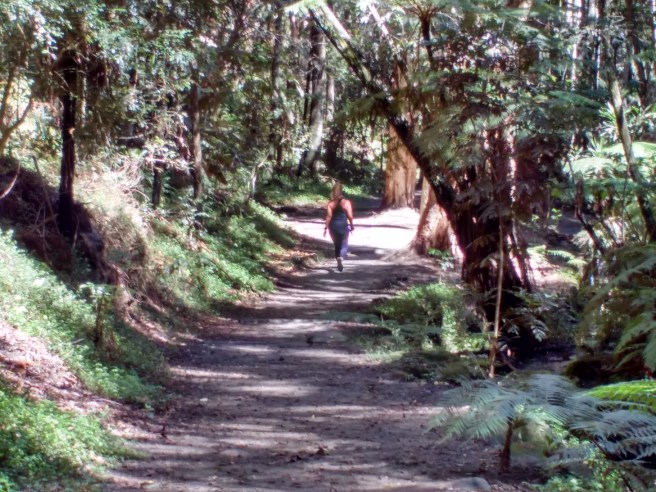
Autobiography in Fiction

stacks of books on shelves of bookcase

When people ask me where I get my ideas from, I tell them I use the world around me. Life is so abundant, if you can write down the actual details of the way things were and are, you hardly need anything else. Even if you relocate the French doors, fast-spinning overhead fan, small red laptop, and low kneeling-chair from your office that you work in in Sydney into an Artist’s Atelier in the south of France at another time, the story will have truth and groundedness.

In Hermione Hoby’s interview with Elizabeth Strout in the Guardian newspaper the Pulitzer prize winner said her stories have always begun with a person, and her eyes and ears are forever open to these small but striking human moments, squirreling them away for future use. “Character, I’m just interested in character,” she said.

“You know, there’s always autobiography in all fiction,” Strout said, referring to her new novel, My Name is Lucy Barton. “There are pieces of me in every single character, whether it’s a man or a woman, because that’s my starting point, I’m the only person I know.” She went on to explain: “You can’t write fiction and be careful. You just can’t. I’ve seen it with my students over the years, and I think actually the biggest challenge a writer has is to not be careful. So many times students would say, ‘Well, I can’t write that, my boyfriend would break up with me.’ And I’d think, you have to do something that’s going to say something, and if you’re careful it’s just not going to work.”

In 2016 at the launch of my debut novel My Year With Sammy the launcher said: “Libby’s level of detail creates poignant insights into character and relationships. If people know Libby they may find themselves subtly entwined in one of her stories.”

On Goodreads’ website they locate The Bell Jar by Sylvia Plath under “Autobiographical Fiction” and describe the book as Plath’s shocking, realistic, and intensely emotional novel about a woman falling into the grip of insanity:

“Esther Greenwood is brilliant, beautiful, enormously talented, and successful, but slowly going under—maybe for the last time. In her acclaimed and enduring masterwork, Sylvia Plath brilliantly draws the reader into Esther’s breakdown with such intensity that her insanity becomes palpably real, even rational—as accessible an experience as going to the movies. A deep penetration into the darkest and most harrowing corners of the human psyche, The Bell Jar is an extraordinary accomplishment and a haunting American classic.” – Goodreads

My advice to you is to be awake to the details around you, but don’t be self-conscious. So here it is. I’m at a Valentine’s Day party. It’s 33 degrees outside. The hostess is sweltering over a hot oven in the kitchen. She is serving up cheese and spinach triangles as aperitifs. Relax, enjoy the party, be present with your eyes and ears open. You will naturally take it all in, and later, sitting at your desk, you will be able to remember just how it was to be eating outside in the heat under a canvas umbrella, attempting to make conversation with the people on either side of you, and thinking how you can best make an early exit.

“I don’t want to write melodrama; I’m not interested in good and bad, I’m interested in all those little ripples that we all live with. And I think that if one gets a truthful emotion down, or a truthful something down, it is timeless.” – Elizabeth Strout, the Guardian

What about you? Is there autobiography in your fiction?

Writing Tip: Don’t Tell, but Show

cartoon illustrating angry boy with red face


An old one but a good one: don’t tell, but show.

What does it mean exactly? It means don’t tell us about loneliness (or any of those complex words like dishonesty, secrecy, jealousy, obsession, regret, death, injustice, etc) show us what loneliness is. We will read what you’ve written and feel the bite of loneliness. Don’t tell us what to feel. Show us the situation, and that feeling will be triggered in us.

don't tell, but show

When you take your child to school on their first day you may find yourself teary and relieved at the same time. Put into words what you see: the child’s face, the wave at the gate, the other mothers saying their goodbyes, another child coming up to take your son by the hand. We will get what you’re trying to say without you telling us directly.

don't tell, but show 2

When you write, be conscious of the senses and how they connect to the experiences you are writing about. Use sight, sound, smell, touch to create concrete pictures. The senses allow you to get as close as humanly possible in words to the wedding, the sunrise, the dog, the suitcase. It’s the best way to penetrate your story and breathe life into it. Don’t tell us about something, drop deep, enter the story and take us with you.

I hope this post on show, don’t tell is useful. Do you have any tips you would add? Let me know in the comments and please share with a friend if you enjoyed it. 

Writing Tip: taste life twice

writer at work at typewriter

Writers live twice. They go along with their regular life, are as fast as anyone in the grocery store, crossing the street, getting dressed for work in the morning. But there’s another part of them that they have been training. The one that lives everything a second time. That sits down and sees their life again and goes over it. Looks at the texture and the details.”  – Natalie Goldberg

quote by Anais Nin against a night sky

So here I am on a month away from my Sydney home wanting to recharge the creative batteries. I’ve just had a 4 night visit to Marrakech, Morocco. I got back to Villefranche sur Mer, where I’m renting a writing studio, last night. It’s a 3 hour flight between Nice France and Marrakech. So seeing as I’d traveled all the way across the world, I thought it a good time to visit Marrakech. Wow! What a creative experience. All the senses are awakened. Maybe I’ll live life twice and write something set in Morocco.

For now I’m feeling grateful to be able to travel and experience other cultures. The Marrakech-born people I met have never left their country. In the photos you can see me and Morad, the night manager at Riad Daria in Marrakech, one of the very kind and welcoming Moroccon’s who helped me during my stay. We’re pictured on the terrace of the riad. After the chaos of Marrakech’s souks, there’s nothing like a calm retreat. Below us is a corner of the rooftop terrace.

The first pic is the famous Jardin Marjorelle, the beautiful garden once owned by Yves Saint Laurent and home to the Berber Museum. He gifted the garden to Marrakech, the city that adopted him in 1964. Saint Laurent and his partner Pierre Berge bought the electric blue villa and its garden to preserve the vision of its original owner, landscape painter Jacques Majorelle, and keep it open to the public.  A memorial to the French fashion designer was built there. This year a new museum dedicated to him was opened next door to Jardin Marjorelle. I was lucky enough to visit. The museum retraces Saint Laurent’s forty years of creativity, the world of fashion he created, some designs influenced by his life in Marrakech. He too tasted life twice.