Writing Tip: Small Fictions


Libby Sommer with her book The Crystal Ballroom in book store
At Harry Hartog Bookseller

I love writing small fictions, also known as hybrid fiction:  flash, micro fiction, prose poetry.  The form is gaining in traction and you can enter your stories in various competitions like the New Flash Fiction Review.

‘New Flash Fiction Review has chosen to honor master storyteller Anton Chekhov through holding an annual award for excellence in flash fiction— or as they might have said, back in Chekhov’s time, “very short fiction”. Anton Pavlovich Chekhov was a Russian playwright and short-story writer, who is considered to be among the greatest writers of short fiction in history. Chekhov’s mastery for saying a lot with a little makes him one of the flash fiction’s spiritual inspirations. Over one-hundred years before the term “flash” was invented, Chekhov himself was writing short stories in under 1,000 words, stories such as “After the Theatre”, “A Country Cottage”, and “Bliss”. In 1886, Chekhov wrote in a letter to his brother, “… you’ll have a moonlit night if you write that on the mill dam a piece of glass from a broken bottle glittered like a bright little star, and that the black shadow of a dog or a wolf rolled past like a ball.”’ – New Flash Fiction Review

My small fiction titled Undulations was first published in Quadrant magazine. Hope you enjoy it.

Undulations

So we’re sitting in Melbourne in a vegan restaurant reminiscing about our school days spent mucking-up in the back row and Jane (her hair still red, short and frizzy, like childhood) remembers daring me to ask our fourth-grade Geography teacher how to spell ‘undulations’.  What?  “Because I wanted to write her a message,” Jane says.  “An unsigned message saying, ‘The way you run your hands over your boobs to demonstrate undulations is disgusting,’ but didn’t know how to spell it.  So I told you that if you were my friend, you’d ask her.  You know how she always said to speak up if we couldn’t spell something?  For some reason she wrote the word down on a piece of paper, rather than on the blackboard.  Maybe she thought you couldn’t see properly from our eyrie.  So you got back to your desk and passed it to me under the chair.  I wrote in my best handwriting, ‘Your demonstrations of undulations are gross,’ blotted it carefully, and placed it furtively on her table after the recess bell had cleared the room.  When we filed in after lunch, I saw her open it up.”  Jane taps me on the arm enthusiastically.  “What happened then?” I say.  “Was she angry?  Did she think it was me?  Did I get punished?”  How forgetful was I?  Jane had mastered the art of getting the ink from the inkwell to the pen nib to the paper—no ugly blotches—her cursive as good as a professional engraver’s.  Even after all this time, she still prefers a fountain pen and has a proclivity for setting wrongs right.  “She threw the chalk in the bin, reached for her cardigan and draped it over her shoulders,” Jane says, grinning.  “Yes, that’s what happened.  And she didn’t demonstrate undulating landscapes on herself or on any of us ever again.”

Copyright © 2018 Libby Sommer

Or you can study this growing-in-popularity short form by getting a copy of Best Small Fictions by Sonder Press:  ‘The Best Small Fictions is the first ever contemporary anthology solely dedicated to anthologizing the best short hybrid fiction published in a given calendar year.’

“If you are a writer of any kind, this book is also a must read because it will only enhance and inspire your own work, particularly through models of stellar openings/endings and meticulous editing.” — JMWW


Why Do You Write?

woman lying on green grass while holding pencil

It’s a tough gig being a writer. Lots of isolation, lots of intense concentration, lots of rejection from publishers and agents.

Why do I write? It’s a good question to ask yourself.

  1.  Because I’m a fool.
  2.  Because I want to impress my old school friends.
  3.  So people will like me.
  4.  So my friends will hate me.
  5.  I’m no good at speaking up.
  6.  So I can invent a new way of looking at the world.
  7.  In order to write the great Australian novel and become famous.
  8.  Because I’m a nut case.
  9.  Because I’m an undiscovered literary genius.
  10.  Because I have something to tell.
  11.  Because I have nothing to tell.

One of my favourite books on the writing process is The Writing Life by Pullitzer Prize winning Annie Dillard. It’s a small and passionate guide to the terrain of a writer’s world.

Dillard begins:

When you write, you lay out a line of words. The line of words is a miner’s pick, a woodcarver’s gouge, a surgeon’s probe. You wield it, and it digs a path you follow. Soon you find yourself deep in new territory. Is it a dead end, or have you located the real subject? You will know tomorrow, or this time next year. You make the path boldly and follow it fearfully. You go where the path leads. At the end of the path, you find a box canyon. You hammer out reports, dispatch bulletins. The writing has changed, in your hands, and in a twinkling, from an expression of your notions to an epistemological tool. The new place interests you because it is not clear. You attend. In your humility, you lay down the words carefully, watching all the angles. Now the earlier writing looks soft and careless. Process is nothing; erase your tracks. The path is not the work. I hope your tracks have grown over; I hope birds ate the crumbs; I hope you will toss it all and not look back.

There is a famous story in the Zen world:

The student, newly arrived at the monastery, asks the master, “What work will I do as I seek enlightenment?”

The master replies, “Chop wood, carry water.”

“And what work will I do once I achieve enlightenment?” asks the student.

“Chop wood, carry water,” says the master.

So how does this stay apply to the writing life? A writer writes. That’s all there is to it.

“A writer who waits for ideal conditions under which to work will die without putting a word on paper.” —E. B. White

What about you? Why do you write?

Writing Tip: A Sense of Place

person woman desk laptop

I’m sitting at my writing desk this spring morning in Sydney thinking about the need to ground our writing in a sense of place, whether landscape or cityscape.

How often have you heard someone say of a book they loved:  ‘I felt like I was there’.

Even if you relocate the cafe overlooking tennis courts at Cooper Park, the sound of tennis balls being hit, a poodle tied to a fake-cane chair at the table of older men after their regular Sunday tennis match that you drank a lemongrass and ginger tea at in Sydney into a café in a story in another state and time, the story will have originality and believability.  ‘But that café was in Sydney, I can’t transport it to Adelaide.’  But you can.  You can have flexibility with specific detail.  The mind is able to transport details, but using actual places that you experienced will give your writing authenticity and truthfulness.  It grounds your work in place, giving life and vitality to your writing, rather than a whole lot of exposition that floats in the air.

 If you don’t create evocative settings, your characters seem to have their conversations in vacuums or in some beige nowhere-in-particular. –  Jerome Stern

Creation of the physical world is as important to your story as action and dialogue.  If your readers can be made to see the hand-knitted socks or the row of vitamins on the kitchen benchtop, the scene becomes alive.  Readers pay attention.  Touch, sound, taste, and smell make readers feel as if their own feet are warm under the cold sheets.

Place situates the story in your reader’s mind.  Fiction that seems to happen in no particular place often seems not to take place at all. –  Jerome Stern

I hope this is helpful. Do you have any suggestions you would add? Let me know in the comments and please share this post with a friend if you enjoyed it.

Writing Tip: The Feedback Sandwich

people coffee meeting team

In the Saturday-afternoon feedback group, we began talking about the ‘off with his head’ or ‘out-it-goes’ part of writing.  We acknowledged that as a group we’d always been very supportive and encouraging of each others work.  That was because we were all in it together.  Our critiquing was not telling lies; it was from a place of open-hearted acceptance.  Everything you put on the page is acceptable.

Sometimes someone says, ‘I want a rigorous no-holds-barred assessment of my work.’  But what do you say to them when the writing is dull and boring?  Don’t give up your day job?  It doesn’t sit comfortably with most of us to be directly critical of someone’s writing.  It’s like telling someone how ugly their baby is.  All of us find it hard to separate our writing from ourselves, and are prone to take criticism personally.

The feedback sandwich is a widely known technique for giving constructive feedback, by ‘sandwiching’ the criticism between two pieces of praise or compliments.


hamburger with cheese and two beef patties

Yesterday, as we passed around copies of our work (just a page or two) we started to address what William Faulkner famously said:

‘In writing, you must kill all your darlings.’

First of all, we looked for the juice in each piece.  Where did the writing come alive?  ‘Get rid of the rest,’ we said.  ‘Off with his head—out it goes.’   It’s very difficult to be this honest, and not everyone wants to hear it.  ‘I simply want gentle support and a few corrections,’ some of us might say.

Be willing to have the courage to look at your work with truthfulness.  It’s good to know where your writing has energy and vitality, rather than to spend a lot of time trying to make something come to life that is dead on the page.   Keep writing.  Something new will come up.   You don’t want to put your readers to sleep by writing a lot of boring stuff.

What about you? What works or doesn’t work for you in critique groups?  Do you have any tips you would add? Let me know in the comments and please share this post with a friend if you enjoyed it. 


Writing Tip: Use Your Obsessions

woman in grey jacket sits on bed uses grey laptop

Every once in a while, when I’m scratching around for something new to write, I make a list of the things I obsess about.  Thankfully, some of them change over time, but there are always new ones to fill the gap.

It’s true that writers write about what they think about most of the time.  Things they can’t let go; things that plague them; stories they carry around in their heads waiting to be heard.

I used to get my creative writing groups to make a list of the topics they obsess about so they could see what occupies their thoughts during their waking hours.  After you write them down, you can use them for spontaneous writing before crafting them into stories.  They have much power.  This is where the juice is for writing.  They are probably driving your life, whether you realize it or not, so you may as well use them rather than waste your energy trying to push them away.  And you can come back to them repeatedly.

One of the things I’m always obsessing about is relationships:  in families, with friends, with lovers.  That’s what I tend to write about.  I think to myself, Why not?  Rather than repress my obsessions, explore them, go with the flow.  And life is always changing, so new material keeps presenting  itself.

We are driven by our passions.  Am I the only one who thinks this?  For me these compulsions contain the life force energy.  We can exploit that energy.  The same with writing itself.  I’m always thinking and worrying about my writing, even when I’m on holidays.  I’m driven.

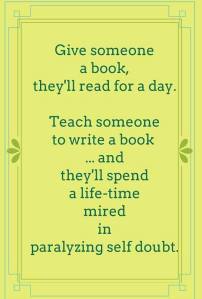
blue quote about writing on yellow background

But not all compulsions are a bad thing.  Get involved with your passions, read about them, talk to other people about them and then they will naturally become ‘grist for the mill’.

What about you?  Do you find yourself writing about the same situations over and over again? I hope these thoughts are useful. Do you have anything you would add? Let me know in the comments and please share this post with a friend if you enjoyed it.

Writing Is Like Becoming A Sushi Chef

sushi rolls displayed on wooden platter

Sometimes there is a person in one of my creative writing classes who is obviously very talented.  I can bring to mind one in particular.  You could sense people holding their breath as she read, and often her hands shook.  The writing process opened her up.  She said she had wanted to write for years.  She was so excited about writing that she straight away wanted to write a book.  I said to her, slow down.  Just practise writing for a while.  Learn what this is all about.

In Japan becoming an itamae of sushi requires years of on-the-job training and apprenticeship.  After five years spent working with a master or teacher itamae, the apprentice is given his first important task, the preparation of the sushi rice.

Writing, like becoming a Sushi Chef,  is a life’s work and takes a lot of practice.  The process is slow, and at the start you are not sure what you are making.

Futomaki  (“thick roll” – rice on inside, nori on the outside)

Uramaki   (“inside-out roll” – rice on outside, nori on the inside)

Temaki     (“hand roll” – cone-shaped roll)

That’s how it was for me.  I thought I could jump in and write a book in 6 months.  In fact, it was 14 years and 5 books before one of my manuscripts was accepted for publication.

So cut yourself some slack before you head off on a writing marathon.

Writing is like learning to prepare the rice for sushi:  the apprenticeship is long, and in the beginning you are not sure whether a Futomaki, a Uramaki or a Temaki will be the end result.

Recharging Your Creative Batteries

land, sea and sky at seaside town of Kiama
Kiama, New South Wales

A change of scene does wonders, especially after all the work and excitement of launching a new book.

Writing a book is hard work.  Even though it is very challenging, we know it is what we were born to do.  After we’ve written the book, edited it, submitted to a publisher, had discussions about cover design, created the back cover blurb, obtained reviews, networked, self-promoted, updated the websites, promoted on Instagram, Facebook and Word Press, organised a launch and readings, it’s only natural to find ourselves exhausted.  Before our batteries are totally flat, we need to give ourselves permission to take some time-out. We need to walk away from the desk. Do something that will breathe fresh life into our work and feed our creative souls.

After the release of THE USUAL STORY, I caught a train to the seaside town of Kiama and had two days to walk by the ocean and breath in the fresh sea air. Fantastic.

Writing Tip: I am not the stories I tell

greyscale photo of man and woman
Photo by Mukesh Mohanty on Pexels.com

Sometimes when people read my stories they assume those stories are me.  They are not me, even if I write in the first person.  They were my thoughts and feelings at the time I wrote them.  But every minute we are all changing.  There is a great freedom in this.  At any time we can let go of our old selves and start again.  This is the writing process.  Instead of blocking us, it gives us permission to move on.  Just like in a progressive ballroom dance:  you give your undivided attention to your partner—keep eye contact for the time you are dancing together—but then you move on to the next person in the circle.

The ability to express yourself on the page—to write how you feel about an old lover, a favourite pair of dance shoes, or the memory of a dance on a chilly winter’s night in the Southern Highlands—that moment you can support how you feel inside with what you say on the page.  You experience a great freedom because you are not suppressing those feelings.  You have accepted them, aligned yourself with them.

I have a poem titled ‘This is what it feels like’—it’s a short poem.  I always think of it with gratitude  because I was able to write in a powerful way how it was to be desperate and frightened.  The act of self expression made me feel less of a victim.  But when people read it they often say nothing.   I remind myself, I am not the poem, I am not the stories I write.  People react from where they are in their own lives.  That’s the way things are.  The strength is in the act of writing, of putting pen to paper.   Write your stories and poems, show them to the world, then move on.  The stories are not you.  They are moments in time that pass through you.

I hope these thoughts are useful. Do you have anything you would add? Let me know in the comments and please share this post with a friend if you enjoyed it.

This is what it feels like

When a single thought

may darken and trap,

terrify, for no apparent reason.

A storm

in your senseless head.

Whatever the thought,

think implosion of self

or crazy,

any thought you have held

in tenuous reality

like lead in the chest.

Say you were heavy footed

downhill and it made you

want to stop.  At midnight

driverless cars advance on you,

but where the hell is the brake?

Copyright © 2018 Libby Sommer

Writing Tip: Turn Towards the Inner Critic

uncapped fountain pen on pageWhen you practice writing, it is essential to separate the creator and the editor, or inner critic, so that the creator has plenty of room to breathe, experiment, and tell it like it really is.  If the inner critic is being too much of a problem and you can’t distinguish it from your authentic writing voice, sit down whenever you find it necessary to have some distance from it and put down on paper what the critic is saying, put a spotlight on the words—“You have nothing original to say, what made you think you could write anything anyone would want to read, your writing is crap, you’re a loser, I’m humiliated, you write a load of rubbish, your work is pathetic, and your grammar stinks …”  On and on it goes!

Say to yourself, It’s OK to feel this.  It’s OK to be open to this.

You can learn to cultivate compassion for yourself  during this internal process by practicing Mindfulness Meditation.  Sit up straight, close your eyes, bring your awareness to your inner experience.  Now,  redirect your attention to the physical sensations of the breath in the abdomen … expanding as the breath comes in … and falling back as the breath goes out.  Use each breath to anchor yourself in the present.   Continue, concentrating on the breath for several minutes.  Now, expand your field of awareness to include the words of the inner critic.  Turn your attention to where in your body you feel the unpleasant thoughts, so you can attend, moment by moment, to the physical reactions to your thoughts.

 “Stay with the bodily sensations, accepting them, letting them be, exploring them without judgment as best you can.”—Mindfulness, Mark Williams and Danny Penman.

Every time you realise that you’re judging yourself, that realisation in itself is an indicator that you’re becoming more aware.

The thing is, the more clearly you know yourself, the more you can accept the critic in you and use it.  If the voice says, “You have nothing interesting to say,” hear the words as white noise, like the churning of a washing machine.  It will change to another cycle and eventually end, just like your thoughts that come and go like the shape shifting of clouds in the sky.  But, in the meantime, you return to your notebook and practice your writing.  You put the fear and the resistance down on the page.

I hope these ideas are useful. Do you have any tips you would add? Let me know in the comments and please share this post with a friend if you enjoyed it.

The Writing Process

alone animal bird clouds

At a literary event recently I heard someone say:  ‘The thing to do is put the idea in your subconscious.  Your brain will do the work.’

That’s the thing. It takes time for our experience to make its way through our consciousness.  For example, it is hard to write about a journey while you are still in the midst of the adventure.  We have no distance from what is happening to us.  The only things we seem to be able to say are ‘having a great time’, ‘the weather is good’, ‘wish you were here’.  It is also hard to write about a place we just moved to, we haven’t absorbed it yet.  We don’t really know where we are, even if we can walk to the train station without losing our way.  We haven’t experienced three scorching summers in this country or seen the dolphins migrating south along the  coast in the winter.

“Maybe away from Paris I could write about Paris as in Paris I could write about Michigan.  I did not know it was too early for that because I did not know Paris well enough.” – Ernest Hemingway, A Moveable Feast  (New York:  Charles Scribner’s Sons, 1964).

So we take in experience, but we need to let things make their way through our consciousness for a while and be absorbed by our whole selves.  We are bower birds, collecting experience, and from the tThrown away apple skins, outer lettuce layers, tea leaves, and chicken bones of our minds come our ideas for stories and poems and songs.  But this does not come any time soon.  It takes a very long time (three to ten years in the case of literary fiction).  We need to keep picking through these scraps until some of the thoughts together form a pattern or can be organised around a central theme, something  we can shape into a narrative.  We mine our hidden thoughts for ideas.  But the ideas need time to percolate:  to slowly filter through.

Rumi, the thirteenth-century Sufi poet, summed up what could be the creative process when he wrote ‘The Guest House’:

This being human is a guest house.

Each morning a new arrival.

A joy, a depression, a meanness,

some momentary awareness comes

as an unexpected visitor.

Welcome and entertain them all!

Even if they are a crowd of sorrows,

who violently sweep your house

empty of its furniture,

still, treat each guest honourably.

He may be clearing you out

for some new delight.

The dark thought, the shame, the malice,

meet them at the door laughing and invite

them in.

Be grateful for whoever comes,

because each has been sent

as a guide from beyond.

Jalaluddin Rumi, in The Essential Rumi,

Translated by Coleman Barks, 1999

Our work is to keep rummaging through the rubbish bins of our minds, exercising the writing muscle, in readiness to answer that knock at the door when it comes.

I hope these thoughts on the writing process are helpful.   Do you have any tips you would add? Let me know in the comments and please share this post with a friend if you enjoyed it.