My 3 Favourite How-To-Write Books

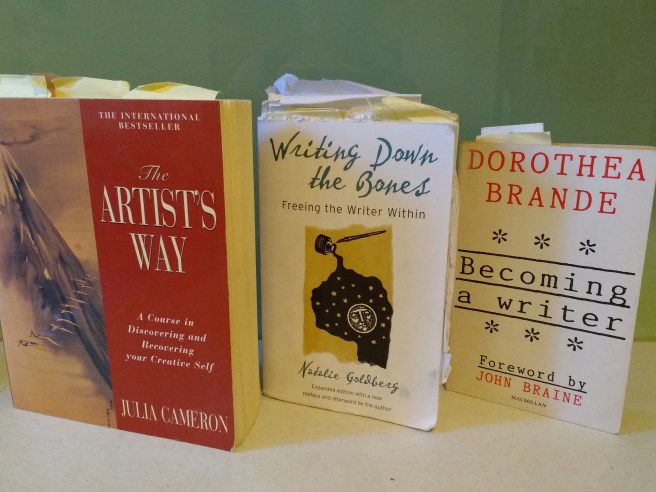
three book covers: The Artist's Way, Writing Down the Bones, Becoming a writer

So much advice out there on writing process but these three books, old ones but good ones, are my favorites. You can see how well-loved they are by how many pages are marked with stickers. I’ve used the books many times when teaching my ‘Writing from Within‘ course where we try to harness the unconscious by falling into an artistic coma.

1.

Have you ever longed to be able to draw or paint, write or compose music? In ‘The Artist’s Way‘ by Julia Cameron you can discover how to unlock your latent creativity and make your dreams a reality.

The Artist’s Way‘  provides a twelve-week course that guides you through the process of recovering your creative self. It dispels the ‘I’m not talented enough’ conditioning that holds many people back and helps you to unleash your own inner artist.

The Artist’s Way‘ helps demystify the creative process by making it part of your daily life. It tackles your self-doubts, self-criticism and worries about time, money and the support to pursue your creative dream.

2.

In ‘Writing Down the Bones‘ by Natalie Goldberg, the secret of creativity, she makes clear, is to subtract rules for writing, not add them. It’s a process of “uneducation” rather than education. Proof that she knows what she’s talking about is abundant in her own sentences. They flow with speed and grace and accuracy and simplicity. It looks easy to a reader, but writers know it is the hardest writing of all.’ – Robert Pirsig

Writing Down the Bones‘  Natalie Goldberg’s first book, sold millions of copies and has been translated into twelve languages. For more than thirty years she practiced Zen and taught seminars in writing as a spiritual practice.

3.

Becoming a Writer‘ by Dorothea Brande is a reissue of a classic work published in 1934 on writing and the creative process. It recaptures the excitement of Dorothea Brande’s creative writing classroom of the 1920s. Decades before brain research “discovered” the role of the right and left brain in all human endeavor, Dorothea Brande was teaching students how to see again, how to hold their minds still, how to call forth the inner writer.

‘Refreshingly slim, beautifully written and deliciously elegant, Dorothea Brande’s Becoming a Writer remains evergreen decades after it was first written. Brande believed passionately that although people have varying amounts of talent, anyone can write. It’s just a question of finding the “writer’s magic”–a degree of which is in us all. She also insists that writing can be both taught and learned. So she is enraged by the pessimistic authors of so many writing books who rejoice in trying to put off the aspiring writer by constantly stressing how difficult it all is.

‘With close reference to the great writers of her day–Wolfe, Forster, Wharton and so on–Brande gives practical but inspirational advice about finding the right time of day to write and being very self disciplined about it–“You have decided to write at four o’clock, and at four o’clock you must write.” She’s strong on confidence building and there’s a lot about cheating your unconscious which will constantly try to stop you writing by coming up with excuses. Then there are exercises to help you get into the right frame of mind and to build up writing stamina.

‘This is Dorothea Brande’s legacy to all those who have ever wanted to express their ideas in written form. A sound, practical, inspirational and charming approach to writing, it fulfills on finding “the writer’s magic.”‘ – John Gardner

I hope these recommendations are helpful. Do you have useful books on writing process you would add? Let me know in the comments and please share this post with a friend if you enjoyed it.

Have You Tried Flash Fiction Yet?

books-bookstore-book-reading-159711.jpeg

Have you heard the term flash fiction? What does it mean?

‘A flash fiction piece is a self-contained story (beginning/middle/end), 1,000 words or less, that can entertain, intrigue, and satisfy a reader during an F5 tornado. That’s it. No genre restrictions, age requirements, or prior experience needed. Just quick, clean stories.’ – Writer’s Digest

‘Part poetry, part narrative, flash fiction–also known as sudden fictionmicro fiction, short short stories, and quick fiction—is a genre that is deceptively complex.’ – The Review Review

‘Flash fiction is a fictional work of extreme brevity that still offers character and plot development. Identified varieties, many of them defined by word count, include the six-word story, the 280-character story, the “dribble”, the “drabble”, “sudden fiction”, flash fiction, nanotale, and “micro-story”.’ – Wikipedia

I like writing in a short form. I’ve been told I have the sensibility of a poet because I have the ability to distill, so the short form suits me. You may be more of a long distance runner, rather than a sprinter, and prefer the long form of a novel.

Have a read of my flash fiction titled It’s Pot Luck When You Move Into A Unit, winner of the short short fiction UTS Alumni Competition. Hope you enjoy it.

It’s Pot Luck When You Move Into a Unit

A nice quiet weekend? the woman downstairs said.  What do you mean? I said, through the open back door, a bag of rubbish in each hand.  She smoothed her ironing on the board and said, They weren’t around over the weekend—with the baby.  She looked happy.  I’m lucky living on the top floor, I said.  She nodded towards the other side of the building.  Jim isn’t so luckyhe’s got the woman upstairs, she said, When he plays the piano and she thumps on the floor.   She put the iron back on its stand.  She’s heavy-footed, that woman.  Bang, bang, bang.   I hear her coming down the stairs every morning at six, and the slam of the front door. 

That night the wind knocked my vase off the window ledge.  I lay awake wondering if the noise of the smash had woken up the people underneath—the ones whose barbecuing sends smoke and disgusting meat smells into my unit.  Nothing clings to your furniture like the stink from last week’s burnt fat.   Sorry about the crash, I muttered to the floor, It was the wind.

Copyright © Libby Sommer 2018

Why not try your hand at writing in this short form and enter a flash fiction competition. Good luck.


Is There A Link Between Spirituality and Creativity?

photo of golden gautama buddha

What is the relationship between spirituality and creativity? The discipline and focused attention cultivated through meditation help us do one thing at a time, totally and absolutely, which greatly enhances our writing.

‘Contemplative practice, daily nature walks, and still, silent listening can be among the best natural meditations. They help clarify our minds and uplift the heart, dissolving our ordinary preoccupations and mental states that dissipate the fertile spirit within. Such daily disciplines are also excellent tonics for our agitated, febrile brains and weary bodies. When we ease into the realm of non-doing–what Chinese Buddhists called wu wei–there is more room for our mysterious, unfabricated inner self to naturally emerge.’ – Lama Surya Das

It’s tough being a writer. Very tough. As Thomas Mann says, A writer is someone for whom writing is more difficult than it is for other people.

Dinty Moore, in his book The Mindful Writer, Noble Truths of the Writing Life, says his lifelong pursuit of writing and creativity has helped to open him to the path of Buddhism:

‘Find inspiration and insight on writing as a spiritual practice through astute quotes, thoughtful advice, and productive exercises on both mindfulness and craft.  This isn’t your typical “how to write” book. Author Dinty W. Moore, a well-respected writing coach and teacher, thoughtfully illuminates the creative process: where writing and creativity originate, how mindfulness plays into work, how to cultivate good writing habits and grow as a person, and what it means to live a life dedicated to writing.’ – The Mindful Writer

Here’s to Mindfulness and Meditation to help us on our way through our roller coaster lives as creative writers.


What Is a Prose Poem?

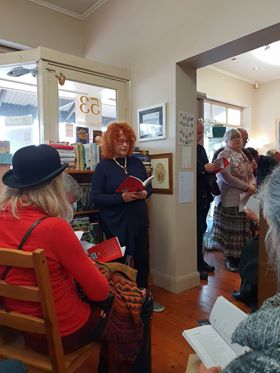
reading from Wild poetry anthology in bookstore


What is a prose poem?

‘Though the name of the form may appear to be a contradiction, the prose poem essentially appears as prose, but reads like poetry. In the first issue of The Prose Poem: An International Journal, editor Peter Johnson explained, “Just as black humor straddles the fine line between comedy and tragedy, so the prose poem plants one foot in prose, the other in poetry, both heels resting precariously on banana peels.”

‘While it lacks the line breaks associated with poetry, the prose poem maintains a poetic quality, often utilizing techniques common to poetry, such as fragmentation, compression, repetition, and rhyme. The prose poem can range in length from a few lines to several pages long, and it may explore a limitless array of styles and subjects.’ -The Academy of American Poets

I rather enjoy writing prose poetry and am slowly (very slowly) working on a collection of published short pieces. Here is one of my Flash Fictions (a close relative of the Prose Poem), first published in Quadrant magazine, October 2014. Hope you like it.

Tell Me About What Happened On New Year’s Eve

I’d looked out the top-floor hospital window towards Coogee to the night sky lit by fireworks and saw the miserable face of the moon and thought that I’d never felt as detached from life as at that moment.  At the same time, I realised that I probably felt so despicable due to the weeks spent lying in hospital and the excruciatingly slow and painful road to recovery.   By sheer force of will, I stopped looking at the dark mirror of the moon.  No one could have told me how much the distant celebrations, the sound of the explosions and the changing shapes and colours of the fireworks could jolt me into the present and away from the unbearable lethargy, the severed muscles and tendons and the nausea caused by the drugs and pain killers.  Was it that I could sense, without glancing up again, that clouds were making their way across the moon and that made me realise:  how would it be to feel this would be your last new year?

Copyright © Libby Sommer


Writing Tip: A Sense of Place

person woman desk laptop

I’m sitting at my writing desk this spring morning in Sydney thinking about the need to ground our writing in a sense of place, whether landscape or cityscape.

How often have you heard someone say of a book they loved:  ‘I felt like I was there’.

Even if you relocate the cafe overlooking tennis courts at Cooper Park, the sound of tennis balls being hit, a poodle tied to a fake-cane chair at the table of older men after their regular Sunday tennis match that you drank a lemongrass and ginger tea at in Sydney into a café in a story in another state and time, the story will have originality and believability.  ‘But that café was in Sydney, I can’t transport it to Adelaide.’  But you can.  You can have flexibility with specific detail.  The mind is able to transport details, but using actual places that you experienced will give your writing authenticity and truthfulness.  It grounds your work in place, giving life and vitality to your writing, rather than a whole lot of exposition that floats in the air.

 If you don’t create evocative settings, your characters seem to have their conversations in vacuums or in some beige nowhere-in-particular. –  Jerome Stern

Creation of the physical world is as important to your story as action and dialogue.  If your readers can be made to see the hand-knitted socks or the row of vitamins on the kitchen benchtop, the scene becomes alive.  Readers pay attention.  Touch, sound, taste, and smell make readers feel as if their own feet are warm under the cold sheets.

Place situates the story in your reader’s mind.  Fiction that seems to happen in no particular place often seems not to take place at all. –  Jerome Stern

I hope this is helpful. Do you have any suggestions you would add? Let me know in the comments and please share this post with a friend if you enjoyed it.

My latest book has been accepted

painting of girl lying on beach in torquoise bikini reading a book

A big thank you to Ginninderra Press.  STORIES FROM BONDI has been accepted for publication by this small but prestigious Australian publisher.

The Ginninderra Press philosophy:

‘We believe that all people – not just a privileged few – have a right to participate actively in cultural creation rather than just being passive consumers of mass media. Our culture is revitalised and enriched when everyone is encouraged to fulfil their creative potential and diminished when that creative potential is stifled or thwarted. We love to observe the transformative possibilities for people when they see their work published and acknowledged. Getting published can and does change lives.’

Getting published has definitely changed my life. The problem has been that larger publishers are not interested in novellas or short story collections.

My first book MY YEAR WITH SAMMY (2015) was a novella, the second two, THE CRYSTAL BALLROOM (2017) and THE USUAL STORY (2018), were novels-in-stories.

STORIES FROM BONDI is a short story collection and will be released in late 2019. An earlier version of the manuscript was part of my MA in Writing (UTS) back in 2001.

I’m thrilled and delighted and very very thankful to Stephen Matthews, Ginninderra Press.

Ginninderra Press, described in The Canberra Times as ‘versatile and visionary’, is an independent book publisher set up in 1996 to provide opportunities for new and emerging authors as well as for authors writing in unfashionable genres or on non-mainstream subjects. In the words of one of our authors, we are ‘a small but significant publisher of small but significant books’.

As an author writing in unfashionable genres:  novellas and short story collections, I am extremely grateful to this award-winning independent publisher for taking me on. If it wasn’t for Stephen Matthews my work would not be out in the world.

Writing Tip: The Feedback Sandwich

people coffee meeting team

In the Saturday-afternoon feedback group, we began talking about the ‘off with his head’ or ‘out-it-goes’ part of writing.  We acknowledged that as a group we’d always been very supportive and encouraging of each others work.  That was because we were all in it together.  Our critiquing was not telling lies; it was from a place of open-hearted acceptance.  Everything you put on the page is acceptable.

Sometimes someone says, ‘I want a rigorous no-holds-barred assessment of my work.’  But what do you say to them when the writing is dull and boring?  Don’t give up your day job?  It doesn’t sit comfortably with most of us to be directly critical of someone’s writing.  It’s like telling someone how ugly their baby is.  All of us find it hard to separate our writing from ourselves, and are prone to take criticism personally.

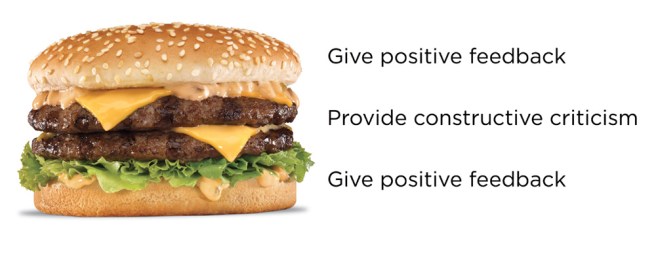
The feedback sandwich is a widely known technique for giving constructive feedback, by ‘sandwiching’ the criticism between two pieces of praise or compliments.


hamburger with cheese and two beef patties

Yesterday, as we passed around copies of our work (just a page or two) we started to address what William Faulkner famously said:

‘In writing, you must kill all your darlings.’

First of all, we looked for the juice in each piece.  Where did the writing come alive?  ‘Get rid of the rest,’ we said.  ‘Off with his head—out it goes.’   It’s very difficult to be this honest, and not everyone wants to hear it.  ‘I simply want gentle support and a few corrections,’ some of us might say.

Be willing to have the courage to look at your work with truthfulness.  It’s good to know where your writing has energy and vitality, rather than to spend a lot of time trying to make something come to life that is dead on the page.   Keep writing.  Something new will come up.   You don’t want to put your readers to sleep by writing a lot of boring stuff.

What about you? What works or doesn’t work for you in critique groups?  Do you have any tips you would add? Let me know in the comments and please share this post with a friend if you enjoyed it. 


Make Friends With Your Feelings

architecture clouds estate exterior

Mark Williams and Danny Penman write in MINDFULNESS, a practical guide to finding peace in a frantic world:  ‘Whatever you feel, as best you can, see if you can bring an open and kind-hearted awareness to all of your feelings. Remember Rumi’s ‘Guest House’ poem (see below). Remember to roll out the welcome mat to even your most painful thoughts, such as fatigue, fear, frustration, loss, guilt or sadness. This will diffuse your automatic reactions and transform a cascade of reactions into a series of choices.’


The Guest House

by Rumi, a thirteenth century Sufi poet:


This being human is a guest house.

Every morning a new arrival.


A joy, a depression, a meanness,

some momentary awareness comes

as an unexpected visitor.


Welcome and entertain them all!

Even if they are a crowd of sorrows,

who violently sweep your house

empty of its furniture,


still, treat each guest honourably.

He may be clearing you out

for some new delight.

I keep reading and rereading this book by Mark Williams and Danny Penman. Each morning I play one of the tracks of the guided meditations CD that is included. It’s my daily practice to help keep me calm and centred. Sometimes I select the Moving Meditation Track that includes some gentle stretching, other times I sit up in  bed and concentrate on my breathing before writing in my journal.  Remember, the breath is always there for us. It anchors us in the present. It is like a good friend. It reminds us that we are OK just as we are.

MINDFULNESS reveals a set of simple yet powerful practices that you can
incorporate into daily life to help break the cycle of anxiety, stress,
unhappiness, and exhaustion. It promotes the kind of happiness and
peace that gets into your bones. It seeps into everything you do and
helps you meet the worst that life throws at you with new courage.’

I hope introducing you to this book and its ideas is useful. Do you have anything you would add? Let me know in the comments and please share this post with a friend if you enjoyed it.


A Poem

white cruise ship

My poem Between the Islands of the Pacific was first published in June Quadrant magazine with poems by Les Murray, Barbara Fisher, Craig Kurtz, Geoff Page, Dan Guenther, Gabriel Fitzmaurice and Graeme Hetherington. Big thank you to Literary Editor, Les Murray.


Between the Islands of the Pacific

Because by now we know everything is not so blue

out here.


The cities had tipped rubbish into the sea,

and we let them without even noticing.


Not even feeling our breathing clear

as gusts reaching ten knots cleaned up our days.


Not even. Today pure blue sky, blue sea,

out there the horizon drawing a line

below the clouds, the absoluteness of it. Nights

of diesel engines shuddering beneath us.


We lounge on chairs side by side on the deck.

At dusk, we stand at the railing of the ship as the sun

slips into the ocean. In the fresh sea air, their backs turned,

some raise a selfie-stick or light a cigarette while others

stand holding their breath.


Where can we go from here, and how?


Copyright © Libby Sommer 2018


Writing Tip: Use Your Obsessions

woman in grey jacket sits on bed uses grey laptop

Every once in a while, when I’m scratching around for something new to write, I make a list of the things I obsess about.  Thankfully, some of them change over time, but there are always new ones to fill the gap.

It’s true that writers write about what they think about most of the time.  Things they can’t let go; things that plague them; stories they carry around in their heads waiting to be heard.

I used to get my creative writing groups to make a list of the topics they obsess about so they could see what occupies their thoughts during their waking hours.  After you write them down, you can use them for spontaneous writing before crafting them into stories.  They have much power.  This is where the juice is for writing.  They are probably driving your life, whether you realize it or not, so you may as well use them rather than waste your energy trying to push them away.  And you can come back to them repeatedly.

One of the things I’m always obsessing about is relationships:  in families, with friends, with lovers.  That’s what I tend to write about.  I think to myself, Why not?  Rather than repress my obsessions, explore them, go with the flow.  And life is always changing, so new material keeps presenting  itself.

We are driven by our passions.  Am I the only one who thinks this?  For me these compulsions contain the life force energy.  We can exploit that energy.  The same with writing itself.  I’m always thinking and worrying about my writing, even when I’m on holidays.  I’m driven.

blue quote about writing on yellow background

But not all compulsions are a bad thing.  Get involved with your passions, read about them, talk to other people about them and then they will naturally become ‘grist for the mill’.

What about you?  Do you find yourself writing about the same situations over and over again? I hope these thoughts are useful. Do you have anything you would add? Let me know in the comments and please share this post with a friend if you enjoyed it.