
4 Reasons Why Silence Is Good For You

woman in white shirt and blue denim short shorts sitting

Spending time in silence can improve your focus, productivity and creativity. Exceptional creativity often happens in solitude.

‘In a loud and distracting world, finding pockets of stillness can benefit your brain and body. Here are four science-backed reasons why.’ – Carolyn Gregoire, The Huffington Post:

1. Silence relieves stress and tension. 

Florence Nightingale, the 19th century British nurse and social activist, once wrote that “Unnecessary noise is the most cruel absence of care that can be inflicted on sick or well.” Nightingale argued that needless sounds could cause distress, sleep loss and alarm for recovering patients.

It turns out that noise pollution has been found to lead to high blood pressure and heart attacks, as well as impairing hearing and overall health. Loud noises raise stress levels by activating the brain’s amygdala and causing the release of the stress hormone cortisol, according to research.

An unpublished 2004 paper by environmental psychologist Dr. Craig Zimring suggests that higher noise levels in neonatal intensive care units led to elevated blood pressure, increased heart rates and disrupted patient sleep patterns.

Just as too much noise can cause stress and tension, research has found that silence has the opposite effect, releasing tension in the brain and body.

2006 study published in the journal Heart found two minutes of silence to be more relaxing than listening to “relaxing” music, based on changes in blood pressure and blood circulation in the brain.

2. Silence replenishes our mental resources.

In our everyday lives, sensory input is being thrown at us from every angle. When we can finally get away from these sonic disruptions, our brains’ attention centers have the opportunity to restore themselves.

The ceaseless attentional demands of modern life put a significant burden on the prefrontal cortex of the brain, which is involved in high-order thinking, decision-making and problem-solving.

As a result, our attentional resources become drained. When those attention resources are depleted, we become distracted and mentally fatigued, and may struggle to focus, solve problems and come up with new ideas.

But according to attention restoration theory, the brain can restore its finite cognitive resources when we’re in environments with lower levels of sensory input than usual. In silence ― for instance, the quiet stillness you find when walking alone in nature ― the brain can let down its sensory guard, so to speak.

3. In silence, we can tap into the brain’s default mode network. 

The default mode network of the brain is activated when we engage in what scientists refer to as “self-generated cognition,” such as daydreaming, meditating, fantasizing about the future or just letting our minds wander.

When the brain is idle and disengaged from external stimuli, we can finally tap into our inner stream of thoughts, emotions, memories and ideas. Engaging this network helps us to make meaning out of our experiences, empathize with others, be more creative and reflect on our own mental and emotional states.

In order to do this, it’s necessary to break away from the distractions that keep us lingering on the shallow surfaces of the mind. Silence is one way of getting there.

Default mode activity helps us think deeply and creatively. As Herman Melville once wrote, “All profound things and emotions of things are preceded and attended by silence.”

4. Getting quiet can regenerate brain cells.

Silence can quite literally grow the brain.

2013 study on mice, published in the journal Brain, Structure, and Function, involved comparing the effects of ambient noise, white noise, pup calls and silence on the rodents’ brains. Although the researchers intended to use silence as a control in the study, they found that two hours of silence daily led to the development of new cells in the hippocampus, a key brain region associated with learning, memory and emotion.

While preliminary, the findings suggested that silence could be therapeutic for conditions like depression and Alzheimer’s, which are associated with decreased rates of neuron regeneration in the hippocampus.

Rest and regeneration are so important for all of us in this loud, fast moving world. There’s something especially valuable in being disciplined in switching off, tuning out, and making room for silence, solitude and tranquility.

Why Exercise the Writing Muscle?

man holding barbell

Writing as a daily practice is a way to exercise the writing muscle. Like working out at the gym, the more you do it, the more results you get. Some days you just don’t feel like working out and you find a million reasons not to go to the gym or out for a jog, a walk, a swim, a bike ride, but you go anyway. You exercise whether you want to or not. You don’t wait around till you feel the urge to work out and have an overwhelming desire to go to the gym. It will never happen, especially if you haven’t been into health and fitness for a long time and you are pretty out of shape. But if you force yourself to exercise regularly, you’re telling your subconscious you are serious about this and it eventually releases its grip on your resistance. You just get on and do it. And in the middle of the work out, you’re actually enjoying it. You’ve felt the endorphins kick in. When you get to the end of the jog, the walk, the bike ride, the swim, the gym workout or the Pilates, Yoga or Zumba class, you don’t want it to end and you’re looking forward to the next time.

That’s how it is with writing too. Once you’ve got the flow happening, you wonder why it took you so long to turn up on the page. Bum on chair is what I used to say to my writing students. Through daily practice your writing does improve.

In The Artist’s Way, Julia Cameron’s book on discovering and recovering your creative self, she refers to daily writing practice as the morning pages. She recommends writing three pages of longhand, strictly stream-of-consciousness—moving the hand across the page and writing whatever comes to mind every day.

Author of Writing Down the Bones, Natalie Goldberg refers to writing practice as timed exercise. She says you might time yourself for ten minutes, twenty minutes, or longer. It’s up to you, but the aim is to capture first thoughts. “First thoughts have tremendous energy. It is the way the mind first flashes on something. The internal censor usually squelches them, so we live in the realm of second and third thoughts, thoughts on thought, twice and three times removed from the direct connection of the first fresh flash.”

Her rules for writing practice are:

1. Keep your hand moving.
2. Don’t cross out.
3. Don’t worry about spelling, punctuation , grammar.
4. Lose control.
5. Don’t think. Don’t get logical.
6. Go for the jugular.

In Creative Journal Writing, author Stephanie Dowrick refers to the same process as free writing; writing without judging, comparing and censoring. “Continuing to write when you don’t know what’s coming next and especially when you feel your own resistances gathering in a mob to mock you.”

Daily writing practice has been described as clearing the driveway of snow before reaching the front door. In other words, it’s what we do as a warm up before the real writing takes place.  And it’s a way to loosen up and discover our own unique writing ‘voice’.  That’s what publishers are looking for when they read through the slush pile.  The storyteller’s voice.  The authentic writing voice of the author is what engages the reader.

What about you? Are you able to carve some time out each day to write?

Short pieces or a novel?


photo of a woman reading book

It’s hard to know sometimes whether to work on the short form or a continuous narrative. I’ve talked about this several times before because it’s a constant dilemma for me. However, the short form seems to be what I do best. Last year I tried very hard to write a genre fiction, but couldn’t get any traction on a story. Instead, I returned to the short form: short stories and prose poems. I am very very happy to say that one story and three poems have now been accepted for publication in Quadrant magazine. Phew! It is such a relief. The previous Literary Editor of Quadrant, poet Les Murray, retired at the end of 2018 and I worried if the new editors of poetry and fiction would like my work. Writing is so subjective. Thank goodness they do.

Have a read of what George Thomas, Deputy Editor of Quadrant writes about the new Literary Editor, Professor Barry Spurr:

The distinguished literary scholar and critic Barry Spurr is the new Literary Editor of Quadrant, succeeding Les Murray who retired at the end of last year after serving in the position since March 1990.

In 2011, Barry was appointed the first Professor of Poetry in Australia, and has long been a world authority on the life and work of T.S. Eliot. His book Anglo-Catholic in Religion: T.S. Eliot and Christianity (Lutterworth, Cambridge, 2010) is widely regarded as the authoritative study in the field.

In an academic career of more than forty years at the University of Sydney, including two stints at St Edmund Hall, Oxford, Barry’s literary scholarship ranged from Early Modern literature to contemporary Australian poetry. He is a leading scholar in the fields of religious literature and liturgical language, most notably in the works of John Donne and T.S. Eliot, and the language, literature and music of the Anglo-Catholic tradition.

His contribution to Australian poetry education and criticism has been prolific, and includes a series of small books for students on individual Australian poets including Kenneth Slessor, Bruce Dawe, Judith Wright, Lee Cataldi, Peter Skrzynecki, Judith Beveridge, Robert Gray, John Tranter, Douglas Stewart, Rosemary Dobson, John Foulcher, as well as the novelist Christopher Koch. In 2007, he was elected Fellow of the Australian College of Educators for his “outstanding contribution to education”.

He has also been a notable public commentator, especially on the role of literature in the modern education system, and the role of the humanities in the modern university. He was the consultant on literature education to the Abbott government’s 2014 review of the national education curriculum chaired by Kevin Donnelly and Ken Wiltshire. Most of his recommendations were included in the final report, which supported “a greater emphasis on dealing with and introducing literature from the western literary canon, especially poetry.”

When he was appointed to his poetry chair by the University of Sydney, Les Murray publicly welcomed him with a letter of congratulations, saying: “It is rare to have a person interested in poetry as distinct from the furthering of what you might call Stasi-type criticism in Australia. In the last 30 years or more, poetry criticism has descended more and more into politics – and a really nasty form of politics.”

In 2016, after he left the University of Sydney, leading literary figures and former academic colleagues from both Sydney and Oxford gave him the festschrift The Free Mind: Essays and Poems in Honour of Barry Spurr (editor Catherine Runcie, publisher Edwin H. Lowe).

Barry has been a contributor to Quadrant since the 1980s. In his most recent piece in March 2018, a review of the collection of Ivan Head’s poetry The Magpie Sermons, he concluded on a severe yet positive note: “In our prosaic and crudely literal world, where just a word in jest in private can be stolen out of context and used to destroy a person’s career and reputation, and where thought, speech and expression are policed and pilloried (even, of all places, in universities), censoring and stifling the imagination, the voices of the poets, contrariwise, enlarging our vision of life and revealing the limitless capacity of language tellingly to communicate that generosity of spirit, have never been more necessary.”

I’m so grateful and blessed to have my work accepted by such a distinguished literary scholar.


Back Cover Book Blurb

painting of girl lying on beach in torquoise bikini reading a book

The  back cover book blurb is crucially important. But it’s harder than you think to write one. My new book, STORIES FROM BONDI will be published by Ginninderra Press in July this year. It’s especially difficult for me to write a blurb for this book as it’s a collection of stories rather than a continuous narrative. We’re told the blurb should be short and sweet, give away enough of what’s inside the book without giving any plot spoilers and draw the reader in.

This is what I’ve put together using quotes about my work from well-known writers. Let me know what you think.

The characters who inhabit a Libby Sommer story live and breathe. In the sensitively-drawn details of their lives, in the echoes of the everyday, we find images of ourselves.    As in her earlier collections, these 17 stories centre on women – their joys, doubts, loves and realisations – on what Sommer calls “the pain of the human condition”. She lays bare the foibles of human nature. From the opening story searching for the Bondi mermaids, to a moving piece set in a health retreat that closes the collection, this is classic Sommer, “brilliantly drawn with wit, compassion and poignancy …” – JAN CORNALL, Writer’s Journey

Last year, when THE USUAL STORY was nearing publication, I wrote a post about creating a great book blurb. That advice related to a continuous narrative, rather than a collection of stories, but some suggestions I made were:

‘A three-act structure. You want to catch the reader’s attention, give them the content, and then give them a reason to care.’ – Author Unlimited

Have a look at this YouTube video by international best-selling self-published Romance writer Alessandra Torre. She tells a terrific story of how she went from 3 book sales a day to thousands by changing her blurb:  The Blurb Equation – How to Write a Kick-Butt Blurb.


The Blurb Equation (Alessandra Torre)

INTRO + HINT + CLIFFY


1. PART 1 INTRO:           the characters or situation is introduced.

2. PART 2 THE HINT:     what the story is about, the conflict or climax.

3. PART 3 THE CLIFFY:  what’s going to happen? Hooks the reader.

Alessandra says to keep the blurb short. More than four paragraphs is too long . Three paragraphs of two to three sentences is best. Don’t give away the plot.

Hope you find this useful. Good luck on your writing journey.


Words to Use Instead of ‘Very’


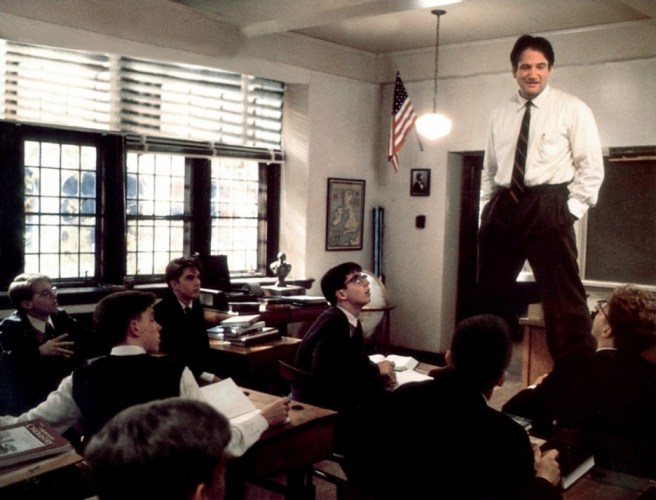
Robin Williams standing on desk in front of classroom of boys

This is the advice Robin Williams had for his classroom of boys in Dead Poet’s Society: 

“So avoid using the word ‘very’ because it’s lazy. A man is not very tired, he is exhausted. Don’t use very sad, use morose. Language was invented for one reason, boys – to woo women – and, in that endeavour, laziness will not do. It also won’t do in your essays.”

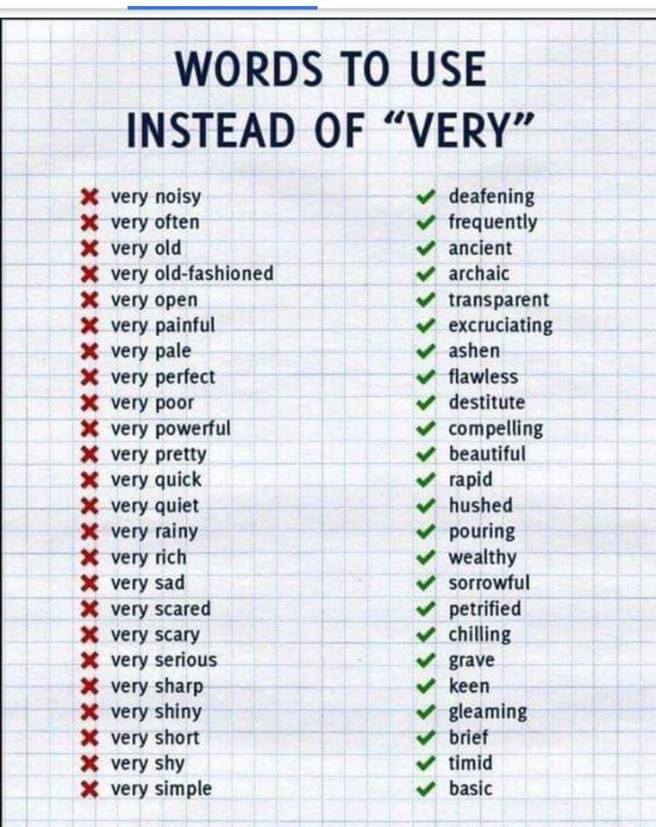
Here are some substitutes for the word ‘very’.

list of words to use instead of 'very'

Sound advice, methinks. Hope you find it useful. I know they teach all this stuff to us in Primary School, but it’s worth a reminder.

Facing the Blank Page

woman in black leather jacket sitting on red chair

When I used to teach classes to beginning writers, it was good.  It forced me to think back to the beginning to when I first put pen to paper.  The thing is, every time we sit down and face the blank page, it’s the same.  Every time we start a new piece of writing, we doubt that we can do it again.  A new voyage with no map.  As people say, it is like setting off towards the horizon, alone in a boat, and the only thing another person can do to help us, is to wave from the shore.

So when I used to teach a creative writing class, I had to tell them the story all over again and remember that this is the first time my students are hearing it.  I had to start at the very beginning.

First up, there’s the pen on the page.  You need this intimate relationship between the pen and the paper to get the flow of words happening.  A fountain pen is best because the ink flows quickly.  We think faster than we can write.  It needs to be a “fat” pen to avoid RSI.

Consider, too, your notebook.  It is important.  The pen and paper are your basic tools, your equipment, and they need to be with you at all times.  Choose a notebook that allows you plenty of space to write big and loose.  A plain cheap thick spiral notepad is good.

After that comes the typing up on the computer and printing out a hard copy.  It’s a right and left brain thing.  You engage the right side of the brain, the creative side, when you put pen to paper, then bring in the left side, the analytic side, when you look at the print out.  You can settle back comfortably with a drink (a cup of tea even) and read what you’ve written.

Then editing and rewriting.

Patrick White said that writing is really like shitting; and then, reading the letters of Pushkin a little later, he found Pushkin said exactly the same thing.  Writing is something you have to get out of you.

Good luck on your creative journey. It’s a tough one. Hang in there and keep writing.

11 Tips: What Makes A Good Story?

portrait of girl wearing christmas hat

Everyone loves a good story. That’s the reason why so many people flock to the movies or spend hours reading novels – it’s because we love to get lost in a great tale. Here are 11 tips from the experts on how to write something fabulous.

1. Tension is the cornerstone of any good story. Eric Nylund

2.  A good story, just like a good sentence, does more than one job at once. That’s what literature is: a story that does more than tell a story, a story that manages to reflect in some way the multilayered texture of life itself. Karen Thompson Walker

3.  Be unpredictable, be real, be interesting. Tell a good story. James Dashner

4.  A good story cannot be devised; it has to be distilled. Raymond Chandler

5.  A good story should make you laugh, and a moment later break your heart. Chuck Palahniuk

6.  Tension is the cornerstone of any good story. Eric Nylund

7.  No, it’s not a very good story – its author was too busy listening to other voices to listen as closely as he should have to the one coming from inside. Stephen King

8.  My only conclusion about structure is that nothing works if you don’t have interesting characters and a good story to tell. Harold Ramis

9.  I do feel that if you can write one good sentence and then another good sentence and then another, you end up with a good story. Amy Hempel

10. I’m just trying to write a good story, strictly from imagination. People just think it’s random, they don’t see the rewriting, phrasing of characters, choosing the words, bringing the world to light in which the characters live in. That creates an illusion that this is real. Eric Jerome Dickey

11. I always try to tell a good story, one with a compelling plot that will keep the pages turning. That is my first and primary goal. Sometimes I can tackle an issue-homelessness, tobacco litigation, insurance fraud, the death penalty-and wrap a good story around it. John Grisham

Hope you find these tips useful. For further reading, check out my posts 3 Parts to a Great Blurb and 10 Ideas for Writing Practice  And to make sure not to miss anything from Libby Sommer Author you can follow me on Facebook  or Instagram.


Where Do We Get Our Story Ideas?

girl learning person studying


“Talking is the first voice of a writer. I always heard it, I just didn’t know you could write it. I write the voices you hear every day—it’s just that people don’t recognize how wonderfully people talk. I think every time a person tells the truth, that person is speaking beautifully.” – Grace Paley

As a writer you’re probably always on red alert looking for story ideas. Maybe you use the world around you, seeking locations and characters and situations, listening in to conversations on buses or trains or in cafes. Changing your daily routine is a way to stimulate the  imagination. Drive or walk to a different part of your suburb or home town and look for different places to write. Writing in cafes is my thing. Challenge yourself to move out of your comfort zone in order to find new ideas. It helps to stay out of routine’s boring rut. I need to be physically comfortable and relaxed when I call on the  muse. Early in my writing career, I wrote sitting up in bed. The ultimate cosy comfort zone. Now a comfy couch in a cafe is my preferred relax place. And when I sit in a cafe to write I always have a printout beside me of the previous day’s writing session. So I’m never staring at a blank page. Helps with the panic, What the hell will I write next?

There’s no better way to find out where to get our story ideas than by hearing from the experts.  Check out some of my favorite authorial quotes below:

“Every secret of a writer’s soul, every experience of his life, every quality of his mind, is written large in his works.”— Virginia Woolf
“And by the way, everything in life is writable about if you have the outgoing guts to do it, and the imagination to improvise. The worst enemy to creativity is self-doubt.”― Sylvia Plath
“Everybody walks past a thousand story ideas every day. The good writers are the ones who see five or six of them. Most people don’t see any.” – Orson Scott
“I want to tell a story, in the old-fashioned way – what happens to somebody – but I want that ‘what happens’ to be delivered with quite a bit of interruption, turnarounds, and strangeness. I want the reader to feel something is astonishing – not the ‘what happens’ but the way everything happens.” –– Alice Munro


“If you haven’t got an idea, write a story anyway.” – William Campbell Gault

Some people keep a container filled with single words and draw out a word each day and write from it. That’s a good way to exercise the writing muscle and to get into the right (rather than left) side of the brain.

Good luck on your search for story ideas. I like to tell people I use anything that moves or makes a noise 🙂

For further reading, check out my posts Writing Tip: Don’t Forget to Pause and Writing Tip: Beating Resistance.  And to make sure not to miss anything from Libby Sommer Author you can follow me on Facebook  or Instagram.

Are First Lines That Important?

toddler reading book

Opening lines are the most important part of your story.

“There are all sorts of theories and ideas about what constitutes a good opening line. It’s a tricky thing, and tough to talk about because I don’t think conceptually while I work on a first draft — I just write. To get scientific about it is a little like trying to catch moonbeams in a jar. But there’s one thing I’m sure about. An opening line should invite the reader to begin the story. It should say: Listen. Come in here. You want to know about this.” – Stephen King

Some of the best opening lines in literature according to Tony Zeoli are:

1. The Bell Jarby Sylvia Plath

“It was a queer, sultry summer, the summer they electrocuted the Rosenbergs, and I didn’t know what I was doing in New York.”

2. Gravity’s Rainbowby Thomas Pynchon

“A screaming comes across the sky.”

3. Cat’s Eyeby Margaret Atwood

“Time is not a line but a dimension, like the dimensions of space.”

4. Blue Nightsby Joan Didion

“In certain latitudes there comes a span of time approaching and following the summer solstice, some weeks in all, when the twilights turn long and blue.”

5. Fahrenheit 451by Ray Bradbury

“It was a pleasure to burn.”

6. David Copperfieldby Charles Dickens

“Whether I shall turn out to be the hero of my own life, or whether that station will be held by anybody else, these pages must show.”

7. The Book of Strange New Thingsby Michel Faber

“Forty minutes later he was up in the sky.”

8. Fear and Loathing in Las Vegasby Hunter S. Thompson

“We were somewhere around Barstow on the edge of the desert when the drugs began to take hold.”

9. Middlesexby Jeffrey Eugenides

“I was born twice: first, as a baby girl, on a remarkably smogless Detroit day in January of 1960; and then again, as a teenage boy, in an emergency room near Petoskey, Michigan, in August of 1974.”

10. The Wavesby Virginia Woolf

“The sun had not yet risen.”

11. The Time Machineby H.G. Wells

“The time traveler (for so it will be convenient to speak of him) was expounding a recondite matter to us.”

12. Lolitaby Vladimir Nabokov

“Lolita, light of my life, fire of my loins.”

13. Slaughterhouse-Fiveby Kurt Vonnegut

“All this happened, more or less.”

14. Sellevisionby Augusten Burroughs

“You exposed your penis on national television, Max.”

15. The Trialby Franz Kafka

“Someone must have slandered Josef K., for one morning, without having done anything truly wrong, he was arrested.”

16. Anna Kareninaby Leo Tolstoy

“All happy families are alike; each unhappy family is unhappy in its own way.”

17. Valley of the Dollsby Jacqueline Susann

“You’ve got to climb to the top of Mount Everest to reach the Valley of the Dolls.”

Good luck!

For further reading, check out my posts Writing Tip: A Change of Pace and Writing Tip: To Plot Or Not To Plot.  And to make sure not to miss anything from Libby Sommer Author you can follow me on Facebook  or Instagram.

Why Use Deep Third Person Limited POV?

person holding silver retractable pen in white ruled book

Why use deep third person limited POV?

Because you can insert internal thoughts from the point-of-view character so the reader can get to know them better. In deep third, you don’t have to put her/his thoughts in first person and italicize them.

I like doing this because it allows me to get deeper inside my character’s head, showing more to the reader. You can bring emotion out in your character using deep third.

Author Ann Laurel Kopchick says, because a first person narrator/character knows that they’re telling a story to the reader. When you’re deep in limited third person, that character/narrator is unaware they are telling a story. The reader is reading the unfiltered thoughts, emotions, and feelings of that character.

Here’s an example of Deep POV from ‘Acting Married’ by Victorine E. Lieske:

She set the tray down on the server against the wall. Super. She’d messed up again. If her training had drilled anything into her head, it was that she was supposed to be invisible and never speak unless spoken to. Why couldn’t she do a simple job? She needed to give them the coffee and get out of there.

Have a read of How to Do Deep POV by Ann Laurel Kopchick.
Some of the topics she writes about include:
  • Don’t just report thoughts and feelings, descend into the character
  • Thoughts and perceptions should be that of the character
  • Use terminology, phrasing, syntax, grammar that the character uses
  • Avoid Filtering

Example with filtering:  She saw the car swerve off the road and head straight for her. She dodged away. “God,” she thought, “I could have been killed!”

Example without filtering:  In a hail of gravel, the car careered off the road and bore down. She threw herself to one side as hot air and metal whooshed passed. God, she could have been killed!

Good luck!

For further reading, check out my posts The Writing Process and Writing Tip: Turn Towards the Inner Critic.  And to make sure not to miss anything from Libby Sommer Author you can follow me on Facebook  or Instagram.