Show, Don’t Tell: The Power of Sensory Writing

cartoon illustrating angry boy with red face

This is an old one, but a good one. Tell Don’t Show.

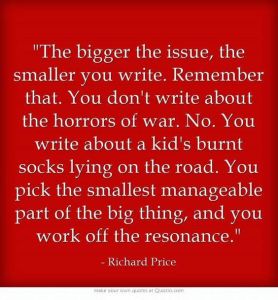
What does it mean exactly? It means don’t tell us about loneliness (or any of those complex words like dishonesty, secrecy, jealousy, obsession, regret, death, injustice, etc) show us what loneliness is. We will read what you’ve written and feel the bite of loneliness.

Don’t tell us what to feel. Show us the situation, and that feeling will be triggered in us.

When you take your child to school on their first day you may find yourself teary and relieved at the same time. Put into words what you see: the child’s face, the wave at the gate, the other mothers saying their goodbyes, another child coming up to take your son by the hand. We will get what you’re trying to say without you telling us directly.

The how-to-write books tell us to use our senses when we write stories:  sight, sound, smell, touch. Writing from the senses is a good way to penetrate your story and make friends with it. Don’t tell us about something, drop deep, enter the story and take us with you.

What about you? Do you consciously bring the senses into your creative writing?

My Poem, ‘Bewildered’

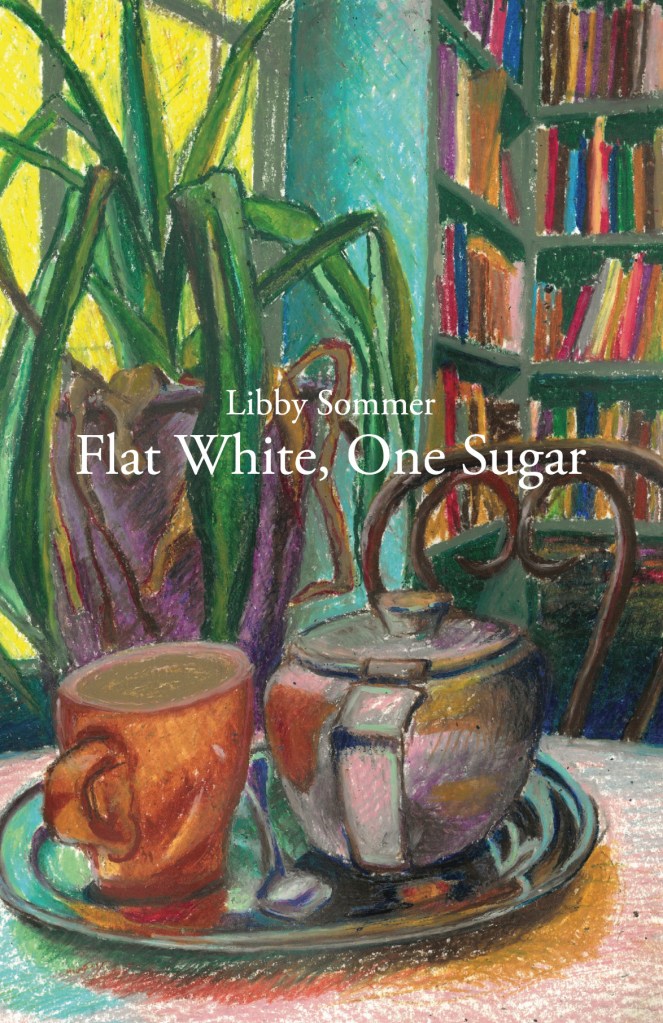
Have a read of my poem ‘Bewildered’, first published in Quadrant Magazine and one of the poems in my collection, ‘Flat White, One Sugar‘ (Ginninderra Press). The book is illustrated by my granddaughter, Natasha Sommer, a graduate of the National Art School.

I hope you enjoy it.

Bewildered:

When I was four

I asked my big brother

Is mum the wicked

queen from Snow White?

He fell about with laugher,

then wrestled me to the ground

using his knees to pin

my shoulders to the floor.

My brother, the bully.

But I loved him.

Years later, when our mother said she

had heart problems, my brother told her

it was impossible.

How can you? he said.

You don’t have a heart.

The questions still disturb me to this day.

Copyright 2024 Libby Sommer

Writing Tip: We Taste Life Twice

Anais Nin famously said that we write to taste life twice, in the moment and in retrospect.

And Natalie Goldberg: “Writers live twice. They go along with their regular life, are as fast as anyone in the grocery store, crossing the street, getting dressed for work in the morning. But there’s another part of them that they have been training. The one that lives everything a second time. That sits down and sees their life again and goes over it. Looks at the texture and the details.” 

Fabulous quotes. Do you agree with them?

Tactics

Have a read of my poem ‘Tactics’, first published in Quadrant Magazine. ‘Tactics’, inspired by my own struggles on the tennis court, is one of the poems in my latest poetry collection, ‘Flat White, One Sugar‘, Ginninderra Press.

I hope you enjoy it.

Tactics:

A woman is hitting back & forth

across the net, a peaked cap

secured by her ponytail.

Can she overcome the self-doubt,

anxiety & lapses of concentration?

She mustn’t let her mind

be the winner in this battle.

Right here, right now,

she’s in control,

even in the wind,

alternating her drives

to the far corners of the court.

Nothing distracts her,

not the noisy leaf blower

or her male opponent

with superior physical strength.

Tactics are her best weapon.

Now she is serving,

tossing the ball high,

straight as an arrow,

reaching up,

accelerating,

out wide

to his lefthanded backhand.

She ignores her cap

escaping with the wind

as she executes

a perfect follow through.

She smiles.

Ace! It’s an ace.

Copyright 2025 Libby Sommer

Writing Tip: Writing in Cafes

I am sitting in a café across the road from a Sydney beach. This stretch of road has a whole row of cafes side by side facing the sea.  This is my favourite kind of writing place:  one where I can sit comfortably for a long period of time and where the owners of the café know me and welcome me.  This café is owned by a Brazilian man and his wife and has comfortable upholstered bench chairs with a direct view of the Pacific Ocean.  For my two-hour writing session my choice could be a traditional Brazilian dish such as Coxinha, Feijoda or Moqueca.  Or a cocktail like Caipirinha or  Caipiroska.  I must order something and it must be more that a Long Black, because I plan to be here for some time.  I want the owners of the café to know I appreciate the time and the space they are allowing me.

However, today I’ll be very boring and order poached eggs on gluten-free bread 

Why go to all this trouble to find a place to write?  Why not just stay home and work?  Because it’s good to get out and have a change of scene.  I find I need to be happy and relaxed when I’m creating on the page and sitting in a café with a pleasant vibe works for me.  Other writers need silence in order to concentrate, but I need to feel I am out and about in a beautiful place having a good time before the creative juices flow.

Strangely, working in a café can help to increase concentration.  The busy café atmosphere keeps the sensory part of you occupied and content, so that the hidden, quieter part of you that composes and focuses is allowed to do its work.  It is something like being cunning when trying to get a spoonful of food into a resistant toddler’s mouth .  You pretend to be an aeroplane with all the sound effects and movements before landing the food-laden plane inside the child’s mouth.  Mission accomplished.

What about you?  Do you need to be at your desk in total silence in order to write, or do you like to experience the swell of humanity around you—to be surrounded by other human beings?  Or at home listening to a particular kind of music?

Do You Like Spiders?

Have a read of my poem ‘Weavers’, first published in Quadrant Magazine. Let me know what you think. ‘Weavers’ is one of the pieces in my second poetry collection ‘Flat White, One Sugar’ (Ginninderra Press).

Weavers:

A well-hidden spider

created patterns

outside my office window

against the wooden frame.

I’d see the new progression

of her magnum opus

from my writing desk.

I’d be weaving plot entanglements

and she’d have shown off

her vision

to fast-moving days

as the year raced to its ending.

In the afternoons I’d be outside

hanging washing

picking up broken branches

watering herbs

and she’d have converted

moths and small flies into

sticky brown blobs.

A kookaburra laughed

from the clothesline.

Daily spider prompts helped drive me,

our compulsions to create on either

side of the glass.

One day the cleaner

sprayed the windows,

splattered and splashed,

with his power-hose.

By noon all surfaces

shone brightly.

Did the spider live?

Did she find a different hideout?

Her masterpiece is imprinted

on my brain:

its scaffolding

beginnings,

endings.

Copyright 2025 Libby Sommer

Writing Tip: Slow Things Down

So, here’s the thing: choose something in particular to write about. For example, what it felt like having a tennis lesson after a twenty year break. Give us the specifics. Dig deep for the details, but at the same time be aware of the world around you. As you focus on what you’re writing, at the same time stay conscious of your surroundings:  the white painted cane Bentwood chairs in the café, the cool breeze from under the door on your sandaled feet, the hum of the traffic outside. Just add a sentence every now and then about the trees that overlooked the tennis courts while you were having a tennis lesson. When we focus on our writing it is good. Seeing the colour of the sky when you toss the ball gives breathing space to your story.

If you are sitting in Meditation you calm the butterfly mind by paying attention to your thoughts, giving them space by acknowledging them before returning to the breath, in and out through the nostrils. In the act of slowing down your breathing, as best you can, you remain open so that you are receptive to awareness of sounds as they arise: sounds near, sounds far, sounds in front, behind, to the side, above or below.

With every breath you take, you feel the air, the sound of the ball as it hits the racket, the  players on the other courts.

We should always be living in the present, not by ignoring the world around us, but by paying close attention. It is not easy to stay alive to ‘what is’. When we slow things down in our writing, it is good practice.

What about you? Do you find a daily meditation practice assists your writing practice?

My Poem ‘What Could We Say?’

Have a read of my poem ‘What Could We Say?’ first published in Quadrant Magazine. It is one of the poems in my latest collection ‘Flat White, One Sugar‘ (Ginninderra Press).

I hope you enjoy it.

What Could We Say?:

Before dawn’s soft lightening,

rain stills itself on flat roofs

in pools of stagnant water.

Each morning we hear

a car speed up the hill

and dark recurring dreams

which tossed and turned

our restless selves, leave us

twisted in the sheets.

Now we start

warming rooms,

opening blinds.

Into the silence,

tight with the unspoken,

our thoughts pokerfaced

– space enough not given or seized –

moments hang,

more half-empty

than half-full.

Copyright 2024 Libby Sommer

The Writing Life

Another of my favourite books on the writing process is The Writing Life by Annie Dillard. A small and passionate guide to the terrain of a writer’s world.

Annie Dillard has written eleven books, including the memoir of her parents, An American Childhood; the Northwest pioneer epic The Living; and the nonfiction narrative Pilgrim at Tinker Creek winner of the 1975 Pullizer Prize.  A gregarious recluse, she is a member of the American Academy of Arts and Letters.

“For non-writers, The Writing Life is a glimpse into the trials and satisfactions of a life spent with words. For writers, it is a warm, rambling, conversation with a stimulating and extraordinarily talented colleague.””–Chicago Tribune””A kind of spiritual Strunk & White, a small and brilliant guidebook to the landscape of a writer’s task…Dillard brings the same passion and connective intelligence to this narrative as she has to her other work.”– “Boston Globe””For her book is…scattered with pearls. Each reader will be attracted to different bright parts…Gracefully and simply told, these little stories illuminate the writing life…Her advice to writers is encouraging and invigorating.”– “Cleveland Plain Dealer””The Writing Life is a spare volume…that has the power and force of a detonating bomb…A book bursting with metaphors and prose bristling with incident.”– “Detroit News”

Dillard begins:

When you write, you lay out a line of words. The line of words is a miner’s pick, a woodcarver’s gouge, a surgeon’s probe. You wield it, and it digs a path you follow. Soon you find yourself deep in new territory. Is it a dead end, or have you located the real subject? You will know tomorrow, or this time next year. You make the path boldly and follow it fearfully. You go where the path leads. At the end of the path, you find a box canyon. You hammer out reports, dispatch bulletins. The writing has changed, in your hands, and in a twinkling, from an expression of your notions to an epistemological tool. The new place interests you because it is not clear. You attend. In your humility, you lay down the words carefully, watching all the angles. Now the earlier writing looks soft and careless. Process is nothing; erase your tracks. The path is not the work. I hope your tracks have grown over; I hope birds ate the crumbs; I hope you will toss it all and not look back.

Which books on writing process have you found to be inspiring?

My Poem, ‘Flat White, One Sugar’

Have a read of my poem ‘Flat White, One Sugar’ first published in Quadrant Magazine. It is the title poem in my latest collection ‘Flat White, One Sugar‘ (Ginninderra Press).

I hope you enjoy it.

Flat White, One Sugar:

Up above is special to the birds.

A new craft beer is special to schooner-lovers,

who know it will have a unique aftertaste

before they’ve even had a sip.

The beanie warming the newborn

is special to the mum

swaddling her in hospital.

The cough is special, wretchedly, to the throat.

The wish you hold secretly inside yourself

is special to your being.

The gumboots are special to dry feet,

more special than the joggers,

which are special only in the gym.

The video of the runners

is not special to the owner of the phone

but is special to the competitors in the race.

I don’t want to be special to baristas

who ask how was my weekend,

or people bent over hand-held devices,

not special to those who don’t listen

when I answer their questions.

I want to be as special

as a morning coffee addiction,

but in the way a scarf is special,

or warm gloves,

not because they stand out from the crowd,

but because they know

they give comfort to others.

Copyright 2024 Libby Sommer