Writing Tip: Slow Things Down

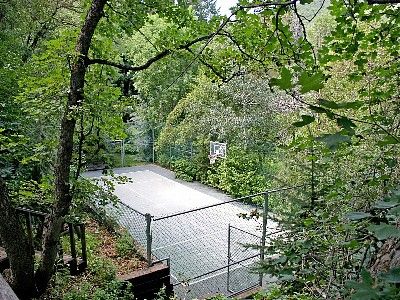
tennis court surrounded by green leafy trees

So, here’s the thing:  choose something in particular to write about. For example, what it felt like having a tennis lesson after a twenty year break. Give us the specifics. Dig deep for the details, but at the same time be aware of the world around you. As you focus on what you’re writing, at the same time stay conscious of your surroundings:  the white painted cane Bentwood chairs in the café, the cool breeze from under the door on your sandaled feet, the hum of the traffic outside. Just add a sentence every now and then about the trees that overlooked the tennis courts while you were having a tennis lesson. When we focus on our writing it is good. Seeing the colour of the sky when you toss the ball gives breathing space to your story.

If you are sitting in Meditation you calm the butterfly mind by paying attention to your thoughts, giving them space by acknowledging them before returning to the breath, in and out through the nostrils. In the act of slowing down your breathing, as best you can, you remain open so that you are receptive to awareness of sounds as they arise: sounds near, sounds far, sounds in front, behind, to the side, above or below.

With every breath you take, you feel the air, the sound of the ball as it hits the racket, the  players on the other courts.

We should always be living in the present, not by ignoring the world around us, but by paying close attention. It is not easy to stay alive to ‘what is’. When we slow things down in our writing, it is good practice.

What about you? Do you find a daily meditation practice assists your writing practice?

Fortnightly Story: Undulations

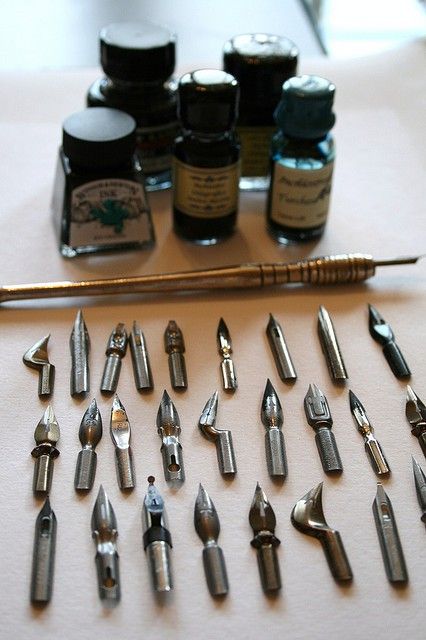
pen nibs and bottles of ink on a desk

So we’re sitting in Melbourne in a vegan restaurant reminiscing about our school days spent mucking-up in the back row and Jane (her hair still red, short and frizzy, like childhood) remembers daring me to ask our fourth-grade Geography teacher how to spell ‘undulations’.  What?  “Because I wanted to write her a message,” Jane says.  “An unsigned message saying, ‘The way you run your hands over your boobs to demonstrate undulations is disgusting,’ but didn’t know how to spell it.  So I told you that if you were my friend, you’d ask her.  You know how she always said to speak up if we couldn’t spell something?  For some reason she wrote the word down on a piece of paper, rather than on the blackboard.  Maybe she thought you couldn’t see properly from our eyrie.  So you got back to your desk and passed it to me under the chair.  I wrote in my best handwriting, ‘Your demonstrations of undulations are gross,’ blotted it carefully, and placed it furtively on her table after the recess bell had cleared the room.  When we filed in after lunch, I saw her open it up.”  Jane taps me on the arm enthusiastically.  “What happened then?” I say.  “Was she angry?  Did she think it was me?  Did I get punished?”  How forgetful was I?  Jane had mastered the art of getting the ink from the inkwell to the pen nib to the paper—no ugly blotches—her cursive as good as a professional engraver’s.  Even after all this time, she still prefers a fountain pen and has a proclivity for setting wrongs right.  “She threw the chalk in the bin, reached for her cardigan and draped it over her shoulders,” Jane says, grinning.  “Yes, that’s what happened.  And she didn’t demonstrate undulating landscapes on herself or on any of us ever again.”

Copyright © 2016 Libby Sommer

First published in Quadrant

Use Declarative Sentences

speech bubble: I'm going to make him an offer he can't refuse
Pinterest image

This declarative sentence was spoken by Don Corleone (played by Marlon Brando) in the movie The Godfather (1972).


It is not uncommon for women and other minority groups to add qualifiers to their statements. Such as ‘Parents need to stop organising every minute of their children’s spare time, don’t you think?’ ‘I loved that movie, didn’t you?’ In our sentence structure we look for reinforcement for our thoughts and opinions. We don’t always make declarative statements. ‘This is wonderful.’ ‘This is a catastrophe.’ We look for re-enforcement from others.

Another thing we do without realising it, is use indefinite modifiers in our speech:  perhaps, maybe, somehow. ‘Maybe I’ll take a trip somewhere.’ As if the speaker has no power to make a decision. ‘Perhaps it will change.’ Again, not a clear declarative sentence like, ‘Yes, nothing stays the same.’

It is important for us as writers to express ourselves in clear assertive sentences. ‘This is excellent.’ ‘It was a red dress.’ Not ‘The thing is, I know it sounds a bit vague, but I think maybe it was a red dress.’ Speaking in declarative sentences is a good rehearsal for trusting your own ideas, in standing up for yourself, for speaking out your truth.

When I write poetry I read through early drafts with a critical eye, taking out indefinite words and modifiers. I attempt to distill each moment to its essence by peeling off the layers until the heart of the poem is exposed. We need to take risks as writers and go deep within ourselves to find our unique voices and express ourselves with clarity.

Even if you are not 100% sure about your own opinions and thoughts write as if you are sure.  Dig deep. Be clear. Don’t be vague on the page. If you keep practicing this, you will eventually reveal your own deep knowing.


What about you? Have you noticed this tendency to qualify in your conversations with others, or in your creative writing, or in blog posts?

Writing in Cafes

cafes, buses, palm trees, bright blue sky, cars on Bronte Road, Bronte

I am sitting in a café across the road from the beach in Bronte, Sydney.  This stretch of road has a whole row of cafes side by side facing the sea.  This is my favourite kind of writing place:  one where I can sit comfortably for a long period of time and where the owners of the café know me and welcome me.  This café is owned by a Brazilian man and his wife and has comfortable upholstered bench chairs with a direct view of the Pacific Ocean.  For my two-hour writing session my choice could be a traditional Brazilian dish such as Coxinha, Feijoda or Moqueca.  Or a cocktail like Caipirinha or  Caipiroska.  I must order something and it must be more that a Soy Cap, because I plan to be here for a long time.  I want the owners of the café to know I appreciate the time and the space they are allowing me.

However, today I’ll be very boring and order poached eggs on gluten-free bread 🙂

Why go to all this trouble to find a place to write?  Why not just stay home and work?  Because it’s good to get out and have a change of scene.  I find I need to be happy and relaxed when I’m creating on the page and sitting in a café with a pleasant vibe works for me.  Other writers need silence in order to concentrate, but I need to feel I am out and about in a beautiful place having a good time before the creative juices flow.

Strangely, working in a café can help to increase concentration.  The busy café atmosphere keeps the sensory part of you occupied and content, so that the hidden, quieter part of you that composes and focuses is allowed to do its work.  It is something like being cunning when trying to get a spoonful of food into a resistant toddler’s mouth .  You pretend to be an aeroplane with all the sound effects and movements before landing the food-laden plane inside the child’s mouth.  Mission accomplished.


What about you?  Do you need to be at your desk in total silence to write, or do you like to experience the swell of humanity around you—to be surrounded by other human beings?  Or at home listening to a particular kind of music?

5 ways to promote your blog for free & efficiently — Roberta Pimentel

Blogger Roberta Pimentel shares some excellent tips on ways to increase traffic to your WordPress blog site:

It has been a while since I have given tips and advice to my readers but now I have scheduled advice and tips to be on Wednesdays. I am really exited about the new schedule since I am also challenging myself to do something new for my readers but off course I do learn a […]

via 5 ways to promote your blog for free & efficiently — Roberta Pimentel

The Writing Life

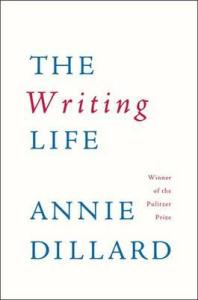
Book cover 'The Writing Life' by Annie Dillard

Another of my favourite books on the writing process is The Writing Life by Annie Dillard, a small and passionate guide to the terrain of a writer’s world.

Annie Dillard has written eleven books, including the memoir of her parents, An American Childhood; the Northwest pioneer epic The Living; and the nonfiction narrative Pilgrim at Tinker Creek winner of the 1975 Pullizer Prize.  A gregarious recluse, she is a member of the American Academy of Arts and Letters.

Continue reading

Fortnightly Story: The Backpack


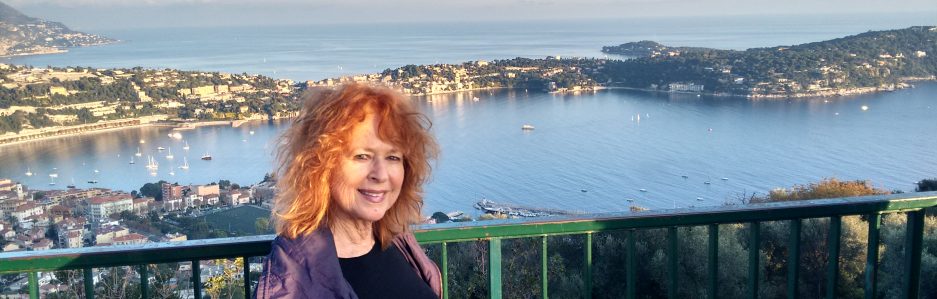
view of Villefranche sur Mer harbour from Mt Baron

What can a man who meets you at the station and offers to carry your backpack mean to a woman traveling the world alone?

I was scared, like anyone who has no sense of direction.  The journey was a series of stops and starts.  Whether to use the Eurail pass or post it back home and ask the kids to get me a refund.  Giovanni appeared one European winter, thick padded jacket, woolen beanie, scarf and gloves, tall and imposing,  I’ll carry your bag.

I was small, the backpack the length of my spine, the zip-off bag on one shoulder, the daypack positioned in front like a nine-month baby bump.  That evening, as we climbed the steps of the Corniche – the wind bitter across the Mediterranean, the metal stairs covered with slippery ice, the railing melting beneath my hand.  Soon it would become my railway platform, my steps, and Giovanni my landlord.

We walked there in the crisp night air.  My own place.  It didn’t cost much.  No-one yet knew I was here.  I could ask Giovanni if I needed any help.  I knew my children would be pleased I had a base.  I didn’t want them to worry.  It was the thing I wanted the most secretly, studying maps, absorbing travel books.  To be safe, a desire whispered to the moon that moved behind my shoulder at night.  If you guide me to a safe haven I promise to be happy.  And the moon listened.  I did my best.

The winter sky closed down and the spring began its flowering.  I took photos and painted and rang the children every week.  Watch your money, don’t talk to strangers, be careful walking at night – you know the drill.  The pebbly beach, the weekend markets, it was all there for the exploring.  A glimpse of the sea between terracotta roofs – a vision in turquoise.  The cobbled streets could show which way to follow – and none of them wrong.  A room at the top of the stairs – till June I stayed reading the English books Giovanni had left in the bookcase, shopping for food, telling my kids and friends they should come for a visit.

Where had the months gone?  Almost two years on the road.  Summer approached. The rents would go up and the tourists arrive.  Time to move on.  I could only take with me what I could carry on my back.  A Jewish gypsy they said.  One more step into the unknown.  Pack up, give away what I couldn’t manage, but keep the palette knife and miniature easel.  There was stuff happening back home.    The boys were grown and earning a living.  Their sister turned twenty-one.  People were reinventing themselves all over the place then coming back home.  A thousand train rides later, my mother nearly eighty.  I won’t be around much longer, she cried.

His was a helping hand in a world that says, but what are you doing there?  What are you doing?

First published in Quadrant

Copyright © Libby Sommer 2016
 

Becoming A Writer

yellow sunflower bookcover of Becoming A Writer by Dorothea Brande

I highly recommend this book a friend from London gave me many years ago at the beginning of my writing journey.

‘A reissue of a classic work published in 1934 on writing and the creative process, Becoming a Writer recaptures the excitement of Dorothea Brande’s creative writing classroom of the 1920s. Decades before brain research “discovered” the role of the right and left brain in all human endeavor, Dorothea Brande was teaching students how to see again, how to hold their minds still, how to call forth the inner writer.’ – Amazon

‘Refreshingly slim, beautifully written and deliciously elegant, Dorothea Brande’s Becoming a Writer remains evergreen decades after it was first written. Brande believed passionately that although people have varying amounts of talent, anyone can write. It’s just a question of finding the “writer’s magic”–a degree of which is in us all. She also insists that writing can be both taught and learned. So she is enraged by the pessimistic authors of so many writing books who rejoice in trying to put off the aspiring writer by constantly stressing how difficult it all is.

With close reference to the great writers of her day–Wolfe, Forster, Wharton and so on–Brande gives practical but inspirational advice about finding the right time of day to write and being very self disciplined about it–“You have decided to write at four o’clock, and at four o’clock you must write.” She’s strong on confidence building and there’s a lot about cheating your unconscious which will constantly try to stop you writing by coming up with excuses. Then there are exercises to help you get into the right frame of mind and to build up writing stamina. She also shows how to harness the unconscious, how to fall into the “artistic coma,” then how to re-emerge and be your own critic.

This is Dorothea Brande’s legacy to all those who have ever wanted to express their ideas in written form. A sound, practical, inspirational and charming approach to writing, it fulfills on finding “the writer’s magic.”‘ – John Gardner