
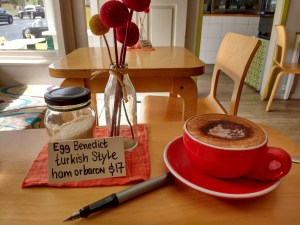
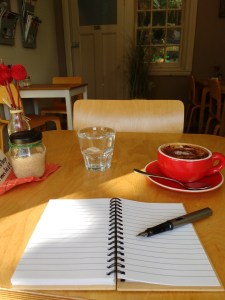
I am sitting in a café across the road from the beach in Bronte, Sydney. This stretch of road has a whole row of cafes side by side facing the sea. This is my favourite kind of writing place: one where I can sit comfortably for a long period of time and where the owners of the café know me and welcome me. This café is owned by a Brazilian man and his wife and has comfortable upholstered bench chairs with a direct view of the Pacific Ocean. For my two-hour writing session my choice could be a traditional Brazilian dish such as Coxinha, Feijoda or Moqueca. Or a cocktail like Caipirinha or Caipiroska. I must order something and it must be more that a Soy Cap, because I plan to be here for a long time. I want the owners of the café to know I appreciate the time and the space they are allowing me.
However, today I’ll be very boring and order poached eggs on gluten-free bread 🙂
Why go to all this trouble to find a place to write? Why not just stay home and work? Because it’s good to get out and have a change of scene. I find I need to be happy and relaxed when I’m creating on the page and sitting in a café with a pleasant vibe works for me. Other writers need silence in order to concentrate, but I need to feel I am out and about in a beautiful place having a good time before the creative juices flow.
Strangely, writing in a café can help to increase concentration. The busy café atmosphere keeps the sensory part of you occupied and content, so that the hidden, quieter part of you that composes and focuses is allowed to do its work. It is something like being cunning when trying to get a spoonful of food into a resistant toddler’s mouth: You pretend to be an aeroplane with all the sound effects and movements before landing the food-laden plane inside the child’s mouth. Mission accomplished.
It is preferable not to turn up at a cafe for a cup of coffee and a writing session at the cafe’s busiest times, like breakfast or lunch. Go at the in between hours when they are pleased to see you because they don’t want the place to look deserted. The beach cafes are places I frequent in spring, autumn and winter, but not much in the summer. Far too crowded and noisy.
There is a real art to finding the right place to write. For me the best place is one that has comfortable chairs, a pleasant outlook (preferably a view of the the sky and/or green or water). A welcoming, almost homely, atmosphere.
What about you? Do you need to be at your desk in total silence to write, or do you like to experience the swell of humanity around you—to be surrounded by other human beings? Or at home listening to a particular kind of music? Let me know in the comments and please share this post with a friend if you enjoyed it.











 Libby Sommer, Author