Why Do You Write?

woman lying on green grass while holding pencil

It’s a tough gig being a writer. Lots of isolation, lots of intense concentration, lots of rejection from publishers and agents.

Why do I write? It’s a good question to ask yourself.

  1.  Because I’m a fool.
  2.  Because I want to impress my old school friends.
  3.  So people will like me.
  4.  So my friends will hate me.
  5.  I’m no good at speaking up.
  6.  So I can invent a new way of looking at the world.
  7.  In order to write the great Australian novel and become famous.
  8.  Because I’m a nut case.
  9.  Because I’m an undiscovered literary genius.
  10.  Because I have something to tell.
  11.  Because I have nothing to tell.

One of my favourite books on the writing process is The Writing Life by Pullitzer Prize winning Annie Dillard. It’s a small and passionate guide to the terrain of a writer’s world.

Dillard begins:

When you write, you lay out a line of words. The line of words is a miner’s pick, a woodcarver’s gouge, a surgeon’s probe. You wield it, and it digs a path you follow. Soon you find yourself deep in new territory. Is it a dead end, or have you located the real subject? You will know tomorrow, or this time next year. You make the path boldly and follow it fearfully. You go where the path leads. At the end of the path, you find a box canyon. You hammer out reports, dispatch bulletins. The writing has changed, in your hands, and in a twinkling, from an expression of your notions to an epistemological tool. The new place interests you because it is not clear. You attend. In your humility, you lay down the words carefully, watching all the angles. Now the earlier writing looks soft and careless. Process is nothing; erase your tracks. The path is not the work. I hope your tracks have grown over; I hope birds ate the crumbs; I hope you will toss it all and not look back.

There is a famous story in the Zen world:

The student, newly arrived at the monastery, asks the master, “What work will I do as I seek enlightenment?”

The master replies, “Chop wood, carry water.”

“And what work will I do once I achieve enlightenment?” asks the student.

“Chop wood, carry water,” says the master.

So how does this stay apply to the writing life? A writer writes. That’s all there is to it.

“A writer who waits for ideal conditions under which to work will die without putting a word on paper.” —E. B. White

What about you? Why do you write?

18 Years of Notes and Cards

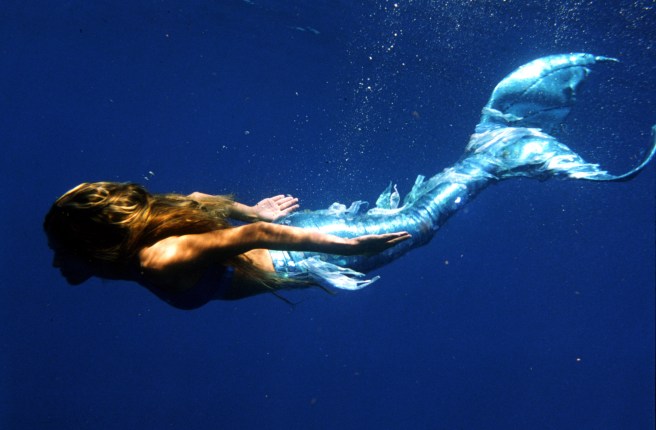
woman dressed as mermaid swimming underwater

The year is 2000. I’m slogging away at a Masters in Writing at UTS. I’d had two careers already, in film and television production at the ABC (an engine-room role) and as Principal of my own PR agency, but my dream had always been to become a writer. My children were grown up and living their own lives. One day towards the end of that year the phone rang and someone left a message saying they were Les Murray. Ha ha, I thought. As if Australia’s most famous living poet would be ringing me. I had sent a story titled Art and the Mermaid to the address on the Quadrant website. Imagine my disbelief and indescribable joy when I found out it wasn’t a friend playing a trick on me, but was in fact the real Les Murray, Literary Editor of Quadrant. He said he’d like to take Art and the Mermaid for Quadrant.

That phone call began an 18-year friendship and working relationship. It changed my life.

The thrill of seeing my work published regularly in Quadrant has given me credibility as a fiction writer and, more recently, as a poet. I’ve felt encouraged to continue to explore unique ways of expressing my thoughts and ideas.

Where would I be if it wasn’t for Les Murray? My writing career may never had started, or continued. To date, three books published, a fourth coming out next year – each book containing chapters that were first published in Quadrant.

Les’s inclusion of my work in the magazine has been instrumental in my development. He’s lifted my confidence, inspired me and made me proud of being a writer. Published in Quadrant was public validation and acceptance into the literary world.

We communicated about my stories and poetry through notes and postcards over all these years: I’d post him a submission and a short letter and he’d respond with either a chatty postcard to say ‘Yes’, or a note saying ‘Alas, …’

When Quadrant published my first story Art and the Mermaid in 2001, I had no idea the next 18 years would lead to 22 more stories and 4 poems published in Quadrant.

With the retirement of Les Murray as Literary Editor, it’s the poignant end of the era of Les at Quadrant. However, Les’s impact continues through the new and established writers he has fostered and who continue their careers. I am forever grateful that I was one of those writers. Congratulations. Literary Editor at Quadrant since March 1990.

Here is my story Art and the Mermaid, first published in Quadrant:

Once upon a time it came to pass, so it is said, that an enormous storm swept the coast of New South Wales, doing extensive damage to the ocean beaches – destroying jetties, breakwaters and washing away retaining walls.  Mountainous seas swept Bondi Beach and dashed against the cliffs carrying ruin with every roller.  At North Bondi near Ben Buckler a huge submerged block of sandstone weighing 233 tons was lifted ten feet and driven 160 feet to the edge of the cliff where it remains to this day.

One day a Sydney sculptor, Lyall Randolph, looked upon the rock and was inspired.  The sculptor was a dreamer.  Let us, he said, have two beautiful mermaids to grace the boulder.  Using two Bondi women as models he cast the two mermaids in fibreglass and painted them in gold.

Without Council approval and at his own expense he erected The Mermaids for all to see on the giant rock that had been washed up by the sea.  The Mermaids sat side by side on the rock.  One shaded her eyes as she scanned the ocean and the other leant back in a relaxed fashion with an uplifted arm sweeping her hair up at the back of her neck.  Their fishy tails complemented the curves and crevices of their bodies.

It so happened that less than a month after The Mermaids were put in place, one was stolen and damaged.  The Council held many meetings to decide if she should be replaced using ratepayers’ money.  The council had previously objected to the sculptor placing the statues there without Council permission.  The sculptor had argued that before placing The Mermaids in position he had taken all necessary steps to obtain the requisite permission.

The large boulder at Ben Buckler, upon which The Mermaids were securely bolted and concreted, he said, is not in the municipality of Waverley at all.  It is in the sea.  According to the Australian Constitution high-tide mark is the defined limit of the Waverley Council’s domain.  The Maritime Services Board and the Lands Department both advised me they had no objection to the erection of The Mermaids.

One Waverley Alderman said he wished both mermaids had been taken instead of only one.  Someone else said the sculptor didn’t need the Council’s permission to put them there in the first place and the The Mermaids had given Bondi a great attraction without any cost to the Council.  The sculptor said The Mermaids had brought great publicity to the Council.  They had been featured in films, newspapers, television and the National Geographic magazine.

The Mayor used his casting vote in favour of the mermaid and she was re-installed.

For over ten years the two beautiful golden mermaids reclined at Ben Buckler, attracting many thousands of sightseers to the beach.

Poised on the huge boulder they braved the driving storms of winter until one day one was washed off.  The Council saw its opportunity and removed the other.

Today, only the remnants of one mermaid remain – but not on the rock.  In a glass cabinet in Waverley Library at Bondi Junction all that is left of the two beautiful mermaids is a figure with half a face.  There’s a hole instead of a cheek, a dismembered torso, part of an uplifted arm, the tender groove of an armpit.  And there, down below, a complete fish’s tail.

Copyright © 2018 Libby Sommer

Header image:  Creative Commons

Is There A Link Between Spirituality and Creativity?

photo of golden gautama buddha

What is the relationship between spirituality and creativity? The discipline and focused attention cultivated through meditation help us do one thing at a time, totally and absolutely, which greatly enhances our writing.

‘Contemplative practice, daily nature walks, and still, silent listening can be among the best natural meditations. They help clarify our minds and uplift the heart, dissolving our ordinary preoccupations and mental states that dissipate the fertile spirit within. Such daily disciplines are also excellent tonics for our agitated, febrile brains and weary bodies. When we ease into the realm of non-doing–what Chinese Buddhists called wu wei–there is more room for our mysterious, unfabricated inner self to naturally emerge.’ – Lama Surya Das

It’s tough being a writer. Very tough. As Thomas Mann says, A writer is someone for whom writing is more difficult than it is for other people.

Dinty Moore, in his book The Mindful Writer, Noble Truths of the Writing Life, says his lifelong pursuit of writing and creativity has helped to open him to the path of Buddhism:

‘Find inspiration and insight on writing as a spiritual practice through astute quotes, thoughtful advice, and productive exercises on both mindfulness and craft.  This isn’t your typical “how to write” book. Author Dinty W. Moore, a well-respected writing coach and teacher, thoughtfully illuminates the creative process: where writing and creativity originate, how mindfulness plays into work, how to cultivate good writing habits and grow as a person, and what it means to live a life dedicated to writing.’ – The Mindful Writer

Here’s to Mindfulness and Meditation to help us on our way through our roller coaster lives as creative writers.


What Is a Prose Poem?

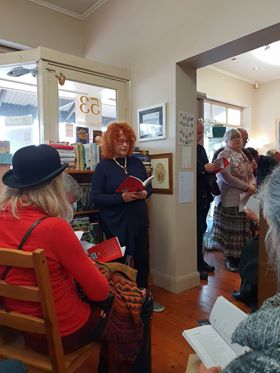
reading from Wild poetry anthology in bookstore


What is a prose poem?

‘Though the name of the form may appear to be a contradiction, the prose poem essentially appears as prose, but reads like poetry. In the first issue of The Prose Poem: An International Journal, editor Peter Johnson explained, “Just as black humor straddles the fine line between comedy and tragedy, so the prose poem plants one foot in prose, the other in poetry, both heels resting precariously on banana peels.”

‘While it lacks the line breaks associated with poetry, the prose poem maintains a poetic quality, often utilizing techniques common to poetry, such as fragmentation, compression, repetition, and rhyme. The prose poem can range in length from a few lines to several pages long, and it may explore a limitless array of styles and subjects.’ -The Academy of American Poets

I rather enjoy writing prose poetry and am slowly (very slowly) working on a collection of published short pieces. Here is one of my Flash Fictions (a close relative of the Prose Poem), first published in Quadrant magazine, October 2014. Hope you like it.

Tell Me About What Happened On New Year’s Eve

I’d looked out the top-floor hospital window towards Coogee to the night sky lit by fireworks and saw the miserable face of the moon and thought that I’d never felt as detached from life as at that moment.  At the same time, I realised that I probably felt so despicable due to the weeks spent lying in hospital and the excruciatingly slow and painful road to recovery.   By sheer force of will, I stopped looking at the dark mirror of the moon.  No one could have told me how much the distant celebrations, the sound of the explosions and the changing shapes and colours of the fireworks could jolt me into the present and away from the unbearable lethargy, the severed muscles and tendons and the nausea caused by the drugs and pain killers.  Was it that I could sense, without glancing up again, that clouds were making their way across the moon and that made me realise:  how would it be to feel this would be your last new year?

Copyright © Libby Sommer


Writing Tip: A Sense of Place

person woman desk laptop

I’m sitting at my writing desk this spring morning in Sydney thinking about the need to ground our writing in a sense of place, whether landscape or cityscape.

How often have you heard someone say of a book they loved:  ‘I felt like I was there’.

Even if you relocate the cafe overlooking tennis courts at Cooper Park, the sound of tennis balls being hit, a poodle tied to a fake-cane chair at the table of older men after their regular Sunday tennis match that you drank a lemongrass and ginger tea at in Sydney into a café in a story in another state and time, the story will have originality and believability.  ‘But that café was in Sydney, I can’t transport it to Adelaide.’  But you can.  You can have flexibility with specific detail.  The mind is able to transport details, but using actual places that you experienced will give your writing authenticity and truthfulness.  It grounds your work in place, giving life and vitality to your writing, rather than a whole lot of exposition that floats in the air.

 If you don’t create evocative settings, your characters seem to have their conversations in vacuums or in some beige nowhere-in-particular. –  Jerome Stern

Creation of the physical world is as important to your story as action and dialogue.  If your readers can be made to see the hand-knitted socks or the row of vitamins on the kitchen benchtop, the scene becomes alive.  Readers pay attention.  Touch, sound, taste, and smell make readers feel as if their own feet are warm under the cold sheets.

Place situates the story in your reader’s mind.  Fiction that seems to happen in no particular place often seems not to take place at all. –  Jerome Stern

I hope this is helpful. Do you have any suggestions you would add? Let me know in the comments and please share this post with a friend if you enjoyed it.

Writing Tip: The Feedback Sandwich

people coffee meeting team

In the Saturday-afternoon feedback group, we began talking about the ‘off with his head’ or ‘out-it-goes’ part of writing.  We acknowledged that as a group we’d always been very supportive and encouraging of each others work.  That was because we were all in it together.  Our critiquing was not telling lies; it was from a place of open-hearted acceptance.  Everything you put on the page is acceptable.

Sometimes someone says, ‘I want a rigorous no-holds-barred assessment of my work.’  But what do you say to them when the writing is dull and boring?  Don’t give up your day job?  It doesn’t sit comfortably with most of us to be directly critical of someone’s writing.  It’s like telling someone how ugly their baby is.  All of us find it hard to separate our writing from ourselves, and are prone to take criticism personally.

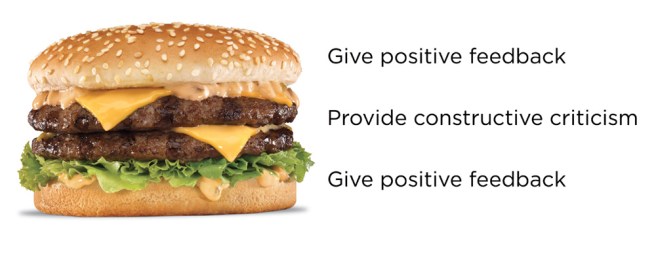
The feedback sandwich is a widely known technique for giving constructive feedback, by ‘sandwiching’ the criticism between two pieces of praise or compliments.


hamburger with cheese and two beef patties

Yesterday, as we passed around copies of our work (just a page or two) we started to address what William Faulkner famously said:

‘In writing, you must kill all your darlings.’

First of all, we looked for the juice in each piece.  Where did the writing come alive?  ‘Get rid of the rest,’ we said.  ‘Off with his head—out it goes.’   It’s very difficult to be this honest, and not everyone wants to hear it.  ‘I simply want gentle support and a few corrections,’ some of us might say.

Be willing to have the courage to look at your work with truthfulness.  It’s good to know where your writing has energy and vitality, rather than to spend a lot of time trying to make something come to life that is dead on the page.   Keep writing.  Something new will come up.   You don’t want to put your readers to sleep by writing a lot of boring stuff.

What about you? What works or doesn’t work for you in critique groups?  Do you have any tips you would add? Let me know in the comments and please share this post with a friend if you enjoyed it. 


A Poem

white cruise ship

My poem Between the Islands of the Pacific was first published in June Quadrant magazine with poems by Les Murray, Barbara Fisher, Craig Kurtz, Geoff Page, Dan Guenther, Gabriel Fitzmaurice and Graeme Hetherington. Big thank you to Literary Editor, Les Murray.


Between the Islands of the Pacific

Because by now we know everything is not so blue

out here.


The cities had tipped rubbish into the sea,

and we let them without even noticing.


Not even feeling our breathing clear

as gusts reaching ten knots cleaned up our days.


Not even. Today pure blue sky, blue sea,

out there the horizon drawing a line

below the clouds, the absoluteness of it. Nights

of diesel engines shuddering beneath us.


We lounge on chairs side by side on the deck.

At dusk, we stand at the railing of the ship as the sun

slips into the ocean. In the fresh sea air, their backs turned,

some raise a selfie-stick or light a cigarette while others

stand holding their breath.


Where can we go from here, and how?


Copyright © Libby Sommer 2018


Writing Tip: Use Your Obsessions

woman in grey jacket sits on bed uses grey laptop

Every once in a while, when I’m scratching around for something new to write, I make a list of the things I obsess about.  Thankfully, some of them change over time, but there are always new ones to fill the gap.

It’s true that writers write about what they think about most of the time.  Things they can’t let go; things that plague them; stories they carry around in their heads waiting to be heard.

I used to get my creative writing groups to make a list of the topics they obsess about so they could see what occupies their thoughts during their waking hours.  After you write them down, you can use them for spontaneous writing before crafting them into stories.  They have much power.  This is where the juice is for writing.  They are probably driving your life, whether you realize it or not, so you may as well use them rather than waste your energy trying to push them away.  And you can come back to them repeatedly.

One of the things I’m always obsessing about is relationships:  in families, with friends, with lovers.  That’s what I tend to write about.  I think to myself, Why not?  Rather than repress my obsessions, explore them, go with the flow.  And life is always changing, so new material keeps presenting  itself.

We are driven by our passions.  Am I the only one who thinks this?  For me these compulsions contain the life force energy.  We can exploit that energy.  The same with writing itself.  I’m always thinking and worrying about my writing, even when I’m on holidays.  I’m driven.

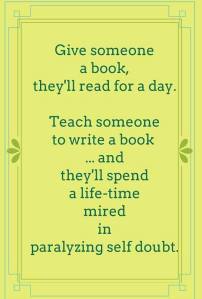
blue quote about writing on yellow background

But not all compulsions are a bad thing.  Get involved with your passions, read about them, talk to other people about them and then they will naturally become ‘grist for the mill’.

What about you?  Do you find yourself writing about the same situations over and over again? I hope these thoughts are useful. Do you have anything you would add? Let me know in the comments and please share this post with a friend if you enjoyed it.

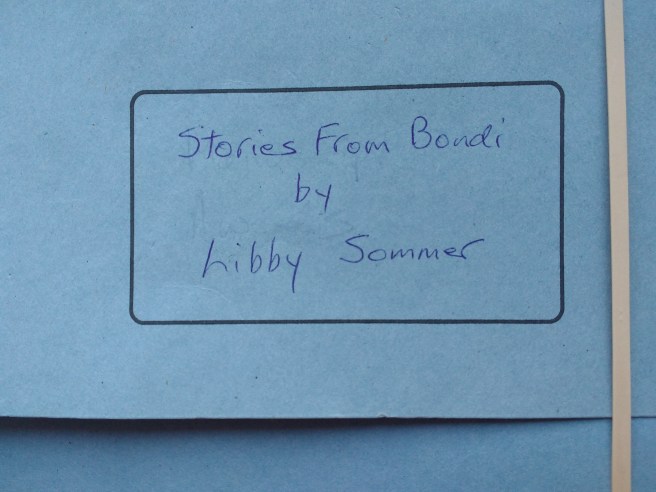
Stories From Bondi

painting of girl lying on beach in torquoise bikini reading a book

I posted another manuscript off to my publisher this week. It’s titled ‘Stories From Bondi‘. I completed an earlier, much shorter version of this book as part of a Masters in Writing at UTS back in 2001. Fingers crossed Ginninderra Press like this collection.

I’ve mentioned before how it took me 18 years of writing and 5 completed manuscripts before I finally had a book accepted by a publisher.

So now I have a small but prestigious publisher  Ginninderra Press who like my work I’m submitting my manuscripts backwards:  numbers 5, 4 and 3 have been published: ‘My Year With Sammy’, ‘The Crystal Ballroom’, ‘The Usual Story’.  Number 2 is ‘Stories From Bondi’.  80% of the short stories were first published in literary journals, including Quadrant and Overland.

Writing a book is a long, long, time-consuming process that requires a super-human amount of persistence and perseverance and dedication to the craft. It’s such a buzz to finally get my work out into the world.

blue manila folder titled Stories From Bondi by Libby Sommer

Writing Is Like Becoming A Sushi Chef

sushi rolls displayed on wooden platter

Sometimes there is a person in one of my creative writing classes who is obviously very talented.  I can bring to mind one in particular.  You could sense people holding their breath as she read, and often her hands shook.  The writing process opened her up.  She said she had wanted to write for years.  She was so excited about writing that she straight away wanted to write a book.  I said to her, slow down.  Just practise writing for a while.  Learn what this is all about.

In Japan becoming an itamae of sushi requires years of on-the-job training and apprenticeship.  After five years spent working with a master or teacher itamae, the apprentice is given his first important task, the preparation of the sushi rice.

Writing, like becoming a Sushi Chef,  is a life’s work and takes a lot of practice.  The process is slow, and at the start you are not sure what you are making.

Futomaki  (“thick roll” – rice on inside, nori on the outside)

Uramaki   (“inside-out roll” – rice on outside, nori on the inside)

Temaki     (“hand roll” – cone-shaped roll)

That’s how it was for me.  I thought I could jump in and write a book in 6 months.  In fact, it was 14 years and 5 books before one of my manuscripts was accepted for publication.

So cut yourself some slack before you head off on a writing marathon.

Writing is like learning to prepare the rice for sushi:  the apprenticeship is long, and in the beginning you are not sure whether a Futomaki, a Uramaki or a Temaki will be the end result.