
A cheque in the mail lifts the spirits of poor struggling writer.

Blue Quadrant magazine with Poetry, Libby Sommer on the cover

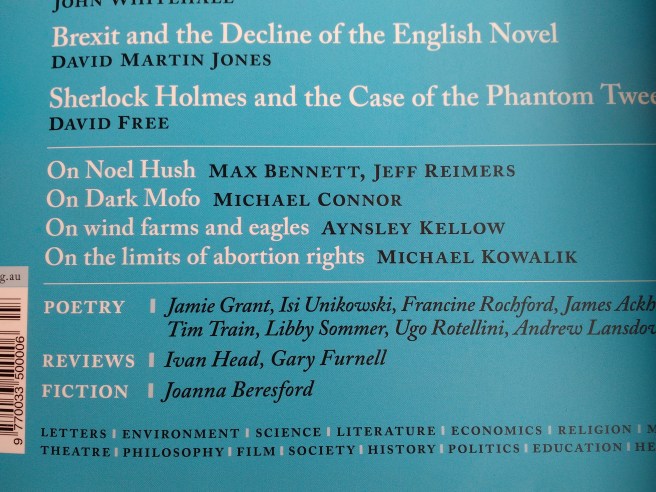
There’s my name on the cover of September Quadrant. First time I’ve made it to the cover under Poetry. This month it’s a prose poem titled AMBER PUPPY. I share the honour with poets Jamie Grant, Isi Unikowski, Francine Rochford, James Ackburst, Tim Train, Ugo Rotellini and Andrew Lansdown.

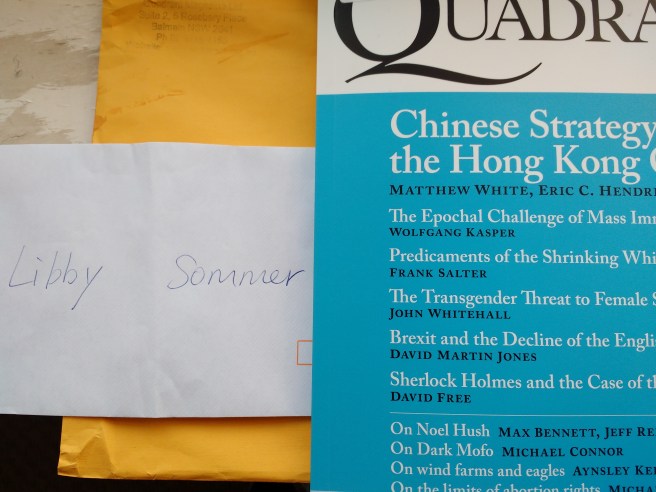
white envelope beside blue Quadrant September 2019 magazine cover

And there’s the white envelope containing my cheque. Halleluja!

So what is a prose poem?

Dictionary:  a piece of imaginative poetic writing in prose.

Poetry Foundation:  A prose composition that, while not broken into verse lines, demonstrates other traits such as symbols, metaphors, and other figures of speech common to poetry …

WikipediaProse poetry is poetry written in prose form instead of verse form, while preserving poetic qualities such as heightened imagery, parataxis, and emotional effects.

Academy of American Poets:  Though the name of the form may appear to be a contradiction, the prose poem essentially appears as prose, but reads like poetry. In the first issue of The Prose Poem: An International Journal, editor Peter Johnson explained, “Just as black humor straddles the fine line between comedy and tragedy, so the prose poem plants one foot in prose, the other in poetry, both heels resting precariously on banana peels.”  While it lacks the line breaks associated with poetry, the prose poem maintains a poetic quality, often utilizing techniques common to poetry, such as fragmentation, compression, repetition, and rhyme. The prose poem can range in length from a few lines to several pages long, and it may explore a limitless array of styles and subjects.

I love writing prose poems. They are definitely my preferred writing form just now.

Have a read of AMBER PUPPY. Quadrant magazine is available in newsagents, some book stores, online and in libraries.

Quadrant magazine cover September 2019


Things Raymond Carver has said about the short form in writing

blur book stack books bookshelves

‘My attention span had gone out on me; I no longer had the patience to try to write novels. … I know it has much to do now with why I write poems and short stories. Get in, get out. Don’t linger. Go on.’

‘Every great or even every very good writer makes the world over according to his own specifications.’

‘It is his world and no other. This is one of the things that distinguishes one writer from another. Not talent.’

‘Isak Dinesan said that she wrote a little every day, without hope and without despair.’

‘”Fundamental accuracy of statement is the ONE sole morality of writing,” Ezra Pound.’

‘It is possible to write a line of seemingly innocuous dialogue and have it send a chill along the reader’s spine – the source of artistic delight, as Nabokov would have it. That’s the kind of writing that most interests me.’

‘That’s all we have, finally, the words, and they had better be the right ones, with the punctuation in the right places so that they can best say what they are meant to say.’

‘I like it when there is some feeling of threat or sense of menace in short stories.’

‘I made the story just as I’d make a poem; one line and then the next, and the next.’

‘V.S. Pritchett’s definition of a short story is “something glimpsed from the corner of the eye, in passing.” Notice the “glimpse” part of this. First the glimpse.’

‘The short story writer’s task is to invest the glimpse with all that is in his power. He’ll bring his intelligence and literary skill to bear (his talent), his sense of proportion and sense of the fitness of things – like no one else sees them. And this is done through the use of clear and specific language, language used so as to bring to life the details that will light up the story for the reader. For the details to be concrete and convey meaning, the language must be accurate and precisely given. The words can be so precise they may even sound flat, but they can still carry, if used right, they can hit all the notes.’

Raymond Carver, Fires, Vintage 1989

So who is Raymond Carver?

Raymond Carver, in full Raymond Clevie Carver, (born May 25, 1938, Clatskanie, Oregon, U.S.—died August 2, 1988, Port Angeles, Washington), American short-story writer and poet whose realistic writings about the working poor mirrored his own life. – Encyclopedia Britannica

What is a Feedback Sandwich? Reblog

wheat bread sandwich

In the Saturday-afternoon feedback group, we began talking about the ‘off with his head’ or ‘out-it-goes’ part of writing.  We acknowledged that as a group we’d always been very supportive and encouraging of each others work.  That was because we were all in it together.  Our critiquing was not telling lies; it was from a place of open-hearted acceptance.  Everything you put on the page is acceptable.

Sometimes someone says, ‘I want a rigorous no-holds-barred assessment of my work.’  But what do you say to them when the writing is dull and boring?  Don’t give up your day job?  It doesn’t sit comfortably with most of us to be directly critical of someone’s writing.  It’s like telling someone how ugly their baby is.  All of us find it hard to separate our writing from ourselves, and are prone to take criticism personally.

The feedback sandwich is a widely known technique for giving constructive feedback, by ‘sandwiching’ the criticism between two pieces of praise or compliments.

Yesterday, as we passed around copies of our work (just a page or two) we started to address what William Faulkner famously said:

‘In writing, you must kill all your darlings.’

First of all, we looked for the juice in each piece.  Where did the writing come alive?  ‘Get rid of the rest,’ we said.  ‘Off with his head—out it goes.’   It’s very difficult to be this honest, and not everyone wants to hear it.  ‘I simply want gentle support and a few corrections,’ some of us might say.

Be willing to have the courage to look at your work with truthfulness.  It’s good to know where your writing has energy and vitality, rather than to spend a lot of time trying to make something come to life that is dead on the page.   Keep writing.  Something new will come up.    You don’t want to put your readers to sleep by writing a lot of boring material.

How is Writing Like a Sushi Roll?

close up photo of sushi served on table

Sometimes there’d be a person in one of my creative writing classes who was obviously very talented.  I can bring to mind one in particular.  You could sense people holding their breath as she read, and often her hands shook.  The writing process opened her up.  She said she had wanted to write for years.  She was so excited about writing that she straight away wanted to write a book.  I said to her, slow down.  Just practice writing for a while.  Learn what this is all about.

The journey to completing a book reminds me of training to become a sushi chef.

In Japan becoming an itamae of sushi requires years of on-the-job training and apprenticeship.  After five years spent working with a master or teacher itamae, the apprentice is given his first important task, the preparation of the sushi rice.

Writing, like becoming a Sushi Chef,  is a life’s work and takes a lot of practice.  The process is slow, and at the start you are not sure what you are making.

Futomaki  (“thick roll” – rice on inside, nori on the outside)

Uramaki   (“inside-out roll” – rice on outside, nori on the inside)

Temaki     (“hand roll” – cone-shaped roll)

That’s how it was for me.  I thought I could jump in and write a book in 6 months.  In fact, it took me 20 years to write a publishable manuscript. My debut novel,  ‘My Year With Sammy’, the story of a difficult yet sensitive child, published by Ginninderra Press in 2015 went on to be Pick of the Week in Spectrum Books and winner of the Society of Women Writers Fiction Book Award in 2016.

So cut yourself some slack before you head off on a writing marathon.

Writing is like learning to prepare the rice for sushi:  the apprenticeship is long, and in the beginning you are not sure whether a Futomaki, a Uramaki or a Temaki will be the end result.

9 Tips to Manage Writers RSI

yoga pose at sunrise

Repetitive strain injury often starts gradually but can soon become severely debilitating. But there are ways to nip it in the bud – and alleviate the worst symptoms.

1. Take Frequent Breaks

Take short, frequent breaks from repetitive tasks such as typing. A 10-minute break every hour. Use the computer only as much as you have to. Small hand movements, like scrolling on a screen, seem to set off RSI.

2. Type using both hands

It’s like playing the piano; correct fingering is essential. We tend to overuse one side of the body.

Become ambidextrous, e.g. use the mouse in your other hand, lift the kettle with the other hand.

3. Move

Get up from your desk every 30 minutes and move your neck and shoulders to release tension.

4. Use a Fountain Pen

When writing by hand, use a thick grip fountain pen that flows really well, rather than a ballpoint pen. Needing to push down on the pen, even lightly, makes the inflammation of RSI worse.

5. Check the ergonomics of your work station

Keep wrists straight and flat when typing. Sit with thighs level, feet flat on floor (or on footrest), sit up straight, shoulders relaxed, upper arms at sides, not splayed out, forearms horizontal or tilted slightly downwards, so knees and elbows are at a right angle. Keep the top of your screen at eye level and adjust the position of your keyboard, so it’s easy to reach without stretching or hunching. Don’t slouch. Use good posture. To keep wrists straight and flat use a gel wrist rest for the keyboard and the mouse.

6. Keep wrist straight when sleeping

Don’t curl your hands into a fist when sleeping. Some people wear a brace to keep their sore wrist straight.

7. Strengthen the supporting muscles

A physio will give you exercises to do to strengthen the arms. e.g. bicep curls

8. Stretch

Stretch neck, shoulders, arms, wrists. I find yoga is excellent for a full body stretch. The downward facing dog pose can cause discomfit in the hands, but I try to remember to flatten the knuckles to reduce pressure on the wrists.

9. Massage

Like yoga, a regular massage helps keep the body aligned and pain free.


Hope you find these tips useful. Good luck.


How to Find Something New to Write About

girl learning person studying

Every once in a while, when I’m scratching around for something new to write, I make a list of the things I obsess about.  Thankfully, some of them change over time, but there are always new ones to fill the gap.

It’s true that writers write about what they think about most of the time.  Things they can’t let go: things that plague them; stories they carry around in their heads waiting to be heard.

Sometimes I used to get my creative writing groups to make a list of the topics they obsess about so they can see what occupies their thoughts during their waking hours.  After you write them down, you can use them for spontaneous writing before crafting them into stories.  They have much power.  This is where the juice is for writing.  They are probably driving your life, whether you realise it or not, so you may as well use them rather than waste your energy trying to push them away.  And you can come back to them repeatedly.

One of the things I’m always obsessing about is relationships:  relationships in families, relationships with friends, relationships with lovers.  That’s what I tend to write about.  I think to myself, Why not?  Rather than repress my obsessions, explore them, go with the flow.  And life is always changing, so new material keeps presenting  itself.

We are driven by our passions.  Am I the only one who thinks this?  For me these compulsions contain the life force energy.  We can exploit that energy.  The same with writing itself.  I’m always thinking and worrying about my writing, even when I’m on holidays.

But not all compulsions are a bad thing.  Get involved with your passions, read about them, talk to other people about them and then they will naturally become ‘grist for the mill’.

What about you?  Do you find yourself writing about the same things over and over again? 

How to Turn Towards Your Inner Critic

man wearing brown suit jacket mocking on white telephone

It is essential to separate the creator and the editor, or inner critic when you practice writing, so that the creator has plenty of room to breathe, experiment, and tell it like it really is.  If the inner critic is being too much of a problem and you can’t distinguish it from your authentic writing voice, sit down whenever you find it necessary to have some distance from it and put down on paper what the critic is saying, put a spotlight on the words—“You have nothing original to say, what made you think you could write anything anyone would want to read, your writing is crap, you’re a loser, I’m humiliated, you write a load of rubbish, your work is pathetic, and your grammar stinks …”  On and on it goes!

Say to yourself, It’s OK to feel this.  It’s OK to be open to this.

You can learn to cultivate compassion for yourself  during this internal process by practicing Mindfulness Meditation.  Sit up straight, close your eyes, bring your awareness to your inner experience.  Now,  redirect your attention to the physical sensations of the breath in the abdomen … expanding as the breath comes in … and falling back as the breath goes out.  Use each breath to anchor yourself in the present.   Continue, concentrating on the breath for several minutes.  Now, expand your field of awareness to include the words of the inner critic.  Turn your attention to where in your body you feel the unpleasant thoughts, so you can attend, moment by moment, to the physical reactions to your thoughts.

 “Stay with the bodily sensations, accepting them, letting them be, exploring them without judgment as best you can.”—Mindfulness, Mark Williams and Danny Penman.

Every time you realise that you’re judging yourself, that realisation in itself is an indicator that you’re becoming more aware.

The thing is, the more clearly you know yourself, the more you can accept the critic in you and use it.  If the voice says, “You have nothing interesting to say,” hear the words as white noise, like the churning of a washing machine.  It will change to another cycle and eventually end, just like your thoughts that come and go like aeroplanes in the sky.  But, in the meantime, you return to your notebook and practice your writing.  You put the fear and the resistance down on the page.

You Are Not the Stories You Tell

woman reading book

Sometimes when people read my stories they assume those stories are me.  They are not me, even if I write in the first person.  They were my thoughts and feelings at the time I wrote them.  But every minute we are all changing.  There is a great freedom in this.  At any time we can let go of our old selves and start again.  This is the writing process.  Instead of blocking us, it gives us permission to move on.  Just like in a progressive ballroom dance:  you give your undivided attention to your partner—keep eye contact for the time you are dancing together—but then you move on to the next person in the circle.

The ability to express yourself on the page—to write how you feel about an old lover, a favourite pair of dance shoes, or the memory of a dance on a chilly winter’s night in the Southern Highlands—that moment you can support how you feel inside with what you say on the page.  You experience a great freedom because you are not suppressing those feelings.  You have accepted them, aligned yourself with them.

I have a poem titled ‘This is what it feels like’—it’s a short poem.  I always think of it with gratitude  because I was able to write in a powerful way how it was to be desperate and frightened.  The act of self expression made me feel less of a victim.  But when people read it they often say nothing.  I remind myself, I am not the poem, I am not the stories I write.  People react from where they are in their own lives.  That’s the way things are.  The strength is in the act of writing, of putting pen to paper.   Write your stories and poems, show them to the world, then move on.  The stories are not you.  They are moments in time that pass through you.

What Are the Microflix Writers Awards?

red-headed author Libby Sommer signing one of her books

I am delighted to say that my micro-fiction ‘In the Mall’ has been selected as an entry in the Microflix Writers Awards. Halleluja. I’ll find out in August if my story is chosen by filmmakers for adaptation to a short film for the 2019 Microflix Awards. My microlit on the theme of SOUND is available to view on the Microflix SOUND extracts page on the website of Australian short story publisher, Spineless Wonders.

Spineless Wonders 2019 Microflix Writers Awards

The Microflix Awards offered each year aim to reward and value the roles of both the author and the filmmaker in the adaptation process. For this reason we offer both the Microflix Film Awards and the Microflix Author Awards.

The Microflix Writers Awards consists of a $500 cash prize for Best Writing as well as range of prizes such as discounts on writers’ centre memberships and other resources for writers as well as book packages for Highly Recommended and Recommended Writers.

Our panel of jurists will select winners of the Microflix Writers Awards from the pool of finalist films screened at the Microflix Festival.


The theme for 2019 is SOUND.

This year, Microflix invites authors to submit microlit texts on the theme of SOUND for adaptation by filmmakers. The texts submitted will be reviewed by microlit specialist and Spineless Wonders’ editor Associate Professor Cassandra Atherton. Submissions will be accepted until 30 April and those selected by Cassandra will be included in the 2019 SOUND Texts section on this website.

Exploring the theme of SOUND

We are looking for prose pieces suitable for film adaptation which riff on the theme of sound. You may wish to reflect on the soundtracks of your life – be that songs and music or sounds from the built environment or the natural world. Your submission may reflect on the absence of sound or it may take us into a world without music. Your approach may be playful, witty, political, philosophical or all of the above.


My fingers are crossed.