Writing Tip: Start Writing

When I used to teach classes to beginning writers, it was good.  It forced me to think back to the beginning to when I first put pen to paper.  The thing is, every time we sit down and face the blank page, it’s the same.  Every time we start a new piece of writing, we doubt that we can do it again.  A new journey with no map – like setting off towards the horizon alone in a boat and the only thing another person can do to help is to wave from the shore.

So when I used to teach a creative writing class, I had to tell them the story all over again and remember that this is the first time my students are hearing it.  I had to start at the very beginning.

First up, there’s the pen on the page.  You need this intimate relationship between the pen and the paper to get the flow of words happening.  A fountain pen is best because the ink flows quickly.  We think faster than we can write.  It needs to be a “fat” pen to avoid RSI.

Consider, too, your notebook.  It is important.  The pen and paper are your basic tools, your equipment, and they need to be with you at all times.  Choose a notebook that allows you plenty of space to write big and loose.  A plain cheap thick spiral notepad is good.

After that comes the typing up on the computer and printing out a hard copy.  It’s a right and left brain thing.  You engage the right side of the brain, the creative side when you put pen to paper, then bring in the left side, the analytic side, when you edit the print out as you settle back comfortably with a drink (a cup of tea, even) and read what you’ve written.

Patrick White said that writing is really like shitting; and then, reading the letters of Pushkin a little later, he found Pushkin said exactly the same thing.  Writing is something you have to get out of you.

typing writing on a pink background

Whether writing a story or writing a blog, start writing, no matter what.

The Writing Life

Another of my favourite books on the writing process is The Writing Life by Annie Dillard. A small and passionate guide to the terrain of a writer’s world.

Annie Dillard has written eleven books, including the memoir of her parents, An American Childhood; the Northwest pioneer epic The Living; and the nonfiction narrative Pilgrim at Tinker Creek winner of the 1975 Pullizer Prize.  A gregarious recluse, she is a member of the American Academy of Arts and Letters.

“For non-writers, The Writing Life is a glimpse into the trials and satisfactions of a life spent with words. For writers, it is a warm, rambling, conversation with a stimulating and extraordinarily talented colleague.””–Chicago Tribune””A kind of spiritual Strunk & White, a small and brilliant guidebook to the landscape of a writer’s task…Dillard brings the same passion and connective intelligence to this narrative as she has to her other work.”– “Boston Globe””For her book is…scattered with pearls. Each reader will be attracted to different bright parts…Gracefully and simply told, these little stories illuminate the writing life…Her advice to writers is encouraging and invigorating.”– “Cleveland Plain Dealer””The Writing Life is a spare volume…that has the power and force of a detonating bomb…A book bursting with metaphors and prose bristling with incident.”– “Detroit News”

Dillard begins:

When you write, you lay out a line of words. The line of words is a miner’s pick, a woodcarver’s gouge, a surgeon’s probe. You wield it, and it digs a path you follow. Soon you find yourself deep in new territory. Is it a dead end, or have you located the real subject? You will know tomorrow, or this time next year. You make the path boldly and follow it fearfully. You go where the path leads. At the end of the path, you find a box canyon. You hammer out reports, dispatch bulletins. The writing has changed, in your hands, and in a twinkling, from an expression of your notions to an epistemological tool. The new place interests you because it is not clear. You attend. In your humility, you lay down the words carefully, watching all the angles. Now the earlier writing looks soft and careless. Process is nothing; erase your tracks. The path is not the work. I hope your tracks have grown over; I hope birds ate the crumbs; I hope you will toss it all and not look back.

Which books on writing process have you found to be inspiring?

Writing Tip: Becoming a Writer

yellow sunflower bookcover of Becoming A Writer by Dorothea Brande

I highly recommend this book a friend from London gave me many years ago at the beginning of my writing journey. It’s an old one, but a good one.

‘A reissue of a classic work published in 1934 on writing and the creative process, Becoming a Writer recaptures the excitement of Dorothea Brande’s creative writing classroom of the 1920s. Decades before brain research “discovered” the role of the right and left brain in all human endeavor, Dorothea Brande was teaching students how to see again, how to hold their minds still, how to call forth the inner writer.’ – Amazon

‘Refreshingly slim, beautifully written and deliciously elegant, Dorothea Brande’s Becoming a Writer remains evergreen decades after it was first written. Brande believed passionately that although people have varying amounts of talent, anyone can write. It’s just a question of finding the “writer’s magic”–a degree of which is in us all. She also insists that writing can be both taught and learned. So she is enraged by the pessimistic authors of so many writing books who rejoice in trying to put off the aspiring writer by constantly stressing how difficult it all is.

With close reference to the great writers of her day–Wolfe, Forster, Wharton and so on–Brande gives practical but inspirational advice about finding the right time of day to write and being very self disciplined about it–“You have decided to write at four o’clock, and at four o’clock you must write.” She’s strong on confidence building and there’s a lot about cheating your unconscious which will constantly try to stop you writing by coming up with excuses. Then there are exercises to help you get into the right frame of mind and to build up writing stamina. She also shows how to harness the unconscious, how to fall into the “artistic coma,” then how to re-emerge and be your own critic.

This is Dorothea Brande’s legacy to all those who have ever wanted to express their ideas in written form. A sound, practical, inspirational and charming approach to writing, it fulfills on finding “the writer’s magic.”‘ – John Gardner

Yep, I’d agree with John Garner. Finding “the writer’s magic” is what it’s all about.

Writing Tip: Use Declarative Sentences

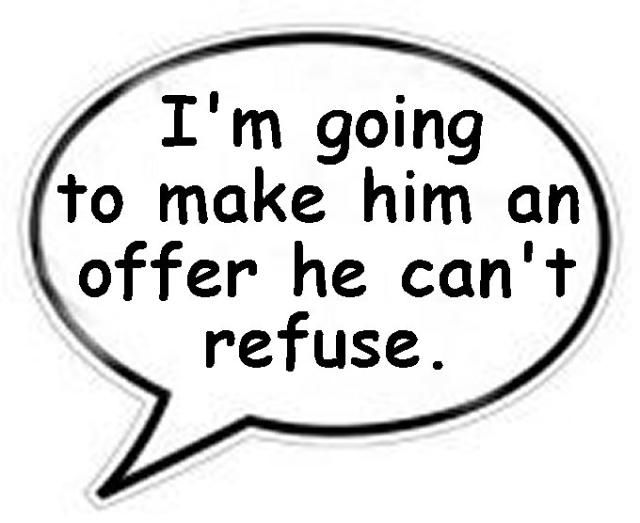
speech bubble: I'm going to make him an offer he can't refuse

This declarative sentence was spoken by Don Corleone (played by Marlon Brando) in the movie The Godfather (1972).

We don’t always make declarative statements. It is not uncommon for women and other minority groups to add qualifiers to their statements. Such as ‘Parents need to stop organising every minute of their children’s spare time, don’t you think?’ ‘I loved that movie, didn’t you?’ In our sentence structure we look for reinforcement for our thoughts and opinions. We don’t always make declarative statements such as:  ‘This is wonderful.’ ‘This is a catastrophe.’ We look for re-enforcement from others.

Another thing we do without realising it, is use indefinite modifiers in our speech:  perhaps, maybe, somehow. ‘Maybe I’ll take a trip somewhere.’ As if the speaker has no power to make a decision. ‘Perhaps it will change.’ Again, not a clear declarative sentence like, ‘Yes, nothing stays the same.’

It is important for us as writers to express ourselves in clear assertive sentences. ‘This is excellent.’ ‘It was a red dress.’ Not ‘The thing is, I know it sounds a bit vague, but I think maybe it was a red dress.’ Speaking in declarative sentences is a good rehearsal for trusting your own ideas, in standing up for yourself, for speaking out your truth.

When I write poetry I read through early drafts with a critical eye, taking out indefinite words and modifiers. I attempt to distill each moment to its essence by peeling off the layers until the heart of the poem is exposed. We need to take risks as writers and go deep within ourselves to find our unique voices and express ourselves with clarity.

Even if you are not 100% sure about your own opinions and thoughts write as if you are sure.  Dig deep. Be clear. Don’t be vague on the page. If you keep practicing this, you will eventually reveal your own deep knowing.

What about you? Have you noticed this tendency to qualify in your conversations with others, or in your creative writing, or in your blog posts?

How is Writing Like a Sushi Roll?

close up photo of sushi served on table

Sometimes there’d be a person in one of my creative writing classes who was obviously very talented.  I can bring to mind one in particular.  You could sense people holding their breath as she read, and often her hands shook.  The writing process opened her up.  She said she had wanted to write for years.  She was so excited about writing that she straight away wanted to write a book.  I said to her, slow down.  Just practice writing for a while.  Learn what this is all about.

The journey to completing a book reminds me of training to become a sushi chef.

In Japan becoming an itamae of sushi requires years of on-the-job training and apprenticeship.  After five years spent working with a master or teacher itamae, the apprentice is given his first important task, the preparation of the sushi rice.

Writing, like becoming a Sushi Chef,  is a life’s work and takes a lot of practice.  The process is slow, and at the start you are not sure what you are making.

Futomaki  (“thick roll” – rice on inside, nori on the outside)

Uramaki   (“inside-out roll” – rice on outside, nori on the inside)

Temaki     (“hand roll” – cone-shaped roll)

That’s how it was for me.  I thought I could jump in and write a book in 6 months.  In fact, it took me 20 years to write a publishable manuscript. My debut novel,  ‘My Year With Sammy’, the story of a difficult yet sensitive child, published by Ginninderra Press in 2015 went on to be Pick of the Week in Spectrum Books and winner of the Society of Women Writers Fiction Book Award in 2016.

So cut yourself some slack before you head off on a writing marathon.

Writing is like learning to prepare the rice for sushi:  the apprenticeship is long, and in the beginning you are not sure whether a Futomaki, a Uramaki or a Temaki will be the end result.

What Is A Prose Poem?


Launchmereading

The Poetry Foundation describes a prose poem as a prose composition that, while not broken into verse lines, demonstrates other traits such as symbols,metaphors, and other figures of speech common to poetry.

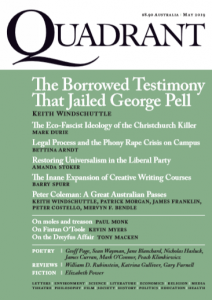
I’m thrilled to tell you that my latest prose poem, TASTE is published in this month’s Quadrant magazine.

green and white cover of Quadrant magazine May 2019


TASTE

I rather like poems about minor calamities, bursts of tiny delights, the sun warming the tender skin of the elderly. Also, the way palm fronds conduct themselves during a southerly, dishevelled, exposing the softness of their billowing arms. Pastries in display cases do something for me too. Even cupcakes iced in gelato colours, adorned with miniature decorations … Can you see my preference for the words ‘miniature’ and ‘tiny’, an inclination towards the distilled in a world favouring often the big and the overwhelming? People with the patience to follow a complex recipe – well, that’s not me, but I like to taste what they cook.  Babies in prams kicking chubby legs make me hover – how difficult not to take a bite. If you write something about a paper straw, I will be fascinated. You could try a ladybird, a pocket-size umbrella. The generalised angst of the human condition, however, may be hard for me to get a handle on.  Watch that man with the disabled daughter moisten his finger after her cupcake is eaten and relish the last crumbs. Consider the rainbow-coloured wristband tied to a letterbox on the way to the park or the miniature plastic bucket and spade we found half-hidden on the beach at Bronte and packed with us for years on every visit to the sea.

First published in Quadrant.

Copyright © Libby Sommer

A big thank you to Literary Editor, Professor Barry Spurr (Australia’s first Professor of Poetry) for accepting my poem. I am honored to be included alongside talented poets Geoff Page, Sean Wayman, Jane Blanchard, Nicholas Hasluck, James Curran, Mark O’Connor and Peach Klimkiewicz.

Facts About The Creative Process

afterglow backlit beautiful crescent moon

At a literary event I heard someone say, “The thing to do is put the idea in your subconscious.  Your brain will do the work.”

It takes time for our experience to make its way through our consciousness.  For example, it is hard to write about a journey while you are still in the midst of the adventure.  We have no distance from what is happening to us.  The only things we seem to be able to say are “having a great time”, “the weather is good”, “wish you were here”.  It is also hard to write about a place we just moved to, we haven’t absorbed it yet.  We don’t really know where we are, even if we can walk to the train station without losing our way.  We haven’t experienced three scorching summers in this country or seen the dolphins migrating south along the  coast in the winter.

“Maybe away from Paris I could write about Paris as in Paris I could write about Michigan.  I did not know it was too early for that because I did not know Paris well enough.” – Ernest Hemingway, A Moveable Feast  (New York:  Charles Scribner’s Sons, 1964).

So we take in experience, but we need to let things make their way through our consciousness for a while and be absorbed by our whole selves.  We are bower birds, collecting experience, and from the thrown away apple skins, outer lettuce layers, tea leaves, and chicken bones of our minds come our ideas for stories and poems and songs.  But this does not come any time soon.  It takes a very long time (three to ten years in the case of literary fiction).  We need to keep picking through those scraps until some of the thoughts together form a pattern or can be organised around a central theme, something  we can shape into a narrative.  We mine our hidden thoughts for ideas.  But the ideas need time to percolate:  to slowly filter through.

Rumi, the thirteenth-century Sufi poet, summed up what could be the creative process when he wrote “The Guest House”:

This being human is a guest house.

Each morning a new arrival.

A joy, a depression, a meanness,

some momentary awareness comes

as an unexpected visitor.

Welcome and entertain them all!

Even if they are a crowd of sorrows,

who violently sweep your house

empty of its furniture,

still, treat each guest honorably.

He may be clearing you out

for some new delight.

The dark thought, the shame, the malice,

meet them at the door laughing and invite

them in.

Be grateful for whoever comes,

because each has been sent

as a guide from beyond.


Jalaluddin Rumi, in The Essential Rumi

Translated by Coleman Barks, 1999

Our work is to keep rummaging through the rubbish bins of our minds, exercising the writing muscle, in readiness to answer that knock at the door when it comes.

As the author Vivian Gornick said, “The writers life is the pits.  You live alone and you work alone, every day I have to recreate myself.”  She paused and laughed.  “But when the work is going well there is nothing that compares.”

What about you? Are you ready to answer the knock at the door?  

Where Do We Get Our Story Ideas?

girl learning person studying


“Talking is the first voice of a writer. I always heard it, I just didn’t know you could write it. I write the voices you hear every day—it’s just that people don’t recognize how wonderfully people talk. I think every time a person tells the truth, that person is speaking beautifully.” – Grace Paley

As a writer you’re probably always on red alert looking for story ideas. Maybe you use the world around you, seeking locations and characters and situations, listening in to conversations on buses or trains or in cafes. Changing your daily routine is a way to stimulate the  imagination. Drive or walk to a different part of your suburb or home town and look for different places to write. Writing in cafes is my thing. Challenge yourself to move out of your comfort zone in order to find new ideas. It helps to stay out of routine’s boring rut. I need to be physically comfortable and relaxed when I call on the  muse. Early in my writing career, I wrote sitting up in bed. The ultimate cosy comfort zone. Now a comfy couch in a cafe is my preferred relax place. And when I sit in a cafe to write I always have a printout beside me of the previous day’s writing session. So I’m never staring at a blank page. Helps with the panic, What the hell will I write next?

There’s no better way to find out where to get our story ideas than by hearing from the experts.  Check out some of my favorite authorial quotes below:

“Every secret of a writer’s soul, every experience of his life, every quality of his mind, is written large in his works.”— Virginia Woolf
“And by the way, everything in life is writable about if you have the outgoing guts to do it, and the imagination to improvise. The worst enemy to creativity is self-doubt.”― Sylvia Plath
“Everybody walks past a thousand story ideas every day. The good writers are the ones who see five or six of them. Most people don’t see any.” – Orson Scott
“I want to tell a story, in the old-fashioned way – what happens to somebody – but I want that ‘what happens’ to be delivered with quite a bit of interruption, turnarounds, and strangeness. I want the reader to feel something is astonishing – not the ‘what happens’ but the way everything happens.” –– Alice Munro


“If you haven’t got an idea, write a story anyway.” – William Campbell Gault

Some people keep a container filled with single words and draw out a word each day and write from it. That’s a good way to exercise the writing muscle and to get into the right (rather than left) side of the brain.

Good luck on your search for story ideas. I like to tell people I use anything that moves or makes a noise 🙂

For further reading, check out my posts Writing Tip: Don’t Forget to Pause and Writing Tip: Beating Resistance.  And to make sure not to miss anything from Libby Sommer Author you can follow me on Facebook  or Instagram.

You Can Read Forever on a Kindle

kindle technology amazon tablet

I never thought I’d prefer reading on a Kindle to reading a real book. It’s just that it’s so quick and easy to keep downloading to Kindle, and the books are not expensive. If you finish a novel at 10pm and are desperate to read the next book in the series, as I was with the Elena Ferrante novels, it takes mere seconds to have a new story in your hands.

At the moment I’m reading Sapiens: A Brief History of Humankind by Yuval Noah Harari. Fabulous. Highly recommended.

Dymocks says about Sapiens,

What makes us brilliant? What makes us deadly? What makes us Sapiens? This bestselling history of our species challenges everything we know about being human.

Planet Earth is 4.5 billion years old. In just a fraction of that time, one species among countless others has conquered it. Us.

We are the most advanced and most destructive animals ever to have lived. What makes us brilliant? What makes us deadly? What makes us Sapiens?

In this bold and provocative book, Yuval Noah Harari explores who we are, how we got here and where we’re going.

Sapiens is a thrilling account of humankind’s extraordinary history – from the Stone Age to the Silicon Age – and our journey from insignificant apes to rulers of the world

‘It tackles the biggest questions of history and of the modern world, and it is written in unforgettably vivid language. You will love it!’ Jared Diamond, author of Guns, Germs and Steel

Amazon says about Sapiens:

A Summer Reading Pick for President Barack Obama, Bill Gates, and Mark Zuckerberg

From a renowned historian comes a groundbreaking narrative of humanity’s creation and evolution—a #1 international bestseller—that explores the ways in which biology and history have defined us and enhanced our understanding of what it means to be “human.”

One hundred thousand years ago, at least six different species of humans inhabited Earth. Yet today there is only one—homo sapiens. What happened to the others? And what may happen to us?

Most books about the history of humanity pursue either a historical or a biological approach, but Dr. Yuval Noah Harari breaks the mold with this highly original book that begins about 70,000 years ago with the appearance of modern cognition. From examining the role evolving humans have played in the global ecosystem to charting the rise of empires, Sapiens integrates history and science to reconsider accepted narratives, connect past developments with contemporary concerns, and examine specific events within the context of larger ideas.

Dr. Harari also compels us to look ahead, because over the last few decades humans have begun to bend laws of natural selection that have governed life for the past four billion years. We are acquiring the ability to design not only the world around us, but also ourselves. Where is this leading us, and what do we want to become?

A terrific book. I think reading is one of the best way to relax, especially during this crazy holiday period.

For tips on writing process, check out my posts  Writing Tip: Use Your Obsessions and Writing Is Like Becoming a Sushi Chef.  And to make sure not to miss anything from Libby Sommer Author you can follow me on Facebook or Instagram.

What does ‘show don’t tell’ mean exactly?

woman sitting on chair while reading book

What does ‘show don’t tell’ mean? It means don’t tell us about loneliness (or any of those complex words like dishonesty, secrecy, jealousy, obsession, regret, death, injustice, etc) show us what loneliness is. We will read what you’ve written and feel the bite of loneliness. Don’t tell us what to feel. Show us the situation, and that feeling will be triggered in us.

When you take your child to school on their first day you may find yourself teary and relieved at the same time. Put into words what you see: the child’s face, the wave at the gate, the other mothers saying their goodbyes, another child coming up to take your son by the hand. We will get what you’re trying to say without you telling us directly.

When you write, be conscious of the senses and how they connect to the experiences you are writing about. Use sight, sound, smell, touch to create concrete pictures. The senses allow you to get as close as humanly possible in words to the wedding, the sunrise, the dog, the suitcase. It’s the best way to penetrate your story and breathe life into it. Don’t tell us about something, drop deep, enter the story and take us with you.

‘Use strong, specific verbs, and avoid overusing adverbs. Provoke emotion through character reactions and vivid writing, don’t simply tell readers how to feel. Use well-placed details to bring scenes to life. Use expressive dialogue to show characters’ emotions and attitudes.’ – Creative Writing 101, Wright State University

For further reading, check out my posts  Have You Tried Flash Fiction Yet? and Is There A Link Between Spirituality and Creativity?. And to make sure not to miss anything from Libby Sommer Author you can follow me on Facebook  or Instagram.