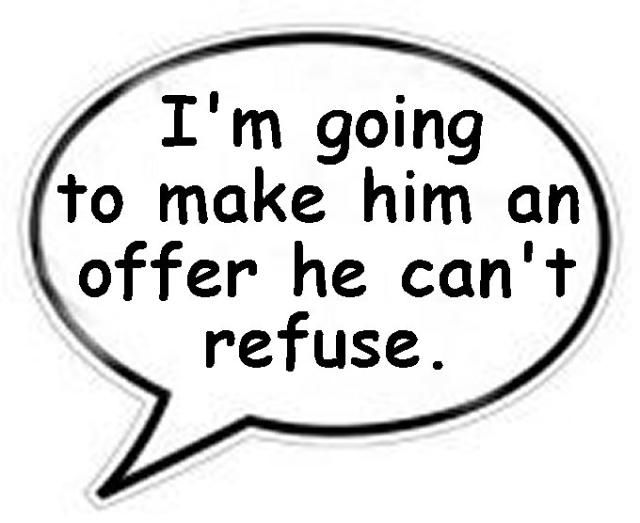
This declarative sentence was spoken by Don Corleone (played by Marlon Brando) in the movie The Godfather (1972).
We don’t always make declarative statements. It is not uncommon for women and other minority groups to add qualifiers to their statements. Such as ‘Parents need to stop organising every minute of their children’s spare time, don’t you think?’ ‘I loved that movie, didn’t you?’ In our sentence structure we look for reinforcement for our thoughts and opinions. We don’t always make declarative statements such as: ‘This is wonderful.’ ‘This is a catastrophe.’ We look for re-enforcement from others.
Another thing we do without realising it, is use indefinite modifiers in our speech: perhaps, maybe, somehow. ‘Maybe I’ll take a trip somewhere.’ As if the speaker has no power to make a decision. ‘Perhaps it will change.’ Again, not a clear declarative sentence like, ‘Yes, nothing stays the same.’
It is important for us as writers to express ourselves in clear assertive sentences. ‘This is excellent.’ ‘It was a red dress.’ Not ‘The thing is, I know it sounds a bit vague, but I think maybe it was a red dress.’ Speaking in declarative sentences is a good rehearsal for trusting your own ideas, in standing up for yourself, for speaking out your truth.
When I write poetry I read through early drafts with a critical eye, taking out indefinite words and modifiers. I attempt to distill each moment to its essence by peeling off the layers until the heart of the poem is exposed. We need to take risks as writers and go deep within ourselves to find our unique voices and express ourselves with clarity.
Even if you are not 100% sure about your own opinions and thoughts write as if you are sure. Dig deep. Be clear. Don’t be vague on the page. If you keep practicing this, you will eventually reveal your own deep knowing.
What about you? Have you noticed this tendency to qualify in your conversations with others, or in your creative writing, or in your blog posts?
Sometimes there would be a person in one of my creative writing classes who was obviously very talented. I can bring to mind one in particular. You could sense people holding their breath as she read, and often her hands shook. The writing process opened her up. She said she had wanted to write for years. She was so excited about writing that she straight away wanted to write a book. I said to her, slow down. Just practice writing for a while. Learn what this is all about.
In Japan becoming an itamae of sushi requires years of on-the-job training and apprenticeship. After five years spent working with a master or teacher itamae, the apprentice is given his first important task, the preparation of the sushi rice.
Writing, like becoming a Sushi Chef, is a life’s work and takes a lot of practice. The process is slow, and at the start you are not sure what you are making.
Futomaki (“thick roll” – rice on inside, nori on the outside)
Uramaki (“inside-out roll” – rice on outside, nori on the inside)
Temaki (“hand roll” – cone-shaped roll)
That’s how it was for me. I thought I could jump in and write a book in 6 months. In fact, it took me 20 years to write a publishable manuscript: ‘My Year With Sammy’ (Ginninderra Press) the story of a difficult yet sensitive child, was my first published book in 2015. Five books have followed since then.
So cut yourself some slack before you head off on a writing marathon.
Writing is like learning to prepare the rice for sushi: the apprenticeship is long, and in the beginning you are not sure whether a Futomaki, a Uramaki or a Temaki will be the end result.
‘Samuel Beckett, answering a hopeless question from a Paris newspaper – “Why do you write?” – said it was all he was good for: “Bon qu’a ca.” Georges Bernanos said that writing was like rowing a boat out to sea: The shoreline disappears, it is too late to turn back, and the rower becomes a galley slave. When Colette was seventy-five and crippled with arthritis she said that now, at last, she could write anything she wanted without having to count on what it would bring in. Marguerite Yourcenar said that if she had inherited the estate left by her mother and then gambled away by her father, she might never have written another word. Jean-Paul Sartre said that writing is an end in itself. (I was twenty-two and working on a newspaper in Montreal when I interviewed him. I had not asked him the why of the matter but the what.) The Polish poet Aleksander Wat told me that it was like the story of the camel and the Bedouin; in the end, the camel takes over. So that was the writing life: an insistent camel.’ – extract from the Preface of The Selected Stories of Mavis Gallant.
In the Saturday-afternoon feedback group recently, we talked about the ‘off with his head’ or ‘out-it-goes’ part of writing. We acknowledged that as a group we’d always been very supportive and encouraging of each others work. That was because we were all in it together. Our critiquing was not telling lies; it was from a place of open hearted acceptance. Everything you put on the page is acceptable.
Sometimes someone says, ‘I want a rigorous no-holds-barred assessment of my work.’ But what do you say to them when the writing is dull and boring? Don’t give up your day job? It doesn’t sit comfortably with most of us to be directly critical of someone’s writing. It’s like telling someone how ugly their baby is. All of us find it hard to separate our writing from ourselves, and are prone to take criticism personally.
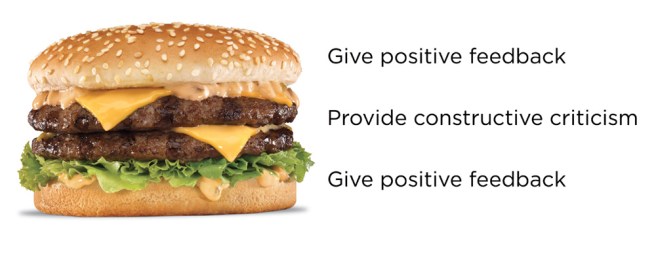
The feedback sandwich is a widely known technique for giving constructive feedback, by ‘sandwiching’ the criticism between two pieces of praise or compliments.
Yesterday, as we passed around copies of our work (just a page or two) we started to address what William Faulkner famously said:
‘In writing, you must kill all your darlings.’
First of all, we looked for the juice in each piece. Where did the writing come alive? ‘Get rid of the rest,’ we said. ‘Off with his head—out it goes.’ It’s very difficult to be this honest, and not everyone wants to hear it. ‘I simply want gentle support and a few corrections,’ some of us might say.
Be willing to have the courage to look at your work with truthfulness. It’s good to know where your writing has energy and vitality, rather than to spend a lot of time trying to make something come to life that is dead on the page. Keep writing. Something new will come up. You don’t want to put your readers to sleep by writing a lot of boring stuff.
Sometimes when people read my stories they assume those stories are me. They are not me, even if I write in the first person. They were my thoughts and feelings at the time I wrote them. But every minute we are all changing. There is a great freedom in this. At any time we can let go of our old selves and start again. This is the writing process. Instead of blocking us, it gives us permission to move on. Just like in a progressive ballroom dance: you give your undivided attention to your partner—keep eye contact for the time you are dancing together—but then you move on to the next person in the circle.
The ability to express yourself on the page—to write how you feel about an old lover, a favourite pair of dance shoes, or the memory of a dance on a chilly winter’s night in the Southern Highlands—that moment you can support how you feel inside with what you say on the page. You experience a great freedom because you are not suppressing those feelings. You have accepted them, aligned yourself with them.
I have a poem titled ‘This is what it feels like’—it’s a short poem. I always think of it with gratitude because I was able to write in a powerful way how it was to be desperate and frightened. The act of self expression made me feel less of a victim. But when people read it they often say nothing. I remind myself, I am not the poem, I am not the stories I write. People react from where they are in their own lives. That’s the way things are. The strength is in the act of writing, of putting pen to paper. Write your stories and poems, show them to the world, then move on. The stories are not you. They are moments in time that pass through you.
Plot means the story line. When people talk about plotting, they mostly mean how to set up the situation, where to put the turning points, and what the characters will be doing in the end. What happens.
Some fiction writers write organically, not knowing where the story they are writing is going. These writers say it would be boring to know what’s going to happen next and they lose their enthusiasm to tell the story because they know the outcome already. They prefer throwing themselves over the edge and into the void. This method can be very anxiety-producing. It means you need a lot of faith in your process.
Other writers plan the story before they begin. In detective fiction the story definitely needs to be worked out beforehand so information can be drip-fed to the reader.
In the past, when creating my short stories, I have worked organically and not known where my stories were headed as I wrote them. The shorter the piece of fiction, the less need for plot. You can write an interesting story in which not very much happens. A woman fights with her neighbour, a man quits his job, or an unhappy family goes out for a pizza. Simple structures work better than something too complicated when the story is short.
Now that I’m working on a new novel, I feel the need to plot.
“A plot can, like a journey, begin with a single step. A woman making up her mind to recover her father’s oil paintings may be enough to start. The journey begins there, as it did for Raskolnikov in Crime and Punishment when he decided to commit his crime,” Jerome Stern Making Shapely Fiction
The plot grows and develops out of what helps and what hinders the characters’ progress toward their goals.
But how do you know if your draft plot has the right amount of weight to carry an entire novel?
What kind of structures work?
Is there a quick way to design your own plot template?
And how do you handle a book with multiple points of view?
“A good plot has a clear motivation. It has a clear structure. It has an outcome. It has subplots. A good plot looks something like the plot structure template below,” The Writers’ Workshop.
Motivation
Lizzie Bennett wants to marry for love
Plot structure
She meets Darcy & Wickham. She dislikes Darcy, and starts to fall for Wickham. Wickham turns out to be a bad guy; Darcy turns out to be a good guy. She now loves Darcy.
Outcome
She marries Darcy
Subplot 1
Jane Bennett (Lizzie’s nice sister) loves Bingley. Bingley vanishes. He reappears. They get hitched.
Subplot 2
Lydia Bennett (Lizzie’s idiot sister) elopes with Wickham. She’s recovered.
Subplot 3
An idiot, Mr Collins, proposes marriage to Lizzie. She says no. Her friend, Charlotte, says yes.
Of course, there are a lot of things that the above plot template doesn’t tell you. It doesn’t say where the novel is set, it doesn’t tell you anything about plot mechanics – it doesn’t say why Lizzie dislikes Mr Darcy, or how Lydia is recovered from her elopement. It doesn’t have anything to say about character.
The Writers’ Workshop strongly advises us to build a template much like the one above before starting to write. “If you’ve already started your MS then, for heaven’s sake, get to that template right away.”
So I’ve decided to put myself out of my misery and create a Plot Template for my new novel. I already had my characters in place and knew what each character wanted. But now I’m forced into planning an ending, which isn’t a bad thing. Some writers don’t find the real beginning to their stories until they’ve written the endings.
So that’s all we need: a beginning, a middle and an end. Aristotle defined it like this: a beginning is what requires nothing to precede it, an end is what requires nothing to follow it, and a middle needs something both before and after it.
Easy peasy. Not.
*
What about you? Do you plot or write organically? I’d love to hear what works for you and what sends you straight to the Writers Block Corner.
Sometimes we sit at our desks to write and can’t think of anything to write. We face the blank page. We sit there until blood pours from our foreheads, as one famous author was heard to say.
Making a list can be good. It makes you start noticing material for writing in your daily life, and your writing comes out of a relationship with your life in all its richness.
10 ideas for writing practice:
Begin with “I don’t remember”. If you get stumped, just repeat the words “I don’t remember” on the page again and keep going.
Tell about sound as it arises. Be aware of sounds from all directions as they arise: sounds near, sounds far, sounds in front, behind, to the side, above or below. Notice any spaces between sounds.
Tell me about last evening. Dinner, sitting on the couch, preparing for bed. Be as detailed as you can. Take your time to locate the specifics and relive your evening on the page.
Tell me what boredom feels like.
See in your mind a place you’ve always loved. Visualise the colours, the sounds, the smells, the tastes.
Write about “saying goodbye”. Tackle it any way you like. Write about your marriage breakup, leaving home, the death of a loved one.
What was your first job?
Write about the most scared you’ve ever been.
Write in cafes. Write what is going on around you.
Describe a parent or a child.
Some people have a jar full of words written on pieces of paper and select one piece of paper at random each day and write from that. Others use a line of a poem to start them off. Then every time they get stuck they rewrite that line and keep going.
Be honest. Cut through the crap and get to the real heart of things.
Zen Buddhist, psychotherapist, writer and teacher, Gail Sher in her book One Continuous Mistake says the solution for her came via haiku (short unrhymed Japanese poems capturing the essence of a moment).
“For several years I wrote one haiku a day and then spent hours polishing those I had written on previous days. This tiny step proved increasingly satisfying,” Gail Sher.
She said it gradually dawned on her that it was not the haiku but the “one per day.” Without even knowing it, she had developed a “practice.” Every day, no matter what, she wrote one haiku. In her mind she became the person who writes “a haiku a day.” And that was the beginning of knowing who she was.
Gail Sher suggests writing on the same subject every day for two weeks.
“Revisiting the same subject day after day will force you to exhaust stale, inauthentic, spurious thought patterns and dare you to enter places of subtler, more ‘fringe’ knowing,” Gail Sher.
She writes in One Continuous Mistake that the Four Noble Truths for writers are:
Writers write.
Writing is a process.
You don’t know what your writing will be until the end of the process.
If writing is your practice, the only way to fail is to not write.
So start coming up with your own list of ideas for practice writing. Life happening around us is good grist-for-the-mill.
Is a novel a short story that keeps going, or, is it a string of stories with connective tissue and padding, or, is it something else?
Essayist Greg Hollingshead believes that the primary difference between the short story and the novel is not length but the larger, more conceptual weight of meaning that the longer narrative must carry on its back from page to page, scene to scene.
“It’s not baggy wordage that causes the diffusiveness of the novel. It’s this long-distance haul of meaning.” Greg Hollingshead
There is a widespread conviction among fiction writers that sooner or later one moves on from the short story to the novel. When John Cheever described himself as the world’s oldest living short story writer, everyone knew what he meant.
Greg Hollingshead says that every once in a while, to the salvation of literary fiction, there appears a mature writer of short stories—someone like Chekhov, or Munro—whose handling of the form at its best is so undulled, so poised, so capacious, so intelligent, that the short in short story is once again revealed as the silly adjective it is, for suddenly here are simply stories, spiritual histories, narratives amazingly porous yet concentrated and undiffused.
When you decide you want to write in a particular form—a novel, short story, poem—read a lot of writing in that form. Notice the rhythm of the form. How does it begin? What makes it complete? When you read a lot in a particular form, it becomes imprinted inside you, so when you sit at your desk to write, you produce that same structure. In reading novels your whole being absorbs the pace of the sentences, the setting of scenes, knowing the colour of the bedspread and how the writer gets her character to move down the hallway to the front door.
I sit at my desk thinking about form as a low-slung blanket of cloud blocks my view of the sky. Through the fly screen I inhale the sweet smell of earth after rain as another day of possibility beckons.
The thing is, we might write five novels before we write a good one. I wrote five book-length manuscripts before one was finally accepted for publication, even though I’d published 30 short stories. So form is important, we need to learn form, but we should also remember to fill form with life. All it takes is practice.
When I used to teach classes to beginning writers, it was good. It forced me to think back to the beginning to when I first put pen to paper. The thing is, every time we sit down and face the blank page, it’s the same. Every time we start a new piece of writing, we doubt that we can do it again. A new voyage with no map. As people say, it is like setting off towards the horizon, alone in a boat, and the only thing another person can do to help us, is to wave from the shore.
So when I used to teach a creative writing class, I had to tell them the story all over again and remember that this is the first time my students are hearing it. I had to start at the very beginning.
First up, there’s the pen on the page. You need this intimate relationship between the pen and the paper to get the flow of words happening. A fountain pen is best because the ink flows quickly. We think faster than we can write. It needs to be a “fat” pen to avoid RSI.
Consider, too, your notebook. It is important. The pen and paper are your basic tools, your equipment, and they need to be with you at all times. Choose a notebook that allows you plenty of space to write big and loose. A plain cheap thick spiral notepad is good.
After that comes the typing up on the computer and printing out a hard copy. It’s a right and left brain thing. You engage the right side of the brain, the creative side, when you put pen to paper, then bring in the left side, the analytic side, when you look at the print out. You can settle back comfortably with a drink (a cup of tea, even) and read what you’ve written. Then edit and rewrite.
Patrick White said that writing is really like shitting; and then, reading the letters of Pushkin a little later, he found Pushkin said exactly the same thing. Writing is something you have to get out of you.
‘My attention span had gone out on me; I no longer had the patience to try to write novels. … I know it has much to do now with why I write poems and short stories. Get in, get out. Don’t linger. Go on.’
‘Every great or even every very good writer makes the world over according to his own specifications.’
‘It is his world and no other. This is one of the things that distinguishes one writer from another. Not talent.’
‘Isak Dinesan said that she wrote a little every day, without hope and without despair.’
‘”Fundamental accuracy of statement is the ONE sole morality of writing,” Ezra Pound.’
‘It is possible to write a line of seemingly innocuous dialogue and have it send a chill along the reader’s spine – the source of artistic delight, as Nabokov would have it. That’s the kind of writing that most interests me.’
‘That’s all we have, finally, the words, and they had better be the right ones, with the punctuation in the right places so that they can best say what they are meant to say.’
‘I like it when there is some feeling of threat or sense of menace in short stories.’
‘I made the story just as I’d make a poem; one line and then the next, and the next.’
‘V.S. Pritchett’s definition of a short story is “something glimpsed from the corner of the eye, in passing.” Notice the “glimpse” part of this. First the glimpse.’
‘The short story writer’s task is to invest the glimpse with all that is in his power. He’ll bring his intelligence and literary skill to bear (his talent), his sense of proportion and sense of the fitness of things – like no one else sees them. And this is done through the use of clear and specific language, language used so as to bring to life the details that will light up the story for the reader. For the details to be concrete and convey meaning, the language must be accurate and precisely given. The words can be so precise they may even sound flat, but they can still carry, if used right, they can hit all the notes.’
Raymond Carver, Fires, Vintage 1989
So who is Raymond Carver?
Raymond Carver, in full Raymond Clevie Carver, (born May 25, 1938, Clatskanie, Oregon, U.S.—died August 2, 1988, Port Angeles, Washington), American short-story writer and poet whose realistic writings about the working poor mirrored his own life. – Encyclopedia Britannica










 Libby Sommer, Author