The other day I was listening to someone talk about the craft of creative writing and she was speaking about the necessity of forward momentum in narrative in order to keep the reader engaged.
The speaker suggested keeping in mind the words: “but then …”
Using those two words, either on the page, or in your head, gives a twist or complication to the story.
‘My attention span had gone out on me; I no longer had the patience to try to write novels. … I know it has much to do now with why I write poems and short stories. Get in, get out. Don’t linger. Go on.’
‘Every great or even every very good writer makes the world over according to his own specifications.’
‘It is his world and no other. This is one of the things that distinguishes one writer from another. Not talent.’
‘Isak Dinesan said that she wrote a little every day, without hope and without despair.’
‘”Fundamental accuracy of statement is the ONE sole morality of writing,” Ezra Pound.’
‘It is possible to write a line of seemingly innocuous dialogue and have it send a chill along the reader’s spine – the source of artistic delight, as Nabokov would have it. That’s the kind of writing that most interests me.’
‘That’s all we have, finally, the words, and they had better be the right ones, with the punctuation in the right places so that they can best say what they are meant to say.’
‘I like it when there is some feeling of threat or sense of menace in short stories.’
‘I made the story just as I’d make a poem; one line and then the next, and the next.’
‘V.S. Pritchett’s definition of a short story is “something glimpsed from the corner of the eye, in passing.” Notice the “glimpse” part of this. First the glimpse.’
‘The short story writer’s task is to invest the glimpse with all that is in his power. He’ll bring his intelligence and literary skill to bear (his talent), his sense of proportion and sense of the fitness of things – like no one else sees them. And this is done through the use of clear and specific language, language used so as to bring to life the details that will light up the story for the reader. For the details to be concrete and convey meaning, the language must be accurate and precisely given. The words can be so precise they may even sound flat, but they can still carry, if used right, they can hit all the notes.’
Raymond Carver, Fires, Vintage 1989
So who is Raymond Carver?
Raymond Carver, in full Raymond Clevie Carver, (born May 25, 1938, Clatskanie, Oregon, U.S.—died August 2, 1988, Port Angeles, Washington), American short-story writer and poet whose realistic writings about the working poor mirrored his own life. – Encyclopedia Britannica
If you are a writer, rejections aren’t just inevitable, they are a way of life — no matter who you are. Unfortunately, dealing with rejection is part of becoming successful as a published author.
It’s really hard to handle rejection, to keep a lid on crippling self-doubt and to keep going.
We can easily play down just how hard it is to write through fear. Fear is made much louder and much larger by rejection.
Rejection feels like a kick in the gut. We have shared our writing and shared are deepest thoughts and so it hurts like hell when we are told it is not good enough.
Writing, of course, is subjective. It may only be one person’s opinion of our work. So we have to keep putting our writing out there in front of different readers, publishers or agents.
Tell yourself as often as you need that you’re not the first writer and won’t be the last to have had a book, a short story, or a poem turned down.
Here is a list of authors who have been treated almost as badly as you have been. It’s sure to make you feel heaps better. It comes from the American literary publisher Knopf’s Archives at the Harry Ransom Humanities Research Centre at the University of Texas:
Jorge Luis Borges
‘utterly untranslatable’
Isaac Bashevis Singer
‘It’s Poland and the rich Jews again.’
Anais Nin
‘There is no commercial advantage in acquiring her, and, in my opinion, no artistic.’
Jack Kerouac
‘His frenetic and scrambled prose perfectly express the feverish travels of the Beat Generation. But is that enough? I don’t think so.’
Lady Chatterley’s Lover by D H Lawrence
‘for your own sake do not publish this book.’
The Wind in the Willows by Kenneth Grahame
‘an irresponsible holiday story’
Lord of the Flies by William Golding
‘an absurd and uninteresting fantasy which was rubbish and dull.’
Watership Down by Richard Adams
‘older children wouldn’t like it because its language was too difficult.’
On Sylvia Plath
‘There certainly isn’t enough genuine talent for us to take notice.’
Crash by J. G Ballard
‘The author of this book is beyond psychiatric help.’
The Deer Park by Norman Mailer
‘This will set publishing back 25 years.’
Gentlemen Prefer Blondes by Anita Loos
‘Do you realize, young woman, that you’re the first American writer ever to poke fun at sex.’
The Diary of Anne Frank
‘The girl doesn’t, it seems to me, have a special perception or feeling which would lift that book above the “curiosity” level.’
Lust for Life by Irving Stone
(rejected 16 times, but found a publisher and went on to sell about 25 million copies)
‘ A long, dull novel about an artist.’
Barchester Towers by Anthony Trollope
‘The grand defect of the work, I think, as a work of art is the low-mindedness and vulgarity of the chief actors. There is hardly a “lady” or “gentleman” amongst them.’
Carrie by Stephen King
‘We are not interested in science fiction which deals with negative utopias. They do not sell.’
Catch — 22by Joseph Heller
‘I haven’t really the foggiest idea about what the man is trying to say… Apparently the author intends it to be funny — possibly even satire — but it is really not funny on any intellectual level … From your long publishing experience you will know that it is less disastrous to turn down a work of genius than to turn down talented mediocrities.’
The Spy who Came in from the Cold by John le Carré
‘You’re welcome to le Carré — he hasn’t got any future.’
Animal Farmby George Orwell
‘It is impossible to sell animal stories in the USA’
Lady Windermere’s Fan by Oscar Wilde
‘My dear sir,
I have read your manuscript. Oh, my dear sir.’
Lolita by Vladimir Nabokov
‘… overwhelmingly nauseating, even to an enlightened Freudian … the whole thing is an unsure cross between hideous reality and improbable fantasy. It often becomes a wild neurotic daydream … I recommend that it be buried under a stone for a thousand years.’
So remember, ‘For writers, rejection is a way of life.’ – author, Erica Verrillo.
Do you plot your stories, or fly by the seat of your pants?
Plot means the story line. When people talk about plotting, they mostly mean how to set up the situation, where to put the turning points, and what the characters will be doing in the end. What happens.
Some fiction writers write organically, not knowing where the story they are writing is going. These writers say it would be boring to know what’s going to happen next and they lose their enthusiasm to tell the story because they know the outcome already. They prefer throwing themselves over the edge and into the void. This method can be very anxiety-producing. It means you need a lot of faith in your process.
Other writers plan the story before they begin. In detective fiction the story definitely needs to be worked out beforehand so information can be drip-fed to the reader.
In the past, when creating my short stories, I have worked organically and not known where my stories were headed as I wrote them. The shorter the piece of fiction, the less need for plot. You can write an interesting story in which not very much happens. A woman fights with her neighbour, a man quits his job, or an unhappy family goes out for a pizza. Simple structures work better than something too complicated when the story is short.
Now that I’m working on a new novel, I feel the need to plot.
“A plot can, like a journey, begin with a single step. A woman making up her mind to recover her father’s oil paintings may be enough to start. The journey begins there, as it did for Raskolnikov in Crime and Punishment when he decided to commit his crime,” Jerome Stern Making Shapely Fiction
The plot grows and develops out of what helps and what hinders the characters’ progress toward their goals.
But how do you know if your draft plot has the right amount of weight to carry an entire novel?
What kind of structures work?
Is there a quick way to design your own plot template?
And how do you handle a book with multiple points of view?
“A good plot has a clear motivation. It has a clear structure. It has an outcome. It has subplots. A good plot looks something like the plot structure template below,” The Writers’ Workshop.
Motivation
Lizzie Bennett wants to marry for love
Plot structure
She meets Darcy & Wickham. She dislikes Darcy, and starts to fall for Wickham. Wickham turns out to be a bad guy; Darcy turns out to be a good guy. She now loves Darcy.
Outcome
She marries Darcy
Subplot 1
Jane Bennett (Lizzie’s nice sister) loves Bingley. Bingley vanishes. He reappears. They get hitched.
Subplot 2
Lydia Bennett (Lizzie’s idiot sister) elopes with Wickham. She’s recovered.
Subplot 3
An idiot, Mr Collins, proposes marriage to Lizzie. She says no. Her friend, Charlotte, says yes.
Of course, there are a lot of things that the above plot template doesn’t tell you. It doesn’t say where the novel is set, it doesn’t tell you anything about plot mechanics – it doesn’t say why Lizzie dislikes Mr Darcy, or how Lydia is recovered from her elopement. It doesn’t have anything to say about character.
The Writers’ Workshop strongly advises us to build a template much like the one above before starting to write. “If you’ve already started your MS then, for heaven’s sake, get to that template right away.”
So I’ve decided to put myself out of my misery and create a Plot Template for my new novel. I already had my characters in place and knew what each character wanted. But now I’m forced into planning an ending, which isn’t a bad thing. Some writers don’t find the real beginning to their stories until they’ve written the ending.
So that’s all we need: a beginning, a middle and an end. Aristotle defined it like this: a beginning is what requires nothing to precede it, an end is what requires nothing to follow it, and a middle needs something both before and after it.
Easy peasy. Not.
What about you? Do you plot or write organically? What works and what sends you straight to the Writers Block Corner?
Header image: Photo by Yogendra Singh on Pexels.com
Sometimes we sit at our desks to write and can’t think of anything to write about. We face the blank page. We sit there until blood pours from our foreheads, as one famous author was heard to say.
Making a list can be good. It makes you start noticing material for writing in your daily life, and your writing comes out of a relationship with your life in all its richness.
10 ideas for writing practice:
Begin with “I don’t remember”. If you get stumped, just repeat the words “I don’t remember” on the page again and keep going.
Tell about sound as it arises. Be aware of sounds from all directions as they arise: sounds near, sounds far, sounds in front, behind, to the side, above or below. Notice any spaces between sounds.
Tell me about last evening. Dinner, sitting on the couch, preparing for bed. Be as detailed as you can. Take your time to locate the specifics and relive your evening on the page.
Tell me what boredom feels like.
See in your mind a place you’ve always loved. Visualise the colours, the sounds, the smells, the tastes.
Write about “saying goodbye”. Tackle it any way you like. Write about your marriage breakup, leaving home, the death of a loved one.
What was your first job?
Write about the most scared you’ve ever been.
Write in cafes. Write what is going on around you.
Describe a parent or a child.
Some people have a jar full of words written on pieces of paper and select one piece of paper at random each day and write from that. Others use a line of a poem to start them off. Then every time they get stuck they rewrite that line and keep going.
Be honest. Cut through the crap and get to the real heart of things.
Zen Buddhist, psychotherapist, writer and teacher, Gail Sher in her book One Continuous Mistake says the solution for her came via haiku (short unrhymed Japanese poems capturing the essence of a moment).
“For several years I wrote one haiku a day and then spent hours polishing those I had written on previous days. This tiny step proved increasingly satisfying,” Gail Sher.
She said it gradually dawned on her that it was not the haiku but the “one per day.” Without even knowing it, she had developed a “practice.” Every day, no matter what, she wrote one haiku. In her mind she became the person who writes “a haiku a day.” And that was the beginning of knowing who she was.
Gail Sher suggests writing on the same subject every day for two weeks.
“Revisiting the same subject day after day will force you to exhaust stale, inauthentic, spurious thought patterns and dare you to enter places of subtler, more ‘fringe’ knowing,” Gail Sher.
She writes in One Continuous Mistake that the Four Noble Truths for writers are:
Writers write.
Writing is a process.
You don’t know what your writing will be until the end of the process.
If writing is your practice, the only way to fail is to not write.
So start coming up with your own list of ideas for practice writing. Life happening around us is good grist-for-the-mill.
At a literary lunch I overheard someone say: ‘The thing to do is put the idea in your subconscious. Your brain will do the work.’
It takes time for our experience to make its way through our consciousness. For example, it is hard to write about a journey while you are still in the midst of the adventure. We have no distance from what is happening to us. The only things we seem to be able to say are ‘having a great time’, ‘the weather is good’, ‘wish you were here’. It is also hard to write about a place we just moved to, we haven’t absorbed it yet. We don’t really know where we are, even if we can walk to the train station without losing our way. We haven’t experienced three scorching summers in this country or seen the dolphins migrating south along the coast in the winter.
“Maybe away from Paris I could write about Paris as in Paris I could write about Michigan. I did not know it was too early for that because I did not know Paris well enough.” – Ernest Hemingway, A Moveable Feast (New York: Charles Scribner’s Sons, 1964).
So we take in experience, but we need to let things make their way through our consciousness for a while and be absorbed by our whole selves. We are bower birds, collecting experience, and from the thrown away apple skins, outer lettuce layers, tea leaves, and chicken bones of our minds come our ideas for stories and poems and songs. But this does not come any time soon. It takes a very long time (three to ten years in the case of literary fiction). We need to keep picking through these scraps until some of the thoughts together form a pattern or can be organised around a central theme, something we can shape into a narrative. We mine our hidden thoughts for ideas. But the ideas need time to percolate: to slowly filter through.
Rumi, the thirteenth-century Sufi poet, summed up what could be the creative process when he wrote ‘The Guest House’:
This being human is a guest house.
Each morning a new arrival.
A joy, a depression, a meanness,
some momentary awareness comes
as an unexpected visitor.
Welcome and entertain them all!
Even if they are a crowd of sorrows,
who violently sweep your house
empty of its furniture,
still, treat each guest honorably.
He may be clearing you out
for some new delight.
The dark thought, the shame, the malice,
meet them at the door laughing and invite
them in.
Be grateful for whoever comes,
because each has been sent
as a guide from beyond.
Jalaluddin Rumi, in The Essential Rumi
Translated by Coleman Barks, 1999
Our work is to keep rummaging through the rubbish bins of our minds, exercising the writing muscle, in readiness to answer that knock at the door when it comes.
As the author Vivian Gornick said: ‘The writers life is the pits. You live alone and you work alone, every day I have to recreate myself.’ She paused and laughed. ‘But when the work is going well there is nothing that compares.’
What about you? Are you ready to answer the knock at the door? 🙂
Is a novel a short story that keeps going, or, is it a string of stories with connective tissue and padding, or, is it something else? Essayist Greg Hollingshead believes that the primary difference between the short story and the novel is not length but the larger, more conceptual weight of meaning that the longer narrative must carry on its back from page to page, scene to scene.
“It’s not baggy wordage that causes the diffusiveness of the novel. It’s this long-distance haul of meaning.” Greg Hollingshead
There is a widespread conviction among fiction writers that sooner or later one moves on from the short story to the novel. When John Cheever described himself as the world’s oldest living short story writer, everyone knew what he meant.
Greg Hollingshead says that every once in a while, to the salvation of literary fiction, there appears a mature writer of short stories—someone like Chekhov, or Munro—whose handling of the form at its best is so undulled, so poised, so capacious, so intelligent, that the short in short story is once again revealed as the silly adjective it is, for suddenly there are simply stories, spiritual histories, narratives amazingly porous yet concentrated and undiffused.
When you decide you want to write in a particular form—a novel, short story, poem—read a lot of writing in that form. Notice the rhythm. How does it begin? What makes it complete? When you read a lot in a particular form, it becomes imprinted inside you, so when you sit at your desk to write, you produce that same structure. In reading novels your whole being absorbs the pace of the sentences, the setting of scenes, knowing the colour of the bedspread and how the writer gets her character to move down the hallway to the front door.
I sit at my desk thinking about form as a low-slung blanket of cloud blocks my view of the sky. Through the fly screen I inhale the sweet smell of earth after rain as another day of possibility beckons.
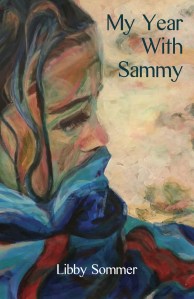
We might write five novels before we write a good one. I wrote five book-length manuscripts before one was finally accepted for publication. My skill was in the short form. I’d published dozens of short stories in prestigious literary journals. So it made sense that my first book, ‘My Year With Sammy’ (Ginninderra Press) is a novella – a small book.
What about you? Is your skill in the short form or the marathon?
How many wonderful ideas have we had in our lives that never became anything more than ideas? What stopped them from becoming reality? Probably lack of drive, or fear, or both.
If the idea of writing a story, writing a memoir, or writing a blog lights a spark within you, sets off a signal, causes you to drool—or fills you with unspeakable anxiety—then you are ready to write. What is holding you back is not lack of drive, but fear. Unadulterated, stark fear.
Fear of what?
Fear of being unable to write well and being criticized by others?
Fear of being unable to stay on track long enough to get to an ending?
Fear that you just don’t have what it takes to maintain focus to tell a good story?
Research into the way the brain operates has revealed that there are two sides to the brain, left and right. Much of our fear of writing comes from the way these two sides do or don’t work together.
“We might term the right brain ‘the creator,’ for apparently it allows us to do creative things—make connections, manifest ideas, imagine situations, see pictures of events. The left side analyses, categorizes, recalls words, and performs its learning functions in a step-by-step manner,” Bernard Selling, Writing From Within.
The analytic left brain has a compartment that houses the “critic.” He or she is the person in us who says,
Watch out!
You can’t do that!
You’ll fail, so don’t even try.
You know you’re not good at that!
“If those two voices in you want to fight, let them fight. Meanwhile, the sane part of you should quietly get up, go over to your notebook, and begin to write from a deeper, more peaceful place. Unfortunately, those two fighters often come with you to your notebook since they are inside your head. So you might have to give them five or ten minutes of voice in your notebook. Let them carry on in writing. It is amazing that when you give those voices writing space, their complaining quickly gets boring and you get sick of them,” Natalie Goldberg, Writing Down the Bones.
It’s just resistance.
Sometimes, the harder you try, the more you become stuck in your own negativity. It can feel like car tyres spinning in a bog and you just can’t move forward with ‘the work’. Your resistance is actually greater than your desire to write. That’s when you need to say ‘stop’ and put it aside for now. Look for another outlet for your energy before starting again. Take a break and read books by wonderful writers. When I get stuck I turn to contemporary poetry for inspiration – thoughtful and passionate poems about living in the modern world. Some of my favourite poets are: Mary Oliver, Naomi Shihab Nye, Les Murray and Joanne Burns.
Sometimes I start another writing project before going back to the original one to get more perspective on things. Other times I will study the beginning and endings of books to get inspiration for a new beginning or a new ending, or sometimes work backwards from the ending as a way to restart.
But don’t get caught in the endless cycle of guilt, avoidance, and pressure. When it is your time to write, write. Put yourself out of your misery and just do it.
What about you? Any tips you’d like to share about overcoming the resistance to write?
It is essential to separate the creator and the editor, or inner critic when you practice writing, so that the creator has plenty of room to breathe, experiment, and tell it like it really is. If the inner critic is being too much of a problem and you can’t distinguish it from your authentic writing voice, sit down whenever you find it necessary to have some distance from it and put down on paper what the critic is saying, put a spotlight on the words—“You have nothing original to say, what made you think you could write anything anyone would want to read, your writing is crap, you’re a loser, I’m humiliated, you write a load of rubbish, your work is pathetic, and your grammar stinks …” On and on it goes!
Say to yourself, It’s OK to feel this. It’s OK to be open to this.
You can learn to cultivate compassion for yourself during this internal process by practicing Mindfulness Meditation. Sit up straight, close your eyes, bring your awareness to your inner experience. Now, redirect your attention to the physical sensations of the breath in the abdomen … expanding as the breath comes in … and falling back as the breath goes out. Use each breath to anchor yourself in the present. Continue, concentrating on the breath for several minutes. Now, expand your field of awareness to include the words of the inner critic. Turn your attention to where in your body you feel the unpleasant thoughts, so you can attend, moment by moment, to the physical reactions to your thoughts.
“Stay with the bodily sensations, accepting them, letting them be, exploring them without judgment as best you can.”—Mindfulness, Mark Williams and Danny Penman.
Every time you realise that you’re judging yourself, that realisation in itself is an indicator that you’re becoming more aware.
The thing is, the more clearly you know yourself, the more you can accept the critic in you and use it. If the voice says, “You have nothing interesting to say,” hear the words as white noise, like the churning of a washing machine. It will change to another cycle and eventually end, just like your thoughts that come and go like trains at the station. But, in the meantime, you return to your notebook and practice your writing. You put the fear and the resistance down on the page.
Do you struggle with an inner critic? Any words of wisdom you’d like to share?
At a literary event I heard someone say, “The thing to do is put the idea in your subconscious. Your brain will do the work.”
It takes time for our experience to make its way through our consciousness. For example, it is hard to write about a journey while you are still in the midst of the adventure. We have no distance from what is happening to us. The only things we seem to be able to say are “having a great time”, “the weather is good”, “wish you were here”. It is also hard to write about a place we just moved to, we haven’t absorbed it yet. We don’t really know where we are, even if we can walk to the train station without losing our way. We haven’t experienced three scorching summers in this country or seen the dolphins migrating south along the coast in the winter.
“Maybe away from Paris I could write about Paris as in Paris I could write about Michigan. I did not know it was too early for that because I did not know Paris well enough.” – Ernest Hemingway, A Moveable Feast (New York: Charles Scribner’s Sons, 1964).
So we take in experience, but we need to let things make their way through our consciousness for a while and be absorbed by our whole selves. We are bower birds, collecting experience, and from the thrown away apple skins, outer lettuce layers, tea leaves, and chicken bones of our minds come our ideas for stories and poems and songs. But this does not come any time soon. It takes a very long time (three to ten years in the case of literary fiction). We need to keep picking through those scraps until some of the thoughts together form a pattern or can be organised around a central theme, something we can shape into a narrative. We mine our hidden thoughts for ideas. But the ideas need time to percolate: to slowly filter through.
Our work is to keep rummaging through the rubbish bins of our minds, exercising the writing muscle, in readiness to answer that knock at the door when it comes.
Rumi, the thirteenth-century Sufi poet, summed up what could be the creative process when he wrote “The Guest House”:
This being human is a guest house.
Each morning a new arrival.
A joy, a depression, a meanness,
some momentary awareness comes
as an unexpected visitor.
Welcome and entertain them all!
Even if they are a crowd of sorrows,
who violently sweep your house
empty of its furniture,
still, treat each guest honorably.
He may be clearing you out
for some new delight.
The dark thought, the shame, the malice,
meet them at the door laughing and invite
them in.
Be grateful for whoever comes,
because each has been sent
as a guide from beyond.
Jalaluddin Rumi, in The Essential Rumi Translated by Coleman Barks, 1999
As the author Vivian Gornick said, “The writers life is the pits. You live alone and you work alone, every day I have to recreate myself.” She paused and laughed. “But when the work is going well there is nothing that compares.”
What about you? Are you ready to answer the knock at the door?
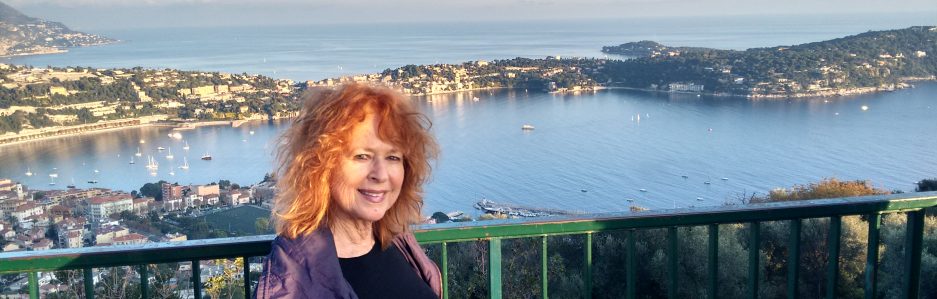









 Libby Sommer, Author