
Why Do You Write?

woman lying on green grass while holding pencil

It’s a tough gig being a writer. Lots of isolation, lots of intense concentration, lots of rejection from publishers and agents.

Why do I write? It’s a good question to ask yourself.

  1.  Because I’m a fool.
  2.  Because I want to impress my old school friends.
  3.  So people will like me.
  4.  So my friends will hate me.
  5.  I’m no good at speaking up.
  6.  So I can invent a new way of looking at the world.
  7.  In order to write the great Australian novel and become famous.
  8.  Because I’m a nut case.
  9.  Because I’m an undiscovered literary genius.
  10.  Because I have something to tell.
  11.  Because I have nothing to tell.

One of my favourite books on the writing process is The Writing Life by Pullitzer Prize winning Annie Dillard. It’s a small and passionate guide to the terrain of a writer’s world.

Dillard begins:

When you write, you lay out a line of words. The line of words is a miner’s pick, a woodcarver’s gouge, a surgeon’s probe. You wield it, and it digs a path you follow. Soon you find yourself deep in new territory. Is it a dead end, or have you located the real subject? You will know tomorrow, or this time next year. You make the path boldly and follow it fearfully. You go where the path leads. At the end of the path, you find a box canyon. You hammer out reports, dispatch bulletins. The writing has changed, in your hands, and in a twinkling, from an expression of your notions to an epistemological tool. The new place interests you because it is not clear. You attend. In your humility, you lay down the words carefully, watching all the angles. Now the earlier writing looks soft and careless. Process is nothing; erase your tracks. The path is not the work. I hope your tracks have grown over; I hope birds ate the crumbs; I hope you will toss it all and not look back.

There is a famous story in the Zen world:

The student, newly arrived at the monastery, asks the master, “What work will I do as I seek enlightenment?”

The master replies, “Chop wood, carry water.”

“And what work will I do once I achieve enlightenment?” asks the student.

“Chop wood, carry water,” says the master.

So how does this stay apply to the writing life? A writer writes. That’s all there is to it.

“A writer who waits for ideal conditions under which to work will die without putting a word on paper.” —E. B. White

What about you? Why do you write?

Is There A Link Between Spirituality and Creativity?

photo of golden gautama buddha

What is the relationship between spirituality and creativity? The discipline and focused attention cultivated through meditation help us do one thing at a time, totally and absolutely, which greatly enhances our writing.

‘Contemplative practice, daily nature walks, and still, silent listening can be among the best natural meditations. They help clarify our minds and uplift the heart, dissolving our ordinary preoccupations and mental states that dissipate the fertile spirit within. Such daily disciplines are also excellent tonics for our agitated, febrile brains and weary bodies. When we ease into the realm of non-doing–what Chinese Buddhists called wu wei–there is more room for our mysterious, unfabricated inner self to naturally emerge.’ – Lama Surya Das

It’s tough being a writer. Very tough. As Thomas Mann says, A writer is someone for whom writing is more difficult than it is for other people.

Dinty Moore, in his book The Mindful Writer, Noble Truths of the Writing Life, says his lifelong pursuit of writing and creativity has helped to open him to the path of Buddhism:

‘Find inspiration and insight on writing as a spiritual practice through astute quotes, thoughtful advice, and productive exercises on both mindfulness and craft.  This isn’t your typical “how to write” book. Author Dinty W. Moore, a well-respected writing coach and teacher, thoughtfully illuminates the creative process: where writing and creativity originate, how mindfulness plays into work, how to cultivate good writing habits and grow as a person, and what it means to live a life dedicated to writing.’ – The Mindful Writer

Here’s to Mindfulness and Meditation to help us on our way through our roller coaster lives as creative writers.


Writing Tip: A Sense of Place

person woman desk laptop

I’m sitting at my writing desk this spring morning in Sydney thinking about the need to ground our writing in a sense of place, whether landscape or cityscape.

How often have you heard someone say of a book they loved:  ‘I felt like I was there’.

Even if you relocate the cafe overlooking tennis courts at Cooper Park, the sound of tennis balls being hit, a poodle tied to a fake-cane chair at the table of older men after their regular Sunday tennis match that you drank a lemongrass and ginger tea at in Sydney into a café in a story in another state and time, the story will have originality and believability.  ‘But that café was in Sydney, I can’t transport it to Adelaide.’  But you can.  You can have flexibility with specific detail.  The mind is able to transport details, but using actual places that you experienced will give your writing authenticity and truthfulness.  It grounds your work in place, giving life and vitality to your writing, rather than a whole lot of exposition that floats in the air.

 If you don’t create evocative settings, your characters seem to have their conversations in vacuums or in some beige nowhere-in-particular. –  Jerome Stern

Creation of the physical world is as important to your story as action and dialogue.  If your readers can be made to see the hand-knitted socks or the row of vitamins on the kitchen benchtop, the scene becomes alive.  Readers pay attention.  Touch, sound, taste, and smell make readers feel as if their own feet are warm under the cold sheets.

Place situates the story in your reader’s mind.  Fiction that seems to happen in no particular place often seems not to take place at all. –  Jerome Stern

I hope this is helpful. Do you have any suggestions you would add? Let me know in the comments and please share this post with a friend if you enjoyed it.

Writing Tip: The Feedback Sandwich

people coffee meeting team

In the Saturday-afternoon feedback group, we began talking about the ‘off with his head’ or ‘out-it-goes’ part of writing.  We acknowledged that as a group we’d always been very supportive and encouraging of each others work.  That was because we were all in it together.  Our critiquing was not telling lies; it was from a place of open-hearted acceptance.  Everything you put on the page is acceptable.

Sometimes someone says, ‘I want a rigorous no-holds-barred assessment of my work.’  But what do you say to them when the writing is dull and boring?  Don’t give up your day job?  It doesn’t sit comfortably with most of us to be directly critical of someone’s writing.  It’s like telling someone how ugly their baby is.  All of us find it hard to separate our writing from ourselves, and are prone to take criticism personally.

The feedback sandwich is a widely known technique for giving constructive feedback, by ‘sandwiching’ the criticism between two pieces of praise or compliments.


hamburger with cheese and two beef patties

Yesterday, as we passed around copies of our work (just a page or two) we started to address what William Faulkner famously said:

‘In writing, you must kill all your darlings.’

First of all, we looked for the juice in each piece.  Where did the writing come alive?  ‘Get rid of the rest,’ we said.  ‘Off with his head—out it goes.’   It’s very difficult to be this honest, and not everyone wants to hear it.  ‘I simply want gentle support and a few corrections,’ some of us might say.

Be willing to have the courage to look at your work with truthfulness.  It’s good to know where your writing has energy and vitality, rather than to spend a lot of time trying to make something come to life that is dead on the page.   Keep writing.  Something new will come up.   You don’t want to put your readers to sleep by writing a lot of boring stuff.

What about you? What works or doesn’t work for you in critique groups?  Do you have any tips you would add? Let me know in the comments and please share this post with a friend if you enjoyed it. 


Writing Tip: Use Your Obsessions

woman in grey jacket sits on bed uses grey laptop

Every once in a while, when I’m scratching around for something new to write, I make a list of the things I obsess about.  Thankfully, some of them change over time, but there are always new ones to fill the gap.

It’s true that writers write about what they think about most of the time.  Things they can’t let go; things that plague them; stories they carry around in their heads waiting to be heard.

I used to get my creative writing groups to make a list of the topics they obsess about so they could see what occupies their thoughts during their waking hours.  After you write them down, you can use them for spontaneous writing before crafting them into stories.  They have much power.  This is where the juice is for writing.  They are probably driving your life, whether you realize it or not, so you may as well use them rather than waste your energy trying to push them away.  And you can come back to them repeatedly.

One of the things I’m always obsessing about is relationships:  in families, with friends, with lovers.  That’s what I tend to write about.  I think to myself, Why not?  Rather than repress my obsessions, explore them, go with the flow.  And life is always changing, so new material keeps presenting  itself.

We are driven by our passions.  Am I the only one who thinks this?  For me these compulsions contain the life force energy.  We can exploit that energy.  The same with writing itself.  I’m always thinking and worrying about my writing, even when I’m on holidays.  I’m driven.

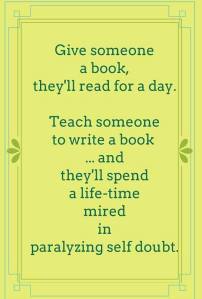
blue quote about writing on yellow background

But not all compulsions are a bad thing.  Get involved with your passions, read about them, talk to other people about them and then they will naturally become ‘grist for the mill’.

What about you?  Do you find yourself writing about the same situations over and over again? I hope these thoughts are useful. Do you have anything you would add? Let me know in the comments and please share this post with a friend if you enjoyed it.

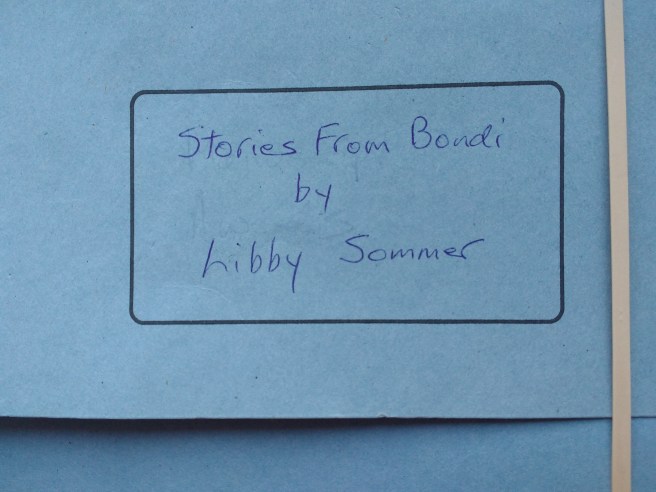
Stories From Bondi

painting of girl lying on beach in torquoise bikini reading a book

I posted another manuscript off to my publisher this week. It’s titled ‘Stories From Bondi‘. I completed an earlier, much shorter version of this book as part of a Masters in Writing at UTS back in 2001. Fingers crossed Ginninderra Press like this collection.

I’ve mentioned before how it took me 18 years of writing and 5 completed manuscripts before I finally had a book accepted by a publisher.

So now I have a small but prestigious publisher  Ginninderra Press who like my work I’m submitting my manuscripts backwards:  numbers 5, 4 and 3 have been published: ‘My Year With Sammy’, ‘The Crystal Ballroom’, ‘The Usual Story’.  Number 2 is ‘Stories From Bondi’.  80% of the short stories were first published in literary journals, including Quadrant and Overland.

Writing a book is a long, long, time-consuming process that requires a super-human amount of persistence and perseverance and dedication to the craft. It’s such a buzz to finally get my work out into the world.

blue manila folder titled Stories From Bondi by Libby Sommer

Writing Is Like Becoming A Sushi Chef

sushi rolls displayed on wooden platter

Sometimes there is a person in one of my creative writing classes who is obviously very talented.  I can bring to mind one in particular.  You could sense people holding their breath as she read, and often her hands shook.  The writing process opened her up.  She said she had wanted to write for years.  She was so excited about writing that she straight away wanted to write a book.  I said to her, slow down.  Just practise writing for a while.  Learn what this is all about.

In Japan becoming an itamae of sushi requires years of on-the-job training and apprenticeship.  After five years spent working with a master or teacher itamae, the apprentice is given his first important task, the preparation of the sushi rice.

Writing, like becoming a Sushi Chef,  is a life’s work and takes a lot of practice.  The process is slow, and at the start you are not sure what you are making.

Futomaki  (“thick roll” – rice on inside, nori on the outside)

Uramaki   (“inside-out roll” – rice on outside, nori on the inside)

Temaki     (“hand roll” – cone-shaped roll)

That’s how it was for me.  I thought I could jump in and write a book in 6 months.  In fact, it was 14 years and 5 books before one of my manuscripts was accepted for publication.

So cut yourself some slack before you head off on a writing marathon.

Writing is like learning to prepare the rice for sushi:  the apprenticeship is long, and in the beginning you are not sure whether a Futomaki, a Uramaki or a Temaki will be the end result.

Writing Tip: Turn Towards the Inner Critic

uncapped fountain pen on pageWhen you practice writing, it is essential to separate the creator and the editor, or inner critic, so that the creator has plenty of room to breathe, experiment, and tell it like it really is.  If the inner critic is being too much of a problem and you can’t distinguish it from your authentic writing voice, sit down whenever you find it necessary to have some distance from it and put down on paper what the critic is saying, put a spotlight on the words—“You have nothing original to say, what made you think you could write anything anyone would want to read, your writing is crap, you’re a loser, I’m humiliated, you write a load of rubbish, your work is pathetic, and your grammar stinks …”  On and on it goes!

Say to yourself, It’s OK to feel this.  It’s OK to be open to this.

You can learn to cultivate compassion for yourself  during this internal process by practicing Mindfulness Meditation.  Sit up straight, close your eyes, bring your awareness to your inner experience.  Now,  redirect your attention to the physical sensations of the breath in the abdomen … expanding as the breath comes in … and falling back as the breath goes out.  Use each breath to anchor yourself in the present.   Continue, concentrating on the breath for several minutes.  Now, expand your field of awareness to include the words of the inner critic.  Turn your attention to where in your body you feel the unpleasant thoughts, so you can attend, moment by moment, to the physical reactions to your thoughts.

 “Stay with the bodily sensations, accepting them, letting them be, exploring them without judgment as best you can.”—Mindfulness, Mark Williams and Danny Penman.

Every time you realise that you’re judging yourself, that realisation in itself is an indicator that you’re becoming more aware.

The thing is, the more clearly you know yourself, the more you can accept the critic in you and use it.  If the voice says, “You have nothing interesting to say,” hear the words as white noise, like the churning of a washing machine.  It will change to another cycle and eventually end, just like your thoughts that come and go like the shape shifting of clouds in the sky.  But, in the meantime, you return to your notebook and practice your writing.  You put the fear and the resistance down on the page.

I hope these ideas are useful. Do you have any tips you would add? Let me know in the comments and please share this post with a friend if you enjoyed it.

The Writing Process

alone animal bird clouds

At a literary event recently I heard someone say:  ‘The thing to do is put the idea in your subconscious.  Your brain will do the work.’

That’s the thing. It takes time for our experience to make its way through our consciousness.  For example, it is hard to write about a journey while you are still in the midst of the adventure.  We have no distance from what is happening to us.  The only things we seem to be able to say are ‘having a great time’, ‘the weather is good’, ‘wish you were here’.  It is also hard to write about a place we just moved to, we haven’t absorbed it yet.  We don’t really know where we are, even if we can walk to the train station without losing our way.  We haven’t experienced three scorching summers in this country or seen the dolphins migrating south along the  coast in the winter.

“Maybe away from Paris I could write about Paris as in Paris I could write about Michigan.  I did not know it was too early for that because I did not know Paris well enough.” – Ernest Hemingway, A Moveable Feast  (New York:  Charles Scribner’s Sons, 1964).

So we take in experience, but we need to let things make their way through our consciousness for a while and be absorbed by our whole selves.  We are bower birds, collecting experience, and from the tThrown away apple skins, outer lettuce layers, tea leaves, and chicken bones of our minds come our ideas for stories and poems and songs.  But this does not come any time soon.  It takes a very long time (three to ten years in the case of literary fiction).  We need to keep picking through these scraps until some of the thoughts together form a pattern or can be organised around a central theme, something  we can shape into a narrative.  We mine our hidden thoughts for ideas.  But the ideas need time to percolate:  to slowly filter through.

Rumi, the thirteenth-century Sufi poet, summed up what could be the creative process when he wrote ‘The Guest House’:

This being human is a guest house.

Each morning a new arrival.

A joy, a depression, a meanness,

some momentary awareness comes

as an unexpected visitor.

Welcome and entertain them all!

Even if they are a crowd of sorrows,

who violently sweep your house

empty of its furniture,

still, treat each guest honourably.

He may be clearing you out

for some new delight.

The dark thought, the shame, the malice,

meet them at the door laughing and invite

them in.

Be grateful for whoever comes,

because each has been sent

as a guide from beyond.

Jalaluddin Rumi, in The Essential Rumi,

Translated by Coleman Barks, 1999

Our work is to keep rummaging through the rubbish bins of our minds, exercising the writing muscle, in readiness to answer that knock at the door when it comes.

I hope these thoughts on the writing process are helpful.   Do you have any tips you would add? Let me know in the comments and please share this post with a friend if you enjoyed it. 


Writing Tip: To Plot or Not to Plot

portrait of beautiful young woman over white background

Plot means the story line.  When people talk about plotting, they mostly mean how to set up the situation, where to put the turning points, and what the characters will be doing in the end.  What happens.

Some fiction writers write organically, not knowing where the story they are writing is going.  These writers say it would be boring to know what’s going to happen next and they lose their enthusiasm to tell the story because they know the outcome already.  They prefer throwing themselves over the edge and into the void.  This method can be very anxiety-producing.  It means you need a lot of faith in your process.

E.L. Doctorow describes the process like this:  “Writing is like driving at night in the fog. You can only see as far as your headlights, but you can make the whole trip that way.”

Other writers plan the story before they begin.  In crime fiction the story definitely needs to be worked out beforehand so information can be drip-fed to the reader.

In the past, when creating my stories, I have worked organically and not known where my stories were headed as I wrote them. Sometimes, when I’m feeling despicable about  writing, I think I really should plot to put me out of my misery. But, in the end, I just keep going, one tiny step at a time.

The shorter the piece of fiction, the less need for plot.  You can write an interesting story in which not very much happens.  A woman fights with her neighbour, a man quits his job, or an unhappy family goes out for a pizza.  Simple structures work better than something too complicated when the story is short.

A plot can, like a journey, begin with a single step.   A woman making up her mind to recover her father’s oil paintings may be enough to start.  The journey begins there, as it did for Raskolnikov in Crime and Punishment when he decided to commit his crime,”  Jerome Stern Making Shapely Fiction

The plot grows and develops out of what helps and what hinders the characters’ progress toward their goals.

The Writers’ Workshop   http://www.writersworkshop.co.uk/plot2.html  ask:

  • But how do you know if your draft plot has the right amount of weight to carry an entire novel?
  • What kind of structures work?
  • Is there a quick way to design your own plot template?
  • And how do you handle a book with multiple points of view?

“A good plot has a clear motivation.  It has a clear structure.  It has an outcome.  It has subplots.  A good plot looks something like the plot structure template below,” The Writers’ Workshop.


Motivation Lizzie Bennett wants to marry for love
Plot structure She meets Darcy & Wickham. She dislikes Darcy, and starts to fall for Wickham. Wickham turns out to be a bad guy; Darcy turns out to be a good guy. She now loves Darcy.
Outcome She marries Darcy
Subplot 1 Jane Bennett (Lizzie’s nice sister) loves Bingley. Bingley vanishes. He reappears. They get hitched.
Subplot 2 Lydia Bennett (Lizzie’s idiot sister) elopes with Wickham. She’s recovered.
Subplot 3 An idiot, Mr Collins, proposes marriage to Lizzie. She says no. Her friend, Charlotte, says yes.

Of course, there are a lot of things that the above plot template doesn’t tell you.  It doesn’t say where the novel is set, it doesn’t tell you anything about plot mechanics – it doesn’t say why Lizzie dislikes Mr Darcy, or how Lydia is recovered from her elopement.  It doesn’t have anything to say about character.

The Writers’ Workshop strongly advises us to build a template much like the one above before starting to write.  “If you’ve already started your MS then, for heaven’s sake, get to that template right away.”

So that’s all we need:  a beginning, a middle and an end.  Aristotle defined it like this:  a beginning is what requires nothing to precede it, an end is what requires nothing to follow it, and a middle needs something both before and after it.

Easy peasy.  Not.

I hope these ideas on plotting, or not plotting, are helpful.   Do you have any tips you would add? Let me know in the comments and please share this post with a friend if you enjoyed it.