Writing Tip: Use Your Obsessions

woman in grey jacket sits on bed uses grey laptop

Every once in a while, when I’m scratching around for something new to write, I make a list of the things I obsess about.  Thankfully, some of them change over time, but there are always new ones to fill the gap.

It’s true that writers write about what they think about most of the time.  Things they can’t let go; things that plague them; stories they carry around in their heads waiting to be heard.

I used to get my creative writing groups to make a list of the topics they obsess about so they could see what occupies their thoughts during their waking hours.  After you write them down, you can use them for spontaneous writing before crafting them into stories.  They have much power.  This is where the juice is for writing.  They are probably driving your life, whether you realize it or not, so you may as well use them rather than waste your energy trying to push them away.  And you can come back to them repeatedly.

One of the things I’m always obsessing about is relationships:  in families, with friends, with lovers.  That’s what I tend to write about.  I think to myself, Why not?  Rather than repress my obsessions, explore them, go with the flow.  And life is always changing, so new material keeps presenting  itself.

We are driven by our passions.  Am I the only one who thinks this?  For me these compulsions contain the life force energy.  We can exploit that energy.  The same with writing itself.  I’m always thinking and worrying about my writing, even when I’m on holidays.  I’m driven.

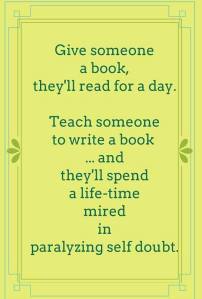
blue quote about writing on yellow background

But not all compulsions are a bad thing.  Get involved with your passions, read about them, talk to other people about them and then they will naturally become ‘grist for the mill’.

What about you?  Do you find yourself writing about the same situations over and over again? I hope these thoughts are useful. Do you have anything you would add? Let me know in the comments and please share this post with a friend if you enjoyed it.

Stories From Bondi

painting of girl lying on beach in torquoise bikini reading a book

I posted another manuscript off to my publisher this week. It’s titled ‘Stories From Bondi‘. I completed an earlier, much shorter version of this book as part of a Masters in Writing at UTS back in 2001. Fingers crossed Ginninderra Press like this collection.

I’ve mentioned before how it took me 18 years of writing and 5 completed manuscripts before I finally had a book accepted by a publisher.

So now I have a small but prestigious publisher  Ginninderra Press who like my work I’m submitting my manuscripts backwards:  numbers 5, 4 and 3 have been published: ‘My Year With Sammy’, ‘The Crystal Ballroom’, ‘The Usual Story’.  Number 2 is ‘Stories From Bondi’.  80% of the short stories were first published in literary journals, including Quadrant and Overland.

Writing a book is a long, long, time-consuming process that requires a super-human amount of persistence and perseverance and dedication to the craft. It’s such a buzz to finally get my work out into the world.

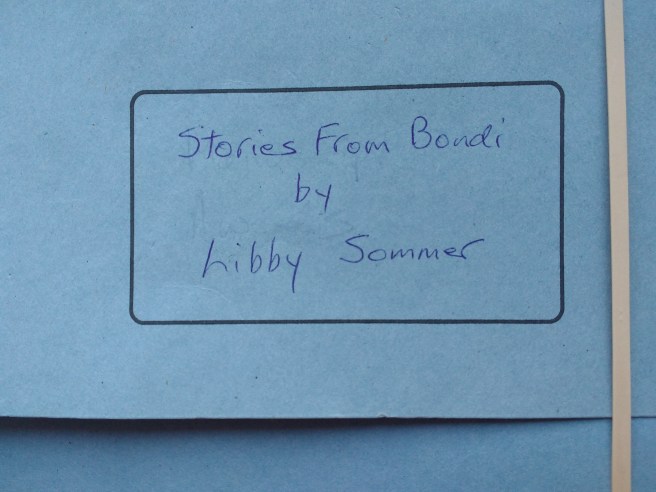
blue manila folder titled Stories From Bondi by Libby Sommer

Writing Is Like Becoming A Sushi Chef

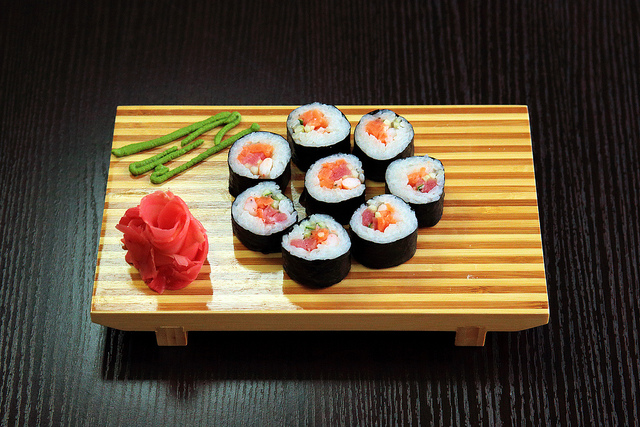
sushi rolls displayed on wooden platter

Sometimes there is a person in one of my creative writing classes who is obviously very talented.  I can bring to mind one in particular.  You could sense people holding their breath as she read, and often her hands shook.  The writing process opened her up.  She said she had wanted to write for years.  She was so excited about writing that she straight away wanted to write a book.  I said to her, slow down.  Just practise writing for a while.  Learn what this is all about.

In Japan becoming an itamae of sushi requires years of on-the-job training and apprenticeship.  After five years spent working with a master or teacher itamae, the apprentice is given his first important task, the preparation of the sushi rice.

Writing, like becoming a Sushi Chef,  is a life’s work and takes a lot of practice.  The process is slow, and at the start you are not sure what you are making.

Futomaki  (“thick roll” – rice on inside, nori on the outside)

Uramaki   (“inside-out roll” – rice on outside, nori on the inside)

Temaki     (“hand roll” – cone-shaped roll)

That’s how it was for me.  I thought I could jump in and write a book in 6 months.  In fact, it was 14 years and 5 books before one of my manuscripts was accepted for publication.

So cut yourself some slack before you head off on a writing marathon.

Writing is like learning to prepare the rice for sushi:  the apprenticeship is long, and in the beginning you are not sure whether a Futomaki, a Uramaki or a Temaki will be the end result.

Recharging Your Creative Batteries

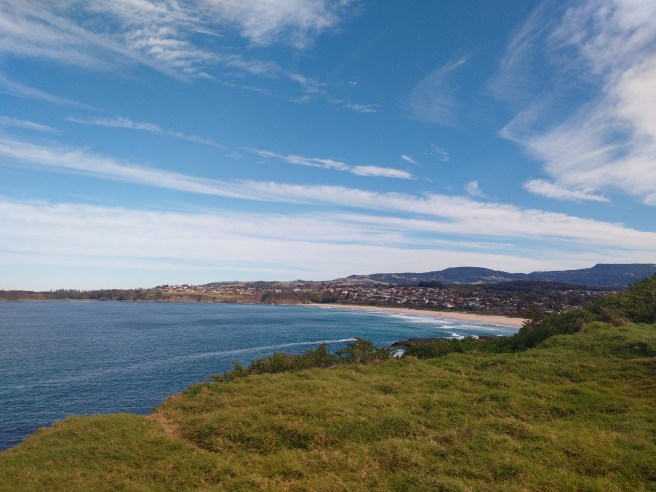
land, sea and sky at seaside town of Kiama
Kiama, New South Wales

A change of scene does wonders, especially after all the work and excitement of launching a new book.

Writing a book is hard work.  Even though it is very challenging, we know it is what we were born to do.  After we’ve written the book, edited it, submitted to a publisher, had discussions about cover design, created the back cover blurb, obtained reviews, networked, self-promoted, updated the websites, promoted on Instagram, Facebook and Word Press, organised a launch and readings, it’s only natural to find ourselves exhausted.  Before our batteries are totally flat, we need to give ourselves permission to take some time-out. We need to walk away from the desk. Do something that will breathe fresh life into our work and feed our creative souls.

After the release of THE USUAL STORY, I caught a train to the seaside town of Kiama and had two days to walk by the ocean and breath in the fresh sea air. Fantastic.

Writing Tip: I am not the stories I tell

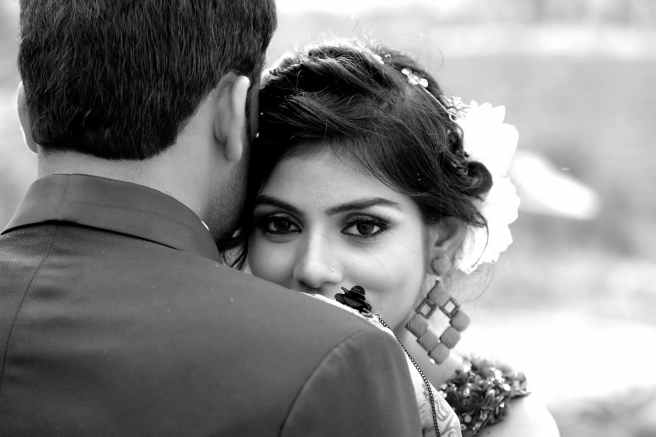
greyscale photo of man and woman
Photo by Mukesh Mohanty on Pexels.com

Sometimes when people read my stories they assume those stories are me.  They are not me, even if I write in the first person.  They were my thoughts and feelings at the time I wrote them.  But every minute we are all changing.  There is a great freedom in this.  At any time we can let go of our old selves and start again.  This is the writing process.  Instead of blocking us, it gives us permission to move on.  Just like in a progressive ballroom dance:  you give your undivided attention to your partner—keep eye contact for the time you are dancing together—but then you move on to the next person in the circle.

The ability to express yourself on the page—to write how you feel about an old lover, a favourite pair of dance shoes, or the memory of a dance on a chilly winter’s night in the Southern Highlands—that moment you can support how you feel inside with what you say on the page.  You experience a great freedom because you are not suppressing those feelings.  You have accepted them, aligned yourself with them.

I have a poem titled ‘This is what it feels like’—it’s a short poem.  I always think of it with gratitude  because I was able to write in a powerful way how it was to be desperate and frightened.  The act of self expression made me feel less of a victim.  But when people read it they often say nothing.   I remind myself, I am not the poem, I am not the stories I write.  People react from where they are in their own lives.  That’s the way things are.  The strength is in the act of writing, of putting pen to paper.   Write your stories and poems, show them to the world, then move on.  The stories are not you.  They are moments in time that pass through you.

I hope these thoughts are useful. Do you have anything you would add? Let me know in the comments and please share this post with a friend if you enjoyed it.
This is what it feels like

When a single thought

may darken and trap,

terrify, for no apparent reason.

A storm

in your senseless head.

Whatever the thought,

think implosion of self

or crazy,

any thought you have held

in tenuous reality

like lead in the chest.

Say you were heavy footed

downhill and it made you

want to stop.  At midnight

driverless cars advance on you,

but where the hell is the brake?

Copyright © 2018 Libby Sommer

Writing Tip: Turn Towards the Inner Critic

uncapped fountain pen on pageWhen you practice writing, it is essential to separate the creator and the editor, or inner critic, so that the creator has plenty of room to breathe, experiment, and tell it like it really is.  If the inner critic is being too much of a problem and you can’t distinguish it from your authentic writing voice, sit down whenever you find it necessary to have some distance from it and put down on paper what the critic is saying, put a spotlight on the words—“You have nothing original to say, what made you think you could write anything anyone would want to read, your writing is crap, you’re a loser, I’m humiliated, you write a load of rubbish, your work is pathetic, and your grammar stinks …”  On and on it goes!

Say to yourself, It’s OK to feel this.  It’s OK to be open to this.

You can learn to cultivate compassion for yourself  during this internal process by practicing Mindfulness Meditation.  Sit up straight, close your eyes, bring your awareness to your inner experience.  Now,  redirect your attention to the physical sensations of the breath in the abdomen … expanding as the breath comes in … and falling back as the breath goes out.  Use each breath to anchor yourself in the present.   Continue, concentrating on the breath for several minutes.  Now, expand your field of awareness to include the words of the inner critic.  Turn your attention to where in your body you feel the unpleasant thoughts, so you can attend, moment by moment, to the physical reactions to your thoughts.

 “Stay with the bodily sensations, accepting them, letting them be, exploring them without judgment as best you can.”—Mindfulness, Mark Williams and Danny Penman.

Every time you realise that you’re judging yourself, that realisation in itself is an indicator that you’re becoming more aware.

The thing is, the more clearly you know yourself, the more you can accept the critic in you and use it.  If the voice says, “You have nothing interesting to say,” hear the words as white noise, like the churning of a washing machine.  It will change to another cycle and eventually end, just like your thoughts that come and go like the shape shifting of clouds in the sky.  But, in the meantime, you return to your notebook and practice your writing.  You put the fear and the resistance down on the page.

I hope these ideas are useful. Do you have any tips you would add? Let me know in the comments and please share this post with a friend if you enjoyed it.

Publication Update

a man and woman dancing tango

On Tuesday I posted the corrected final proofs of THE USUAL STORY back to publisher Ginninderra Press.  Am now in the home stretch for July release of the book, a prequel to THE CRYSTAL BALLROOM.  Have finalised the blurb for back cover and obtained copyright approval for front cover image.

The primary goal of proofing is to serve as a tool for customer verification that the entire job is accurate. Prepress proofing (also known as off-press proofing[4]) is a cost-effective way of providing a visual copy without the expense of creating a press proof.[5] If errors are found during the printing process on press, correcting them can prove very costly to one or both parties involved. – Wikipedia

I’ve been working on the back cover Book Blurb for the last couple of months – rewritten it maybe 300 times. But I think it reads well now, so well I hope readers won’t be disappointed when they read the book itself. Hopefully the story lives up to its promise.

Like THE CRYSTAL BALLROOM, THE USUAL STORY is written in stand-alone discreet chapters. Versions of several of the chapters were first published as short stories in literary journals. I connected the stories by using segments as linking devices: the main character’s telling of the aftermath of a painful affair, her search for understanding of what went before, and the tango. It’s not an easy thing to do. My proof reader said the manuscript reads like a novel, rather than as a collection of linked stories. Am very happy to hear that. Another term for the structure of the book is novel-in-stories.

‘While the short story pauses to explore an illuminated moment, and the novel chugs toward a grand conclusion, the novel in stories moves in spirals and loops, a corkscrewing joy rode.’ – Danielle Trussoni

So corrected final proofs are now with  Ginninderra Press in Adelaide, a small but prestigious publisher.

The next step towards a July release of THE USUAL STORY –  a delicately fragmented story of memory, intrigue and passion –  is the uploading of the files to the printer.

An exciting time.


Writing Tip: To Plot or Not to Plot

portrait of beautiful young woman over white background

Plot means the story line.  When people talk about plotting, they mostly mean how to set up the situation, where to put the turning points, and what the characters will be doing in the end.  What happens.

Some fiction writers write organically, not knowing where the story they are writing is going.  These writers say it would be boring to know what’s going to happen next and they lose their enthusiasm to tell the story because they know the outcome already.  They prefer throwing themselves over the edge and into the void.  This method can be very anxiety-producing.  It means you need a lot of faith in your process.

E.L. Doctorow describes the process like this:  “Writing is like driving at night in the fog. You can only see as far as your headlights, but you can make the whole trip that way.”

Other writers plan the story before they begin.  In crime fiction the story definitely needs to be worked out beforehand so information can be drip-fed to the reader.

In the past, when creating my stories, I have worked organically and not known where my stories were headed as I wrote them. Sometimes, when I’m feeling despicable about  writing, I think I really should plot to put me out of my misery. But, in the end, I just keep going, one tiny step at a time.

The shorter the piece of fiction, the less need for plot.  You can write an interesting story in which not very much happens.  A woman fights with her neighbour, a man quits his job, or an unhappy family goes out for a pizza.  Simple structures work better than something too complicated when the story is short.

A plot can, like a journey, begin with a single step.   A woman making up her mind to recover her father’s oil paintings may be enough to start.  The journey begins there, as it did for Raskolnikov in Crime and Punishment when he decided to commit his crime,”  Jerome Stern Making Shapely Fiction

The plot grows and develops out of what helps and what hinders the characters’ progress toward their goals.

The Writers’ Workshop   http://www.writersworkshop.co.uk/plot2.html  ask:

  • But how do you know if your draft plot has the right amount of weight to carry an entire novel?
  • What kind of structures work?
  • Is there a quick way to design your own plot template?
  • And how do you handle a book with multiple points of view?

“A good plot has a clear motivation.  It has a clear structure.  It has an outcome.  It has subplots.  A good plot looks something like the plot structure template below,” The Writers’ Workshop.


Motivation Lizzie Bennett wants to marry for love
Plot structure She meets Darcy & Wickham. She dislikes Darcy, and starts to fall for Wickham. Wickham turns out to be a bad guy; Darcy turns out to be a good guy. She now loves Darcy.
Outcome She marries Darcy
Subplot 1 Jane Bennett (Lizzie’s nice sister) loves Bingley. Bingley vanishes. He reappears. They get hitched.
Subplot 2 Lydia Bennett (Lizzie’s idiot sister) elopes with Wickham. She’s recovered.
Subplot 3 An idiot, Mr Collins, proposes marriage to Lizzie. She says no. Her friend, Charlotte, says yes.

Of course, there are a lot of things that the above plot template doesn’t tell you.  It doesn’t say where the novel is set, it doesn’t tell you anything about plot mechanics – it doesn’t say why Lizzie dislikes Mr Darcy, or how Lydia is recovered from her elopement.  It doesn’t have anything to say about character.

The Writers’ Workshop strongly advises us to build a template much like the one above before starting to write.  “If you’ve already started your MS then, for heaven’s sake, get to that template right away.”

So that’s all we need:  a beginning, a middle and an end.  Aristotle defined it like this:  a beginning is what requires nothing to precede it, an end is what requires nothing to follow it, and a middle needs something both before and after it.

Easy peasy.  Not.

I hope these ideas on plotting, or not plotting, are helpful.   Do you have any tips you would add? Let me know in the comments and please share this post with a friend if you enjoyed it. 
 

Writing Tip: A Change of Pace

adult book boring face

I’m very excited to have my poem BETWEEN THE ISLANDS OF THE PACIFIC in the June 2018 Quadrant  alongside some great poets including Les Murray, Barbara Fisher, Craig Kurtz, Geoff Page, Dan Guenther, Gabriel Fitzmaurice, Graeme Hetherington. Just received my copy.

It’s refreshing to have a change of pace. I’ve been having a break from working on long narratives by working on shorter pieces: prose poems, flash fiction, micro fiction, etc. Very gratifying to have one (so far) accepted for publication.

The poem was inspired by a cruise I did earlier this year with my family. At the time I thought I could write a book length story set on a ship, but, as things turned out, couldn’t find enough material to write a long fiction. But I was able to write a poem instead. For this I am very grateful.

Writing poetry, a synopsis or a book blurb are all good things to have to do in terms of improving our ability to compress or distill an idea. Having to get our message across in just a few words. Instagram is a useful for this too. One sentence to connect with our followers. And Facebook.  The very short forms are a good discipline for us writers.

I belong to an excellent weekly feedback poetry group. If it wasn’t for them, I wouldn’t be able to get my poems to that next level of being at a publishable standard. From good to very good. Many gratitudes.

img_20180606_144812215

What about you? Do you experiment with different forms or genres? I find it helps to keep the feeling of desperation at bay. Will I ever be able to write another word? Do you have a perspective you would add? Let me know in the comments and please share this post with a friend if you enjoyed it.
Poem in Anthology

full length of man sitting on floor


red book cover of Wild anthology

Wow! Exciting news. I’m delighted to say my poem BRONTE BEACH has been selected for inclusion in the Ginninderra Press Wild Anthology. The anthology has been edited by Joan Fenney and includes 159 talented poets from across Australia exploring the many facets of ‘wild’ – human, animal, environmental and metaphorical. The book will be launched on 7th July as part of the Ginninderra Press 10 year celebrations in Port Adelaide. I’ll be in Adelaide reading my poem at East Avenue Books in Clarence Park at 2pm on 8th July. Would be great to see you then.