
Short Story or Novel

pexels-photo.jpg

Is a novel a short story that keeps going, or, is it a string of stories with connective tissue and padding, or, is it something else?  Essayist Greg Hollingshead believes that the primary difference between the short story and the novel is not length but the larger, more conceptual weight of meaning that the longer narrative must carry on its back from page to page, scene to scene.

“It’s not baggy wordage that causes the diffusiveness of the novel.  It’s this long-distance haul of meaning.”  Greg Hollingshead

There is a widespread conviction among fiction writers that sooner or later one moves on from the short story to the novel.  When John Cheever described himself as the world’s oldest living short story writer, everyone knew what he meant.

Greg Hollingshead says that every once in a while, to the salvation of literary fiction, there appears a mature writer of short stories—someone like Chekhov, or Munro—whose handling of the form at its best is so undulled, so poised, so capacious, so intelligent, that the short in short story is once again revealed as the silly adjective it is, for suddenly here are simply stories, spiritual histories, narratives amazingly porous yet concentrated and undiffused.

When you decide you want to write in a particular form—a novel, short story, poem—read a lot of writing in that form.  Notice the rhythm of the form.  How does it begin?  What makes it complete?  When you read a lot in a particular form, it becomes imprinted inside you, so when you sit at your desk to write, you produce that same structure.  In reading novels your whole being absorbs the pace of the sentences, the setting of scenes, knowing the colour of the bedspread and how the writer gets her character to move down the hallway to the front door.

I sit at my desk thinking about form as a low-slung blanket of cloud blocks my view of the sky.  Through the fly screen I inhale the sweet smell of earth after rain as another day of possibility beckons.

The thing is, we might write five novels before we write a good one.  I wrote five book-length manuscripts before one was finally accepted for publication, even though I’d published 30 short stories.  So form is important, we need to learn form, but we should also remember to fill form with life.  All it takes is practice.

I hope this post is useful. Do you have any tips you would add? Let me know in the comments and please share this post with a friend if you enjoyed it.


Short Story: At the Festival

pexels-photo-167491.jpeg

My short story ‘At the Festival’ was first published in Quadrant May 2016. It was inspired by my yearly visits to the Canberra National Folk Festival. The music is really world music rather than folk. A happening event. 60,000 people. Lots of colour and movement for a writer who likes to get ideas from the world around them – though this is a work of fiction.

It was six o’clock in the evening when she finally passed the wind turbines.  There, at last, stood Lake George, where long-woolled sheep grazed the field and to the west the Brindabella mountain range was coloured grey and pink by the setting sun.   On she drove along an ink-black strip of road where, on either side, tall green-grey eucalypts had formed a welcoming archway.  The way flattened out then curved into a narrow empty road.  Not one person did she see, not one building, just a handful of brown-bellied cows and later a group of kangaroos standing formidable and still in the headlights.  The turn for Watson wasn’t clearly sign-posted but she felt confident in turning east along the row of liquid ambers in autumn bloom that took her to the cabins.

Twice on the journey she had pulled into a service station and shut her eyes and briefly rested but now, as she neared Canberra, she felt wide awake and full of energy.  Even the dark length of road which progressed flatly to Reception seemed to hold the promise of a new beginning.  She sensed the towering, protective presence of the mountain range, the forested hills and, further on, just past the turnoff, the clear, pleasant thump of music coming from the festival.

The receptionist gave her a key, and eagerly she drove further on to cabin number five.  Inside, the room was renovated:  the two single beds replaced by a double.  The same compact kitchenette set into one end of the room but a new television secured to the wall by a multidirectional wall bracket.  In between, on the bare linoleum floor, stood a small table laminated with melamine and two matching chairs.  She set her keys and mobile on the table and reached for the electric jug for tea. Continue reading

Writing as a Daily Practice

pexels-photo-851213.jpeg

Writing as a daily practice is a way to exercise the writing muscle. Like working out at the gym, the more you do it, the more results you get. Some days you just don’t feel like working out and you find a million reasons not to go to the gym or out for a jog, a walk, a swim, a bike ride, but you go anyway. You exercise whether you want to or not. You don’t wait around till you feel the urge to work out and have an overwhelming desire to go to the gym. It will never happen, especially if you haven’t been into health and fitness for a long time and you are pretty out of shape. But if you force yourself to exercise regularly, you’re telling your subconscious you are serious about this and it eventually releases its grip on your resistance. You just get on and do it. And in the middle of the work out, you’re actually enjoying it. You’ve felt the endorphines kick in. When you get to the end of the jog, the walk, the bike ride, the swim, the gym workout or the Pilates, Yoga or Zumba class, you don’t want it to end and you’re looking forward to the next time.

That’s how it is with writing too. Once you’ve got the flow happening, you wonder why it took you so long to turn up on the page. Bum on chair is what I say to my writing students. Through daily practice your writing does improve.

In The Artist’s Way, Julia Cameron’s book on discovering and recovering your creative self, she refers to daily writing practice as the morning pages. She recommends writing three pages of longhand, strictly stream-of-consciousness—moving the hand across the page and writing whatever comes to mind every day.

Author of Writing Down the Bones, Natalie Goldberg refers to writing practice as timed exercise. She says you might time yourself for ten minutes, twenty minutes, or longer. It’s up to you, but the aim is to capture first thoughts. “First thoughts have tremendous energy. It is the way the mind first flashes on something. The internal censor usually squelches them, so we live in the realm of second and third thoughts, thoughts on thought, twice and three times removed from the direct connection of the first fresh flash.”

Her rules for writing practice are:

1. Keep your hand moving.
2. Don’t cross out.
3. Don’t worry about spelling, punctuation , grammar.
4. Lose control.
5. Don’t think. Don’t get logical.
6. Go for the jugular.

In Creative Journal Writing, author Stephanie Dowrick refers to the same process as free writing; writing without judging, comparing and censoring. “Continuing to write when you don’t know what’s coming next and especially when you feel your own resistances gathering in a mob to mock you.”

Daily writing practice has been described as clearing the driveway of snow before reaching the front door. In other words, it’s what we do as a warm up before the real writing takes place.  And it’s a way to loosen up and discover our own unique writing ‘voice’.  That’s what publishers are looking for when they read through the slush pile.  The storyteller’s voice.  The authentic writing voice of the author is what engages the reader. Easier said than done.

I hope this writing tip is helpful. Do you have any tips on committing to a daily writing practice you would add? Let me know in the comments and please share this post with a friend if you enjoyed it.
Short Story: Jean-Pierre

vf clock

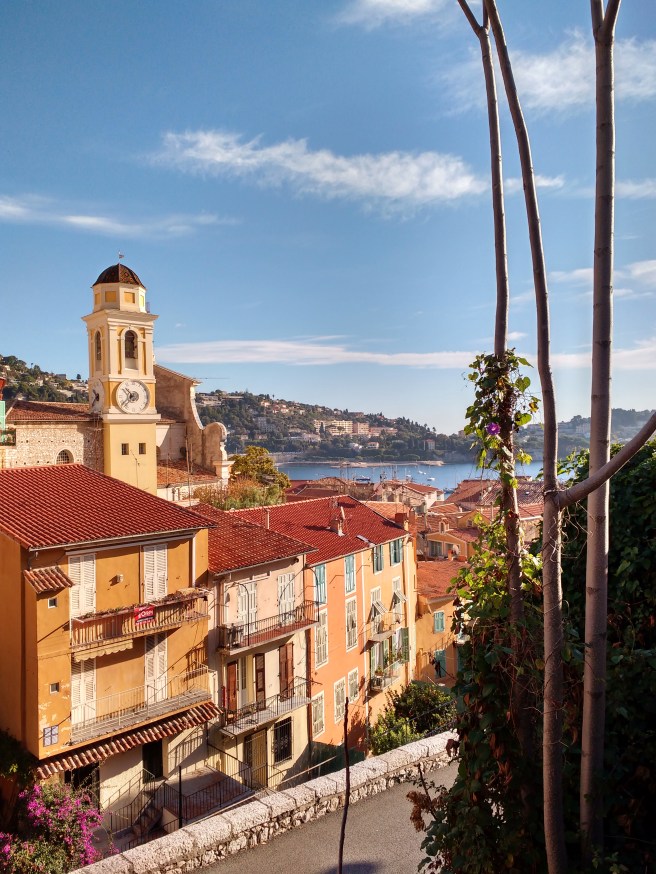
‘Jean-Pierre’, first published in Quadrant magazine in July 2016, was inspired by my frequent visits to a small fishing village in the south of France. Basically, I am always looking for story ideas. I use anything that moves or makes a noise, is what I tend to tell people. And as I like to ground my stories in a strong sense of place, Villefranche-sur-Mer was my inspiration:  

This was in a far distant land.  There were Pilates classes but no surfing beaches or vegan restaurants.  People said to hell with low-fat diets and tiny portions.  Charles, who had wanted her to hire his friend Jean-Pierre as tour guide, had encouraged her in yoga class.    ‘Look, Zina, you’re a facilitator—you’ve been running those groups—for what—thirty years?’

‘Only twenty, for goodness sake.’  She had turned forty-nine and frowned at him upside down between the legs of a downward facing dog.  She had a face marked by the sun, a face left to wrinkle and form crevasses by years of smoking, a face made shiny by the application of six drops of jojoba oil, although the shop girl had recommended she use only three.  ‘I love that word facilitator.  It says so much.’

‘Twenty.  All right.  This guy’s not at all your type.  He’s a numbers man.  He shows tourists around in between Engineering contracts.  He can show you how to buy a bus or a train ticket, how to withdraw money out of the wall—get your bearings.  You can hire him for half a day.  Or, in your case, half a day and half the night.’

‘Very funny,’ she said, stifling a laugh.  Now they were on all fours arching their backs like cats, then flattening their spines to warm up the discs.  Indian chanting music took your mind off the fact that the person behind you was confronted with your broad derriere. ‘So what’s the story with Jean-Pierre?’ Continue reading

At the Beginning, Pen and Paper

pexels-photo-834897.jpeg

When I used to teach classes to beginning writers, it was good.  It forced me to think back to the beginning to when I first put pen to paper.  The thing is, every time we sit down and face the blank page, it’s the same.  Every time we start a new piece of writing, we doubt that we can do it again.  A new voyage with no map.  As people say, it is like setting off towards the horizon, alone in a boat, and the only thing another person can do to help us, is to wave from the shore.

So when I used to teach a creative writing class, I had to tell them the story all over again and remember that this is the first time my students are hearing it.  I had to start at the very beginning.

First up, there’s the pen on the page.  You need this intimate relationship between the pen and the paper to get the flow of words happening.  A fountain pen is best because the ink flows quickly.  We think faster than we can write.  It needs to be a “fat” pen to avoid RSI.

Consider, too, your notebook.  It is important.  The pen and paper are your basic tools, your equipment, and they need to be with you at all times.  Choose a notebook that allows you plenty of space to write big and loose.  A plain cheap thick spiral notepad is good.

After that comes the typing up on the computer and printing out a hard copy.  It’s a right and left brain thing.  You engage the right side of the brain, the creative side, when you put pen to paper, then bring in the left side, the analytic side, when you look at the print out.  You can settle back comfortably with a drink (a cup of tea even 🙂 ) and read what you’ve written.  Then edit and rewrite.

Patrick White said that writing is really like shitting; and then, reading the letters of Pushkin a little later, he found Pushkin said exactly the same thing.  Writing is something you have to get out of you.

I hope this Writing Tip is helpful. Do you have any tips you would add? Let me know in the comments and please share this post with a friend if you enjoyed it.

Short Story: Alfresco


pexels-photo-317157.jpeg

Hope you enjoy reading this short story ‘Alfresco’ first published in May-June Quadrant 2017.  It took me a year of rewrites until finally reaching a publishable standard. What gave me the idea for the story was that I’d booked into a yoga retreat in Queensland and thought I’d probably get some creative writing ideas when there. But what happened was the retreat was cancelled due to lack of bookings. As I’d written a beginning for the story already I had to make the rest up. It had amused me that you could make a booking for a room with an ‘alfresco’ bathroom: 

She remembers the exact moment she agreed to go to the mid-winter yoga retreat. Her friend Vivian had been there before and said she would come back a new person. Transformed. Continue reading

Autobiography in Fiction

stacks of books on shelves of bookcase

When people ask me where I get my ideas from, I tell them I use the world around me. Life is so abundant, if you can write down the actual details of the way things were and are, you hardly need anything else. Even if you relocate the French doors, fast-spinning overhead fan, small red laptop, and low kneeling-chair from your office that you work in in Sydney into an Artist’s Atelier in the south of France at another time, the story will have truth and groundedness.

In Hermione Hoby’s interview with Elizabeth Strout in the Guardian newspaper the Pulitzer prize winner said her stories have always begun with a person, and her eyes and ears are forever open to these small but striking human moments, squirreling them away for future use. “Character, I’m just interested in character,” she said.

“You know, there’s always autobiography in all fiction,” Strout said, referring to her new novel, My Name is Lucy Barton. “There are pieces of me in every single character, whether it’s a man or a woman, because that’s my starting point, I’m the only person I know.” She went on to explain: “You can’t write fiction and be careful. You just can’t. I’ve seen it with my students over the years, and I think actually the biggest challenge a writer has is to not be careful. So many times students would say, ‘Well, I can’t write that, my boyfriend would break up with me.’ And I’d think, you have to do something that’s going to say something, and if you’re careful it’s just not going to work.”

In 2016 at the launch of my debut novel My Year With Sammy the launcher said: “Libby’s level of detail creates poignant insights into character and relationships. If people know Libby they may find themselves subtly entwined in one of her stories.”

On Goodreads’ website they locate The Bell Jar by Sylvia Plath under “Autobiographical Fiction” and describe the book as Plath’s shocking, realistic, and intensely emotional novel about a woman falling into the grip of insanity:

“Esther Greenwood is brilliant, beautiful, enormously talented, and successful, but slowly going under—maybe for the last time. In her acclaimed and enduring masterwork, Sylvia Plath brilliantly draws the reader into Esther’s breakdown with such intensity that her insanity becomes palpably real, even rational—as accessible an experience as going to the movies. A deep penetration into the darkest and most harrowing corners of the human psyche, The Bell Jar is an extraordinary accomplishment and a haunting American classic.” – Goodreads

My advice to you is to be awake to the details around you, but don’t be self-conscious. So here it is. I’m at a Valentine’s Day party. It’s 33 degrees outside. The hostess is sweltering over a hot oven in the kitchen. She is serving up cheese and spinach triangles as aperitifs. Relax, enjoy the party, be present with your eyes and ears open. You will naturally take it all in, and later, sitting at your desk, you will be able to remember just how it was to be eating outside in the heat under a canvas umbrella, attempting to make conversation with the people on either side of you, and thinking how you can best make an early exit.

“I don’t want to write melodrama; I’m not interested in good and bad, I’m interested in all those little ripples that we all live with. And I think that if one gets a truthful emotion down, or a truthful something down, it is timeless.” – Elizabeth Strout, the Guardian

What about you? Is there autobiography in your fiction?

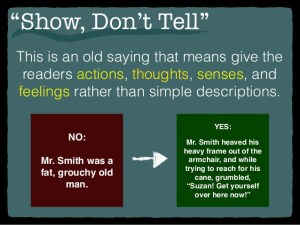
Writing Tip: Don’t Tell, but Show

cartoon illustrating angry boy with red face


An old one but a good one: don’t tell, but show.

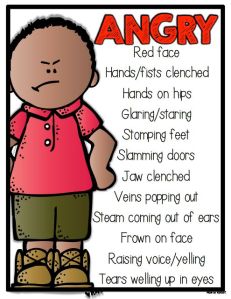
What does it mean exactly? It means don’t tell us about loneliness (or any of those complex words like dishonesty, secrecy, jealousy, obsession, regret, death, injustice, etc) show us what loneliness is. We will read what you’ve written and feel the bite of loneliness. Don’t tell us what to feel. Show us the situation, and that feeling will be triggered in us.

don't tell, but show

When you take your child to school on their first day you may find yourself teary and relieved at the same time. Put into words what you see: the child’s face, the wave at the gate, the other mothers saying their goodbyes, another child coming up to take your son by the hand. We will get what you’re trying to say without you telling us directly.

don't tell, but show 2

When you write, be conscious of the senses and how they connect to the experiences you are writing about. Use sight, sound, smell, touch to create concrete pictures. The senses allow you to get as close as humanly possible in words to the wedding, the sunrise, the dog, the suitcase. It’s the best way to penetrate your story and breathe life into it. Don’t tell us about something, drop deep, enter the story and take us with you.

I hope this post on show, don’t tell is useful. Do you have any tips you would add? Let me know in the comments and please share with a friend if you enjoyed it. 
Writing Tip: taste life twice

writer at work at typewriter

Writers live twice. They go along with their regular life, are as fast as anyone in the grocery store, crossing the street, getting dressed for work in the morning. But there’s another part of them that they have been training. The one that lives everything a second time. That sits down and sees their life again and goes over it. Looks at the texture and the details.”  – Natalie Goldberg

quote by Anais Nin against a night sky

So here I am on a month away from my Sydney home wanting to recharge the creative batteries. I’ve just had a 4 night visit to Marrakech, Morocco. I got back to Villefranche sur Mer, where I’m renting a writing studio, last night. It’s a 3 hour flight between Nice France and Marrakech. So seeing as I’d traveled all the way across the world, I thought it a good time to visit Marrakech. Wow! What a creative experience. All the senses are awakened. Maybe I’ll live life twice and write something set in Morocco.

For now I’m feeling grateful to be able to travel and experience other cultures. The Marrakech-born people I met have never left their country. In the photos you can see me and Morad, the night manager at Riad Daria in Marrakech, one of the very kind and welcoming Moroccon’s who helped me during my stay. We’re pictured on the terrace of the riad. After the chaos of Marrakech’s souks, there’s nothing like a calm retreat. Below us is a corner of the rooftop terrace.

The first pic is the famous Jardin Marjorelle, the beautiful garden once owned by Yves Saint Laurent and home to the Berber Museum. He gifted the garden to Marrakech, the city that adopted him in 1964. Saint Laurent and his partner Pierre Berge bought the electric blue villa and its garden to preserve the vision of its original owner, landscape painter Jacques Majorelle, and keep it open to the public.  A memorial to the French fashion designer was built there. This year a new museum dedicated to him was opened next door to Jardin Marjorelle. I was lucky enough to visit. The museum retraces Saint Laurent’s forty years of creativity, the world of fashion he created, some designs influenced by his life in Marrakech. He too tasted life twice.


Does solitude enrich creative work?

wp2

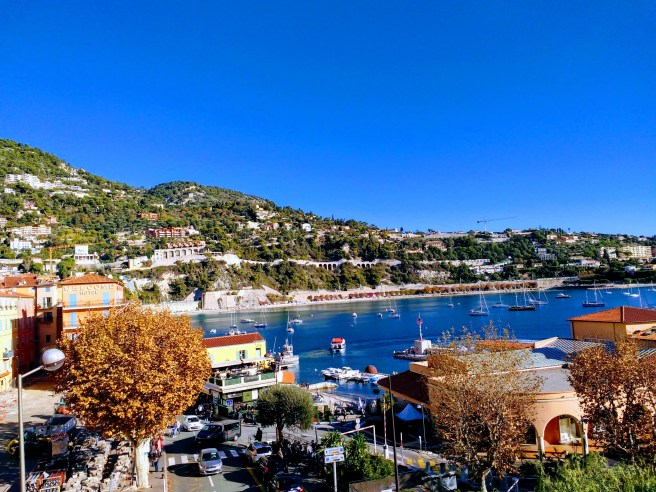
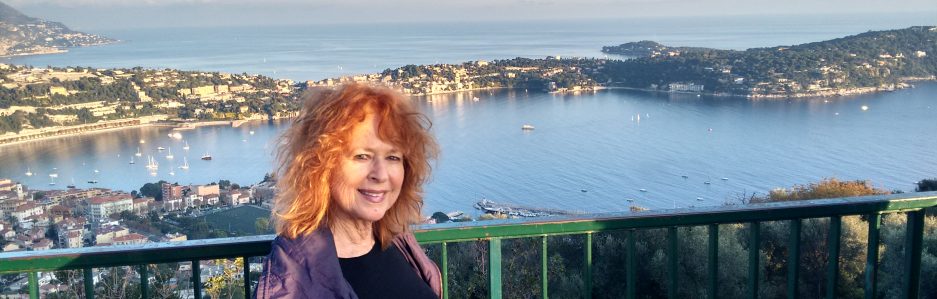
I’ve been living for two weeks now in Villefranche sur Mer a small fishing village on the French Riviera. This is the fourth year I’ve rented an apartment here and had a month to  myself to read and to write and go for long walks around the stunning coastline of the Cote d’Azur.

wp6

I’ve had my ups and downs, but what’s new? I love being in this magnificent part of the world but find it challenging being alone in a foreign country where I don’t speak the language. I have tried to learn French, but languages aren’t my forte. It’s certainly a good opportunity to dig deep in silence.

wp3

Check out this article in the Huffington Post on Why Silence Is So Good For Your Brain.

As our internal and external environments become louder and louder, more people are beginning to seek out silence, whether through a practice of sitting quietly for 10 minutes every morning or heading off to a 10-day silent retreat.

wp5

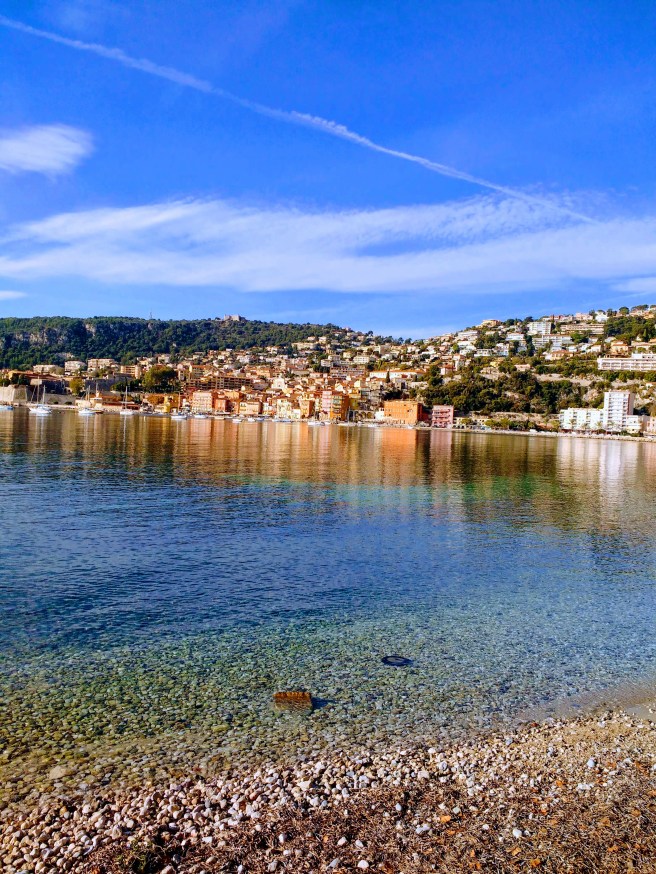
It’s mild early winter here on the Mediterranean and on sunny days people still swim and sunbake on the beach. The Bay of Villefranche, reputed as one of the five most beautiful bays in the world, is anchored by two major cities – Nice and Monaco – on either side. Villefranche is still a traditional Nicoise fishing village, pedestrians-only in the Old Town.

vf clock

Twice a week there is a fabulous fresh market in the garden square. I especially like the cheese man on a Saturday where I buy Roquefort and Camembert. On Wednesdays I buy Italian Parmesan from the Italian man. Villefranche is close to the border with Italy, so we are able to enjoy a few special Italian treats like pizza and capuccinos. The Wednesday Italian man sells charcuterie and fresh pasta too. Another man cooks and sells socca and pissaladiere, two traditonal favourites of this area. And then there’s the man selling tapinades. The black olive tapinade is my favourite. And, of course, being a fishing village, there’s the fish monger with his freshly caught catch of the day.

wp8
fisherman

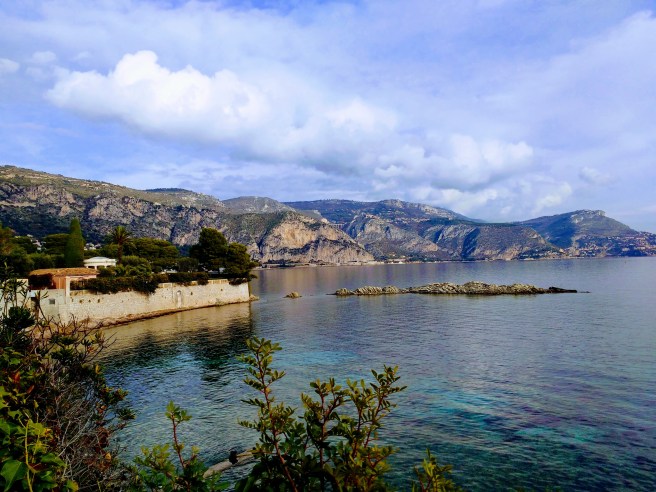
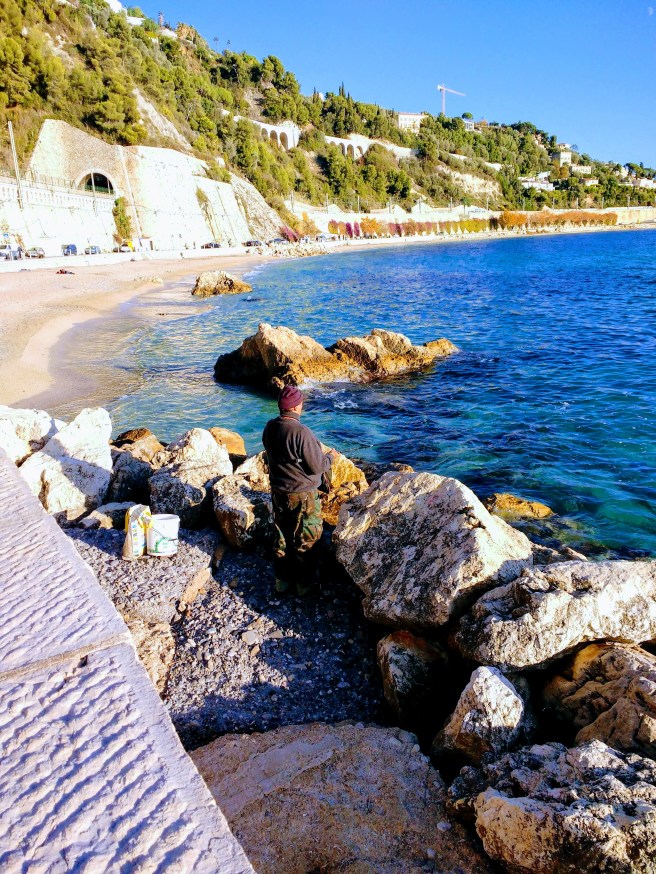
Surrounding Villefranche’s large bay are cliffs and steep hillsides, brimming with olive and citrus trees, Mediterranean pines, bougainvillea and flowering plants. The lush vegetation meets the water’s edge where the shades of blue are dazzling.

vf bouganvillea

The stunning light levels here on the French Riviera have long attracted the artist and writer community (Matisse, Chagall, Picasso, Renoir, F. Scott Fitzgerald, Chanel, Cocteau and Nietzsche, to name a few).

wp10

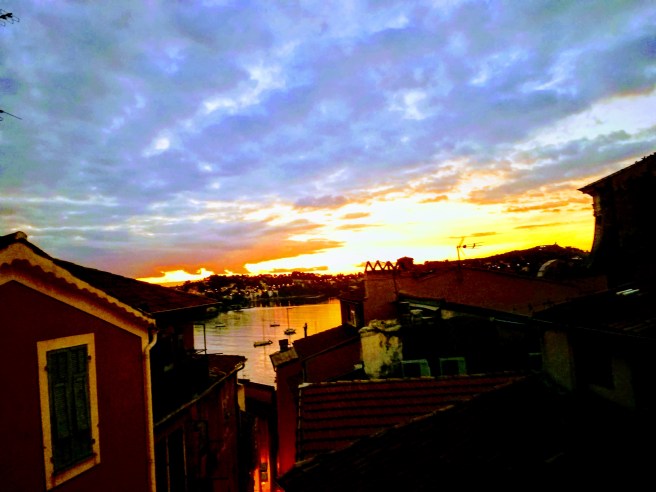
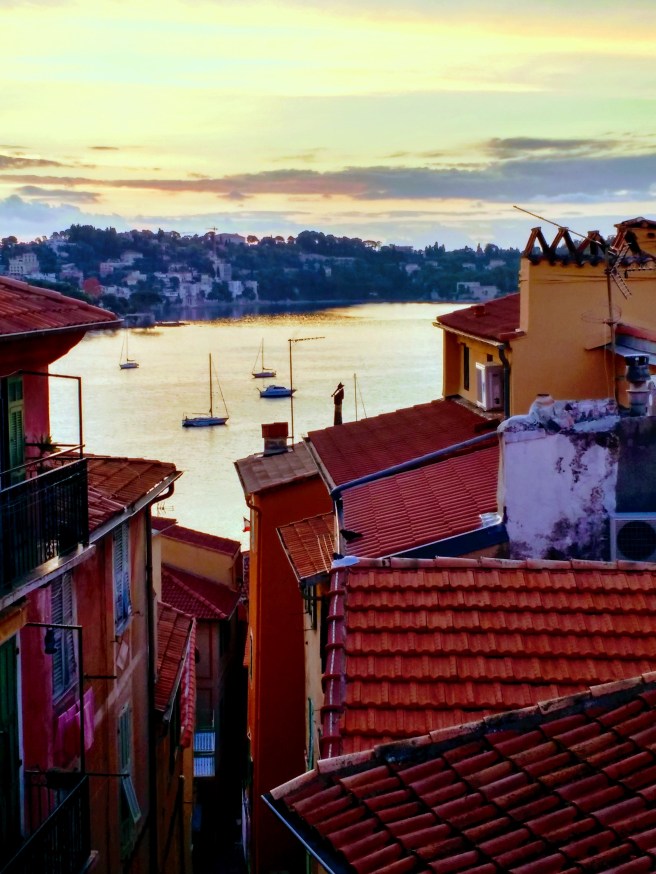
I’ve gone a bit overboard on the sunrise and sunset shots as seen from my apartment Sur le Toit (under the roof), but the colours are so stunning they are one of the highlights of my time here. Inspirational.

wp1


‘In the neutral state of aloneness, the psychoemotional line between solitude and loneliness can be as thin as a razor’s edge and as lacerating to the soul. How to draw it skillfully in orienting ourselves to the world, exterior and interior, is what poet, novelist, and memoirist May Sarton (May 3, 1912–July 16, 1995) explores in a beautiful poem she penned ten days after her twenty-sixth birthday, decades before she came to contemplate solitude in stunning prose. Originally titled “Considerations,” the poem was slightly revised and published the following year as “Canticle 6” in Sarton’s second poetry collection, the altogether sublime Inner Landscape (public library).’ – Maria Popova


CANTICLE 6
by May Sarton

Alone one is never lonely: the spirit
adventures, waking
In a quiet garden, in a cool house, abiding single there;
The spirit adventures in sleep, the sweet thirst-slaking
When only the moon’s reflection touches the wild hair.
There is no place more intimate than the spirit alone:
It finds a lovely certainty in the evening and the morning.
It is only where two have come together bone against bone
That those alonenesses take place, when, without warning
The sky opens over their heads to an infinite hole in space;
It is only turning at night to a lover that one learns
He is set apart like a star forever and that sleeping face
(For whom the heart has cried, for whom the frail hand burns)
Is swung out in the night alone, so luminous and still,
The waking spirit attends, the loving spirit gazes
Without communion, without touch, and comes to know at last
Out of a silence only and never when the body blazes
That love is present, that always burns alone, however steadfast.

I’ve brought with me to France on this writing-retreat-for-one the first 40 pages of my novel-in-progress and am working on the story, line by line, to add depth and characterisation. Am having difficulty concentrating on my manuscript though as I struggle with the emotional rollercoaster of jetlag and then a leaking apartment. Feel more settled today since I moved out of Sur le Toit and down to the waterfront. A good night’s sleep helps.

I returned to my manuscript and wrote a new sentence 🙂