Writing Tip: Writing In Cafes

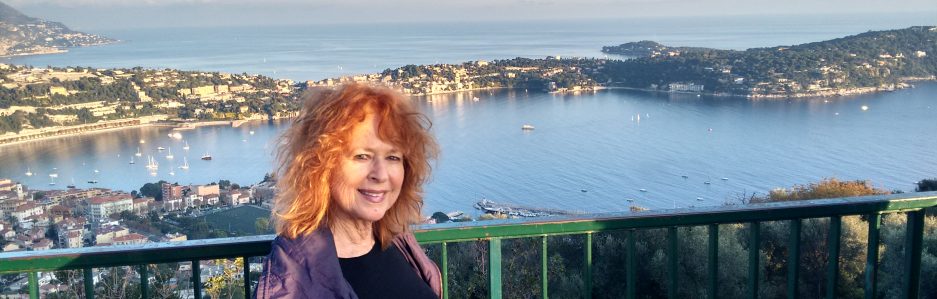
cafes, buses, palm trees, bright blue sky, cars on Bronte Road, Bronte

I am sitting in a café across the road from the beach in Bronte, Sydney.  This stretch of road has a whole row of cafes side by side facing the sea.  This is my favourite kind of writing place:  one where I can sit comfortably for a long period of time and where the owners of the café know me and welcome me.  This café is owned by a Brazilian man and his wife and has comfortable upholstered bench chairs with a direct view of the Pacific Ocean.  For my two-hour writing session my choice could be a traditional Brazilian dish such as Coxinha, Feijoda or Moqueca.  Or a cocktail like Caipirinha or  Caipiroska.  I must order something and it must be more that a Soy Cap, because I plan to be here for a long time.  I want the owners of the café to know I appreciate the time and the space they are allowing me.

However, today I’ll be very boring and order poached eggs on gluten-free bread 🙂

Why go to all this trouble to find a place to write?  Why not just stay home and work?  Because it’s good to get out and have a change of scene.  I find I need to be happy and relaxed when I’m creating on the page and sitting in a café with a pleasant vibe works for me.  Other writers need silence in order to concentrate, but I need to feel I am out and about in a beautiful place having a good time before the creative juices flow.

Strangely, writing in a café can help to increase concentration.  The busy café atmosphere keeps the sensory part of you occupied and content, so that the hidden, quieter part of you that composes and focuses is allowed to do its work.  It is something like being cunning when trying to get a spoonful of food into a resistant toddler’s mouth:  You pretend to be an aeroplane with all the sound effects and movements before landing the food-laden plane inside the child’s mouth.  Mission accomplished.

It is preferable not to turn up at a cafe for a cup of coffee and a writing session at the cafe’s busiest times, like breakfast or lunch. Go at the in between hours when they are pleased to see you because they don’t want the place to look deserted. The beach cafes are places I frequent in spring, autumn and winter, but not much in the summer. Far too crowded and noisy.

There is a real art to finding the right place to write. For me the best place  is one that has comfortable chairs, a pleasant outlook (preferably a view of the the sky and/or green or water). A welcoming, almost homely, atmosphere.

What about you?  Do you need to be at your desk in total silence to write, or do you like to experience the swell of humanity around you—to be surrounded by other human beings?  Or at home listening to a particular kind of music? Let me know in the comments and please share this post with a friend if you enjoyed it. 
One-Page Review of The Crystal Ballroom

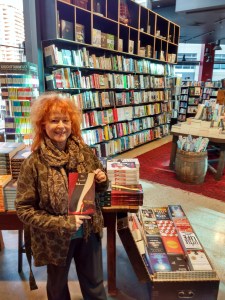
author holding copy of The Crystal Ballroom


I was delighted to see a one-page review of my novel ‘The Crystal Ballroom‘ in October Quadrant magazine (available now in newsagents or on-line).

Penelope Nelson writes:

‘Have you ever heard Latin American music coming from an upper room over a shop, and lingered briefly at the sign about dancing classes? Perhaps you have seen people–a man in built-up shoes or a woman with a surfeit of silver bangles–heading for an old town hall after dark. The world of ballroom dancing and tango lessons has its own etiquette and hierarchies. Libby Sommer’s new fiction ‘The Crystal Ballroom’ lifts the lid on the delights and pitfalls of this fascinating sub-culture …

‘Sommer has great skill in creating atmosphere. The music, the swirling scents of aftershave and sweat, the decor of ballrooms, flats, motels and shared tents are powerfully evoked …

‘Some of the best passages in the book express the joy of dancing:

We’re practising walking the length of the hall. Alberto says that in Buenos Aires students of tango spend two years just learning to walk properly.  “Extend forward,” he says, “step forward, only placing the weight on the extended leg at the last moment, toes pointed, sides of the feet staying connected on the floor.” Then backwards with a straight leg, torso pulled up, chest up and out, and with a partner again, always there’s that special connection with a partner.

Hopefully, this wonderful review by Penelope Nelson will give sales of the book a boost. ‘The Crystal Ballroom’ is available directly from Gininnderra Press, in bookstores, and online.

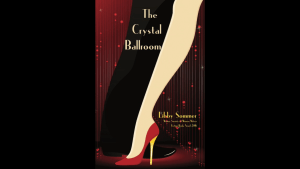
red and black The Crystal Ballroom book cover


3 of the Best: Finding the Writer’s Magic

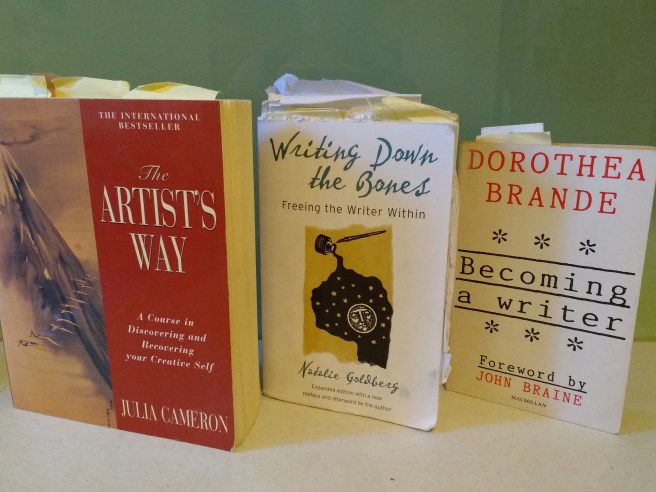
three book covers: The Artist's Way, Writing Down the Bones, Becoming a writer

So much advice out there on writing process but these three books, old ones but good ones, are my favorites. You can see how well-loved they are by how many pages are marked with stickers. I’ve used the books many times when teaching my ‘Writing from Within’ course where we try to harness the unconscious by falling into an artistic coma.

1.

Have you ever longed to be able to draw or paint, write or compose music? In ‘The Artist’s Way’ by Julia Cameron you can discover how to unlock your latent creativity and make your dreams a reality.

‘The Artist’s Way’  provides a twelve-week course that guides you through the process of recovering your creative self. It dispels the ‘I’m not talented enough’ conditioning that holds many people back and helps you to unleash your own inner artist.

‘The Artist’s Way’ helps demystify the creative process by making it part of your daily life. It tackles your self-doubts, self-criticism and worries about time, money and the support to pursue your creative dream.

2.

In ‘Writing Down the Bones’ by Natalie Goldberg, the secret of creativity, she makes clear, is to subtract rules for writing, not add them. It’s a process of “uneducation” rather than education. Proof that she knows what she’s talking about is abundant in her own sentences. They flow with speed and grace and accuracy and simplicity. It looks easy to a reader, but writers know it is the hardest writing of all.’ – Robert Pirsig

‘Writing Down the Bones’  Natalie Goldberg’s first book, sold millions of copies and has been translated into twelve languages. For more than thirty years she practiced Zen and taught seminars in writing as a spiritual practice.

3.

‘Becoming a writer’ by Dorothea Brande is a reissue of a classic work published in 1934 on writing and the creative process. It recaptures the excitement of Dorothea Brande’s creative writing classroom of the 1920s. Decades before brain research “discovered” the role of the right and left brain in all human endeavor, Dorothea Brande was teaching students how to see again, how to hold their minds still, how to call forth the inner writer.

‘Refreshingly slim, beautifully written and deliciously elegant, Dorothea Brande’s Becoming a Writer remains evergreen decades after it was first written. Brande believed passionately that although people have varying amounts of talent, anyone can write. It’s just a question of finding the “writer’s magic”–a degree of which is in us all. She also insists that writing can be both taught and learned. So she is enraged by the pessimistic authors of so many writing books who rejoice in trying to put off the aspiring writer by constantly stressing how difficult it all is.

‘With close reference to the great writers of her day–Wolfe, Forster, Wharton and so on–Brande gives practical but inspirational advice about finding the right time of day to write and being very self disciplined about it–“You have decided to write at four o’clock, and at four o’clock you must write.” She’s strong on confidence building and there’s a lot about cheating your unconscious which will constantly try to stop you writing by coming up with excuses. Then there are exercises to help you get into the right frame of mind and to build up writing stamina.

‘This is Dorothea Brande’s legacy to all those who have ever wanted to express their ideas in written form. A sound, practical, inspirational and charming approach to writing, it fulfills on finding “the writer’s magic.”‘ – John Gardner

I hope these recommendations are helpful. Do you have useful books on writing process you would add? Let me know in the comments and please share this post with a friend if you enjoyed it.