‘Stories From Bondi’

painting of girl lying on beach in torquoise bikini reading a book

Woohoo. I finished correcting first proofs of my new collection STORIES FROM BONDI due for publication by Ginninderra Press in September. A big job. Final proofs are the next step in the publishing process.

So what are first proofs?

Initial proofs of the book from the typesetter, sometimes still delivered in galley format.

For the author, this first set of author proofs can be a challenge because often what is delivered is the raw typesetting output. Text will have been formatted and a key task for the author is to check that no text corruptions occurred at the file conversion stage of typesetting.

However, because tables, illustrations, etc. may not yet have been added, what these first proofs still lack are the real page breaks and an indication of the book’s final extent. For this reason, careful scrutiny still needs to be given to the final proofs.

This definition is extracted (and expanded on) from the book Getting Published: A Companion for the Humanities and Social Sciences by Gerald Jackson and Marie Lenstrup.

Back Cover Book Blurb

painting of girl lying on beach in torquoise bikini reading a book

The  back cover book blurb is crucially important. But it’s harder than you think to write one. My new book, STORIES FROM BONDI will be published by Ginninderra Press in July this year. It’s especially difficult for me to write a blurb for this book as it’s a collection of stories rather than a continuous narrative. We’re told the blurb should be short and sweet, give away enough of what’s inside the book without giving any plot spoilers and draw the reader in.

This is what I’ve put together using quotes about my work from well-known writers. Let me know what you think.

The characters who inhabit a Libby Sommer story live and breathe. In the sensitively-drawn details of their lives, in the echoes of the everyday, we find images of ourselves.    As in her earlier collections, these 17 stories centre on women – their joys, doubts, loves and realisations – on what Sommer calls “the pain of the human condition”. She lays bare the foibles of human nature. From the opening story searching for the Bondi mermaids, to a moving piece set in a health retreat that closes the collection, this is classic Sommer, “brilliantly drawn with wit, compassion and poignancy …” – JAN CORNALL, Writer’s Journey

Last year, when THE USUAL STORY was nearing publication, I wrote a post about creating a great book blurb. That advice related to a continuous narrative, rather than a collection of stories, but some suggestions I made were:

‘A three-act structure. You want to catch the reader’s attention, give them the content, and then give them a reason to care.’ – Author Unlimited

Have a look at this YouTube video by international best-selling self-published Romance writer Alessandra Torre. She tells a terrific story of how she went from 3 book sales a day to thousands by changing her blurb:  The Blurb Equation – How to Write a Kick-Butt Blurb.


The Blurb Equation (Alessandra Torre)

INTRO + HINT + CLIFFY


1. PART 1 INTRO:           the characters or situation is introduced.

2. PART 2 THE HINT:     what the story is about, the conflict or climax.

3. PART 3 THE CLIFFY:  what’s going to happen? Hooks the reader.

Alessandra says to keep the blurb short. More than four paragraphs is too long . Three paragraphs of two to three sentences is best. Don’t give away the plot.

Hope you find this useful. Good luck on your writing journey.


5 Tips for Choosing Images for Your Book Cover

painting of girl lying on beach in torquoise bikini reading a book

My latest book, Stories From Bondi will be published by Ginninderra Press later this year. Because designing the book cover comes early in the production process, and authors have the opportunity to provide input on the design, I have been researching suitable images.

“Covers need to be both visually enticing and appropriate for a book’s content and audience.”

I often turn to Shuttlestock when looking for a cover pic or for advertising purposes. I did advertise my last book on Facebook recently. According to  Help! My Facebook Ads Suckit’s best not to use the book cover in the ad. Facebook don’t want your ad to look like an ad. Too many ad-looking posts are not good for Facebook business. So I create an image for each book that represents the story, but is not the cover image.

I’m using the above pic every time I refer to Stories From Bondi. It’s not the book cover.

This pic below is the image I use when referring to my last book, The Usual Story I purchased copyright and use the image for my Facebook ads.

Regarding Facebook ads Marketing Secrets blog has some great advice.  Have a read of ‘Confused By Facebook Marketing? Learn the Ins and Outs With These Handy Tips‘.

a man and woman dancing tango

Some great recommendations on choosing a cover image for your book cover from Damonza cover design:

Choosing a photograph or illustration for your book’s cover can be a daunting task. No matter how imaginative writers can be, visual imagination is not always included. For many authors, the fact that an entire novel requires only one picture to illustrate it is a blessing. The problem is that you still need to come up with that one picture — and it needs to be a good one. Because it’s just one picture. One. The following are a few book cover design tips to help you formulate and execute a concept for your cover’s imagery.

1. Solidify Your Ideas

Is your book about the plight of a young waitress trying to make it in the cut-throat world of fine dining while juggling her love life? If so, an illustration of a moving truck is probably not your best option for a cover graphic. Think of elements from your story that would fit well in a background image. For the story of our struggling server, a photograph of an abandoned apron could be complimented by a matchbook with a suitor’s phone number scribbled in it. Focus on items or scenes that suggest your subject matter. If you’ve hit a roadblock for image ideas, consult with a designer. The pros handle images for a living and simply leave the words to you.

2. Be Aware of Legal Issues

You may be thrilled when you use Google Image Search to locate that perfect photo for your cover, but beware — licensing issues will probably prevent you from using it. You will need to find the copyright owner (usually the photographer) and acquire written permission to use the image. Some photographers will be happy you’re using their work, some will ask you to pay a fee, and a few will flat-out refuse to let you use their work. In some cases, you may not be able to track down the copyright holder at all. Be prepared for this scenario and have a back up plan. The last thing you want is to have your book ready to go to press, only to be held up by a legal battle over an image.

3. Browse Stock Photo Websites

If you’re really lacking in inspiration for your cover, there are hundreds of stock photo websites that have plenty of imagery available. Search for words that have something to do with your story and see what pops up. You may just find yourself flooded with ideas after seeing what the internet thinks! In the best case scenario, you may even find an image that you want to use for your cover. Stock photo websites sell conditional and exclusive licenses for every image on the site, so securing rights to use one will be a breeze. If you’ve chosen a designer to work with, talk to him or her about using stock photos. They can help you through the licensing process and anything else that gets complicated.

4. Take Your Own Photographs

If you’re looking for something with a little more of a personal touch, try to create your own image. Even cell phones these days have high resolution cameras that can take brilliant photos. There are also thousands of apps that can help you add filters and effects to the photo you’ve taken. When choosing to go this route, however, you must make sure that your photos are being taken in (and staying in) high resolution formats, otherwise they won’t be printable. If you have a photograph that you would like to use but you’re not sure if it will work, show it to your designer. Designers can apply filters and alter photos so that they look great on a book cover.

5. Work With a Professional Designer on your Book Cover Design Tips

No matter how you end up finding and selecting the images for the cover of your book, it is advisable to work with a professional designer to put everything together. They can help you choose fonts and colors that will compliment the imagery you’ve chosen and can even adjust the images you have to better suit a book cover.


For further reading, check out my posts Recharging Your Creative Batteries and Writing Tip: I Am Not the Stories I Tell.  And to make sure not to miss anything from Libby Sommer Author you can follow me on Facebook  or Instagram.
My latest book has been accepted

painting of girl lying on beach in torquoise bikini reading a book

A big thank you to Ginninderra Press.  STORIES FROM BONDI has been accepted for publication by this small but prestigious Australian publisher.

The Ginninderra Press philosophy:

‘We believe that all people – not just a privileged few – have a right to participate actively in cultural creation rather than just being passive consumers of mass media. Our culture is revitalised and enriched when everyone is encouraged to fulfil their creative potential and diminished when that creative potential is stifled or thwarted. We love to observe the transformative possibilities for people when they see their work published and acknowledged. Getting published can and does change lives.’

Getting published has definitely changed my life. The problem has been that larger publishers are not interested in novellas or short story collections.

My first book MY YEAR WITH SAMMY (2015) was a novella, the second two, THE CRYSTAL BALLROOM (2017) and THE USUAL STORY (2018), were novels-in-stories.

STORIES FROM BONDI is a short story collection and will be released in late 2019. An earlier version of the manuscript was part of my MA in Writing (UTS) back in 2001.

I’m thrilled and delighted and very very thankful to Stephen Matthews, Ginninderra Press.

Ginninderra Press, described in The Canberra Times as ‘versatile and visionary’, is an independent book publisher set up in 1996 to provide opportunities for new and emerging authors as well as for authors writing in unfashionable genres or on non-mainstream subjects. In the words of one of our authors, we are ‘a small but significant publisher of small but significant books’.

As an author writing in unfashionable genres:  novellas and short story collections, I am extremely grateful to this award-winning independent publisher for taking me on. If it wasn’t for Stephen Matthews my work would not be out in the world.

Stories From Bondi

painting of girl lying on beach in torquoise bikini reading a book

I posted another manuscript off to my publisher this week. It’s titled ‘Stories From Bondi‘. I completed an earlier, much shorter version of this book as part of a Masters in Writing at UTS back in 2001. Fingers crossed Ginninderra Press like this collection.

I’ve mentioned before how it took me 18 years of writing and 5 completed manuscripts before I finally had a book accepted by a publisher.

So now I have a small but prestigious publisher  Ginninderra Press who like my work I’m submitting my manuscripts backwards:  numbers 5, 4 and 3 have been published: ‘My Year With Sammy’, ‘The Crystal Ballroom’, ‘The Usual Story’.  Number 2 is ‘Stories From Bondi’.  80% of the short stories were first published in literary journals, including Quadrant and Overland.

Writing a book is a long, long, time-consuming process that requires a super-human amount of persistence and perseverance and dedication to the craft. It’s such a buzz to finally get my work out into the world.

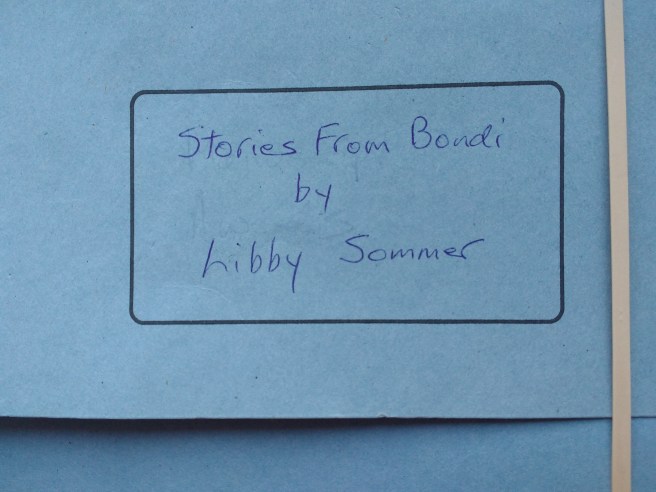
blue manila folder titled Stories From Bondi by Libby Sommer