
My Microlit ‘In the Mall’

My Microlit ‘In the Mall’ was selected as an entry in the Microflix Writers Awards available to be chosen by filmmakers for adaption to a short film for the 2019 Film Awards. On the theme of SOUND it is available to view on the Microflix SOUND extracts page on the website of Australian short story publisher, Spineless Wonders.

So what is Microlit? According to writer, teacher and editor, Karen Whitelaw: Imagery is important to all writing, but none more than microlit. … Writing is a visual art; paint pictures with words. Things don’t have to be explained, merely implied. This is the beauty of the form, that behind the words a whole world is peeping through. The micro-story has to say something.

Have a read of my story. Hope you enjoy it.

IN THE MALL

In a café inside a mall in Sydney a small curly-topped girl sobbed and sobbed. She sat on her father’s lap, stabbing her finger into a slice of banana bread. Her dad soothed, whispered, coaxed. What would you like, Tara? He cut into his poached egg. Toast? he cajoled. The girl sobbed more loudly, wailing, coughing, staring out into the mall. I want my mum. She cuddled a pink soft piglet. Our eyes scanned the glass display of croissants, pies and pastries. I loved every carb that did not pass my lips. I loved the sobbing child who heard no one else in that cafe but herself, whose lungs fought hard to reach a soaring, sorrowful pitch. What have you got? an elderly woman asked her. Still crying, the child held up her toy. Her father gave up on his poached eggs and carried her out, still wailing. We went and sat at the table with the stabbed-at bread her finger had made and swept the moist crumbs into a heap.

Copyright © 2019 Libby Sommer


World Maternal Mental Health Day

Renoir painting of mother on cane chair outside breastfeeding child
Pierre Auguste Renoir

Wednesday, 6 May 2020 is World Maternal Mental Health Day: raising awareness of maternal mental health issues so that more women will get treatment and fewer will suffer.

I responded to a call out for submissions of stories, essays and poems that address perinatal depression and anxiety.

I’m delighted to tell you that my short story ‘The New Baby’, first published in Quadrant magazine, has been selected for inclusion in this anthology.

The planned release date for the anthology is May this year, to coincide with World Maternal Mental Health Day.

What a privilege to be part of this important collection of 25 stories, poems and essays that will also be featured as part of PANDA (Perinatal Anxiety & Depression Awareness) week in November.

Every November PANDA Week provides an opportunity to increase understanding in the community about an illness that is more common and more serious than many people realise.

Things Raymond Carver has said about the short form in writing

blur book stack books bookshelves

‘My attention span had gone out on me; I no longer had the patience to try to write novels. … I know it has much to do now with why I write poems and short stories. Get in, get out. Don’t linger. Go on.’

‘Every great or even every very good writer makes the world over according to his own specifications.’

‘It is his world and no other. This is one of the things that distinguishes one writer from another. Not talent.’

‘Isak Dinesan said that she wrote a little every day, without hope and without despair.’

‘”Fundamental accuracy of statement is the ONE sole morality of writing,” Ezra Pound.’

‘It is possible to write a line of seemingly innocuous dialogue and have it send a chill along the reader’s spine – the source of artistic delight, as Nabokov would have it. That’s the kind of writing that most interests me.’

‘That’s all we have, finally, the words, and they had better be the right ones, with the punctuation in the right places so that they can best say what they are meant to say.’

‘I like it when there is some feeling of threat or sense of menace in short stories.’

‘I made the story just as I’d make a poem; one line and then the next, and the next.’

‘V.S. Pritchett’s definition of a short story is “something glimpsed from the corner of the eye, in passing.” Notice the “glimpse” part of this. First the glimpse.’

‘The short story writer’s task is to invest the glimpse with all that is in his power. He’ll bring his intelligence and literary skill to bear (his talent), his sense of proportion and sense of the fitness of things – like no one else sees them. And this is done through the use of clear and specific language, language used so as to bring to life the details that will light up the story for the reader. For the details to be concrete and convey meaning, the language must be accurate and precisely given. The words can be so precise they may even sound flat, but they can still carry, if used right, they can hit all the notes.’

Raymond Carver, Fires, Vintage 1989

So who is Raymond Carver?

Raymond Carver, in full Raymond Clevie Carver, (born May 25, 1938, Clatskanie, Oregon, U.S.—died August 2, 1988, Port Angeles, Washington), American short-story writer and poet whose realistic writings about the working poor mirrored his own life. – Encyclopedia Britannica

What Are the Microflix Writers Awards?

red-headed author Libby Sommer signing one of her books

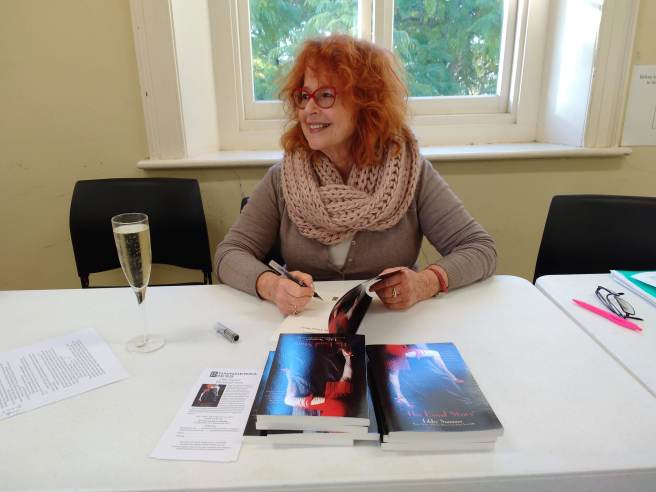
I am delighted to say that my micro-fiction ‘In the Mall’ has been selected as an entry in the Microflix Writers Awards. Halleluja. I’ll find out in August if my story is chosen by filmmakers for adaptation to a short film for the 2019 Microflix Awards. My microlit on the theme of SOUND is available to view on the Microflix SOUND extracts page on the website of Australian short story publisher, Spineless Wonders.

Spineless Wonders 2019 Microflix Writers Awards

The Microflix Awards offered each year aim to reward and value the roles of both the author and the filmmaker in the adaptation process. For this reason we offer both the Microflix Film Awards and the Microflix Author Awards.

The Microflix Writers Awards consists of a $500 cash prize for Best Writing as well as range of prizes such as discounts on writers’ centre memberships and other resources for writers as well as book packages for Highly Recommended and Recommended Writers.

Our panel of jurists will select winners of the Microflix Writers Awards from the pool of finalist films screened at the Microflix Festival.


The theme for 2019 is SOUND.

This year, Microflix invites authors to submit microlit texts on the theme of SOUND for adaptation by filmmakers. The texts submitted will be reviewed by microlit specialist and Spineless Wonders’ editor Associate Professor Cassandra Atherton. Submissions will be accepted until 30 April and those selected by Cassandra will be included in the 2019 SOUND Texts section on this website.

Exploring the theme of SOUND

We are looking for prose pieces suitable for film adaptation which riff on the theme of sound. You may wish to reflect on the soundtracks of your life – be that songs and music or sounds from the built environment or the natural world. Your submission may reflect on the absence of sound or it may take us into a world without music. Your approach may be playful, witty, political, philosophical or all of the above.


My fingers are crossed.


Short Story or Novel

pexels-photo.jpg

Is a novel a short story that keeps going, or, is it a string of stories with connective tissue and padding, or, is it something else?  Essayist Greg Hollingshead believes that the primary difference between the short story and the novel is not length but the larger, more conceptual weight of meaning that the longer narrative must carry on its back from page to page, scene to scene.

“It’s not baggy wordage that causes the diffusiveness of the novel.  It’s this long-distance haul of meaning.”  Greg Hollingshead

There is a widespread conviction among fiction writers that sooner or later one moves on from the short story to the novel.  When John Cheever described himself as the world’s oldest living short story writer, everyone knew what he meant.

Greg Hollingshead says that every once in a while, to the salvation of literary fiction, there appears a mature writer of short stories—someone like Chekhov, or Munro—whose handling of the form at its best is so undulled, so poised, so capacious, so intelligent, that the short in short story is once again revealed as the silly adjective it is, for suddenly here are simply stories, spiritual histories, narratives amazingly porous yet concentrated and undiffused.

When you decide you want to write in a particular form—a novel, short story, poem—read a lot of writing in that form.  Notice the rhythm of the form.  How does it begin?  What makes it complete?  When you read a lot in a particular form, it becomes imprinted inside you, so when you sit at your desk to write, you produce that same structure.  In reading novels your whole being absorbs the pace of the sentences, the setting of scenes, knowing the colour of the bedspread and how the writer gets her character to move down the hallway to the front door.

I sit at my desk thinking about form as a low-slung blanket of cloud blocks my view of the sky.  Through the fly screen I inhale the sweet smell of earth after rain as another day of possibility beckons.

The thing is, we might write five novels before we write a good one.  I wrote five book-length manuscripts before one was finally accepted for publication, even though I’d published 30 short stories.  So form is important, we need to learn form, but we should also remember to fill form with life.  All it takes is practice.

I hope this post is useful. Do you have any tips you would add? Let me know in the comments and please share this post with a friend if you enjoyed it.

Short Story: At the Festival

pexels-photo-167491.jpeg

My short story ‘At the Festival’ was first published in Quadrant May 2016. It was inspired by my yearly visits to the Canberra National Folk Festival. The music is really world music rather than folk. A happening event. 60,000 people. Lots of colour and movement for a writer who likes to get ideas from the world around them – though this is a work of fiction.

It was six o’clock in the evening when she finally passed the wind turbines.  There, at last, stood Lake George, where long-woolled sheep grazed the field and to the west the Brindabella mountain range was coloured grey and pink by the setting sun.   On she drove along an ink-black strip of road where, on either side, tall green-grey eucalypts had formed a welcoming archway.  The way flattened out then curved into a narrow empty road.  Not one person did she see, not one building, just a handful of brown-bellied cows and later a group of kangaroos standing formidable and still in the headlights.  The turn for Watson wasn’t clearly sign-posted but she felt confident in turning east along the row of liquid ambers in autumn bloom that took her to the cabins.

Twice on the journey she had pulled into a service station and shut her eyes and briefly rested but now, as she neared Canberra, she felt wide awake and full of energy.  Even the dark length of road which progressed flatly to Reception seemed to hold the promise of a new beginning.  She sensed the towering, protective presence of the mountain range, the forested hills and, further on, just past the turnoff, the clear, pleasant thump of music coming from the festival.

The receptionist gave her a key, and eagerly she drove further on to cabin number five.  Inside, the room was renovated:  the two single beds replaced by a double.  The same compact kitchenette set into one end of the room but a new television secured to the wall by a multidirectional wall bracket.  In between, on the bare linoleum floor, stood a small table laminated with melamine and two matching chairs.  She set her keys and mobile on the table and reached for the electric jug for tea. Continue reading

2 Years Rewriting Short Story

close up of September Quadrant magazine cover

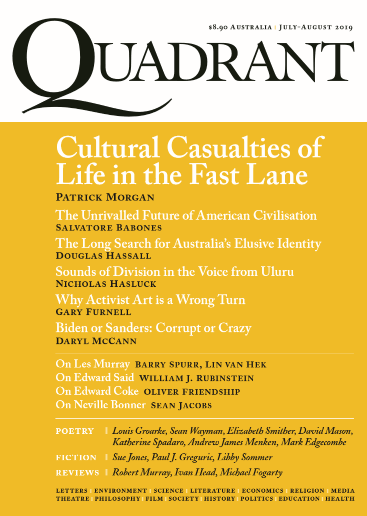
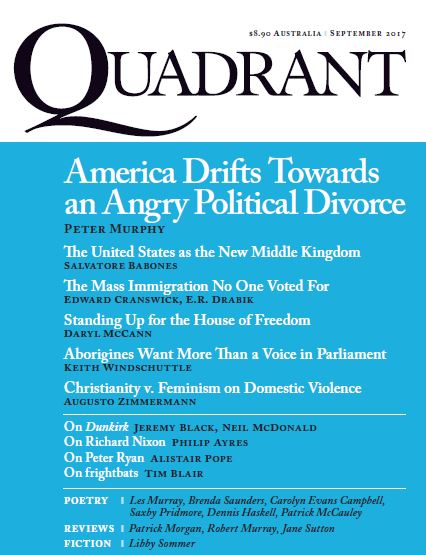
My short story On Valentine’s Day appears in the September Quadrant available now in newsagents and good book stores. It took two years of rewriting before the story was accepted for publication. In Friday’s mail I received my contributor’s copy and a generous cheque. My name is on the front cover. Always a thrill. It took many years of my stories appearing in Quadrant before my name made it to the cover 🙂

The first paragraph of On Valentine’s Day reads:

You had to get out of them occasionally, those Australian country towns with the funny names:  Wagga Wagga, Wee Waa, Woy Woy. Once, after a devastating week wiped out more than $4 trillion from the global stock exchanges, one of the local papers boasted a banner headline:  WAGGA WAGGA WOMAN WEDS WOY WOY TOY BOY. You had to make an effort from time to time to get out, even if it meant flying all the way across the Nullarbor to go to a Valentine’s Day party.


My critique group will recognize the first paragraph. We meet weekly at the New South Wales Writers Centre to give and receive feedback on two pages of our writing. I brought sections of the 4,000 word On Valentine’s Day many times to the Women Writers Network at the Centre. Two dear friends also read the  story and commented. Very much appreciated. More than once my two friends read the whole of On Valentine’s Day and offered constructive criticism. I couldn’t have got the story to a publishable standard without my writing group and my two friends. Lucky me.

Quadrant is a highly regarded literary magazine: http://quadrant.org.au/september-quadrant-now-sale/

Quadrant blue magazine cover

I can’t emphasize enough how useful it is to have a weekly writing group. I work to that deadline. We take a couple of pages each and have 12 minutes to read and receive feedback. I think of it as ‘off Broadway’ and ‘on Broadway’.  Famous comedians like Jerry Seinfeld and Woody Allen say they test their material out on an ‘off Broadway’ audience before performing ‘on Broadway’.

picture of the New South Wales Writers Centre with trees in foreground
New South Wales Writers Centre

What about you? Are you in a writing group? Do you find it useful?

‘Painstaking Progress’ revisited


sunset over the ocean

‘Painstaking Progress’ is another of my stories, like ‘Art and the Mermaid’, that was first published in Quadrant Magazine. It shows the difficulties of the writing process for the narrator as she tries to make sense of  her family history and agonizes about the relationship with her young lover.

Painstaking Progress

by Libby Sommer

I’m imagining a cloudy autumn morning.  There’s a room.  Half office, half bedroom.  Not too large and not too small.  The windows of the room face east and look out towards the ocean across the expanse of a green gully.

I picture a woman sitting on a bed with pillows behind her back.  The windows are open.  Perhaps it is Saturday morning.  On the bedside table is a mug of tea and a photograph of the woman’s daughter on her wedding day.

The wind begins to stir the big trees outside and the morning haze is beginning to move and for a short moment the sun lightens the carpet and heavy dark wood furniture.  The shadows of the curtains’ curves darken the floor, almost invisible to the woman on the bed.   The morning sun lightens the CD player, the alarm clock, the piles of books stacked on the revolving Victorian bookcase.

She looks out at the water and at the triangle of beach.  Sometimes it seems that nothing much changes out there, although on some days the waves break close to shore and at other times further out to sea.  She can see it all from the bed, even at night time.  The bed faces the beach and the ocean, and so does the desk.  The room is like standing at the rail of a ship.

On the radio:  ‘Waves, to me, are a reason to live,’ says the surfer.  ‘When you see the roar, the jaws, there is nothing that touches it on the face of the earth.’

In June the twilight begins in the afternoon.  The days close in on me, here in

this room.  The infinite possibilities in the sky and the sea and the possibility of nothing.

What is this writing life?  It tears me to pieces every day.

Continue reading

Is it a short story or a novel?

white laptop,black and white notepad and pen, white mobile, on desk

Is a novel a short story that keeps going, or, is it a string of stories with connective tissue and padding, or, is it something else?  Essayist Greg Hollingshead believes that the primary difference between the short story and the novel is not length but the larger, more conceptual weight of meaning that the longer narrative must carry on its back from page to page, scene to scene.

“It’s not baggy wordage that causes the diffusiveness of the novel.  It’s this long-distance haul of meaning.”  Greg Hollingshead

There is a widespread conviction among fiction writers that sooner or later one moves on from the short story to the novel.  When John Cheever described himself as the world’s oldest living short story writer, everyone knew what he meant.

Greg Hollingshead says that every once in a while, to the salvation of literary fiction, there appears a mature writer of short stories—someone like Chekhov, or Munro—whose handling of the form at its best is so undulled, so poised, so capacious, so intelligent, that the short in short story is once again revealed as the silly adjective it is, for suddenly there are simply stories, spiritual histories, narratives amazingly porous yet concentrated and undiffused.

When you decide you want to write in a particular form—a novel, short story, poem—read a lot of writing in that form.  Notice the rhythm. How does it begin?  What makes it complete?  When you read a lot in a particular form, it becomes imprinted inside you, so when you sit at your desk to write, you produce that same structure.  In reading novels your whole being absorbs the pace of the sentences, the setting of scenes, knowing the colour of the bedspread and how the writer gets her character to move down the hallway to the front door.

I sit at my desk thinking about form as a low-slung blanket of cloud blocks my view of the sky.  Through the fly screen I inhale the sweet smell of earth after rain as another day of possibility beckons.

We might write five novels before we write a good one.  I wrote five book-length manuscripts before one was finally accepted for publication. My skill was in the short form. I’d published dozens of short stories in prestigious literary journals. So it made sense that my first book, ‘My Year With Sammy’ (Ginninderra Press) is a novella –  a small book.

What about you? Is your skill in the short form or the marathon?

book cover My Year With Sammy

Click To Buy