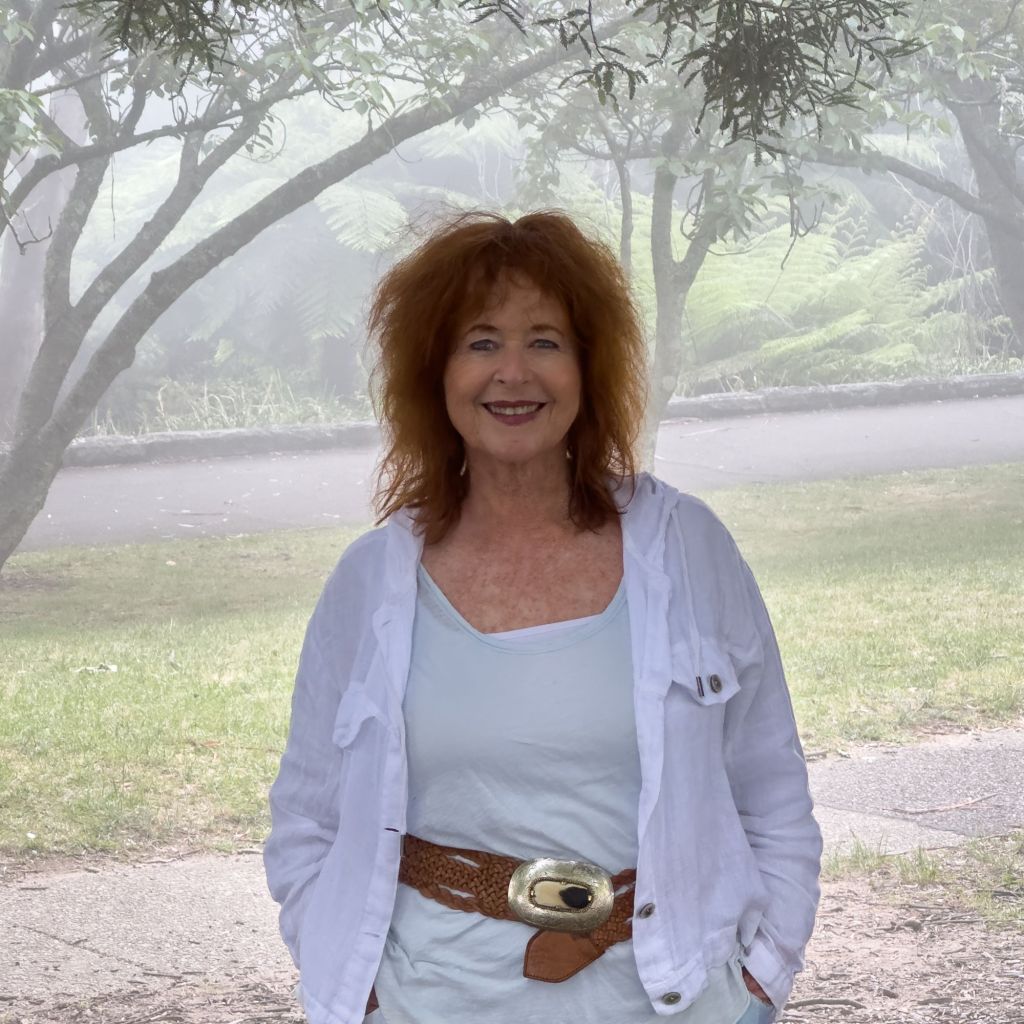
Some very good news: I have a half page prose poem “You Remember” in this month’s October Quadrant Magazine. It’s always a big thrill to see my name up there. Thanks, as always, to Literary Editor Professor Barry Spurr.
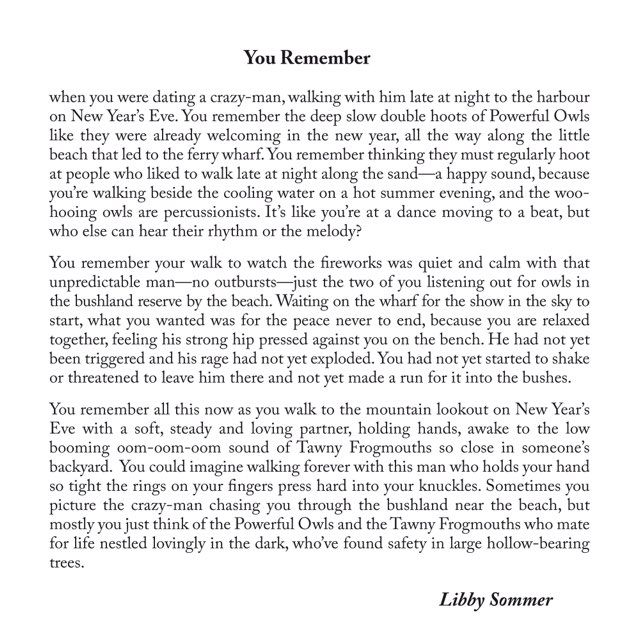
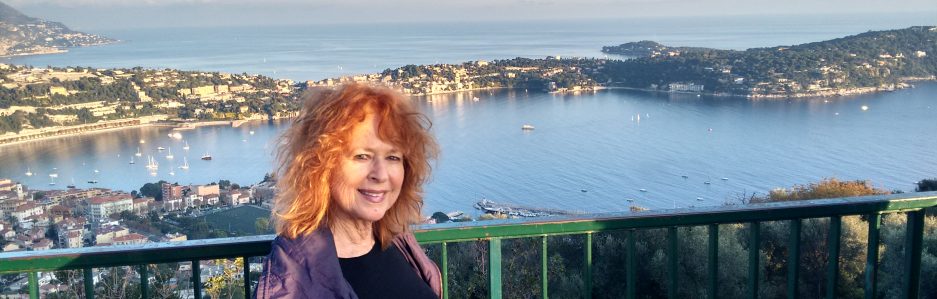
Some very good news: I have a half page prose poem “You Remember” in this month’s October Quadrant Magazine. It’s always a big thrill to see my name up there. Thanks, as always, to Literary Editor Professor Barry Spurr.

Have a read of my prose poem, ‘When the New Boyfriend Nearly Died’ first published in Quadrant Magazine. The poem is included in my second poetry collection titled ‘Flat White, One Sugar‘, released this month by Ginninderra Press.
Hope you enjoy it.
When the New Boyfriend Nearly Died:
In the hospital’s public toilet, your face pleads back at you, white and worried. Far as you know, your new boyfriend had a heart attack while bouncing between your child-bearing hips. Too much of a strain. It’s not your fault. When he was admitted to Emergency you didn’t know if you’d ever see him again.
After five hours of waiting, you ask the receptionist if you can go in. When she asks you, you can’t pronounce his Polish surname. You spell out the letters. She considers you through the gap in the partition. You tell her you’re his new girlfriend. So you’re the one, she must be thinking before pressing the red button that lets you in.
He is lying in bed, a canula in his arm. His eyes are closed. You sit in a chair beside him and hold his hand. This would never have happened if it weren’t for you. Nurses and doctors hurry past clutching clipboards.
Don’t die on me, you plead.
If he dies, what you will miss are his text messages of love, the thwack of his body, and the pots of Japanese tea you shared. In bed you’d sip from tiny ceramic mugs.
You make a mental list of your strengths and weaknesses: you’re good at hedonistic pleasures, bad at Cryptics, bad at lonely Sundays, good at making new friends, bad at staying in touch, good at making loose-leaf tea after sex with an addict, good at falling for men who can’t stop swallowing uppers and downers. Good at loving your new boyfriend who took too many pills and now you’re worried he’ll die. Are you dreaming, or did he just squeeze your hand?
Copyright 2024 Libby Sommer
Photo by Kvs Sidhu on Pexels.com

Have a read of my prose poem, ‘The Backpack” first published in Quadrant Magazine. Hope you enjoy it.
The Backpack:
What can a man who meets you at the station and offers to carry your backpack mean to a woman traveling the world alone?
I was scared, like anyone who has no sense of direction. The journey was a series of stops and starts. Whether to use the Eurail pass or post it back home and ask the kids to get me a refund. Giovanni appeared one European winter, thick padded jacket, woolen beanie, scarf and gloves, tall and imposing, I’ll carry your bag.
I was small, the backpack the length of my spine, the zip-off bag on one shoulder, the daypack positioned in front like a nine-month baby bump. That evening, as we climbed the steps of the Corniche – the wind bitter across the Mediterranean, the metal stairs covered with slippery ice, the railing melting beneath my hand. Soon it would become my railway platform, my steps, and Giovanni my landlord.
We walked there in the crisp night air. My own place. It didn’t cost much. No-one yet knew I was here. I could ask Giovanni if I needed any help. I knew my children would be pleased I had a base. I didn’t want them to worry. It was the thing I wanted the most secretly, studying maps, absorbing travel books. To be safe, a desire whispered to the moon that moved behind my shoulder at night. If you guide me to a safe haven I promise to be happy. And the moon listened. I did my best.
The winter sky closed down and the spring began its flowering. I took photos and painted and rang the children every week. Watch your money, don’t talk to strangers, be careful walking at night – you know the drill. The pebbly beach, the weekend markets, it was all there for the exploring. A glimpse of the sea between terracotta roofs – a vision in turquoise. The cobbled streets could show which way to follow – and none of them wrong. A room at the top of the stairs – till June I stayed reading the English books Giovanni had left in the bookcase, shopping for food, telling my kids and friends they should come for a visit.
Where had the months gone? Almost two years on the road. Summer approached. The rents would go up and the tourists arrive. Time to move on. I could only take with me what I could carry on my back. A Jewish gypsy they said. One more step into the unknown. Pack up, give away what I couldn’t manage, but keep the palette knife and miniature easel. There was stuff happening back home. The boys were grown and earning a living. Their sister turned twenty-one. People were reinventing themselves all over the place then coming back home. A thousand train rides later, my mother nearly eighty. I won’t be around much longer, she cried.
His was a helping hand in a world that says, but what are you doing there? What are you doing?
Copyright © Libby Sommer 2023
Have a read of my prose poem, “The Backpack”, first published in Quadrant Magazine. “The Backpack” is one of the stories in my collection, “Stories from Bondi” (Ginninderra Press). “Stories from Bondi”: the foibles of human nature, with all their pathos and humour, are laid bare for the reader.
The Backpack:
What can a man who meets you at the station and offers to carry your backpack mean to a woman traveling the world alone?
I was scared, like anyone who has no sense of direction. The journey was a series of stops and starts. Whether to use the Eurail pass or post it back home and ask the kids to get me a refund. Giovanni appeared one European winter, thick padded jacket, woolen beanie, scarf and gloves, tall and imposing, I’ll carry your bag.
I was small, the backpack the length of my spine, the zip-off bag on one shoulder, the daypack positioned in front like a nine-month baby bump. That evening, as we climbed the steps of the Corniche – the wind bitter across the Mediterranean, the metal stairs covered with slippery ice, the railing melting beneath my hand. Soon it would become my railway platform, my steps, and Giovanni my landlord.
We walked there in the crisp night air. My own place. It didn’t cost much. No-one yet knew I was here. I could ask Giovanni if I needed any help. I knew my children would be pleased I had a base. I didn’t want them to worry. It was the thing I wanted the most secretly, studying maps, absorbing travel books. To be safe, a desire whispered to the moon that moved behind my shoulder at night. If you guide me to a safe haven I promise to be happy. And the moon listened. I did my best.
The winter sky closed down and the spring began its flowering. I took photos and painted and rang the children every week. Watch your money, don’t talk to strangers, be careful walking at night – you know the drill. The pebbly beach, the weekend markets, it was all there for the exploring. A glimpse of the sea between terracotta roofs – a vision in turquoise. The cobbled streets could show which way to follow – and none of them wrong. A room at the top of the stairs – till June I stayed reading the English books Giovanni had left in the bookcase, shopping for food, telling my kids and friends they should come for a visit.
Where had the months gone? Almost two years on the road. Summer approached. The rents would go up and the tourists arrive. Time to move on. I could only take with me what I could carry on my back. A Jewish gypsy they said. One more step into the unknown. Pack up, give away what I couldn’t manage, but keep the palette knife and miniature easel. There was stuff happening back home. The boys were grown and earning a living. Their sister turned twenty-one. People were reinventing themselves all over the place then coming back home. A thousand train rides later, my mother nearly eighty. I won’t be around much longer, she cried.
His was a helping hand in a world that says, but what are you doing there? What are you doing?
Copyright © Libby Sommer 2023
Have a read of my prose poem, ‘The Cellist’ first published in Quadrant September 2020.
Hope you enjoy it.
‘The Cellist‘:
I was grudgingly ancient. Not older, wiser and ancient. But easily recognisable as ancient. Skin was the culprit – the human body’s largest organ. I had his mobile number and he had mine, the cellist from the seniors’ dating site. I examined its configuration. Was there a pattern I needed to decode? I hated initiating, but he needed reassurance. It might take him forever to ring. Composing a text, my palms sweated. My heart thumped. Was he okay with texting? I hated my impatience. I hated my unexpected fragility. I sent the text. Yesterday’s meet-up was fun. I’d like to go for a ride on your motorbike sometime, although the helmet will squash my hair.
Then I worried I’d gone too far. My legs wrapped around him on a bike? I sounded like a whore. A desperado. A woman too long without a man. His reply was immediate. Had he been holding the phone in his hand? We can start with a short ride around the block. I’ve got a large helmet. Everyone gets hat hair.
I don’t want you to go on his motorbike, my daughter warned. I’ll go for a ride on his bike, my granddaughter offered. What sort of boat’s he got? A tinnie or a sail boat? asked my grandson. I googled: ‘what to expect when riding pillion’. Hang on. Brace for braking and acceleration by holding on to the rider’s waist. Bikes must lean to corner. Relax. Tyres provide plenty of grip.
We had dinner, exchanged silly jokes, leaned towards each other, went back to my place – and had incredible sex. The sensitivity of a stringed instrumentalist was really something else. If I knew how, I would have burst into song.
Copyright 2020 Libby Sommer

Have a read of my prose poem ‘Someone I Don’t Know Side-Swiped My Car’, first published in Quadrant magazine April 2021, Hope you enjoy it.
Someone I Don’t Know Side-Swiped My Car:
Bad luck recently, you could say, after surviving some extremely unfortunate luck. For hours I sat across from you in the Emergency Bay: your face dripping with blood. They gave you a compress to stop the flow of red from your cheekbones and your nose. Every time you touched your face, it opened up the wound. Punched in both eyes and the nose. A robbery as you walked home, I hear you tell your girlfriend on the mobile. And then you’re telling the emergency nurse you can’t wait any longer to see a doctor. ‘You may have concussion,’ she cautioned.
Did you find your way home?
For days I wonder how you are. I sniff the first spring jasmine hanging over the fence and your girlfriend whom I’ve never met crowds my thoughts, till one day, peering out my bedroom window, I notice someone has side-swiped my car. Not exactly what I’d expected to see but, man, the wisteria are showing their purple blooms. A nervous possum balances on the telephone line above the road and there’s a newspaper article about an elderly cyclist who died after a freak bike accident caused by a swooping magpie. Bad luck that a second vehicle crashed into my car while it waited at the smash repair place. Look up, take care, someone or something you don’t know may sideswipe you or punch you in the nose.
Copyright 2021 Libby Sommer
.

In terms of creating new material during a pandemic, poetry is where I turn for inspiration. What about you?
According to Edward Mallinckrodt Distinguished Professor of English, Washington University, St. Louis, Missouri, 1976–90. Poet Laureate of the U.S., 1988–90, Poetry is literature that evokes a concentrated imaginative awareness of experience or a specific emotional response through language chosen and arranged for its meaning, sound, and rhythm.
Do you find reading and writing poetry right now is how you are able to express yourself during a troubling time?
Phyllis Klein from Women’s Therapy Services puts it this way: “Turning to poetry, poetry gives rhythm to silence, light to darkness. In poetry we find the magic of metaphor, compactness of expression, use of the five senses, and simplicity or complexity of meaning in a few lines.”
This is my pre-pandemic poem ‘Taste‘ first published in Quadrant magazine May 2019. Have a read. Hope you enjoy it.
Taste:
I rather like poems about minor calamities, bursts of tiny delights, the sun warming the tender skin of the elderly. Also, the way palm fronds conduct themselves during a southerly, dishevelled, exposing the softness of their billowing arms. Pastries in display cases do something for me too. Even cupcakes iced in gelato colours, adorned with miniature decorations … Can you see my preference for the words ‘miniature’ and ‘tiny’, an inclination towards the distilled in a world favouring often the big and the overwhelming? People with the patience to follow a complex recipe – well, that’s not me, but I like to taste what they cook. Babies in prams kicking chubby legs make me hover – how difficult not to take a bite. If you write something about a paper straw, I will be fascinated. You could try a ladybird, a pocket-size umbrella. The generalised angst of the human condition, however, may be hard for me to get a handle on. Watch that man with the disabled daughter moisten his finger after her cupcake is eaten and relish the last crumbs. Consider the rainbow-coloured wristband tied to a letterbox on the way to the park or the miniature plastic bucket and spade we found half-hidden on the beach at Bronte and packed with us for years on every visit to the sea.
Copyright © 2019 Libby Sommer
So what is a prose poem? According to the Poetry Foundation, a prose poem is a prose composition that, while not broken into verse lines, demonstrates other traits such as symbols, metaphors, and other figures of speech common to poetry.
If you are able to distill meaning in a very short form, you may enjoy writing prose poetry.
Have a read of my prose poem ‘Sixteen Is A Very Difficult Age, You Know’, first published in Quadrant magazine September 2018.
Sixteen Is a Very Difficult Age, You Know:
Well yes it is. This time of year isn’t easy either. It has most of us by the neck. You don’t want to get sick at Christmas. They said he needs six weeks of intensive therapy then they’ll decide about medication. How – when everything’s closed till February? Yes, he’s up and down. Better some days, but hardly ever. They said hide all the tablets and remove the kitchen knives. I ring or text to see how he’s going. He doesn’t always pick up. Don’t refer to the incident. Wait for him to say something. Well, he doesn’t say much though he’ll let me give him a hug – sometimes. So here I am trying to gather his forgotten dreams from the air. They’re drifting just outside my reach.
Copyright © 2018 Libby Sommer

Have a read of my latest prose poem, Someone I Don’t Know Side-Swiped My Car, first published in Quadrant magazine April 2021, Hope you enjoy it:
Someone I Don’t Know Side-Swiped My Car
Bad luck recently, you could say, after surviving some extremely unfortunate luck. For hours I sat across from you in the Emergency Bay: your face dripping with blood. They gave you a compress to stop the flow of red from your cheekbones and your nose. Every time you touched your face, it opened up the wound. Punched in both eyes and the nose. A robbery as you walked home, I hear you tell your girlfriend on the mobile. And then you’re telling the emergency nurse you can’t wait any longer to see a doctor. ‘You may have concussion,’ she cautioned.
Did you find your way home?
For days I wonder how you are. I sniff the first spring jasmine hanging over the fence and your girlfriend whom I’ve never met crowds my thoughts, till one day, peering out my bedroom window, I notice someone has side-swiped my car. Not exactly what I’d expected to see but, man, the wisteria are showing their purple blooms. A nervous possum balances on the telephone line above the road and there’s a newspaper article about an elderly cyclist who died after a freak bike accident caused by a swooping magpie. Bad luck that a second vehicle crashed into my car while it waited at the smash repair place. Look up, take care, someone or something you don’t know may sideswipe you or punch you in the nose.
Copyright 2021 Libby Sommer
My prose poem ‘In the Mall’ was selected as an entry in the Microflix Writers Awards and was available to be chosen by filmmakers for adaption to a short film for the 2019 Microflix Awards. The theme was ‘sound’.
Have a read. Hope you enjoy it.
‘In the Mall‘:
In a café inside a mall in Sydney a small curly-topped girl sobbed and sobbed. She sat on her father’s lap, stabbing her finger into a slice of banana bread. Her dad soothed, whispered, coaxed. What would you like, Tara? He cut into his poached egg. Toast? he cajoled. The girl sobbed more loudly, wailing, coughing, staring out into the mall. I want my mum. She cuddled a pink soft piglet. Our eyes scanned the glass display of croissants, pies and pastries. I loved every carb that did not pass my lips. I loved the sobbing child who heard no one else in that cafe but herself, whose lungs fought hard to reach a soaring, sorrowful pitch. What have you got? an elderly woman asked her. Still crying, the child held up her toy. Her father gave up on his poached eggs and carried her out, still wailing. We went and sat at the table with the stabbed-at bread her finger had made and swept the moist crumbs into a heap.
Copyright (c) Libby Sommer 2019
 Libby Sommer, Author