My prose poem ‘Amber Puppy’

woman walking along a track beneath trees in a park

My prose poem ‘Amber Puppy’ was first published in Quadrant magazine in September 2019. Have a read. I do enjoy this short form of writing, a cross between a poem and a prose piece, although, according to Wikipedia,  prose poetry is poetry written in prose form instead of verse form, while preserving poetic qualities such as heightened imagery, parataxis, and emotional effects.

Have a look and tell me what you think:

Amber Puppy: 

What can an amber puppy mean in a world of Siris and driverless cars?

I was older, one of the Baby Boomers. Life was a series of warnings:  Don’t fall over rugs or loose cords, don’t overeat, don’t go to bed before nine, drink coffee after midday, watch too much Netflix. When the new puppy arrived one birthday, rich brown as a raisin, I heard it shadowing me: Don’t trip on the dog’s lead.

There was much to be anxious about. One day, walking through the park – the rain had eased, spring waterfalls spilled into the creek, soon we would cool off under the trees – I lost my grip on the lead. Into the bushes he fled, disappearing into green. Since when did parks swallow small dogs? I drove home in a frantic car. My best friend. I’d loved him and he’d loved me.

The days staggered past like drunks. I prayed silently, absorbed sunshine, climbed steps, wrote Letters to the Editor. Don’t panic, don’t shallow breathe, don’t think the worst – you could hear it all around. A reclining Buddha could show you how to deepen the breath. A bird call at first light could tell you when to get up. A storm could remember to fill the dams and the water tanks – I was meandering between the trees when I saw him scampering through the creek. Splashing around then shaking himself dry. A muddy escapee. A barking survivor.

Where had he been these three long days? I could wash him, wrap him in a towel, take him home. Unexpected good news could still happen. Dogs off-the-leash need to stay close to their mistresses. Trees shed their leaves in winter and dogs run away, but find their way back. Seventy-two hours later, what can an amber puppy tell you in a world of Botox and identity theft?

See the difference between holding on and losing your grip.

Copyright © 2019 Libby Sommer


My Poem: ‘Renewal’

photo of person walking on beach

Have a read of my poem ‘Renewal’,  first published in Quadrant magazine September 2019. It’s a very short poem, but relevant today in tough twenty-twenty. Hope you enjoy it.


Renewal:

 To walk

with a heavy step.

Needing nothing

a credit card can buy

but wanting to be

somewhere new.


Seeing the same old things

you’ve explored to death.

Imagining yourself

someplace else

breathing in

a new perspective.


A regenerated self

could see differently.

But what would that do to

the old self still following

in its own footsteps?


Copyright © 2019 Libby Sommer

My Prose Poem: ‘Taste’

woman sitting on chair while reading book

In terms of creating new material during a pandemic, poetry is where I turn for inspiration.  What about you?

According to Edward Mallinckrodt Distinguished Professor of English, Washington University, St. Louis, Missouri, 1976–90. Poet Laureate of the U.S., 1988–90,  Poetry is literature that evokes a concentrated imaginative awareness of experience or a specific emotional response through language chosen and arranged for its meaning, sound, and rhythm.

Do you find reading and writing poetry right now is how you are able to express yourself during a troubling time?

Phyllis Klein from Women’s Therapy Services puts it this way:  “Turning to poetry, poetry gives rhythm to silence, light to darkness. In poetry we find the magic of metaphor, compactness of expression, use of the five senses, and simplicity or complexity of meaning in a few lines.”

This is my pre-pandemic poem ‘Taste‘ first published in Quadrant magazine May 2019. Have a read. Hope you enjoy it.

Taste:

I rather like poems about minor calamities, bursts of tiny delights, the sun warming the tender skin of the elderly. Also, the way palm fronds conduct themselves during a southerly, dishevelled, exposing the softness of their billowing arms. Pastries in display cases do something for me too. Even cupcakes iced in gelato colours, adorned with miniature decorations … Can you see my preference for the words ‘miniature’ and ‘tiny’, an inclination towards the distilled in a world favouring often the big and the overwhelming? People with the patience to follow a complex recipe – well, that’s not me, but I like to taste what they cook.  Babies in prams kicking chubby legs make me hover – how difficult not to take a bite. If you write something about a paper straw, I will be fascinated. You could try a ladybird, a pocket-size umbrella. The generalised angst of the human condition, however, may be hard for me to get a handle on.  Watch that man with the disabled daughter moisten his finger after her cupcake is eaten and relish the last crumbs. Consider the rainbow-coloured wristband tied to a letterbox on the way to the park or the miniature plastic bucket and spade we found half-hidden on the beach at Bronte and packed with us for years on every visit to the sea.

Copyright © 2019 Libby Sommer
 

My Prose Poem: ‘Sixteen Is A Very Difficult Age, You Know’

alone animal bird clouds

So what is a prose poem? According to the Poetry Foundation, a prose poem is a prose composition that, while not broken into verse lines, demonstrates other traits such as symbols, metaphors, and other figures of speech common to poetry.

If you are able to distill meaning in a very short form, you may enjoy writing prose poetry.

Have a read of my prose poem Sixteen Is A Very Difficult Age, You Know, first published in Quadrant magazine September 2018.

Sixteen Is a Very Difficult Age, You Know

Well yes it is. This time of year isn’t easy either. It has most of us by the neck.  You don’t want to get sick at Christmas. They said he needs six weeks of intensive therapy then they’ll decide about medication. How – when everything’s closed till February? Yes, he’s up and down. Better some days, but hardly ever. They said hide all the tablets and remove the kitchen knives. I ring or text to see how he’s going. He doesn’t always pick up. Don’t refer to the incident. Wait for him to say something. Well, he doesn’t say much though he’ll let me give him a hug – sometimes. So here I am trying to gather his forgotten dreams from the air. They’re drifting just outside my reach.

Copyright © 2018 Libby Sommer


Poem: Bronte Beach


cafes, buses, palm trees, bright blue sky, cars on Bronte Road, Bronte

I like to create a strong sense of place when I write. I find it grounds my stories and poems. Pre-pandemic, Bronte Beach was one of my favourite homes-away-from-home. I used to hang out in a cafe there writing in my notebook. My poem Bronte Beach is entirely grounded in place.  It was first published in Wild anthology (Ginninderra Press,  2018). Have a read. Hope you enjoy it.


Bronte Beach:

The surf’s been hammered by rain,

and along the pavement open-faced cafes wedge side by side:

compact, glass-fronted, in flattened

Art Deco buildings, with competing blackboard menus.

Rain drips from the edge of the canvas awning,

and a smell of fried fish in rancid oil

through the mouth of the sliding door

as an oversized bus pulls in and blocks the view.

Marooned on the swell are wet-suited board riders,

unwavering as the cliff face above the rocks that define the beach.

Beyond the rock pool the waves

remain stubbornly low spreading a shallow calm.

The rain settles, rusting roof racks in the salt air,

and those expired meters will upset the fattened

people-who-lunch in the darkening afternoon.

All day the treacherous ocean scours

the man-made sea pool, where

all-weather swimmers scan the water

for migrating dolphins or whales.

A white-hulled speedboat appears

in the grey-blue, travelling north,

and the black-clad board riders wait,

grounded, legless pigeons who can,

in a heartbeat, fan their iridescent wings.

Squabbling seagulls swoop and dive

and chase each other between the palms,

each white slow and steady flap of wings

picked up by the whiteness of the backwash

of the speed boat out there on the pastel-pink ocean,

disappearing behind the haze.


Copyright 2018 Libby Sommer


Poem: Between the Islands of the Pacific

sky, clouds, rising sun over Pacific Ocean

Not that most of us are in a rush to sign up for a cruise any time soon … but here is my poem, BETWEEN THE ISLANDS OF THE PACIFIC, first published in Quadrant magazine June, 2018. It’s sort of relevant to the current situation. Hope you enjoy it.


Between the Islands of the Pacific


Because by now we know everything is not so blue

out here.


The cities had tipped rubbish into the sea,

and we let them without even noticing.


Not even feeling our breathing clear

as gusts reaching ten knots cleaned up our days.


Not even. Today pure blue sky, blue sea,

out there the horizon drawing a line

below the clouds, the absoluteness of it. Nights

of diesel engines shuddering beneath us.


We lounge on chairs side by side on the deck.

At dusk, we stand at the railing of the ship as the sun

slips into the ocean. In the fresh sea air, their backs turned,

some raise a selfie-stick or light a cigarette while others

stand holding their breath.


Where can we go from here, and how?


Copyright © Libby Sommer 2018


A Poem

woman in white shirt and blue denim short shorts sitting

Hello everyone. Hello to all you fellow quarantiners hanging-in-there.

I’d like to share with you my poem ELSEWHERE, first published in Quadrant magazine in December 2017. Hope you like it. The poem is relevant to today’s situation, in many ways.


Elsewhere

Hair remembers how dark a room becomes

when hair is not let loose, straw fallen from the head

of a broom, drifting onto a path,

crunched underfoot by someone who never realised

it was straw. Hair drank, jogged,

ate by itself, knew how to tick ‘Like’

on Social Media. But hair felt

out of touch with itself

unable to distinguish the difference between

fear of the unknown, and fear of something

bad. Hair remembered the ultramarine blue of sea and sky

and the hundred varieties of tuna, calamari and squid.


Hair has dreams, that’s what hair does.

Covers over a shiny scalp, frames the face.

Adventure means exploration and discovery.

And hair remembers—blankets of humidity, harsh light,

residing there in the brain’s temporal lobes.

Even now, when hair is back home,

it remembers the wanting things to remain the same

but gives thanks for faraway places

where you can untangle and restyle yourself.


© Libby Sommer 2017

Stay safe and be well.

My Poem: ‘Lying On A Harbour Beach at Noon’

painting of girl lying on beach in torquoise bikini reading a book

During the pandemic I find myself turning more and more to poetry, the reading and the writing of poetry.

Here is my poem Lying On A Harbour Beach At Noon, first published in Quadrant magazine January 2017.

Hope you enjoy it.


Lying On A Harbour Beach At Noon


There is an opening out of the self which happens

when the sun is high in a cloudless blue

and its warmth sinks into the body.


It occurs on a gentle beach.

It is a slow opening,

like waking up in

your own cosy apartment.

When all the tenants wake up

and the blinds snap

the windows open wide.

If you are in bed you struggle to open to the bright light.

If you are elsewhere, feeling your separateness, alienated,

you long for home and think you’re falling apart.


You are not falling apart.

You could open into your own particular self,

feel your skin move away from the bone,

your belly like an open wound tightening

then opening with everything exposed.

You know you can stop the empty grasping if you want to

because you have a deep knowing,

you open to it, and for now

it holds you gently.


Copyright 2017 Libby Sommer


Stay safe everyone, and be well.

Another submission success

hands typing on typewriter

I am very happy to say my new prose poem ‘Someone I Don’t Know Sideswiped My Car’ has been accepted for publication by literary magazine Quadrant. A huge boost to my confidence as a writer. Fear of the blank page and running out of ideas never leaves me. Am very grateful that I am still producing and publishing new work.

So what is prose poetry?

Wikipedia offers this definition of prose poetry: “Prose poetry is poetry written in prose instead of using verse but preserving poetic qualities such as heightened imagery and emotional effects.”

‘A prose poem falls somewhere in the gray area between a story and a poem. Prose poetry also tends to be very, very short, often (but not always) less than one page. Prose poetry blends the styles of poetry and narrative prose.’ – Writer’s Relief

I love creating stories in this very very short form.

A cheque in the mail lifts the spirits of poor struggling writer.

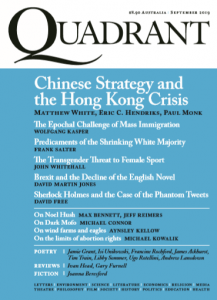
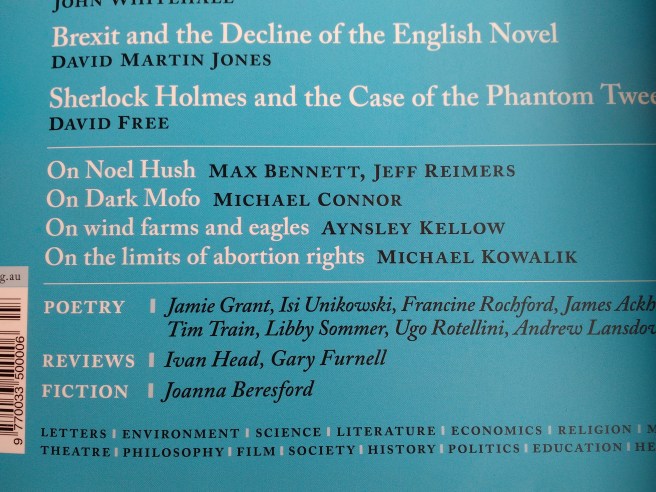
Blue Quadrant magazine with Poetry, Libby Sommer on the cover

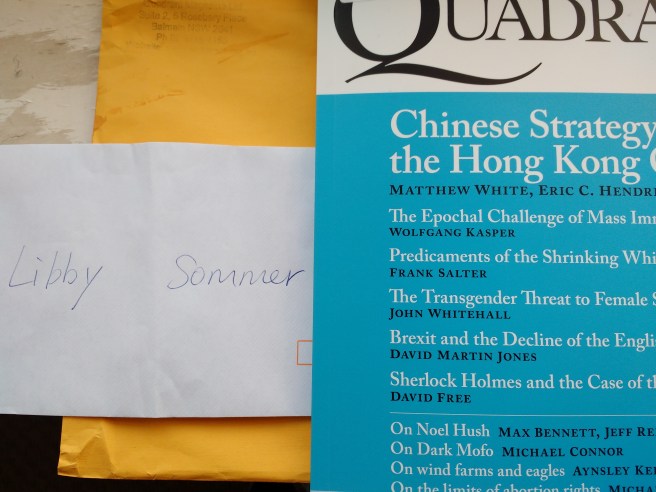
There’s my name on the cover of September Quadrant. First time I’ve made it to the cover under Poetry. This month it’s a prose poem titled AMBER PUPPY. I share the honour with poets Jamie Grant, Isi Unikowski, Francine Rochford, James Ackburst, Tim Train, Ugo Rotellini and Andrew Lansdown.

white envelope beside blue Quadrant September 2019 magazine cover

And there’s the white envelope containing my cheque. Halleluja!

So what is a prose poem?

Dictionary:  a piece of imaginative poetic writing in prose.

Poetry Foundation:  A prose composition that, while not broken into verse lines, demonstrates other traits such as symbols, metaphors, and other figures of speech common to poetry …

WikipediaProse poetry is poetry written in prose form instead of verse form, while preserving poetic qualities such as heightened imagery, parataxis, and emotional effects.

Academy of American Poets:  Though the name of the form may appear to be a contradiction, the prose poem essentially appears as prose, but reads like poetry. In the first issue of The Prose Poem: An International Journal, editor Peter Johnson explained, “Just as black humor straddles the fine line between comedy and tragedy, so the prose poem plants one foot in prose, the other in poetry, both heels resting precariously on banana peels.”  While it lacks the line breaks associated with poetry, the prose poem maintains a poetic quality, often utilizing techniques common to poetry, such as fragmentation, compression, repetition, and rhyme. The prose poem can range in length from a few lines to several pages long, and it may explore a limitless array of styles and subjects.

I love writing prose poems. They are definitely my preferred writing form just now.

Have a read of AMBER PUPPY. Quadrant magazine is available in newsagents, some book stores, online and in libraries.

Quadrant magazine cover September 2019