Turning Towards the Inner Critic

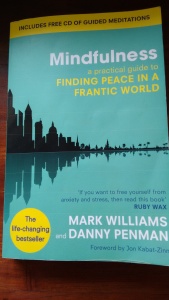
'Mindfulness' book cover

by Libby Sommer

It is essential to separate the creator and the editor, or inner critic when you practice writing, so that the creator has plenty of room to breathe, experiment, and tell it like it really is.  If the inner critic is being too much of a problem and you can’t distinguish it from your authentic writing voice, sit down whenever you find it necessary to have some distance from it and put down on paper what the critic is saying, put a spotlight on the words—“You have nothing original to say, what made you think you could write anything anyone would want to read, your writing is crap, you’re a loser, I’m humiliated, you write a load of rubbish, your work is pathetic, and your grammar stinks …”  On and on it goes!

Say to yourself, It’s OK to feel this.  It’s OK to be open to this.

You can learn to cultivate compassion for yourself  during this internal process by practicing Mindfulness Meditation.  Sit up straight, close your eyes, bring your awareness to your inner experience.  Now,  redirect your attention to the physical sensations of the breath in the abdomen … expanding as the breath comes in … and falling back as the breath goes out.  Use each breath to anchor yourself in the present.   Continue, concentrating on the breath for several minutes.  Now, expand your field of awareness to include the words of the inner critic.  Turn your attention to where in your body you feel the unpleasant thoughts, so you can attend, moment by moment, to the physical reactions to your thoughts.

 “Stay with the bodily sensations, accepting them, letting them be, exploring them without judgment as best you can.”—Mindfulness, Mark Williams and Danny Penman.

Every time you realise that you’re judging yourself, that realisation in itself is an indicator that you’re becoming more aware.

The more clearly you know yourself, the more you can accept the critic in you and use it.  If the voice says, “You have nothing interesting to say,” hear the words as white noise, like the churning of a washing machine.  It will change to another cycle and eventually end, just like your thoughts and just like the sounds around you that come and go. But, in the meantime, you return to your notebook and practice your writing.  You put the fear and the resistance down on the page.

Do you have any insights for those of us who struggle with a loud inner critic?  
I’m A Writing Workshop Junkie

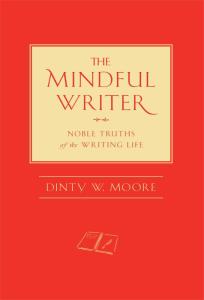
red book cover of The Mindful Writer by Dinty W. Moore

‘A writer is someone for whom writing is more difficult than it is for other people.’ – Thomas Mann

Even though I’ve had many of my short stories published, plus a novel, and a second novel accepted, I’m always wanting to learn more about the writing process – especially the link between creativity and spirituality.  Four weeks ago I enrolled in ‘The Mindful Writer’,  a course devised and presented by  Walter Mason.  Highly recommended.  He combines the insights of meditation and mindfulness with the joy of creative writing.

‘Tap into your true creative thinking through mindfulness and become aware of the vast reserves of wisdom within.’ – Walter Mason

Dinty Moore, in his book The Mindful Writer, Noble Truths of the Writing Life, says his lifelong pursuit of writing and creativity has helped to open him to the path of Buddhism:

“Find inspiration and insight on writing as a spiritual practice through astute quotes, thoughtful advice, and productive exercises on both mindfulness and craft.  This isn’t your typical “how to write” book. Author Dinty W. Moore, a well-respected writing coach and teacher, thoughtfully illuminates the creative process: where writing and creativity originate, how mindfulness plays into work, how to cultivate good writing habits and grow as a person, and what it means to live a life dedicated to writing. The Mindful Writer features bite-sized essays that will delight and inform not only writers, but also other artists, mediators and mindfulness practitioners. Built around heartening quotes from famous writers and thinkers, it is a resource that readers will turn to again and again for guidance and encouragement.” – Simon & Schuster Australia

On the never-ending path of learning more about the craft of writing, I also enrolled at the Blogging University (yet again) and took the WordPress course  Writing: Shaping Your Story – an intermediate course on the art of revision:  four weeks of self-editing and rewriting.  Dig into the process of focusing and building a story, whether fiction or nonfiction.  Lots of useful information.  And the course is free :).

So back to my desk now and to the work of crafting a new novel.


Turning Towards the Inner Critic

book cover: Mindfulness

It is essential to separate the creator and the editor, or inner critic when you practice writing, so that the creator has plenty of room to breathe, experiment, and tell it like it really is.  If the inner critic is being too much of a problem and you can’t distinguish it from your authentic writing voice, sit down whenever you find it necessary to have some distance from it and put down on paper what the critic is saying, put a spotlight on the words—“You have nothing original to say, what made you think you could write anything anyone would want to read, your writing is crap, you’re a loser, I’m humiliated, you write a load of rubbish, your work is pathetic, and your grammar stinks …”  On and on it goes!

Say to yourself, It’s OK to feel this.  It’s OK to be open to this.

You can learn to cultivate compassion for yourself  during this internal process by practicing Mindfulness Meditation.  Sit up straight, close your eyes, bring your awareness to your inner experience.  Now,  redirect your attention to the physical sensations of the breath in the abdomen … expanding as the breath comes in … and falling back as the breath goes out.  Use each breath to anchor yourself in the present.   Continue, concentrating on the breath for several minutes.  Now, expand your field of awareness to include the words of the inner critic.  Turn your attention to where in your body you feel the unpleasant thoughts, so you can attend, moment by moment, to the physical reactions to your thoughts.

 “Stay with the bodily sensations, accepting them, letting them be, exploring them without judgment as best you can.”—Mindfulness, Mark Williams and Danny Penman.

Every time you realise that you’re judging yourself, that realisation in itself is an indicator that you’re becoming more aware.

Continue reading