This is an old one, but a good one. Tell Don’t Show.
What does it mean exactly? It means don’t tell us about loneliness (or any of those complex words like dishonesty, secrecy, jealousy, obsession, regret, death, injustice, etc) show us what loneliness is. We will read what you’ve written and feel the bite of loneliness.
Don’t tell us what to feel. Show us the situation, and that feeling will be triggered in us.
When you take your child to school on their first day you may find yourself teary and relieved at the same time. Put into words what you see: the child’s face, the wave at the gate, the other mothers saying their goodbyes, another child coming up to take your son by the hand. We will get what you’re trying to say without you telling us directly.
The how-to-write books tell us to use our senses when we write stories: sight, sound, smell, touch. Writing from the senses is a good way to penetrate your story and make friends with it. Don’t tell us about something, drop deep, enter the story and take us with you.
What about you? Do you consciously bring the senses into your creative writing?
Have a read of my short story, “Tom”, first published in Quadrant Magazine. “Tom” is one of the self-contained chapters in my novel-in-stories, “The Crystal Ballroom” (Ginninderra Press). “The Crystal Ballroom”: stories of love and loss in the singles dance scene.
Tom:
May Ling steps across the skipping rope. I’m waiting for her with her baby brother, outside the school hall, but she hasn’t seen me yet. Every Thursday when she finishes her Hip Hop class I hang about with the other mothers and grandmothers and carers. It’s a routine I enjoy—walking up here with the baby in the stroller and then chatting with May Ling as we walk home.
May Ling is my son’s daughter. She has straight black hair and brown almond eyes, slim legs and tiny hands. Her hands are artistic: she draws beautiful pictures. In her black strappy shoes and blue-and-white school dress that falls below her knees, she looks very grown-up.
The park is on the bend of the road that leads to the school. There is a sandpit, swings, slippery dip, climbing chains and a rocking horse. We put our things down on one of the wooden benches on the perimeter of the park and sit in the shade of the trees. I unpack the afternoon tea: three apples, two bottles of water, rice crackers, sultana biscuits, peanut butter sandwiches.
The other mothers and carers come over and start up a conversation. What beautiful children. How old are they? What nationality?
‘Their mother is Chinese,’ I explain.
Some women are envious; they wish their own mothers would mind the children when they go to work or play golf.
I’ve got the bucket and spades and the plastic rakes hanging off one of the handles of the stroller ready for the sandpit. I keep them in the boot of the car between visits. Also in the boot is the collapsible stroller, the picnic blanket, the extra booster seat, the beach chair and the Cancer Council tent all folded up tight in its blue bag. I’m prepared for all possibilities.
When we leave the park we stop outside the rose garden of the RSL club so May Ling can pick a flower to take home to her mummy. Sometimes we sing a song from The Wizard of Oz. Today May Ling is chanting, Where’s my daddy? Where’s my daddy? I’d said to her that he might drive past and give her a lift like he’d done once before.
Ingrid said she’s surprised that with all his qualifications he can’t get a job. I said he doesn’t want any job. It has to be the right job, even if it takes him six months—yet again—to find it.
Last week I was standing in the kitchen at his house and he was rinsing the plates on the bench and stacking them into the dishwasher. I told him that May Ling had asked if mummy and daddy were getting a divorce. He laughed and said he would have to tell her to stop telling me things. ‘Don’t stop her from talking to me,’ I said. ‘Everyone fights. I told her that.’
After dinner and when it’s time for him to go upstairs to run a bath, I say my goodbyes. I am not allowed to go up because they all get in the bath together. He gives me a couple of chocolates from out of the fridge to eat on my way home before kissing me on the cheek at the front door.
‘Drive carefully, Sofia,’ he calls out as I head towards the car.
When I’d told him about the split-up with Tom he’d said he could never understand what on earth I’d seen in the man.
Doctor Ross had said that a lot of people continue in a relationship because they don’t want to go through the pain of breaking up. ‘In six months time you won’t feel a thing,’ he said in an effort to reassure me.
I shrugged. ‘The grandchildren won’t be pleased.’
‘Grandma’s broken up with her surfie boyfriend.’ he joked.
*
A seagull, wings flapping calmly and evenly, passes this place where I sit. It’s a crescent-shaped bay on the harbour where a man and a woman walk hand in hand along the beach, their dog running ahead. Tiny ripples on the water drift gently towards the shore.
Tom seemed calm at first, after I said what must have disappointed him, but then he became withdrawn and went into the bathroom. He cleaned his teeth and then came back out. He pulled the sheets back on the bed. He got in and appeared to fall asleep straight away.
‘Good night,’ I said to his back.
‘I thought I said goodnight,’ he said, turning towards me.
‘Goodnight,’ I said kissing him on the cheek.
He turned away again.
I can see now that Tom felt out of his depth at my younger son’s wedding and I feel remorse for hurting him.
Ingrid had counseled: ‘His mother probably said to him, “I told you she’d drop you after the wedding”.’
A row of tall dark cypress trees shield the beach from the road. On one of the wooden bench chairs by the water sits a woman dressed all in black.
‘What’s your mother like?’ I asked.
‘She sits in a corner and does what she’s told,’ he said. ‘I sat up with her last night and we watched a movie. What do you think of that?’
‘I think it’s dreadful—dreadful that you’re still living there with your parents.’
‘It’s very difficult for me. Very difficult. It’s the money.’
‘What do you want from him?’ his mother said to me, unable to hide the hatred in her voice, when I’d called that one time.
I told Tom what his mother said.
He wanted to say to her: ‘Are you pleased—are you pleased now? Have you got what you want?’
So now I am back to how things had been before, alone at nights, and as though he had never existed.
In the school holidays May Ling usually stays for a day or two at my place. One day recently she came running up the steps carrying a drawing and a poster of a horse. I came out to meet her, wiping my hands on the chequered tea-towel. I’m sure my face was flushed from the heat. May Ling’s floral skirt was almost to her ankles as she kicked off her shoes at the back door. I said to her that she looked as pretty as a picture.
‘Do you have the photos? The ones of daddy when he was a baby? I’ve been waiting all day to see the photos.’
‘Yes, yes. Come on in and we’ll get out the album.’
The last of the sun’s light slanted through the blinds as we sat side by side turning the pages. ‘You don’t look anything like you used to look,’ she said.
‘It was a long time ago,’ I sighed. ‘My hair is not the same. Poppy looks very different too, don’t you think?’
She shook her head. ‘No. He looks the same to me. Poppy looks the same.’
‘It must be my hairstyle.’
‘Why did you and Poppy divorce?’
‘I got married too young. I was only a teenager.’
‘Did you have a fight?’
I didn’t answer so she moved the conversation on to the split up with Tom. She’s let me know several times that she’s upset about it and can’t understand why it’s happened.
‘And what about you and Tom and your divorce?’ she asked, rolling her eyes upward. ‘Or whatever you call it. The divorce that isn’t a divorce. Did you have a fight?’
‘Yes, I told you before.’
‘What about?’
‘It was about a couple of things.’
‘What did you fight about?’
‘I told you one of the things.’
‘I’ve forgotten. What things?’
‘It’s very hard to tell you because you’re only six years old and you mightn’t understand.’
‘Tell me and I’ll tell you if I understand.’
‘Well it’s hard to say exactly. Like, can you put into words why you didn’t like that teacher at school, except that she expected too much of you?’
‘Yes. She asked us to draw our favourite place. I said, Port Stephens is my favourite place but I don’t know how to draw it. She said, Just do it, and didn’t give me any help. Miss McDonald used to help us do things. Not, Do this, Do that. So, there I’ve said it. It’s your turn now.’
I was uncomfortable having this conversation with May Ling. Her father has warned me that she will persist and persist and persist until she gets the answers and the more you try to escape her questions the more she persists. May Ling is not like other six-year-olds. Her parents treat her as an equal and she appears to be very mature. She knows I met Tom at a dance. It was a ‘meet your match’ dance and you had to choose a name for yourself from the name cards laid out at the front door when you arrived. Like Batman and Robin, Bec and Lleyton. You chose a card and had to find your matching partner. He selected Tarzan and I chose Jane.
‘Well, I told you the bit about the photo,’ I said.
‘What photo?’
‘When I saw the photo in his wallet. It was a rude picture.’
‘A bare bottom?’
‘No, the top half.’
‘Of a friend?’
‘No. He cut the photo out of a magazine.’
‘Who was she?’
‘No-one he knew. Just someone he’d cut out of a magazine. There was no photo of his sons or of me.’
‘I don’t think that’s so bad,’ she said. ‘What else happened? You said there were two things?’
‘He was a lot younger.’
‘You could have said your birthday came before his.’
‘Well what do you think would be a good reason?’
‘If he found another girlfriend.’
Outside a van rounded the bend of the road and disappeared down the hill with a swooshing sound. After a pause I said: ‘I remember now why we split up. The problem was that I didn’t love him and he said he loved me.’
She frowned. ‘Well, let’s play a game. One of us is Tom and the other one is you and we have the fight.’
‘No, darling. Let’s go upstairs and have a story. It’s late. It’s already past your bedtime.’
‘Let’s do it, Sofia. I’ll be Tom.’ She scowled at me her brows knitted in a triangle. ‘Oh Sofia,’ she pleaded.
‘If you go to bed now I’ll let you choose the story or otherwise I’ll chose it.’
She crossed her arms with a ‘Humph’. Then, ‘Well show me how you used to dance with Tom. You said that’s where you met him.
Taking her hand I said, ‘Come on, darling.’
We went up to her bedroom and she looked through her bookcase carefully for the appropriate story. No Dr Seuss or The Little Mermaid tonight. Instead she decided on Beauty and the Beast: the story of a man who is unable to love someone, so he’s turned into an ugly beast.
*
It was dark in the lounge room, but I didn’t open the shutters. I didn’t feel anything in particular, no hate, no repugnance. I had agreed that he could come when he asked the previous evening. I paid close attention to the sounds, to the light, to the noises in the
park next door that had enveloped the room. He looked at me stretched out on the couch expecting me to speak. I didn’t look him in the face. Didn’t look at him at all.
‘You’ll see,’ he said. ‘It will be better this time. Things will be better.’
He removed my shoes, threw them on the floor. ‘So you’ll give me another chance?’
He knelt beside me. Didn’t say any more that he loves me. Said, ‘It’s a comfort to know we’ll keep seeing each other.’
I didn’t answer.
‘That’s all I want,’ he said. ‘Just to know I’m going to see you.’
He unzipped my jeans.
‘You know it will end again,’ I said.
‘Not too soon though. Will it?’
Slowly. Slow, patient. With my eyes shut. ‘I don’t know.’
‘I’m prepared to take the risk,’ he said. ‘I want to. I don’t want to not see you again.’
I stroked his hair.
He pulled off his T-shirt. Undressed himself.
A seagull, wings flapping gently and evenly passes this place where I sit. He skirts the line of the beach between water and sand and finally comes to rest on the top rung of the railing that defines the path to the beach.
‘Sex is good for you,’ the female doctor had said, moving back to her desk. It was a routine examination.
‘Us women need the testosterone,’ she added with a little smile.
I’d wanted to end it again, it must have been for the fifth time. After the phone call I felt angry and wanted to tell him not to come. I was letting him visit against my will, since I was still angry. The next night and for several nights after that I wanted to tell him not to come. He’s conducted himself in a way that disgusted me. He denied he’d had a couple of drinks and said he was tired, that no, he hadn’t been drinking, he was just tired.
I was silent at first, after he said what repulsed me, but then he sensed my lack of warmth and said he’d call again before the weekend. He asked who I was going out to dinner with and I say it was a married couple, some friends who had invited other friends of mine but I didn’t want to include him in the invitation because he’d feel uncomfortable with these people and this would make me ill at ease too. He could come on the Friday.
‘You were waiting for him to grow up, but he hasn’t,’ Dr Ross had said forcefully, with intention, as was his way. ‘It won’t work. You’ll get bored with him again. You don’t like the uncertainty. You’re in control in this relationship. You’re the adult. He’s the child. It’s your call—your choice. I just try to give you support.’
*
The wind blows from the south. The waves soften at their edges. May Ling is playing in the sand with her red bucket. She’s looking for schools of fish to catch, the white plastic ice cream container full of shells and sand and seaweed. Her small fingers rearrange the pieces of her collection. A seaplane labours against the wind, not quite balanced between sea and clouds.
‘May Ling,’ I call out. ‘Look at the seaplane.’
She looks up through the brim of her black eyelashes then walks up towards me.
‘Look what I’ve got,’ she says, opening her fingers.
‘What sugar plum?’
‘Shells.’
‘Have you ever collected shells before?’
‘No.’ She puts them into the plastic container filled with seawater and sand. ‘A fish tank,’ she says proudly.
‘Do you like this beach?’
She shrugs. ‘It’s not too bad.’
She walks back to the water’s edge, tiptoeing between the rocks and the flotsam and jetsam that the waves have left on the shore, skipping across the moss-covered stones.
‘Sofia , can you come in with me?’ she calls out. ‘Come into the water and help me catch some fish.’
There is the sound of the waves lapping the shore. Butterflies—mostly turquoise and black—more colour than the birds, flit between the branches and flap in front of the harbour. The sea plane finishes its circling and lands not far from the beach.
‘There’s something so wonderful about watching the waves,’ Tom had said. ‘Especially when you’ve just been out there, and come back in. Afterwards I always like to just sit on the sand and watch the waves.’
May Ling comes back up to where I sit under a tree on the grass. ‘I’m hungry,’ she says. ‘Did you bring anything to eat?’
I reach for the cooler bag and unzip it. ‘What would you like?’
May Ling looks in at the food and frowns. ‘Is that all?’
She reaches for a small carton of apple juice and sips quickly on the straw before handing it back.
‘Isn’t it any good?’
She smirks. ‘It tastes off.’ She turns around and walks back towards the sea.
‘It tastes fine to me,’ I call out.
She yells from the water’s edge: ‘Sof, can you come in?’
The water is all green and slippery shimmering in the sunlight.
*
Yesterday I had lunch at a Japanese restaurant after a visit to the gym. It was not unusual for me to be there at that time, no more unusual than all the other people sitting alone on bar stools as the small containers of food did their revolutions. Jason, a friend I hadn’t seen for a long time was manipulating his chopsticks with great intensity. He was greying, confident, but struggling to attract patients to his new psychology practice.
‘They can see value in spending money on a massage,’ he complained, ‘but not in a visit to someone like me.’
After we talked about our work and our families and our lives in general under the glare of the fluorescent light, he raised his eyebrows and gave his opinion on the relationship with Tom.
‘I have to be honest. I feel very angry. If it was a man in the same situation people would say, dirty old man. But for a woman it’s okay. Someone that age has a prick that’s ready morning, noon and night. I’m more interested in a mature woman—someone I can really talk to. I’m not interested in young women. They might have great bodies but that doesn’t do it for me.’
*
‘What do you think, Sofia, do they look okay? Is this what you’d imagined I’d wear to the beach—Sofia? Do I look all right? Is this what you’d imagined me wearing when you said we’d go for a swim this weekend?’
‘I hadn’t imagined you on the beach,’ my irritated voice had answered from the bed. ‘I hadn’t thought about what you’d be wearing on the beach.’
He’d been preening himself from side to side in front of the mirror opposite the sun-drenched rosy pink chaise lounge—pale against the warm tones; but when he walked back towards the mirror, he turned bronze again from head to foot, in his shiny black swimmers. His fine body hair covered his legs and arms.
‘Usually I don’t wear a costume under my wetsuit,’ he said, ‘so I bought these Speedos and a pair of board shorts. Which ones do you think I should wear to the beach?’
‘You can wear both. Wear the Speedos under the board shorts.’
He was standing in front of the sliding mirrored doors that framed the wardrobe opposite two windows, looking at the reflection of a very boyish, very attractive figure, not very tall or very small, with blonde loose curly hair like that of a cherub. He pulled on the cord of his swimming costume, puffed out his hard freckled chest, curved like a suit of armour; and the whites of his hazel eyes and his white regular teeth glowed through the apricot warmth of the room.
‘It’s fine, Tom,’ I reassured him. ‘They look fine. You haven’t got any white marks from the wetsuit. Either costume looks fine. Whatever you feel comfortable in. You can wear whatever you want.’
He grinned. ‘I’ve never owned a pair of Speedos. I’ve watched blokes on the beach in their Speedos walking up from the water.’
‘It’s fine.’
He laughed to himself, unable to disguise the pride in his voice: ‘They call these swimming costumes budgie smugglers. That’s what they’re called now.’
‘Ingrid’s eyes will pop out of her head when she sees you at Nielson Park today.’
Tom, motionless in front of his own image, laughed again to himself. ‘I know so well not to wear the wrong thing when I’m with you.’
*
‘I thought you were using your head instead of …’ Ingrid said, unable to hold back the intensity of her disapproval. She had been showing me the latest photos of her new dog. She is very happy with Skippy and has said that he is good company and that he sleeps on her bed.
Before telling her I was back with Tom again I’d said I had something say, but please don’t pass judgment. She spat the words at me.
‘It’s not that,’ I said. ‘That’s not the motivation. It’s for the companionship.’ ‘Companionship? You can have that with girlfriends. Tom has no conversation.’
‘But he’s easy to be with. It’s nice to go out for a meal or to the movies.’
‘Movies are good. You don’t talk and there’s something going on.’ She sipped her latte then added, ‘He’s not the answer.’
‘There is no answer. It’s the loneliness. I can’t stand the loneliness.’
She nodded then sat more upright in her chair. ‘We’re all different. It’s a long way for him to travel though.’
‘Three hours either way.’
‘Must be worth his while.’
‘It might last a week, a month, a year, who knows. If you get the big C diagnosis you could be dead in a few weeks.’
She shrugged. ‘We all make our decisions. That’s why I bought my little
Skippy.’ She put his puppy photos back into her handbag.
The ocean must be calm today. No energetic crashing coming from the direction of the sea. This morning I’m inside protected from the heat behind heavy curtains. I can’t see the water.
‘Messenger boy.’ he’d laughed, referring to himself, on an overcast Saturday morning, after he’s brought me a cup of tea in bed and was about to go up the road to buy the newspaper.
‘Having you just completes my life,’ he said when he finished reading the sports pages. ‘I can’t think of anything nicer than sitting on the bed with you on a morning like this. After the weekend I’m going to go back feeling so good. Thank you so much.’
He stretched himself out on the chaise lounge that was under the window next to the bed and said: ‘Everyone’s got someone. Why shouldn’t we? Who cares what anyone else thinks? It’s between you and me.’
‘What did your parents say when you said you’re coming to Sydney this weekend?’
He grinned. ‘Nothing. When I said goodbye Dad said to Mum, Just let him go.’
‘Did your mother say something?’
‘No.’
‘How do you feel about your parents going away for two months on Monday?’
‘Okay.’
‘Last time you were worried before they went away. But you know now how to use the washing machine.’
‘I’ve got it all written down. I’ve got it written it in a book.’
*
‘What’s the resolution of the story?’ May Ling asks, sprinkling grated cheese on her pasta.
‘How do you know these things?’ I say. ‘Who tells you?’
‘At school.’
‘In First Class at school they teach you about the resolution of a story?’
‘In the library. What is the problem that starts the story?’
‘Do you know what resolution means?
‘It means how things turn out in the end.’
I look to my son and daughter-in-law: ‘What will they teach them in Year Twelve if they learn this in First Class already?’
‘You haven’t answered me,’ interrupts May Ling. ‘I’m listening,’ she says with a hand to her ear.
‘It’s very hard for me to explain these things to you,’ I say yet again.
‘What are the complexities of the story?’ she asks.
I turn to my son for help.
‘The story is about a woman who is looking for love,’ he says to his daughter.
‘There are many kinds of love,’ I apologise. ‘Not just between a man and a woman. Love for children … grandchildren.’
A quiet still morning. Water trickles down through the rocks after last night’s rain. Several different bird calls in the gully. Intermittent hammering in the unit above. The large heavy curtains barely parted to keep out the eastern heat, but open enough to see the leaves of a tree rustling in the morning sea breeze that blows across my feet.
Tom and I had stood at the window and looked through the bare branches and realized that now we could see all the way to the horizon at Bondi. The ridge blocked the line of the horizon but we could see the clouds that hung just above it. We’d loved watching the sky.
‘I’ve seen the sky looking like this before,’ he’d said, putting his arm around my waist.
‘What do you mean?’
‘So still. A winter sky.’
At the back door before he left he said: ‘So you think there’s still heat in the furnace?’
I’d laughed and nodded.
‘That’s what the expression is, isn’t it?’
‘I don’t know. I haven’t heard it. Heat in the fire? It probably feels like a furnace to you.’
‘It works well being casual like this,’ he said. ‘We don’t have to deal with each others problems.’
I asked Ingrid what she thought he meant by that. She said it was probably something he’d heard someone else say.
‘I’ve been thinking about it—wondering what he meant.’
‘Nothing,’ she said. ‘He didn’t mean anything. He just says things that he hears other people say.’
‘I’m very proud to be seen with you,’ he’d said. ‘A younger man with an older woman. I’m not ashamed to be seen with you.’
Now, I sit by the water until the sun goes down. Then walk back home.
So, here’s the thing: choose something in particular to write about. For example, what it felt like having a tennis lesson after a twenty year break. Give us the specifics. Dig deep for the details, but at the same time be aware of the world around you. As you focus on what you’re writing, at the same time stay conscious of your surroundings: the white painted cane Bentwood chairs in the café, the cool breeze from under the door on your sandaled feet, the hum of the traffic outside. Just add a sentence every now and then about the trees that overlooked the tennis courts while you were having a tennis lesson. When we focus on our writing it is good. Seeing the colour of the sky when you toss the ball gives breathing space to your story.
If you are sitting in Meditation you calm the butterfly mind by paying attention to your thoughts, giving them space by acknowledging them before returning to the breath, in and out through the nostrils. In the act of slowing down your breathing, as best you can, you remain open so that you are receptive to awareness of sounds as they arise: sounds near, sounds far, sounds in front, behind, to the side, above or below.
With every breath you take, you feel the air, the sound of the ball as it hits the racket, the players on the other courts.
We should always be living in the present, not by ignoring the world around us, but by paying close attention. It is not easy to stay alive to ‘what is’. When we slow things down in our writing, it is good practice.
What about you? Do you find a daily meditation practice assists your writing practice?
Have a read of my prose poem, “The Backpack”, first published in Quadrant Magazine. “The Backpack” is one of the stories in my collection, “Stories from Bondi” (Ginninderra Press). “Stories from Bondi”: the foibles of human nature, with all their pathos and humour, are laid bare for the reader.
The Backpack:
What can a man who meets you at the station and offers to carry your backpack mean to a woman traveling the world alone?
I was scared, like anyone who has no sense of direction. The journey was a series of stops and starts. Whether to use the Eurail pass or post it back home and ask the kids to get me a refund. Giovanni appeared one European winter, thick padded jacket, woolen beanie, scarf and gloves, tall and imposing, I’ll carry your bag.
I was small, the backpack the length of my spine, the zip-off bag on one shoulder, the daypack positioned in front like a nine-month baby bump. That evening, as we climbed the steps of the Corniche – the wind bitter across the Mediterranean, the metal stairs covered with slippery ice, the railing melting beneath my hand. Soon it would become my railway platform, my steps, and Giovanni my landlord.
We walked there in the crisp night air. My own place. It didn’t cost much. No-one yet knew I was here. I could ask Giovanni if I needed any help. I knew my children would be pleased I had a base. I didn’t want them to worry. It was the thing I wanted the most secretly, studying maps, absorbing travel books. To be safe, a desire whispered to the moon that moved behind my shoulder at night. If you guide me to a safe haven I promise to be happy. And the moon listened. I did my best.
The winter sky closed down and the spring began its flowering. I took photos and painted and rang the children every week. Watch your money, don’t talk to strangers, be careful walking at night – you know the drill. The pebbly beach, the weekend markets, it was all there for the exploring. A glimpse of the sea between terracotta roofs – a vision in turquoise. The cobbled streets could show which way to follow – and none of them wrong. A room at the top of the stairs – till June I stayed reading the English books Giovanni had left in the bookcase, shopping for food, telling my kids and friends they should come for a visit.
Where had the months gone? Almost two years on the road. Summer approached. The rents would go up and the tourists arrive. Time to move on. I could only take with me what I could carry on my back. A Jewish gypsy they said. One more step into the unknown. Pack up, give away what I couldn’t manage, but keep the palette knife and miniature easel. There was stuff happening back home. The boys were grown and earning a living. Their sister turned twenty-one. People were reinventing themselves all over the place then coming back home. A thousand train rides later, my mother nearly eighty. I won’t be around much longer, she cried.
His was a helping hand in a world that says, but what are you doing there? What are you doing?
I am sitting in a café across the road from a Sydney beach. This stretch of road has a whole row of cafes side by side facing the sea. This is my favourite kind of writing place: one where I can sit comfortably for a long period of time and where the owners of the café know me and welcome me. This café is owned by a Brazilian man and his wife and has comfortable upholstered bench chairs with a direct view of the Pacific Ocean. For my two-hour writing session my choice could be a traditional Brazilian dish such as Coxinha, Feijoda or Moqueca. Or a cocktail like Caipirinha or Caipiroska. I must order something and it must be more that a Long Black, because I plan to be here for some time. I want the owners of the café to know I appreciate the time and the space they are allowing me.
However, today I’ll be very boring and order poached eggs on gluten-free bread
Why go to all this trouble to find a place to write? Why not just stay home and work? Because it’s good to get out and have a change of scene. I find I need to be happy and relaxed when I’m creating on the page and sitting in a café with a pleasant vibe works for me. Other writers need silence in order to concentrate, but I need to feel I am out and about in a beautiful place having a good time before the creative juices flow.
Strangely, working in a café can help to increase concentration. The busy café atmosphere keeps the sensory part of you occupied and content, so that the hidden, quieter part of you that composes and focuses is allowed to do its work. It is something like being cunning when trying to get a spoonful of food into a resistant toddler’s mouth . You pretend to be an aeroplane with all the sound effects and movements before landing the food-laden plane inside the child’s mouth. Mission accomplished.
What about you? Do you need to be at your desk in total silence in order to write, or do you like to experience the swell of humanity around you—to be surrounded by other human beings? Or at home listening to a particular kind of music?
In terms of creating new material during a pandemic, poetry is where I turn for inspiration. What about you?
According to Edward Mallinckrodt Distinguished Professor of English, Washington University, St. Louis, Missouri, 1976–90. Poet Laureate of the U.S., 1988–90, Poetry is literature that evokes a concentrated imaginative awareness of experience or a specific emotional response through language chosen and arranged for its meaning, sound, and rhythm.
Do you find reading and writing poetry right now is how you are able to express yourself during a troubling time?
Phyllis Klein from Women’s Therapy Services puts it this way: “Turning to poetry, poetry gives rhythm to silence, light to darkness. In poetry we find the magic of metaphor, compactness of expression, use of the five senses, and simplicity or complexity of meaning in a few lines.”
This is my pre-pandemic poem ‘Taste‘ first published in Quadrant magazine May 2019. Have a read. Hope you enjoy it.
Taste:
I rather like poems about minor calamities, bursts of tiny delights, the sun warming the tender skin of the elderly. Also, the way palm fronds conduct themselves during a southerly, dishevelled, exposing the softness of their billowing arms. Pastries in display cases do something for me too. Even cupcakes iced in gelato colours, adorned with miniature decorations … Can you see my preference for the words ‘miniature’ and ‘tiny’, an inclination towards the distilled in a world favouring often the big and the overwhelming? People with the patience to follow a complex recipe – well, that’s not me, but I like to taste what they cook. Babies in prams kicking chubby legs make me hover – how difficult not to take a bite. If you write something about a paper straw, I will be fascinated. You could try a ladybird, a pocket-size umbrella. The generalised angst of the human condition, however, may be hard for me to get a handle on. Watch that man with the disabled daughter moisten his finger after her cupcake is eaten and relish the last crumbs. Consider the rainbow-coloured wristband tied to a letterbox on the way to the park or the miniature plastic bucket and spade we found half-hidden on the beach at Bronte and packed with us for years on every visit to the sea.
In terms of creating new material during a pandemic, poetry is where I turn for inspiration. What about you?
According to Edward Mallinckrodt Distinguished Professor of English, Washington University, St. Louis, Missouri, 1976–90. Poet Laureate of the U.S., 1988–90, Poetry is literature that evokes a concentrated imaginative awareness of experience or a specific emotional response through language chosen and arranged for its meaning, sound, and rhythm.
Do you find reading and writing poetry right now is how you are able to express yourself during a troubling time?
Phyllis Klein from Women’s Therapy Services puts it this way: “Turning to poetry, poetry gives rhythm to silence, light to darkness. In poetry we find the magic of metaphor, compactness of expression, use of the five senses, and simplicity or complexity of meaning in a few lines.”
This is my pre-pandemic poem ‘Taste‘ first published in Quadrant magazine May 2019. Have a read. Hope you enjoy it.
Taste:
I rather like poems about minor calamities, bursts of tiny delights, the sun warming the tender skin of the elderly. Also, the way palm fronds conduct themselves during a southerly, dishevelled, exposing the softness of their billowing arms. Pastries in display cases do something for me too. Even cupcakes iced in gelato colours, adorned with miniature decorations … Can you see my preference for the words ‘miniature’ and ‘tiny’, an inclination towards the distilled in a world favouring often the big and the overwhelming? People with the patience to follow a complex recipe – well, that’s not me, but I like to taste what they cook. Babies in prams kicking chubby legs make me hover – how difficult not to take a bite. If you write something about a paper straw, I will be fascinated. You could try a ladybird, a pocket-size umbrella. The generalised angst of the human condition, however, may be hard for me to get a handle on. Watch that man with the disabled daughter moisten his finger after her cupcake is eaten and relish the last crumbs. Consider the rainbow-coloured wristband tied to a letterbox on the way to the park or the miniature plastic bucket and spade we found half-hidden on the beach at Bronte and packed with us for years on every visit to the sea.
When people ask me where I get my ideas from, I tell them I use the world around me. Life is so abundant, if you can write down the actual details of the way things were and are, you hardly need anything else. Even if you relocate the French doors, fast-spinning overhead fan, small red Dell laptop, and low kneeling-chair from your office that you work in in Sydney into an Artist’s Atelier in the south of France at another time, the story will have truth and groundedness.
In Hermione Hoby’s interview with Elizabeth Strout in the Guardian newspaper, the Pulitzer prize winner said her stories have always begun with a person, and her eyes and ears are forever open to these small but striking human moments, squirreling them away for future use. “Character, I’m just interested in character,” she said.
“You know, there’s always autobiography in all fiction,” Strout said, referring to her novel, My Name is Lucy Barton. “There are pieces of me in every single character, whether it’s a man or a woman, because that’s my starting point, I’m the only person I know.” She went on to explain:
“You can’t write fiction and be careful. You just can’t. I’ve seen it with my students over the years, and I think actually the biggest challenge a writer has is to not be careful. So many times students would say, ‘Well, I can’t write that, my boyfriend would break up with me.’ And I’d think, you have to do something that’s going to say something, and if you’re careful it’s just not going to work.”
At the launch of one of my books MC Susanne Gervay OAM said: “Libby’s level of detail creates poignant insights into character and relationships. If people know Libby they may find themselves subtly entwined in one of her stories.”
On Goodreads’ website they locate The Bell Jar by Sylvia Plath under “Autobiographical Fiction” and describe the book as Plath’s shocking, realistic, and intensely emotional novel about a woman falling into the grip of insanity:
“Esther Greenwood is brilliant, beautiful, enormously talented, and successful, but slowly going under—maybe for the last time. In her acclaimed and enduring masterwork, Sylvia Plath brilliantly draws the reader into Esther’s breakdown with such intensity that her insanity becomes palpably real, even rational—as accessible an experience as going to the movies. A deep penetration into the darkest and most harrowing corners of the human psyche, The Bell Jar is an extraordinary accomplishment and a haunting American classic.”
My advice to you, dear writer, is to be awake to the details around you, but don’t be self-conscious. “So here it is. I’m at a Valentine’s Day party. It’s 33 degrees outside. The hostess is sweltering over a hot oven in the kitchen. She is serving up cheese and spinach triangles as aperitifs.” Relax, enjoy the party, be present with your eyes and ears open. You will naturally take it all in, and later, sitting at your desk, you will be able to remember just how it was to be eating outside in the heat under a canvas umbrella, attempting to make conversation with the people on either side of you, and thinking how you can best make an early exit 🙂
In the interview with Elizabeth Strout in the Guardian, Strout said:
“I don’t want to write melodrama; I’m not interested in good and bad, I’m interested in all those little ripples that we all live with. And I think that if one gets a truthful emotion down, or a truthful something down, it is timeless.”
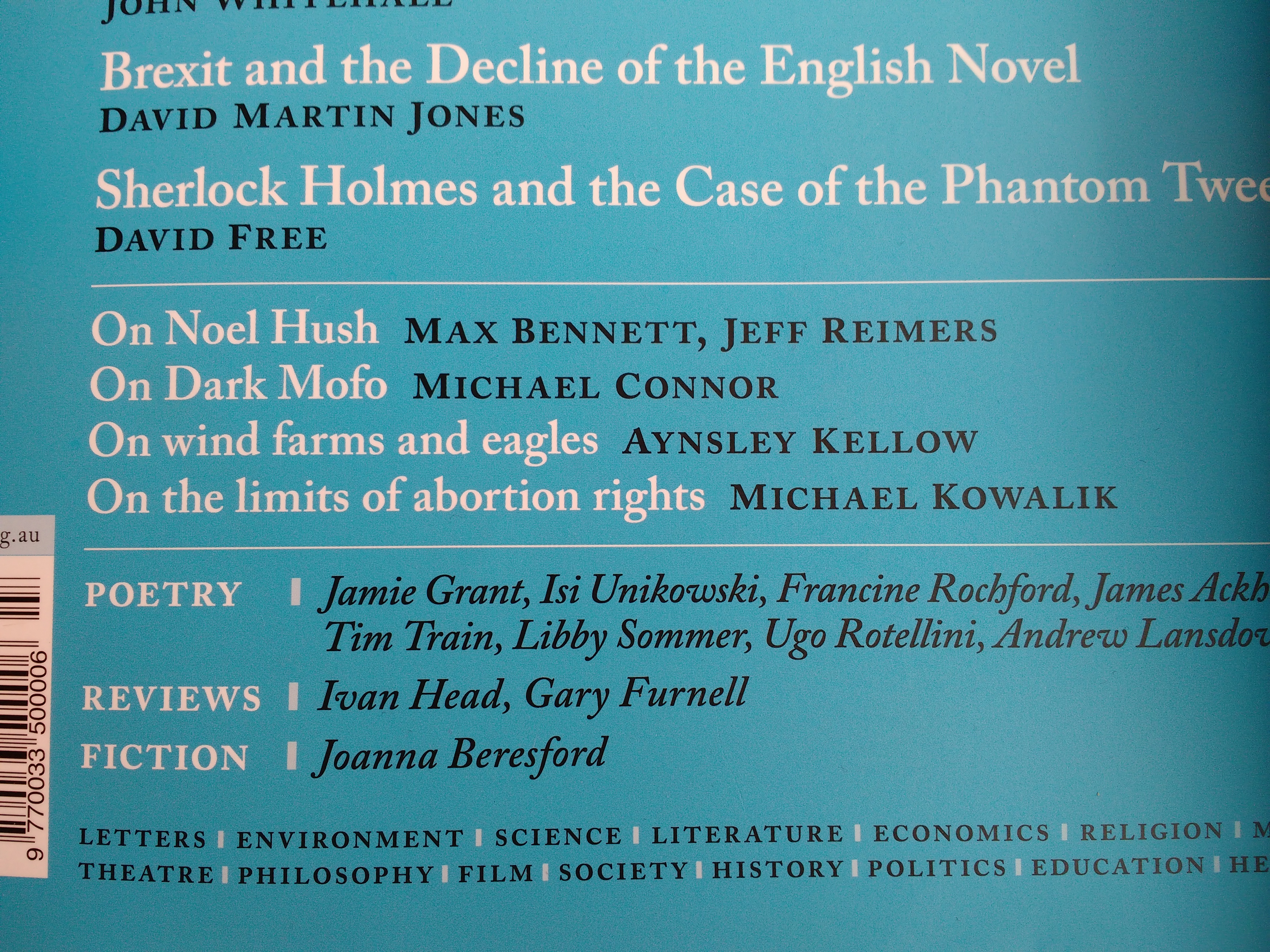
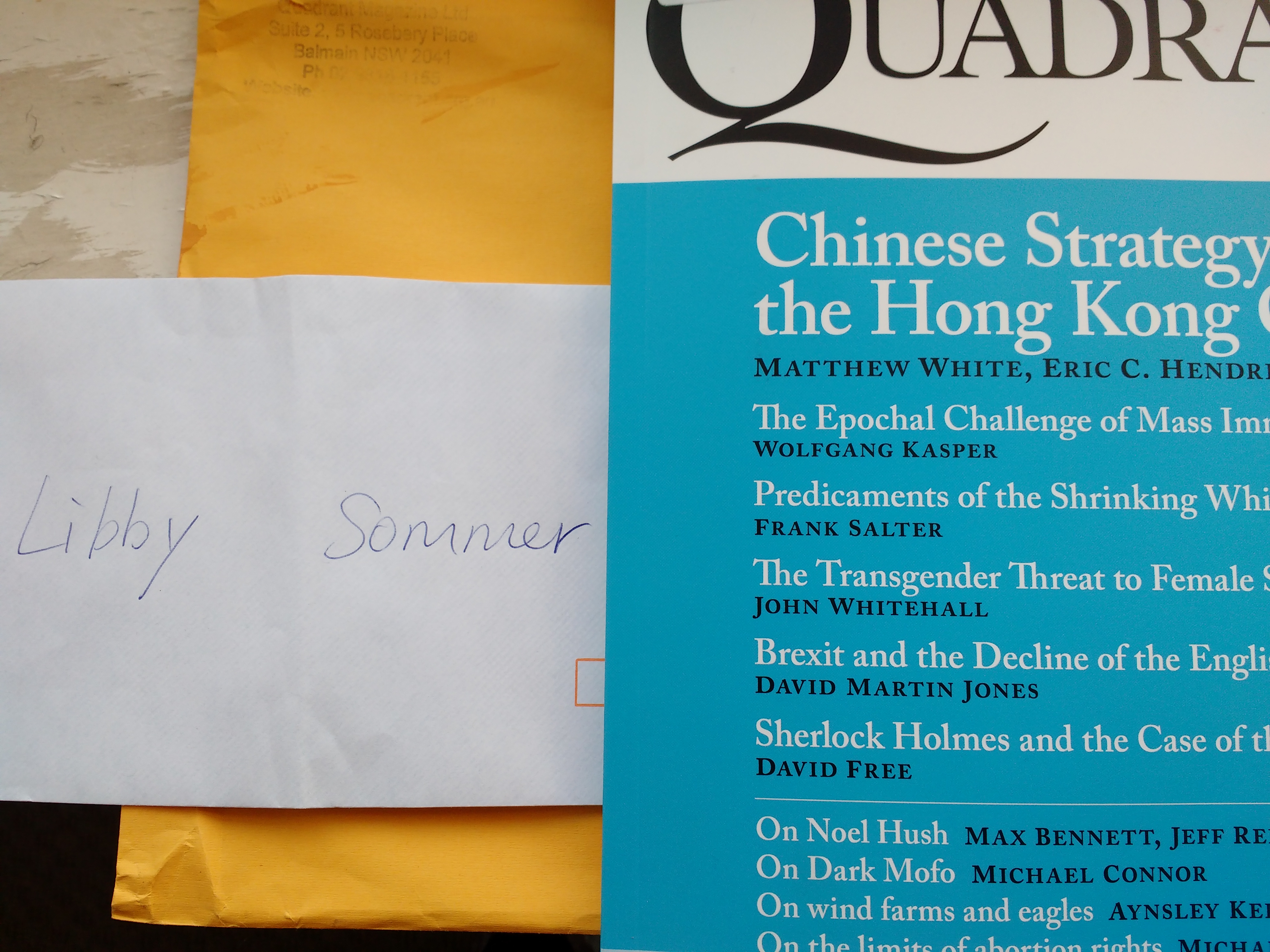
There’s my name on the cover of September Quadrant. First time I’ve made it to the cover under Poetry. This month it’s a prose poem titled AMBER PUPPY. I share the honour with poets Jamie Grant, Isi Unikowski, Francine Rochford, James Ackburst, Tim Train, Ugo Rotellini and Andrew Lansdown.
And there’s the white envelope containing my cheque. Halleluja!
So what is a prose poem?
Dictionary: a piece of imaginative poetic writing in prose.
Poetry Foundation: A prose composition that, while not broken into verse lines, demonstrates other traits such as symbols, metaphors, and other figures of speech common to poetry …
Wikipedia: Prose poetry is poetry written in prose form instead of verse form, while preserving poetic qualities such as heightened imagery, parataxis, and emotional effects.
Academy of American Poets: Though the name of the form may appear to be a contradiction, the prose poem essentially appears as prose, but reads like poetry. In the first issue of The Prose Poem: An International Journal, editor Peter Johnson explained, “Just as black humor straddles the fine line between comedy and tragedy, so the prose poem plants one foot in prose, the other in poetry, both heels resting precariously on banana peels.” While it lacks the line breaks associated with poetry, the prose poem maintains a poetic quality, often utilizing techniques common to poetry, such as fragmentation, compression, repetition, and rhyme. The prose poem can range in length from a few lines to several pages long, and it may explore a limitless array of styles and subjects.
I love writing prose poems. They are definitely my preferred writing form just now.
Have a read of AMBER PUPPY. Quadrant magazine is available in newsagents, some book stores, online and in libraries.
‘My attention span had gone out on me; I no longer had the patience to try to write novels. … I know it has much to do now with why I write poems and short stories. Get in, get out. Don’t linger. Go on.’
‘Every great or even every very good writer makes the world over according to his own specifications.’
‘It is his world and no other. This is one of the things that distinguishes one writer from another. Not talent.’
‘Isak Dinesan said that she wrote a little every day, without hope and without despair.’
‘”Fundamental accuracy of statement is the ONE sole morality of writing,” Ezra Pound.’
‘It is possible to write a line of seemingly innocuous dialogue and have it send a chill along the reader’s spine – the source of artistic delight, as Nabokov would have it. That’s the kind of writing that most interests me.’
‘That’s all we have, finally, the words, and they had better be the right ones, with the punctuation in the right places so that they can best say what they are meant to say.’
‘I like it when there is some feeling of threat or sense of menace in short stories.’
‘I made the story just as I’d make a poem; one line and then the next, and the next.’
‘V.S. Pritchett’s definition of a short story is “something glimpsed from the corner of the eye, in passing.” Notice the “glimpse” part of this. First the glimpse.’
‘The short story writer’s task is to invest the glimpse with all that is in his power. He’ll bring his intelligence and literary skill to bear (his talent), his sense of proportion and sense of the fitness of things – like no one else sees them. And this is done through the use of clear and specific language, language used so as to bring to life the details that will light up the story for the reader. For the details to be concrete and convey meaning, the language must be accurate and precisely given. The words can be so precise they may even sound flat, but they can still carry, if used right, they can hit all the notes.’
Raymond Carver, Fires, Vintage 1989
So who is Raymond Carver?
Raymond Carver, in full Raymond Clevie Carver, (born May 25, 1938, Clatskanie, Oregon, U.S.—died August 2, 1988, Port Angeles, Washington), American short-story writer and poet whose realistic writings about the working poor mirrored his own life. – Encyclopedia Britannica







 Libby Sommer, Author