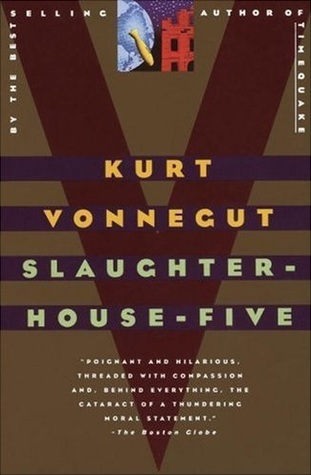
A fantastic example of this writing advice is Kurt Vonnegut’s Slaughterhouse-Five.
Poignant and hilarious, threaded with compassion and, behind everything, the cataract of a thundering moral statement. – The Boston Globe
Kurt Vonnegut’s absurdist classic Slaughterhouse-Five introduces us to Billy Pilgrim, a man who becomes unstuck in time after he is abducted by aliens from the planet Tralfamadore. In a plot-scrambling display of virtuosity, we follow Pilgrim simultaneously through all phases of his life, concentrating on his (and Vonnegut’s) shattering experience as an American prisoner of war who witnesses the firebombing of Dresden.
Don’t let the ease of reading fool you – Vonnegut’s isn’t a conventional, or simple, novel. He writes, “There are almost no characters in this story, and almost no dramatic confrontations, because most of the people in it are so sick, and so much the listless playthings of enormous forces. One of the main effects of war, after all, is that people are discouraged from being characters.”
Slaughterhouse-Five is not only Vonnegut’s most powerful book, it is also as important as any written since 1945. Like Catch- 22, it fashions the author’s experiences in the Second World War into an eloquent and deeply funny plea against butchery in the service of authority. Slaughterhouse-Five boasts the same imagination, humanity, and gleeful appreciation of the absurd found in Vonnegut’s other works, but the book’s basis in rock-hard, tragic fact gives it a unique poignancy – and humor. – Goodreads
Sometimes there would be a person in one of my creative writing classes who was obviously very talented. I can bring to mind one in particular. You could sense people holding their breath as she read, and often her hands shook. The writing process opened her up. She said she had wanted to write for years. She was so excited about writing that she straight away wanted to write a book. I said to her, slow down. Just practice writing for a while. Learn what this is all about.
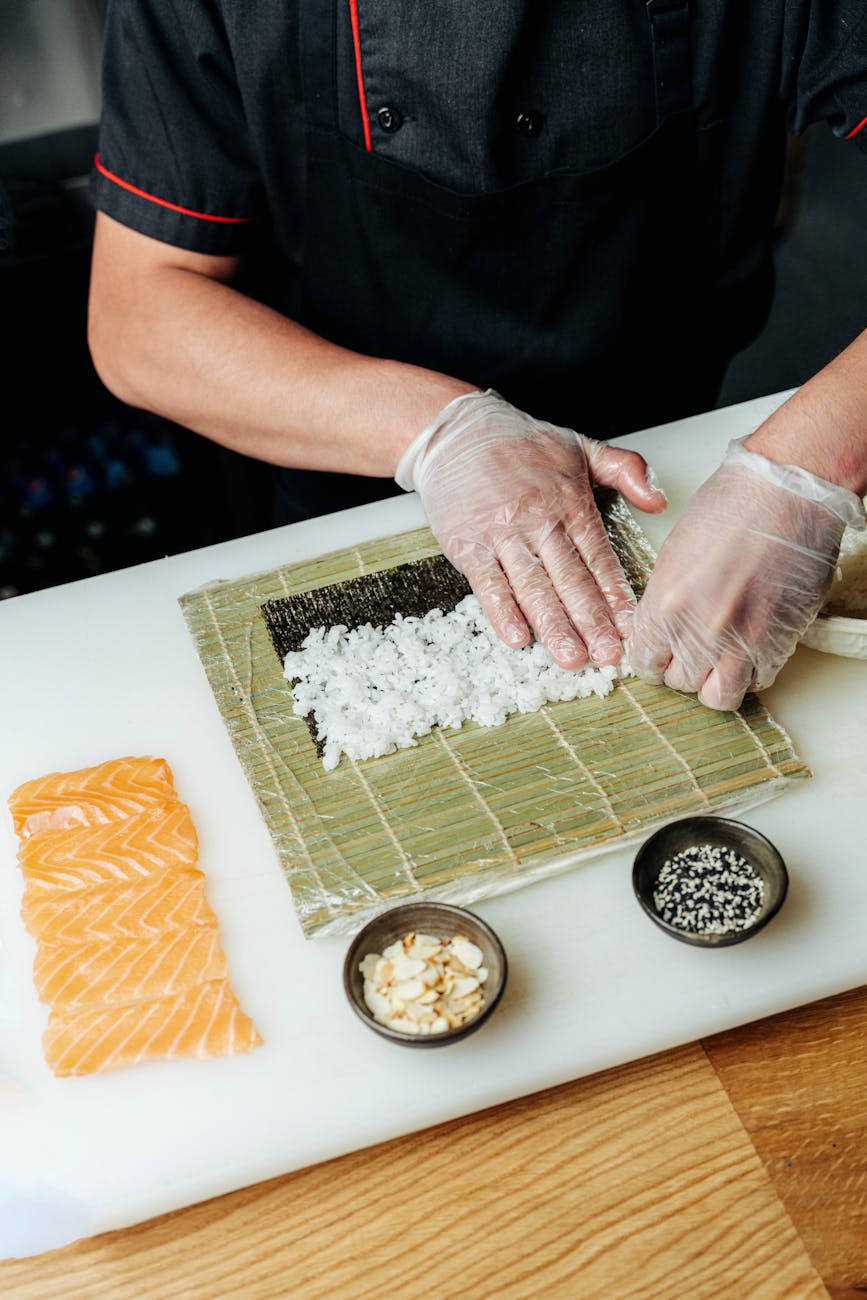
In Japan becoming an itamae of sushi requires years of on-the-job training and apprenticeship. After five years spent working with a master or teacher itamae, the apprentice is given his first important task, the preparation of the sushi rice.
Writing, like becoming a Sushi Chef, is a life’s work and takes a lot of practice. The process is slow, and at the start you are not sure what you are making.
Futomaki (“thick roll” – rice on inside, nori on the outside)
Uramaki (“inside-out roll” – rice on outside, nori on the inside)
Temaki (“hand roll” – cone-shaped roll)
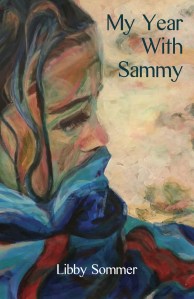
That’s how it was for me. I thought I could jump in and write a book in 6 months. In fact, it took me 20 years to write a publishable manuscript: ‘My Year With Sammy’ (Ginninderra Press) the story of a difficult yet sensitive child, was my first published book in 2015. Five books have followed since then.
So cut yourself some slack before you head off on a writing marathon.
Writing is like learning to prepare the rice for sushi: the apprenticeship is long, and in the beginning you are not sure whether a Futomaki, a Uramaki or a Temaki will be the end result.
Plot means the story line. When people talk about plotting, they mostly mean how to set up the situation, where to put the turning points, and what the characters will be doing in the end. What happens.
Some fiction writers write organically, not knowing where the story they are writing is going. These writers say it would be boring to know what’s going to happen next and they lose their enthusiasm to tell the story because they know the outcome already. They prefer throwing themselves over the edge and into the void. This method can be very anxiety-producing. It means you need a lot of faith in your process.
Other writers plan the story before they begin. In detective fiction the story definitely needs to be worked out beforehand so information can be drip-fed to the reader.
In the past, when creating my short stories, I have worked organically and not known where my stories were headed as I wrote them. The shorter the piece of fiction, the less need for plot. You can write an interesting story in which not very much happens. A woman fights with her neighbour, a man quits his job, or an unhappy family goes out for a pizza. Simple structures work better than something too complicated when the story is short.
Now that I’m working on a new novel, I feel the need to plot.
“A plot can, like a journey, begin with a single step. A woman making up her mind to recover her father’s oil paintings may be enough to start. The journey begins there, as it did for Raskolnikov in Crime and Punishment when he decided to commit his crime,” Jerome Stern Making Shapely Fiction
The plot grows and develops out of what helps and what hinders the characters’ progress toward their goals.
But how do you know if your draft plot has the right amount of weight to carry an entire novel?
What kind of structures work?
Is there a quick way to design your own plot template?
And how do you handle a book with multiple points of view?
“A good plot has a clear motivation. It has a clear structure. It has an outcome. It has subplots. A good plot looks something like the plot structure template below,” The Writers’ Workshop.
Motivation
Lizzie Bennett wants to marry for love
Plot structure
She meets Darcy & Wickham. She dislikes Darcy, and starts to fall for Wickham. Wickham turns out to be a bad guy; Darcy turns out to be a good guy. She now loves Darcy.
Outcome
She marries Darcy
Subplot 1
Jane Bennett (Lizzie’s nice sister) loves Bingley. Bingley vanishes. He reappears. They get hitched.
Subplot 2
Lydia Bennett (Lizzie’s idiot sister) elopes with Wickham. She’s recovered.
Subplot 3
An idiot, Mr Collins, proposes marriage to Lizzie. She says no. Her friend, Charlotte, says yes.
Of course, there are a lot of things that the above plot template doesn’t tell you. It doesn’t say where the novel is set, it doesn’t tell you anything about plot mechanics – it doesn’t say why Lizzie dislikes Mr Darcy, or how Lydia is recovered from her elopement. It doesn’t have anything to say about character.
The Writers’ Workshop strongly advises us to build a template much like the one above before starting to write. “If you’ve already started your MS then, for heaven’s sake, get to that template right away.”
So I’ve decided to put myself out of my misery and create a Plot Template for my new novel. I already had my characters in place and knew what each character wanted. But now I’m forced into planning an ending, which isn’t a bad thing. Some writers don’t find the real beginning to their stories until they’ve written the endings.
So that’s all we need: a beginning, a middle and an end. Aristotle defined it like this: a beginning is what requires nothing to precede it, an end is what requires nothing to follow it, and a middle needs something both before and after it.
Easy peasy. Not.
*
What about you? Do you plot or write organically? I’d love to hear what works for you and what sends you straight to the Writers Block Corner.
Is a novel a short story that keeps going, or, is it a string of stories with connective tissue and padding, or, is it something else? Essayist Greg Hollingshead believes that the primary difference between the short story and the novel is not length but the larger, more conceptual weight of meaning that the longer narrative must carry on its back from page to page, scene to scene.
“It’s not baggy wordage that causes the diffusiveness of the novel. It’s this long-distance haul of meaning.” Greg Hollingshead
There is a widespread conviction among fiction writers that sooner or later one moves on from the short story to the novel. When John Cheever described himself as the world’s oldest living short story writer, everyone knew what he meant.
Greg Hollingshead says that every once in a while, to the salvation of literary fiction, there appears a mature writer of short stories—someone like Chekhov, or Munro—whose handling of the form at its best is so undulled, so poised, so capacious, so intelligent, that the short in short story is once again revealed as the silly adjective it is, for suddenly there are simply stories, spiritual histories, narratives amazingly porous yet concentrated and undiffused.
When you decide you want to write in a particular form—a novel, short story, poem—read a lot of writing in that form. Notice the rhythm. How does it begin? What makes it complete? When you read a lot in a particular form, it becomes imprinted inside you, so when you sit at your desk to write, you produce that same structure. In reading novels your whole being absorbs the pace of the sentences, the setting of scenes, knowing the colour of the bedspread and how the writer gets her character to move down the hallway to the front door.
I sit at my desk thinking about form as a low-slung blanket of cloud blocks my view of the sky. Through the fly screen I inhale the sweet smell of earth after rain as another day of possibility beckons.
We might write five novels before we write a good one. I wrote five book-length manuscripts before one was finally accepted for publication. My skill was in the short form. I’d published dozens of short stories in prestigious literary journals. So it made sense that my first book, ‘My Year With Sammy’ (Ginninderra Press) is a novella – a small book.
What about you? Is your skill in the short form or the marathon?
Have a read of my short story ‘Art and the Mermaid’ first published in Quadrant Magazine. ‘Art and the Mermaid’ and is one of the stories in my collection ‘Stories from Bondi’ (Ginninderra Press), a series of stories set in Bondi Beach.
I hope you enjoy it.
Art and the Mermaid:
Once upon a time it came to pass, so it is said, that an enormous storm swept the coast of New South Wales, doing extensive damage to the ocean beaches – destroying jetties, breakwaters and washing away retaining walls. Mountainous seas swept Bondi Beach and dashed against the cliffs carrying ruin with every roller. At North Bondi near Ben Buckler a huge submerged block of sandstone weighing 233 tons was lifted ten feet and driven 160 feet to the edge of the cliff where it remains to this day.
One day a Sydney sculptor, Lyall Randolph, looked upon the rock and was inspired. The sculptor was a dreamer. Let us, he said, have two beautiful mermaids to grace the boulder. Using two Bondi women as models he cast the two mermaids in fibreglass and painted them in gold.
Without Council approval and at his own expense he erected The Mermaids for all to see on the giant rock that had been washed up by the sea. The Mermaids sat side by side on the rock. One shaded her eyes as she scanned the ocean and the other leant back in a relaxed fashion with an uplifted arm sweeping her hair up at the back of her neck. Their fishy tails complemented the curves and crevices of their bodies.
It so happened that less than a month after The Mermaids were put in place, one was stolen and damaged. The Council held many meetings to decide if she should be replaced using ratepayers’ money. The council had previously objected to the sculptor placing the statues there without Council permission. The sculptor had argued that before placing The Mermaids in position he had taken all necessary steps to obtain the requisite permission.
The large boulder at Ben Buckler, upon which The Mermaids were securely bolted and concreted, he said, is not in the municipality of Waverley at all. It is in the sea. According to the Australian Constitution high-tide mark is the defined limit of the Waverley Council’s domain. The Maritime Services Board and the Lands Department both advised me they had no objection to the erection of The Mermaids.
One Waverley Alderman said he wished both mermaids had been taken instead of only one. Someone else said the sculptor didn’t need the Council’s permission to put them there in the first place and the The Mermaids had given Bondi a great attraction without any cost to the Council. The sculptor said The Mermaids had brought great publicity to the Council. They had been featured in films, newspapers, television and the National Geographic magazine.
The Mayor used his casting vote in favour of the mermaid and she was re-installed.
For over ten years the two beautiful golden mermaids reclined at Ben Buckler, attracting many thousands of sightseers to the beach.
Poised on the huge boulder they braved the driving storms of winter until one day one was washed off. The Council saw its opportunity and removed the other.
Today, only the remnants of one mermaid remain – but not on the rock. In a glass cabinet in Waverley Library at Bondi Junction all that is left of the two beautiful mermaids is a figure with half a face. There’s a hole instead of a cheek, a dismembered torso, part of an uplifted arm, the tender groove of an armpit. And there, down below, a complete fish’s tail.
Have a read of my short story, ‘Around the World In Fifty Steps’. It was my first publication, back in 2001 when I’d just graduated with an MA in Professional Writing from the University of Technology Sydney. A heady time to see my name in a prestigious literary journal like Overland (progressive culture since 1954). I’d written the story originally as a synopsis for a book. Although the book never did find a publisher, I was very happy that the synopsis was published as a short story. Not bad for a high school dropout.
Around the World in Fifty Steps:
Joanna lives in a Sydney suburb with her two sons. It’s 1992 and Australia is in recession.
“I’m sick of licking arse in a service industry,” she says of her marketing business. “And I’m fed up with financial insecurity, the feast or famine of too many projects or not enough and chasing new business and getting clients to pay their bills.”
“I’m thinking of renting the house out and travelling,” she tells her grown up sons after reading “The Pitter Patter of Thirty-Year-Old Feet” in the Sydney Morning Herald.
“You’re ready to leave home are you mum?” said one son.
“Why don’t you just go on a long holiday instead,” said the other.
“I want a new beginning, a change of career, a new home, a community of people, an intimate relationship with a significant other, that sort of thing.”
“You could always get yourself a dog,” suggests a friend.
Her son moves out when she puts his rent up.
“Are you going to wait till he buys a new house for cash before you ask for a decent rent?” her mother had said.
“I’ve decided to go and live with Dad for a change,” says the other son.
“I’ll be away for six to twelve months,” Joanna says as she throws her client files on the rubbish tip.
She spends the spring in Italy. The summer in England, Scotland and Ireland, the autumn walking the gorge country of the Ardeche in France.
In the winter she rents a studio apartment in Villefranche on the French Riviera. The studio belongs to a friend of a friend so she’s able to get it at a good price. She works as a casual deck hand on one of the luxury cruisers in dry dock for maintenance. “The first thing I want you to do,” says her boss when she arrives at work on the first day, “is blitz the tender.” After a backbreaking morning of hard physical work cleaning the small run-about she goes to lunch. She orders a salad nicoise and a coffee and realises her lunch will cost her a morning’s pay.
A young and handsome French man who lives in Paris but comes to Villefranche to visit his grandmother most weekends, pursues her. Joanna comes to realise that French men love and cherish women as much as they appreciate good food.
She shops at the markets, paints and reads and falls in love with the light and the colours of the south of France.
“I’m able to live contentedly alone without a regular job, without a car, without speaking the language,” she writes to her friends back home.
In the summer she moves on again before the tourist masses arrive and the rent goes up.
She gives away to her new friends in Villefranche all the things that won’t now fit in her backpack but keeps her paint brushes and pallet knife.
On the Greek island of Skyros she joins a group of landscape artists led by a famous English painter.
“My purpose in leading this group is to help everyone find their own unique style,” says the woman.
Joanna spends the autumn in London meeting with other artists from the island and the woman becomes her mentor and they meet for a cup of tea every week and talk about the isolation of being an artist as well as many other things.
“It’s important to stop and regenerate before the creative battery runs flat,” she says.
Joanna paints every day and goes out with an English man named Clive.
“Your painting is vivid and alive,” says the famous English artist. “I’ll write you a letter of introduction to my contacts in Australia when you’re ready to exhibit this collection.”
Clive has a strong face with chiselled square cheekbones. Dark brown eyes and dark hair that falls in a square fringe on his forehead. His fingers are long and sensitive for playing the piano.
“What are you doing there?” her mother asks on the phone from across the ocean.
“I’m painting,” says Joanna.
“But what are you doing?”
“My mother is like a poisonous gas that can cross from one side of the world to the other,” Joanna says.
Joanna dreams about her sons every night and Clive tells her she cries in her sleep.
She yearns for the bright Australian light and for the sound of the ocean.
She returns to Australia for her eldest son’s wedding.
In Sydney, Joanna supplements her income from the house rental by getting a job as a casual for a clothing company. She unpacks boxes and steampresses the garments. Her back, neck and shoulders ache and she suspects she’s getting RSI from the steampresser.
Clive rings to say he’s coming to visit her.
In preparation for his arrival she moves all her furniture out of storage and rents a small place near the beach hoping that he’ll love it in Australia and decide to stay.
Two weeks before his arrival Clive rings to say he’s not coming and Joanna finds out through a friend that he’s met someone else and is moving in with her.
She tears up his photos and throws his Christmas present at the wall.
Joanna stops painting.
She reflects on the past and all that she’s lost.
I thought when love for you died, I should die. It’s dead. Alone, most strangely, I live on. Rupert Brooke.
Joanna stays in bed most days but still feels so tired that she can only remain vertical for four hours in any twenty-four hour period.
The phone stops ringing.
She rehearses her own death by going to the edge of the cliff.
From the edge she sketches the waves breaking on rocks, the lone seagull on the shore at the water’s edge.
At home she fills in the drawing, blending black charcoal and white pastel reminding herself the darkest hour is before the dawn.
And, after winter spring always comes.
Joanna sells the house where she lived with her children and spends half the money on a home unit overlooking the ocean and the rest of the money on Australian shares.
Her new home faces the east and she can smell the salt from the ocean.
“It takes twenty years to be a successful artist,” echoes in her mind.
On a new canvas she drags the colours of the sunrise across the blank white space.
At a literary event I heard someone say, “The thing to do is put the idea in your subconscious. Your brain will do the work.”
It takes time for our experience to make its way through our consciousness. For example, it is hard to write about a journey while you are still in the midst of the adventure. We have no distance from what is happening to us. The only things we seem to be able to say are “having a great time”, “the weather is good”, “wish you were here”. It is also hard to write about a place we just moved to, we haven’t absorbed it yet. We don’t really know where we are, even if we can walk to the train station without losing our way. We haven’t experienced three scorching summers in this country or seen the dolphins migrating south along the coast in the winter.
“Maybe away from Paris I could write about Paris as in Paris I could write about Michigan. I did not know it was too early for that because I did not know Paris well enough.” – Ernest Hemingway, A Moveable Feast (New York: Charles Scribner’s Sons, 1964).
So we take in experience, but we need to let things make their way through our consciousness for a while and be absorbed by our whole selves. We are bower birds, collecting experience, and from the thrown away apple skins, outer lettuce layers, tea leaves, and chicken bones of our minds come our ideas for stories and poems and songs. But this does not come any time soon. It takes a very long time (three to ten years in the case of literary fiction). We need to keep picking through those scraps until some of the thoughts together form a pattern or can be organised around a central theme, something we can shape into a narrative. We mine our hidden thoughts for ideas. But the ideas need time to percolate: to slowly filter through.
Our work is to keep rummaging through the rubbish bins of our minds, exercising the writing muscle, in readiness to answer that knock at the door when it comes.
Rumi, the thirteenth-century Sufi poet, summed up what could be the creative process when he wrote “The Guest House”:
This being human is a guest house.
Each morning a new arrival.
A joy, a depression, a meanness,
some momentary awareness comes
as an unexpected visitor.
Welcome and entertain them all!
Even if they are a crowd of sorrows,
who violently sweep your house
empty of its furniture,
still, treat each guest honorably.
He may be clearing you out
for some new delight.
The dark thought, the shame, the malice,
meet them at the door laughing and invite
them in.
Be grateful for whoever comes,
because each has been sent
as a guide from beyond.
Jalaluddin Rumi, in The Essential Rumi Translated by Coleman Barks, 1999
As the author Vivian Gornick said, “The writers life is the pits. You live alone and you work alone, every day I have to recreate myself.” She paused and laughed. “But when the work is going well there is nothing that compares.”
What about you? Are you ready to answer the knock at the door?
Have a read of my short story, ‘Towards the End’, first published in Quadrant Magazine. ‘Towards the End’ is one of the tales in my collection, ‘Stories from Bondi‘ (Ginninderra Press).
I hope you enjoy it.
Towards the End:
He leaned back on the chrome chair, stretched his legs out under the square black table and placed his mobile phone in front of him. He looked over to the counter at the back of the cafe at the cakes and muffins on display and the Italian biscuits in jars. He turned back to the glass windows and wondered if he had the guts to tell her today. He wanted to. By Christ he wanted to. He straightened up, his elbows on the table, his hands clasped together in front of his face. There’d been some good times, that’s for sure. But what the heck. A man’s got to do what a man’s got to do.
The sliding glass door clanked open and Anny walked in. He looked over at her, first from the rear as she closed the door and then as she approached, her face flushed, her dark hair flying back from her shoulders. Not bad looking. A bit on the heavy side but not a bad looker all the same. Yes, there’d been some good times. Especially in the sack.
Anny removed her sunglasses as she walked over and he looked into the bright green of her eyes as she bent down and kissed him on the cheek. He felt the moisture on her face as her skin touched his.
She took off her sunshade and hung it on the back of the chair and sat down.
You’ll never guess what happened, she said.
What?
I’m still so angry I can hardly speak. She pushed her hair away from her forehead as she dabbed at the sweat with a serviette.
What happened?
This man, she said. This dreadful man. Anny used her fingers to wipe the moisture from under her eyes. I was walking along the cliff path from Bondi to Bronte, like I usually do, minding my own business, when I heard a jogger behind me.
Nothing unusual about that.
So I moved further to the left to let him pass.
Yeah. That’s the rules, keep to the left.
He must have been about to pass on the inside because next moment I heard a thud and there he was picking himself up from the side of the track.
Anny stopped talking as the waitress approached with notepad and pen.
A spaghetti marinara for me, said Daniel smiling at the waitress. And a coffee.
How do you like your coffee?
He grinned at her. Hot and black, thanks.
Anny turned away from him and squinted at the blackboard. I’ll have the Greek salad and a decaf skimmed cap. And a glass of water, please.
And I’ll have an orange juice as well, said Daniel.
Daniel’s eyes followed her as she walked towards the kitchen. Then his mobile buzzed from the table. He picked it up and held it to his ear.
Yep, he said. I can give them a ballpark figure, but that’s about it. Just a ballpark. Yeah, okay then. Here’s his number. Daniel opened the front of the phone and pressed a button. 0413 501 583, he said. He put the phone back on the table its antennae sticking out towards Anny. I hate it when people say things like that, he said.
What?
Oh nothing. Just the usual crap. They all think they can get something for nothing.
Daniel’s pasta arrived first and he began to eat. He sucked in a spaghetti tail and then impatiently cut some of the pasta with his knife. He dispensed with the knife and continued to eat with his fork. He scooped up the marinara with its splayed-like prongs.
So what happened? he said as he sucked in a loose strand of spaghetti, catching its long skinny tail with his fork.
He must have caught his foot on the edge between the footpath and the grass. I was about to say ‘are you all right’ when he roared out at me ‘it’s all your fault you know’. ‘I was keeping to the left’ I said. He ignored me and ran on, red shiny shorts flapping. How dare he speak to me like that. ‘Asshole’ I called out after him. He gave me the finger up sign and kept running. I was furious.
Daniel didn’t answer as he waited for the waitress to place a plate of salad in front of Anny. He blew on his pasta before placing another mouthful towards the back of his tongue, his thin lips closing over the fork.
When I reached Bronte, said Anny. This man had finished his circuit and was on his way back. We recognised each other and he started telling me off about which side of the path I could walk on. ‘Don’t tell me where to walk mate’ I hissed. That’s when he stopped jogging and moved towards me. I thought he was going to punch me.
Really?
I was a bit scared I can tell you, but I braced myself. That’s when he said ‘you’ve got some chip on your shoulder because you’re fat and ugly’. I laughed at him because it sounded so ridiculous and as far as that was concerned it proved my point. What an asshole. Just thinking about it makes me angry.
Daniel turned away from her. He couldn’t tell her now. Not after that. He looked out the window to the truck parked across the road. ‘Dean’s Premium Natural Fruit Juice: the way it should be’ emblazoned on the side. The way it should be. That’s a bit of a joke. Well I know this is the way it shouldn’t be. He couldn’t get Louise out of his head.. That last time – her tight white t-shirt over those tight little breasts – leaning over her plate. Eating that huge roll. The sight of her opening her mouth so wide he thought the sides of her lips would crack. Stuffing it in she was. Later at her place when he couldn’t wait. Coming up behind her as she cleaned her teeth. Ramming it in.
He tore the crusty white Italian bread into small pieces and used it to mop up the remains of the sauce and wiped the red sauce from the corner of his mouth. He reached for his glass and sucked up the remains of his orange juice through a yellowed straw, then burped. He put the glass down, his broad hand wrapped around the grooved surface and leaned across the table. He looked into Anny’s face.
I have to go.
Go where?
I’ll pay the bill.
What’s wrong?
I want to make a move on that Elizabeth Bay deal.
He stood up, his keys dangling from the loop at the back of his trousers, his rubber soled shoes silent as he headed towards the door. Only the sound of his keys and then the bang of the door.
Outside he pulled out his mobile and dialed.
I’m leaving now honey, he said. I’ll be there in a few minutes.
In the cafe Anny watched from the window. She sighed, stood up slowly and then walked over to the cake counter. He’s a workaholic that bloke.
I’ll have a slice of that chocolate mud cake and a cappuccino, she said to the girl behind the register.
Have you tried writing flash fiction yet? What does flash fiction mean?
‘A flash fiction piece is a self-contained story (beginning/middle/end), 1,000 words or less, that can entertain, intrigue, and satisfy a reader during an F5 tornado. That’s it. No genre restrictions, age requirements, or prior experience needed. Just quick, clean stories.’ – Writer’s Digest
‘Part poetry, part narrative, flash fiction–also known as sudden fiction, micro fiction, short short stories, and quick fiction—is a genre that is deceptively complex.’ – The Review Review
‘Flash fiction is a fictional work of extreme brevity that still offers character and plot development. Identified varieties, many of them defined by word count, include the six-word story, the 280-character story, the “dribble”, the “drabble”, “sudden fiction”, flash fiction, nanotale, and “micro-story”.’ – Wikipedia
I like writing in a short form. I’ve been told I have the sensibility of a poet because I have the ability to distill, so the short form suits me. You may be more of a long distance runner, rather than a sprinter, and prefer the long form of a novel.
Have a read of my flash fiction titled It’s Pot Luck When You Move Into A Unit, winner of the short short fiction UTS Alumni Competition a few years ago. Hope you enjoy it.
It’s Pot Luck When You Move Into a Unit
A nice quiet weekend? the woman downstairs said. What do you mean? I said, through the open back door, a bag of rubbish in each hand. She smoothed her ironing on the board and said, They weren’t around over the weekend—with the baby. She looked happy. I’m lucky living on the top floor, I said. She nodded towards the other side of the building. Jim isn’t so lucky—he’s got the woman upstairs, she said, When he plays the piano and she thumps on the floor. She put the iron back on its stand. She’s heavy-footed, that woman. Bang, bang, bang. I hear her coming down the stairs every morning at six, and the slam of the front door.
That night the wind knocked my vase off the window ledge. I lay awake wondering if the noise of the smash had woken up the people underneath—the ones whose barbecuing sends smoke and disgusting meat smells into my unit. Nothing clings to your furniture like the stink from last week’s burnt fat. Sorry about the crash, I muttered to the floor, It was the wind.
Copyright 2023 Libby Sommer
Why not try your hand at writing in this short form and enter a flash fiction competition. Good luck.
Have a read of my short story, ”Jean-Pierre’, first published in Quadrant Magazine. It’s one of the stories in my collection ‘Stories from Bondi‘ (Ginninderra Press).
I hope you enjoy it.
Jean-Pierre
This was in a far distant land. There were Pilates classes but no surfing beaches or vegan restaurants. People said to hell with low-fat diets and tiny portions. Charles, who had wanted her to hire his friend Jean-Pierre as tour guide, had encouraged her in yoga class. ‘Look, Zina, you’re a facilitator—you’ve been running those groups—for what—thirty years?’
‘Only twenty, for goodness sake.’ She had turned forty-nine and frowned at him upside down between the legs of a downward facing dog. She had a face marked by the sun, a face left to wrinkle and form crevasses by years of smoking, a face made shiny by the application of six drops of jojoba oil, although the shop girl had recommended she use only three. ‘I love that word facilitator. It says so much.’
‘Twenty. All right. This guy’s not at all your type. He’s a numbers man. He shows tourists around in between Engineering contracts. He can show you how to buy a bus or a train ticket, how to withdraw money out of the wall—get your bearings. You can hire him for half a day. Or, in your case, half a day and half the night.’
‘Very funny,’ she said, stifling a laugh. Now they were on all fours arching their backs like cats, then flattening their spines to warm up the discs. Indian chanting music took your mind off the fact that the person behind you was confronted with your broad derriere. ‘So what’s the story with Jean-Pierre?’
‘Someone I met at a conference in Monaco,’ said Charles on an out-breath. ‘Large-yacht communications. He’s charismatic, let me tell you.’ Charles dyed his hair and beard a rich brown, and in yoga class it stood on end to reveal a circle of grey at the crown. He had paid many visits to this far away country since he started learning the language. She’d never had the courage to have a go herself. She knew how to say good morning, Madame every time she walked into a shop, how to ask for the bill, how to say please and thank you. What else did you need? Charles had moved on to German classes and was planning a trip to Berlin with his wife. They were even taking their two kids. Toledo and Paris they called them.
‘Look, you’re going to the land of endless rail strikes,’ Charles said. ‘You’ll need Jean-Pierre, or you’ll be stranded on train platforms, not knowing what to do or where to go.’
‘Come on now. You’re such an exaggerator. They’re not always on strike.’
They lay on their backs, legs wide open in the air in a happy baby pose. ‘All right, I suppose so,’ she said. ‘You can give me his email address.’
‘I love croissants and baguettes and all of that,’ said Charles, sighing over his shoulder.
The yoga instructor was walking around the room, checking out their poses and had reached the back row. ‘Focus inwards, be in the moment,’ he reprimanded Zina and Charles.
‘Let the soles of your feet reach for the ceiling,’ he said before returning to the stage to demonstrate the cosmic egg. He eased his face between his thighs. ‘Now bury your eye sockets into your kneecaps.’
‘I’m not trying to fix you up with JP,’ Charles whispered. ‘I really hate that kind of thing.’ He twinkled across at her.
‘Lift your hips high off the mat and boom your heart toward the back wall.’
Jean-Pierre was still charismatic, and, on close examination, was still handsome. About sixty, with a splendid head of hair. His face was persuasive, his forehead, his large nose. They ate croissants at Cosmo, the busiest café in the village. She drank green tea infused with fresh mint, the leaves determined to block the spout of the tea pot. Jean-Pierre sipped on an espresso.
He nodded at her tea. ‘English,’ he said with a note of barely disguised distain. ‘The English drink tea.’
She bristled. A racist. A narrow-minded, insular, arrogant racist.
She looked at his intense face as he stroked the black and white head of his dog who peeped out above the zip of his jacket and felt sorry for his preconceptions and a little sorry for herself when she reflected on it, because, really, he seemed to know very little about Australia. Do you have black Africans living off social security? Poor Jean-Pierre didn’t know an African from an Aborigine.
‘No, green tea is not English,’ she said haughtily, giving him the evil-eye, to show him, to show him this: ‘Green tea originated in China.’
Madame?’ said the waiter, reaching for her empty plate.
‘Merci,’ she nodded.
‘Did you fly Business?’ Jean-Pierre said abruptly. ‘Such a long flight from Australia.’
‘Economy. I’m a poor struggling facilitator.’
‘You have to get out there and promote your courses. Then you can fly Business.’
‘We don’t all do things just for the money.’
Jean-Pierre looked down the narrow cobbled pedestrian-only street. ‘There are two things you must watch out for here,’ he said. ‘The motor bikes … and the dog pooh.’
‘Thanks,’ she said, then, trying to be friendly. ‘In New York they say you can tell the tourists from the locals because the tourists are the ones looking up at the skyscrapers and the locals are the ones looking down for the dog pooh.’
He twisted the gold band that girded the blowsy fat of his finger. ‘I was married to a New York lawyer once. Very clever. She read four books a week. I read only one a month. Are you married?’
‘Not currently.’
‘My son speaks four languages,’ said Jean-Pierre. ‘My mother likes to say that anyone can get a Masters, but if you’ve got four languages—rather than three—you’ll be a success in life. I’ve only got three. What about you? Any children?’
Eli had stayed at her place for the week just before she left home. He’d sat in the lounge room, eyes fixed to his iPad. She would sometimes watch on as he played a combat game. He’d build a village, train his troops and take them into battle. She would watch his face deep in concentration, so focused he seemed unable to hear when she asked him to set the table, or unstack the dishwasher. She didn’t like the every-second-week-deal with his father, so disruptive to getting a routine in place. Eli would come with her to the gym sometimes, or they’d go for a jog around the oval. It’s not as if his father did any of those things. She did her best: drove Eli to cricket and footie, helped with his homework, listened whenever he was willing to talk, always made sure there was meat in the house when it was her week “on”. Eli said to her, ‘When you and Dad were together, we always ate with the TV turned off. Now you’re divorced, you and me can eat dinner in front of the tele if we feel like it. Much better.’
‘Yes,’ she said to Jean-Pierre. ‘I have a son.’
‘It’s different in this country. We’re Catholics. We don’t usually divorce. Not when there are children. Are you a Catholic?’
‘No.’
‘Religious?’
‘Spiritual, but not religious. We could do with less religion in the world, in my opinion. Why?’
‘I was going to suggest I show you the island of Saint Honorat off Antibes, but tourists only go there in order to see the sacred abbey. The thing is, I grew up in Antibes. I know it like the back of my hand. I could hire a car and we can drive to different parts that the tourists don’t see. We can spend a few hours in Antibes, then, after that, if you want, we can have lunch. What do you think?’
‘What would it cost?’
‘Well, there’s the cost of the car, then my time. So … all up, 180 euros.
‘I’ll give it some thought.’
Jean-Pierre lowered his dog to the ground, reached for his wallet, pulled out a ten euro note and placed it on the edge of the table for the waiter.
She unzipped her handbag to pay her share but he patted her on the arm and said proudly, ‘No. No. Put your money away. I’m a Frenchman.’
The second time they met up, they went for a walk into Nice via the foreshore. It was a difficult walk. Eighty sets of steps interspersed with slippery limestone rocks. When she asked why the gate was locked at the end of the walk, necessitating a dangerous climb over a high fence on the edge of a cliff, Jean-Pierre said the authorities probably kept the gate locked because they didn’t want tourists getting washed off the rocks at high tide. It wasn’t a good look.
Now he wanted to have lunch at the Port.
‘Where do you like to eat?’ she asked. She was still thinking about the climb over the gate, when she’d been so afraid that she wouldn’t be able to get her leg high enough and would crash to an early death on the rocks below. She’d needed to sit on the stone wall to compose herself afterwards. It was Jean-Pierre who had acknowledged her courage, had said she’d done well, that she’d even looked graceful when she’d executed the tricky maneuver and swung herself out into the void before throwing herself over the top. Before they’d left on the walk he’d told her he hadn’t followed the coastline into Nice for a long time, and was really looking forward to walking it again. He wouldn’t be charging her his usual hourly rate, as it was something he’d been wanting to do for ages. ‘My wife kept me on a tight leash.’
‘There are plenty of places to eat at the Port,’ he said. They walked down the hill and he leaned in and gave her shoulder a quick squeeze. ‘You did well,’ he repeated. She blushed with embarrassment at the intimacy of his gesture. She’d only just met him, after all. And anyway, she was no good at relationships. There were people she knew who were good at them and people who weren’t. She was no good.
‘What sort of restaurant do you like to lunch at back home?’ he said.
‘We mostly don’t have a big meal in the middle of the day.’
‘No? What do you do?’
‘Well, um, we usually jog around the park, then stand in line to order large skimmed lattes.’
‘Ah,’ he said, and put his hand over hers where it rested on the table. She felt her hand go still like a frightened animal. Jean-Pierre’s hand was rough and warm as it lay over hers. Maybe she shouldn’t have drunk two beers in the middle of the day.
On Saturday afternoon Jean-Pierre took her and a group of American tourists by ferry to an old island prison. ‘You’ll find this place worth a visit,’ he said, as they waited on the wharf. ‘An infamous jail for deportees, prisoners convicted of political crimes, such as espionage or conspiracy.’
‘Interesting,’ she said, stepping across the gangplank. She sat down beside Jean-Pierre at the front of the boat. The four American couples filed down to the back row of seats. ‘We can throw Smarties at you from here,’ one of them joked.
Jean-Pierre tapped on her sunshade. ‘You won’t need this. It’s dark in the cells.’ He pulled a map out of his pocket and opened it out, pointing to the layout of the buildings. ‘The locations of the public toilets,’ he said. ‘That’s what every tour guide needs to know.’ He folded up his map and put it in his breast-pocket. ‘I want to give you a quick kiss now, before we get into one of those dark cells,’ he said. ‘I won’t be able to see you in there.’ He turned towards her, and suddenly his face, up very close, appeared at the end of her nose, floating, as she leant against the back of the seat. He shut his eyes and kissed her, soft and probing, and she kept her sunshade on for privacy, lips, mouth, teeth and tongue, his hand moving very slowly up her arm, up to her shoulder and to her bare neck, and hovered there for only a moment, cradling her face, before he moved away, straightened his trousers, and quietly pulled out his map again.
She adjusted herself and stared out the window to the water. Jean-Pierre gave the signal that they were nearing their destination and to prepare for disembarkation.
‘We don’t do things like that in Sydney,’ murmured Zina. She refreshed her lipstick.
‘No?’ Jean-Pierre grinned and levelled out her visor.
‘No, it’s um, all those coffees. You just keep running. Forever and ever. You spend your whole life,’ her hands juggled an imaginary Tai Chi ball—‘on the run.’
Well-kept concrete walkways led up, over and around the island’s hill. Jean-Pierre steered them through a rustic entrance to the old prison complex.
‘And now,’ he said, ‘we come to that part of our tour most likely to give you claustrophobia. The Reclusion Disciplinaire area.’
They stepped up and through a narrow hallway toward the low, dark solitary confinement cells.
‘This is where prisoners were kept in silence and darkness,’ Jean-Pierre was saying. He led the way into the dark of the single-person cells. ‘You won’t be able to see a thing in there.’
She squinted ahead at the front of the group, which had now gathered by the doorway. It looked scary. She took off her sunglasses and shade, but could see nothing as she stepped in. The blackness lay heavily all around, not like a moonless sky, but like a creepy cupboard with stone walls and low roof, a stone tomb. There was something inhuman in the cruelty of the space, a place where the light never shone, hidden, despair-inducing.
‘I’m right behind you,’ Jean-Pierre said, moving close, ‘in case you’re frightened.’ He gave her hand a squeeze, then placed his arm around her waist. She could smell his after-shave—or was it cologne?—feel the warmth of his breath on her neck, and leaned, unseeing and anxious, into his body. She reached for his arm and clutched at his hand where it rested on her waist.
***
When they went to bed together, she almost broke into joyous laughter. He’d drawn her in without even trying. His face, his voice, his eyes. It was a whole-package thing. He made her feel so special. He was more appreciative than anyone she had ever known. He hugged and kissed and even offered to go downstairs and get her cigarettes out of her handbag.
He got out of bed and went over to the piano. He fumbled with some sheet music in the semi-dark, holding each up to the light until he found what he wanted.
‘I play this sometimes,’ he said, in a quiet voice. ‘It starts with a single note, a B natural, growing in dynamic from a soft pianissimo to a very loud fortissimo.’ She listened as he played the one note, building up to full strength. Who was this guy?
When he’d finished, he turned to her and said, ‘Especially for you. I use my music to express my feelings.’
They made love again. Once more he got out of bed and sat beneath the black and white photograph of himself with his mother and his brother. He began to play. After a while he stopped playing and went into the bathroom to wash his hands. When he returned he wore the hand towel looped over his erect penis. She rolled over to have a look and kissed him, his face glowing with pride.
Morning. The bakeries were laying out their breads and pastries filling the air with the mouth-watering aroma of freshly baked baguettes. In the antique shop windows, as the sun struck them, the cleaners hosed the cobbled alleys. Jean-Pierre rose early and walked to the boulangerie.
He laid the breakfast out on a tray and brought it in to her in bed. Outside the window, the sky was a clear faded blue, and patches of sun, geometric designs of light, streaked the doona. He put the tray on the bed, and she sat up and stroked his face, his skin still chilled from the morning air. She pointed at the pain au chocolat.
‘So I need to forget about the diet?’
‘Oui.’ His mouth was already filled with pastry, chocolate oozing between his lips. ‘It’s good for you. Don’t you know that the flour in this country is so good, and so different, that even gluten-intolerant people can eat the bread and quiches?’
Her workshops, as she wrote to Eli back home, were going well. She’d managed to book a space in an old 16th century Citadel overlooking the Mediterranean. And she’d made a new friend. Something had happened to her in an old isolation cell, she didn’t know what exactly. But she had to get back home. I hope you and Dad are getting on okay and he hasn’t had any more nasty blow-ups. It’s a mild winter here. Some people are even swimming and sunbaking on the beach. Love, Mum
They went on the bus to visit his mother, the music of Bach on a score above his head. In Bach there was not only symmetry and logic but more, a system, a reiteration which everything hinged on. His hair was uncombed. His face had the modesty, the unpretentious lips of someone secretly able to calculate the frequencies of the string vibrations. His mother met him at the door and took his dark face in her hands. She stepped back to see better.
‘Your hair,’ she said.
He combed it down with his fingers. His brother came from the kitchen to embrace him.
‘Where have you been?’ he cried.
At night Jean-Pierre began to sleep with one hand resting on her solar plexus, the other curled around her shoulder, as if to shield her from bad dreams.
When she slept against him like that, her life on the other side of the world crumpled into her backpack that hung on a hook behind the door. Could she live the rest of her life in a far-away-country? Maybe she could. Except for that funny feeling in the pit of her. Like a rock in the guts.
On Sunday morning Jean-Pierre took her for a walk up to Mont Baron. ‘You’ll love the view from the old Fort,’ he said. ‘You can see Italy to the left and Nice to the right.’
‘Sounds wonderful!’ she said, closing the door behind them. They climbed the steep steps that led up the hill. The sky was gold with light.
‘Why don’t you come with me to Australia?’ she said.
‘I don’t think so.’
She listened to the sound of water over rocks.
‘No?’ she said.
He was silent. After a moment he said, ‘I can’t.’
She began to imagine she could hear the sound of a kookaburra laughing.
‘No,’ she said. ‘I think I should stay here with you.’ She reached for his hand.
‘No, you can’t. I can see you phoning Eli to tell him you’d decided to stay and him crying, No, Mummy. Come home.’
‘You know us Australians,’ she said, suddenly desperate. ‘We’re like boomerangs. We keep on coming back.’
She went into the bedroom to change her clothes. He started to follow her but sat down again instead. He could hear intermittent, familiar sounds, drawers opening and being shut, stretches of silence. It was as if she were packing.
‘Are you really leaving on Saturday?’ he said.
‘What did you say?’
‘Saturday. Is that it then?’
‘Why don’t you come with me?’
‘I could never live in a country with no European history. But I’ll surprise you one day. I’ll ring Eli early and ask what beach you’re walking on and I’ll just turn up on the sand.’
During that last day she thought of nothing but Jean-Pierre as she packed and cleaned out her little apartment.
‘What do you do, you have a stopover in Dubai?’ Jean-Pierre said, standing next to her at the taxi rank in the early morning chill. A bitter wind blew from the mountains. He had come over to carry her bag down the stairs.
‘I go straight through. It’s three hours on the ground in Dubai, so I walk around the airport then read my book.’
Jean-Pierre looked directly into her eyes. ‘I’ve bought you a little gift,’ he said.
‘You have?’
‘Don’t unwrap it until you’re on the plane.’
She smiled. ‘Okay.” Then she looked at his face, to place him clearly in her mind. He was wearing a white t-shirt and blue jeans under a padded coat. She kissed him on the lips, then got into the taxi.
‘Something to take with you,’ he said, leaning in the window. In his hand he clasped a small gift-wrapped box. The sun, still low on the horizon, cast an amber glow on his precious face.
‘Thank you,’ she said. She reached for his hand through the window and then put on her seatbelt.
And she thought about this all twenty-four hours of the journey across the Indian Ocean. She would keep opening the little box to admire the marquisite earrings he’d given her. She would catch a taxi from the airport and at home notice the house smelt musty; she would open all the doors and windows to let the air move through, the curtains blowing and air coming in and out. From a far-away-place, and at night, he would ring to say, resignedly, ‘My mother is living with me now.’ His gift, when she’d take the earrings out of their black box, would remind her of something that had happened to her once.
She felt like someone who she had always known, that old friend of herself, grounded in home, decisions already made, and behind her somewhere, like the shadow of an identical twin, her other self, who must remain in the far-off distance, never to be exposed to the light.





 Libby Sommer, Author