Stories From Bondi

painting of girl lying on beach in torquoise bikini reading a book

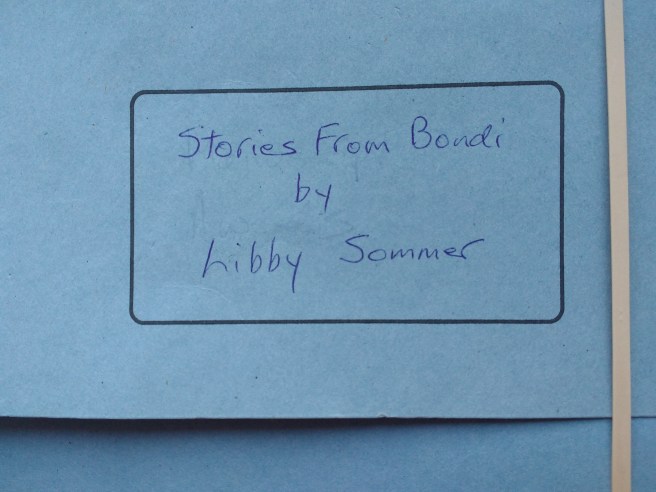
I posted another manuscript off to my publisher this week. It’s titled ‘Stories From Bondi‘. I completed an earlier, much shorter version of this book as part of a Masters in Writing at UTS back in 2001. Fingers crossed Ginninderra Press like this collection.

I’ve mentioned before how it took me 18 years of writing and 5 completed manuscripts before I finally had a book accepted by a publisher.

So now I have a small but prestigious publisher  Ginninderra Press who like my work I’m submitting my manuscripts backwards:  numbers 5, 4 and 3 have been published: ‘My Year With Sammy’, ‘The Crystal Ballroom’, ‘The Usual Story’.  Number 2 is ‘Stories From Bondi’.  80% of the short stories were first published in literary journals, including Quadrant and Overland.

Writing a book is a long, long, time-consuming process that requires a super-human amount of persistence and perseverance and dedication to the craft. It’s such a buzz to finally get my work out into the world.

blue manila folder titled Stories From Bondi by Libby Sommer

Short Story: Helen


vf clock

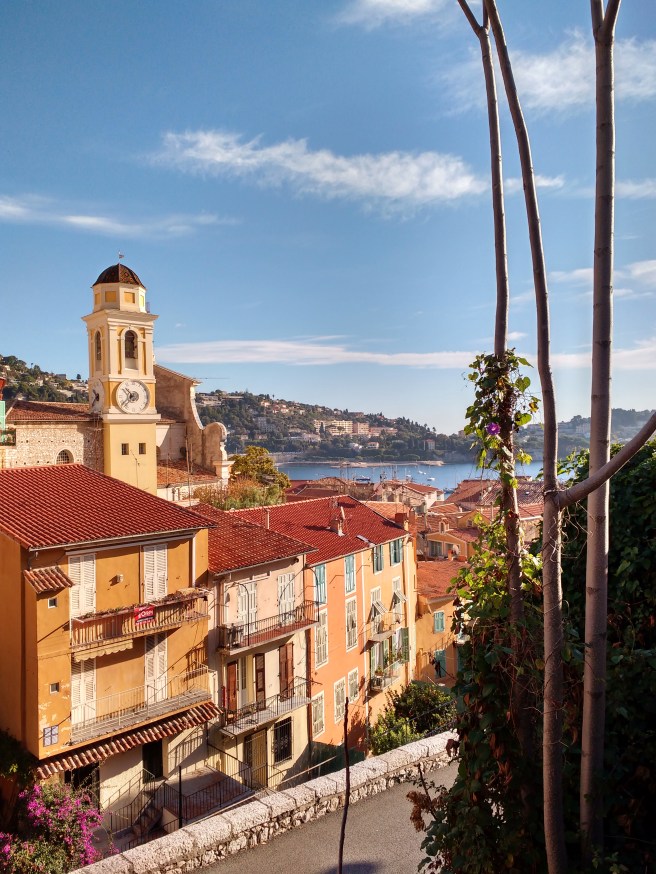
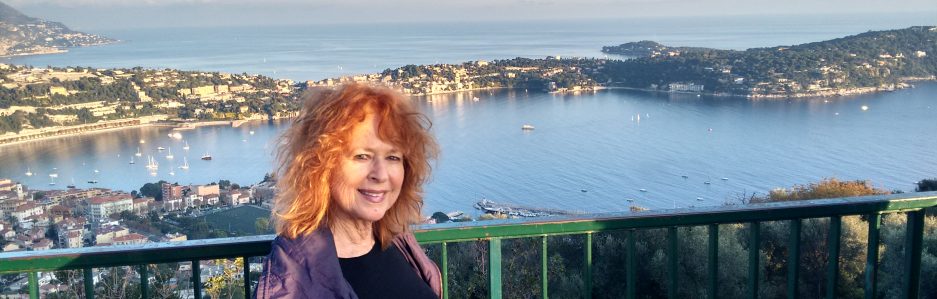
Another one of my short stories, first published in Quadrant magazine June 2015, inspired by visits to France.  Each year, if possible, I rent a studio for a month in a little fishing village in the south of France. I refer to these periods of quiet time away as a Writing-Retreat-For-One. A great place to read and write and go for long walks and, hopefully, come up with story ideas.

Although she loved her nieces and nephews, it was when she turned thirty-nine that driving young children around in her car seemed to make her nervous—a tightening in the stomach.  “Aunty Helen, would you like to take Naomi to see The Muppets?  Are you free?”  Always these requests from one of her sisters looking tired and desperate—one of her younger siblings, they used to be so close—and Helen would force herself to make the effort to be the good aunty.  The responsibility of passengers in her car always made her anxious.  She was anxious about one thing or the other most of the time, but wanted to appear selfless and generous-spirited.  Her availability, or non-availability, was noted, itemised, either in her favour, or against her.  She didn’t want to be labelled self-obsessed.  She had entered an era when the nicest thing a person could say to her was, “You’re a fabulous aunty.  The kids love you.”  Continue reading

Short Story or Novel

pexels-photo.jpg

Is a novel a short story that keeps going, or, is it a string of stories with connective tissue and padding, or, is it something else?  Essayist Greg Hollingshead believes that the primary difference between the short story and the novel is not length but the larger, more conceptual weight of meaning that the longer narrative must carry on its back from page to page, scene to scene.

“It’s not baggy wordage that causes the diffusiveness of the novel.  It’s this long-distance haul of meaning.”  Greg Hollingshead

There is a widespread conviction among fiction writers that sooner or later one moves on from the short story to the novel.  When John Cheever described himself as the world’s oldest living short story writer, everyone knew what he meant.

Greg Hollingshead says that every once in a while, to the salvation of literary fiction, there appears a mature writer of short stories—someone like Chekhov, or Munro—whose handling of the form at its best is so undulled, so poised, so capacious, so intelligent, that the short in short story is once again revealed as the silly adjective it is, for suddenly here are simply stories, spiritual histories, narratives amazingly porous yet concentrated and undiffused.

When you decide you want to write in a particular form—a novel, short story, poem—read a lot of writing in that form.  Notice the rhythm of the form.  How does it begin?  What makes it complete?  When you read a lot in a particular form, it becomes imprinted inside you, so when you sit at your desk to write, you produce that same structure.  In reading novels your whole being absorbs the pace of the sentences, the setting of scenes, knowing the colour of the bedspread and how the writer gets her character to move down the hallway to the front door.

I sit at my desk thinking about form as a low-slung blanket of cloud blocks my view of the sky.  Through the fly screen I inhale the sweet smell of earth after rain as another day of possibility beckons.

The thing is, we might write five novels before we write a good one.  I wrote five book-length manuscripts before one was finally accepted for publication, even though I’d published 30 short stories.  So form is important, we need to learn form, but we should also remember to fill form with life.  All it takes is practice.

I hope this post is useful. Do you have any tips you would add? Let me know in the comments and please share this post with a friend if you enjoyed it.

Short Story: At the Festival

pexels-photo-167491.jpeg

My short story ‘At the Festival’ was first published in Quadrant May 2016. It was inspired by my yearly visits to the Canberra National Folk Festival. The music is really world music rather than folk. A happening event. 60,000 people. Lots of colour and movement for a writer who likes to get ideas from the world around them – though this is a work of fiction.

It was six o’clock in the evening when she finally passed the wind turbines.  There, at last, stood Lake George, where long-woolled sheep grazed the field and to the west the Brindabella mountain range was coloured grey and pink by the setting sun.   On she drove along an ink-black strip of road where, on either side, tall green-grey eucalypts had formed a welcoming archway.  The way flattened out then curved into a narrow empty road.  Not one person did she see, not one building, just a handful of brown-bellied cows and later a group of kangaroos standing formidable and still in the headlights.  The turn for Watson wasn’t clearly sign-posted but she felt confident in turning east along the row of liquid ambers in autumn bloom that took her to the cabins.

Twice on the journey she had pulled into a service station and shut her eyes and briefly rested but now, as she neared Canberra, she felt wide awake and full of energy.  Even the dark length of road which progressed flatly to Reception seemed to hold the promise of a new beginning.  She sensed the towering, protective presence of the mountain range, the forested hills and, further on, just past the turnoff, the clear, pleasant thump of music coming from the festival.

The receptionist gave her a key, and eagerly she drove further on to cabin number five.  Inside, the room was renovated:  the two single beds replaced by a double.  The same compact kitchenette set into one end of the room but a new television secured to the wall by a multidirectional wall bracket.  In between, on the bare linoleum floor, stood a small table laminated with melamine and two matching chairs.  She set her keys and mobile on the table and reached for the electric jug for tea. Continue reading

Short Story: Alfresco


pexels-photo-317157.jpeg

Hope you enjoy reading this short story ‘Alfresco’ first published in May-June Quadrant 2017.  It took me a year of rewrites until finally reaching a publishable standard. What gave me the idea for the story was that I’d booked into a yoga retreat in Queensland and thought I’d probably get some creative writing ideas when there. But what happened was the retreat was cancelled due to lack of bookings. As I’d written a beginning for the story already I had to make the rest up. It had amused me that you could make a booking for a room with an ‘alfresco’ bathroom: 

She remembers the exact moment she agreed to go to the mid-winter yoga retreat. Her friend Vivian had been there before and said she would come back a new person. Transformed. Continue reading

Autobiography in Fiction

stacks of books on shelves of bookcase

When people ask me where I get my ideas from, I tell them I use the world around me. Life is so abundant, if you can write down the actual details of the way things were and are, you hardly need anything else. Even if you relocate the French doors, fast-spinning overhead fan, small red laptop, and low kneeling-chair from your office that you work in in Sydney into an Artist’s Atelier in the south of France at another time, the story will have truth and groundedness.

In Hermione Hoby’s interview with Elizabeth Strout in the Guardian newspaper the Pulitzer prize winner said her stories have always begun with a person, and her eyes and ears are forever open to these small but striking human moments, squirreling them away for future use. “Character, I’m just interested in character,” she said.

“You know, there’s always autobiography in all fiction,” Strout said, referring to her new novel, My Name is Lucy Barton. “There are pieces of me in every single character, whether it’s a man or a woman, because that’s my starting point, I’m the only person I know.” She went on to explain: “You can’t write fiction and be careful. You just can’t. I’ve seen it with my students over the years, and I think actually the biggest challenge a writer has is to not be careful. So many times students would say, ‘Well, I can’t write that, my boyfriend would break up with me.’ And I’d think, you have to do something that’s going to say something, and if you’re careful it’s just not going to work.”

In 2016 at the launch of my debut novel My Year With Sammy the launcher said: “Libby’s level of detail creates poignant insights into character and relationships. If people know Libby they may find themselves subtly entwined in one of her stories.”

On Goodreads’ website they locate The Bell Jar by Sylvia Plath under “Autobiographical Fiction” and describe the book as Plath’s shocking, realistic, and intensely emotional novel about a woman falling into the grip of insanity:

“Esther Greenwood is brilliant, beautiful, enormously talented, and successful, but slowly going under—maybe for the last time. In her acclaimed and enduring masterwork, Sylvia Plath brilliantly draws the reader into Esther’s breakdown with such intensity that her insanity becomes palpably real, even rational—as accessible an experience as going to the movies. A deep penetration into the darkest and most harrowing corners of the human psyche, The Bell Jar is an extraordinary accomplishment and a haunting American classic.” – Goodreads

My advice to you is to be awake to the details around you, but don’t be self-conscious. So here it is. I’m at a Valentine’s Day party. It’s 33 degrees outside. The hostess is sweltering over a hot oven in the kitchen. She is serving up cheese and spinach triangles as aperitifs. Relax, enjoy the party, be present with your eyes and ears open. You will naturally take it all in, and later, sitting at your desk, you will be able to remember just how it was to be eating outside in the heat under a canvas umbrella, attempting to make conversation with the people on either side of you, and thinking how you can best make an early exit.

“I don’t want to write melodrama; I’m not interested in good and bad, I’m interested in all those little ripples that we all live with. And I think that if one gets a truthful emotion down, or a truthful something down, it is timeless.” – Elizabeth Strout, the Guardian

What about you? Is there autobiography in your fiction?

Short Story: On Valentine’s Day

colourful books on bookcase shelves

On Valentine’s Day was first published in October 2017 in Quadrant magazine. It is set in Perth, Australia. I like my stories to have a strong sense of place, so used a visit to this city to research the setting. Usually it takes me two to six months to write a new piece of fiction of 3,000-5,000 words. This one took about a year of recrafting until the story reached a publishable standard. I was so happy when it was finally accepted. I’m not sure what inspired the story itself. I usually come up with a character and then work out what happens to him or her as the story progresses, but ‘place’ is what grounds me in the story telling.  Continue reading

Writing Tip: Don’t Tell, but Show

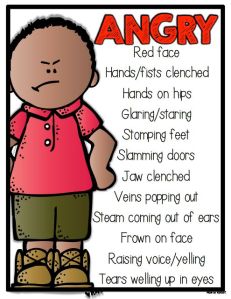
cartoon illustrating angry boy with red face


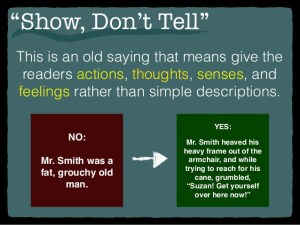
An old one but a good one: don’t tell, but show.

What does it mean exactly? It means don’t tell us about loneliness (or any of those complex words like dishonesty, secrecy, jealousy, obsession, regret, death, injustice, etc) show us what loneliness is. We will read what you’ve written and feel the bite of loneliness. Don’t tell us what to feel. Show us the situation, and that feeling will be triggered in us.

don't tell, but show

When you take your child to school on their first day you may find yourself teary and relieved at the same time. Put into words what you see: the child’s face, the wave at the gate, the other mothers saying their goodbyes, another child coming up to take your son by the hand. We will get what you’re trying to say without you telling us directly.

don't tell, but show 2

When you write, be conscious of the senses and how they connect to the experiences you are writing about. Use sight, sound, smell, touch to create concrete pictures. The senses allow you to get as close as humanly possible in words to the wedding, the sunrise, the dog, the suitcase. It’s the best way to penetrate your story and breathe life into it. Don’t tell us about something, drop deep, enter the story and take us with you.

I hope this post on show, don’t tell is useful. Do you have any tips you would add? Let me know in the comments and please share with a friend if you enjoyed it. 

A Hammam in Marrakech


Some consider a hammam to be the ultimate Moroccan experience.

A hammam is a steam bath where you wash yourself down, sweat out the dirt of the day and then scrub, with an optional massage afterwards.

Because I’d heard the scrubbing can be a bit too strong for fair sensitive skins like mine, I chose the massage-only option. I’d had a good scrub under the shower back at my riad.

My massage at La Maison Arabe in Marrakech (pictured above) was the most luxurious massage I’ve ever experienced. A big strong woman used scented oil to massage every inch of my body (apart from the privates) – around the stomach, around the breasts, all over the place. It was SOOO relaxing and very sensual.

‘In past centuries hammams were the only source of hot water in the medina. Traditionally they are built of mudbrick, lined with tadelakt (satiny hand-polished limestone plaster that traps moisture) and capped with a some with star-studded vents to let steam escape.’ – Lonely Planet

For many Moroccans hammams are as much a social occasion (particularly for women) as they are about bathing. In some of the public hammams non-Muslims are not accepted. Or you can go to a private hammam.

‘Public baths were first introduced to Morocco (and the rest of Africa) by the Romans and adapted to fit in with Islamic ablution rituals – foregoing the communal Roman bathing pool to use running water to wash under instead – after Islam gained a foothold across the region.’ – Lonely Planet

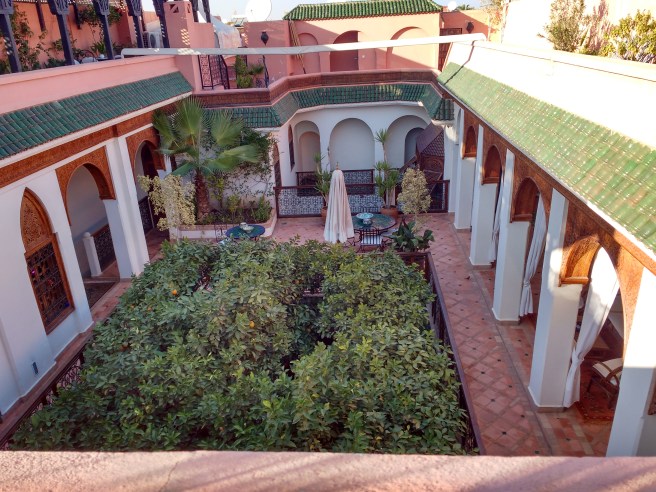
On my 5 day visit to Marrakech I stayed at Riad Daria in the Kasbah. A perfect calm retreat from the chaos of the souks. The souks are the medina’s market streets, criss-crossed with smaller streets lined with storerooms and cubby-hole-sized artisans’ studios.

riaddaria
Riad Daria in the Kasbah

Riad Daria is an authentic riad with a courtyard garden divided in four parts, with a fountain in the centre.

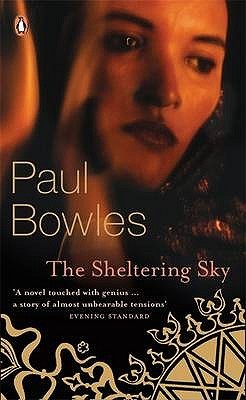
So here I am back in France on my month long writing-retreat-for-one after a short visit to Marrakech needing to concentrate on WIP again. Who knows? Maybe my trip to exotic Morocco will inspire me to write a book about loneliness, madness, love and existentalism like ‘The Sheltering Sky’ by Paul Bowles.


theshelteringsky

“How fragile we are under the sheltering sky. Behind the sheltering sky is a vast dark universe, and we’re just so small.”
― Paul Bowles, The Sheltering Sky

description

“Paul Bowles masterpiece reminds me of some alternate, trippy, version of Fitzgerald’s Tender Is the Night, but instead we see the other side of the Mediterranean. Tangier and the deserts of North Africa take the place of the South of France. A different love triangle exposes different forms of loneliness, madness, love, and existential expats.

The thing I love about Bowles is he brings a composer’s mind to writing. His novel isn’t propelled forward by a strong plot (although it has plot) or attractive characters (none of the characters are very attractive), but the music of his language alone pushes and pulls, tugs and compels the reader page after page. It felt very much like I was floating limp and languid in Bowles prose as his hypnotic sentences washed over me and drifted me slowly toward the inevitable end.” – Darwin8u, Goodreads.

Hope you too get to travel to exotic places for inspiration and rejuvenation.

Writing Tip: Slow things down

woman in blue tennis dress position to hit big forehand

So, here’s the thing:  choose something in particular to write about. For example, what it felt like having a tennis lesson after a twenty year break. Give us the specifics. Dig deep for the details, but at the same time be aware of the world around you. As you focus on what you’re writing, at the same time stay conscious of your surroundings:  the white painted cane Bentwood chairs in the café, the cool breeze from under the door on your sandaled feet, the hum of the traffic outside. Just add a sentence every now and then about the trees that overlooked the tennis courts while you were having a tennis lesson. When we focus on our writing it is good. Seeing the colour of the sky when you toss the ball gives breathing space to your story.

If you are sitting in Meditation you calm the butterfly mind by paying attention to your thoughts, giving them space by acknowledging them before returning to the breath, in and out through the nostrils. In the act of slowing down your breathing, as best you can, you remain open so that you are receptive to awareness of sounds as they arise: sounds near, sounds far, sounds in front, behind, to the side, above or below.

With every breath you take, you feel the air, the sound of the ball as it hits the racket, the players on the other courts.

To slow myself down in tennis I often use the one, two, three method when serving or when receiving a ball from the server. I count ‘one’ as I prepare the service swing, ‘two’ as I toss the ball and ‘three’ when the racket connects with the ball. When receiving a serve I count ‘one’ as the server tosses the ball, ‘two’ when the server hits the ball, ‘three’ when I hit the ball to return the serve. It helps. My tennis coach Chris at Wentworth Tennis suggested I do this, to slow things down.

We should always be living in the present, not by ignoring the world around us, but by paying close attention. It is not easy to stay alive to ‘what is’. When we slow things down in our writing (and in our tennis), it is good practice.

What about you? Do you find a daily meditation practice assists your writing practice?