Autobiography in Fiction

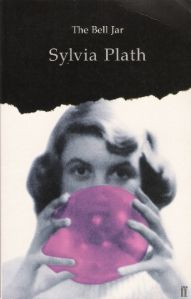
book cover, The Bell Jar by Sylvia Plath

When people ask me where I get my ideas from, I tell them I use the world around me. Life is so abundant, if you can write down the actual details of the way things were and are, you hardly need anything else. Even if you relocate the French doors, fast-spinning overhead fan, small red Dell laptop, and low kneeling-chair from your office that you work in in Sydney into an Artist’s Atelier in the south of France at another time, the story will have truth and groundedness.

In Hermione Hoby’s interview with Elizabeth Strout in the Guardian newspaper, the Pulitzer prize winner said her stories have always begun with a person, and her eyes and ears are forever open to these small but striking human moments, squirreling them away for future use. “Character, I’m just interested in character,” she said.

“You know, there’s always autobiography in all fiction,” Strout said, referring to her novel, My Name is Lucy Barton. “There are pieces of me in every single character, whether it’s a man or a woman, because that’s my starting point, I’m the only person I know.” She went on to explain:

“You can’t write fiction and be careful. You just can’t. I’ve seen it with my students over the years, and I think actually the biggest challenge a writer has is to not be careful. So many times students would say, ‘Well, I can’t write that, my boyfriend would break up with me.’ And I’d think, you have to do something that’s going to say something, and if you’re careful it’s just not going to work.”

At the launch of one of my books MC Susanne Gervay OAM said: “Libby’s level of detail creates poignant insights into character and relationships. If people know Libby they may find themselves subtly entwined in one of her stories.”

On Goodreads’ website they locate The Bell Jar by Sylvia Plath under “Autobiographical Fiction” and describe the book as Plath’s shocking, realistic, and intensely emotional novel about a woman falling into the grip of insanity:

“Esther Greenwood is brilliant, beautiful, enormously talented, and successful, but slowly going under—maybe for the last time. In her acclaimed and enduring masterwork, Sylvia Plath brilliantly draws the reader into Esther’s breakdown with such intensity that her insanity becomes palpably real, even rational—as accessible an experience as going to the movies. A deep penetration into the darkest and most harrowing corners of the human psyche, The Bell Jar is an extraordinary accomplishment and a haunting American classic.”

My advice to you, dear writer, is to be awake to the details around you, but don’t be self-conscious. “So here it is. I’m at a Valentine’s Day party. It’s 33 degrees outside. The hostess is sweltering over a hot oven in the kitchen. She is serving up cheese and spinach triangles as aperitifs.” Relax, enjoy the party, be present with your eyes and ears open. You will naturally take it all in, and later, sitting at your desk, you will be able to remember just how it was to be eating outside in the heat under a canvas umbrella, attempting to make conversation with the people on either side of you, and thinking how you can best make an early exit 🙂

In the interview with Elizabeth Strout in the Guardian, Strout said:

“I don’t want to write melodrama; I’m not interested in good and bad, I’m interested in all those little ripples that we all live with. And I think that if one gets a truthful emotion down, or a truthful something down, it is timeless.”

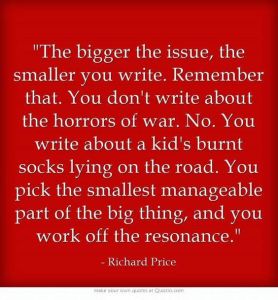
The Bigger the Issue, the Smaller You Write

pexels-photo-851213.jpeg


A quote: the bigger the issue, the smaller you write - Richard Price

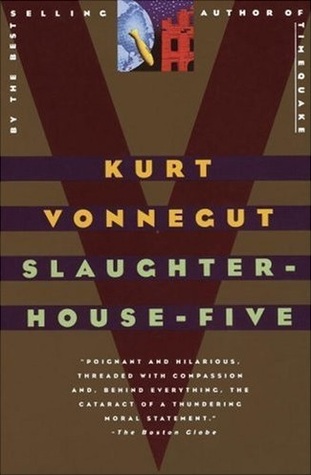
A fantastic example of this writing advice is Kurt Vonnegut’s  Slaughterhouse-Five.

Poignant and hilarious, threaded with compassion and, behind everything, the cataract of a thundering moral statement. – The Boston Globe

book cover of Kurt Vonnegut's 'Slaughterhouse-Five'

Kurt Vonnegut’s absurdist classic Slaughterhouse-Five introduces us to Billy Pilgrim, a man who becomes unstuck in time after he is abducted by aliens from the planet Tralfamadore. In a plot-scrambling display of virtuosity, we follow Pilgrim simultaneously through all phases of his life, concentrating on his (and Vonnegut’s) shattering experience as an American prisoner of war who witnesses the firebombing of Dresden.

Don’t let the ease of reading fool you – Vonnegut’s isn’t a conventional, or simple, novel. He writes, “There are almost no characters in this story, and almost no dramatic confrontations, because most of the people in it are so sick, and so much the listless playthings of enormous forces. One of the main effects of war, after all, is that people are discouraged from being characters.”

Slaughterhouse-Five is not only Vonnegut’s most powerful book, it is also as important as any written since 1945. Like Catch- 22, it fashions the author’s experiences in the Second World War into an eloquent and deeply funny plea against butchery in the service of authority. Slaughterhouse-Five boasts the same imagination, humanity, and gleeful appreciation of the absurd found in Vonnegut’s other works, but the book’s basis in rock-hard, tragic fact gives it a unique poignancy – and humor. – Goodreads

Highly recommended. A masterpiece.

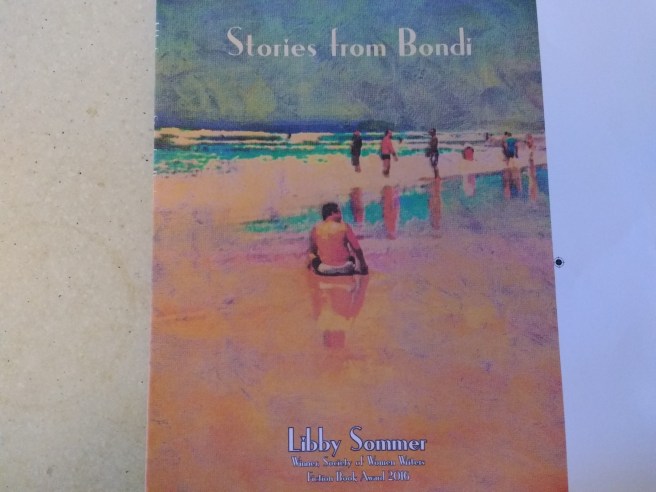
Book Review: ‘Stories from Bondi’

book cover of 'Stories from Bondi' showing people on the sand by the sea
Book reviewer Dr Beatriz Copello, D.C.A. (Creative Writing) U.O.W., Cultural Editor of Semanario El Español and Psychologist, has written a wonderful review of  my new book STORIES FROM BONDI.
She writes:

Stories from Bondi is a collection of short stories by Libby Sommer.  Libby Sommer is the award-winning Australian author of My Year with Sammy (2015), The Crystal Ballroom (2017) and The Usual Story (2018) and is a regular contributor of stories and poems to Quadrant Magazine.

The stories contained in this book are varied in tone, mood and themes and they go from the very light and funny to sombre and sad, and from the innocent to the complex.  Most of the stories are set in the Eastern Suburbs of Sydney and for the inhabitants of this city it is fun to recognise familiar places and people from foreign places will learn about the beauty of  Sydney.

Australian humour is sprinkled over the pages as well as truly Australian expressions, typical social comments and comments about the style of clothing the characters wear. Some authors describe characters’ clothes in a way that is pedantic.  This is not the case with Sommer, the way this author dresses her characters emphasize aspects of their personality.

Various stories are about Anny, a well-defined character who the reader gets to know through her many and varied experiences.  Through Anny’s point of view the reader encounters reflections about modern women, their issues, concerns and sexual mores.

In Stories From Bondi the sea is ever present, as well as the seagulls … seagulls flapping wings, seagulls walking on sand or seaweed, seagulls flying … seagulls who are witnesses of Anny’s life.

Strong women’s issues are covered in some of the stories, but also issues that many women readers would identify as their own, issues such as body image, for example in “After The Rain” where Anny expresses concerns about her figure, the author writes:

“Although there are fans on the ceiling, it’s very hot in the restaurant.  Anny wants to take off her cardigan but she doesn’t want to expose her upper arms that is, that are less than perfect even though she does weights and other things at the gym.

She wears a jacket or a cardigan always now to draw the eyes and attention away from that part of her body that is growing larger at a more rapid rate than the rest of her, which is causing her much alarm.”

Sommer with her imaginative mind take us to places, where many women on their own would not dare to go, like lonely overseas trips or to Sex Clubs.  Yes, Anny visits a sex club in the story titled “Around Midnight”, story which is packed with the unexpected and with humour.  Although, I enjoyed reading this story I would have loved for it to have stronger and more explicit sex scenes.  Humour is also found in other stories like in “It’s Not Easy Being On Holidays”, she writes:

“Anny said, On New Year’s Eve I ran my hand up the inside of a man’s trousers from the ankles up and discovered he wasn’t wearing any underwear either.

You discover a little something?

A big something, she said.

They both laughed.”

In the story mentioned above there are also a few really funny passages full of innocence, one of these is when Anny phones her son to tell him about her holidays, Sommer writes:

“And Pamela and Annabel all over each other in front of me.  I can’t stand it.

Would it worry you so much if they were straight?

I can’t stand anyone being passionate in front of me — straight or gay.  It makes me jealous.  It’s inconsiderate of them.

Well, what did you expect going on holidays with two gays, two lesbians, a bisexual and a dog?

You’re right.”

Sommer has the ability to create believable characters and place them in real life situations, whether these situations are arranged or occur by chance. The ‘unusual’ sometimes is found in this writer’s narrative, like when she describes different types of Glutei Maximi, for those unacquainted with Latin this mean simply ‘bums’. Sommer is a good observer and as such gives us good descriptions of ‘bums’, the character Anny comments:

“Gradually the men on the beach sauntered towards the boat with money clasped in their bare hands.  They lined up one behind the other as they waited their turn, assorted body shapes and colours.  Tight firm bums, droopy wrinkly bums. Some with tell-tale underwear marks and others browned all over.”

Slices of life are brought to the reader with cinematic qualities: sceneries, the characters, the situations, all can be seen in the mind’s eye like in a movie. The following is a small example:

“Max leant back on his elbows nibbling on a bunch of grapes.  He knocked the bottle of red wine beside him.  The bright red liquid seeped into the white sand.

A fly buzzed around the apples.

A trail of ants marched towards the bread.

The Brie softened in the sun.”

The above paragraph is the ending of one of the stories, a simple ending that says so much.

In the collection there is one very sad story of abuse and growing up too quickly and not knowing how to stop abusers who prey on innocent girls.  There are also issues experienced by the characters which are very common to women one of this is the need to feel safe, the story “The Backpack” has that need very clearly expressed by the character:

“I knew my children would be pleased I had a base.  I didn’t want them to worry. It was the thing I wanted the most secretly, studying maps, absorbing travel books. To be safe, a desire whispered to the moon that moved behind my shoulder at night.  If you guide me to a safe haven, I promise to be happy.  And the moon listened.  I did my best.”  How many women would identify with this? Many it is my guess.

All the main characters in Stories From Bondi are women, mainly writers who are portrayed as intelligent, inquisitive, reflective and observant who experience an array of emotions, men would find the stories fascinating and would learn about what goes in women’s heads.

Bondi is not the only setting mentioned in the book, other Australian cities and small towns are the background of some the stories, places like Perth, Cairns, Wee Wa, Brindabella as well as European cities.

Sometimes the author transitions from omniscient narrator to first person narrator, this works in most of the stories but in some small sections this does not happen. This minor issue does not demerit the stories at all.

There is one experimental story in the collection: “Around The World In Fifty Steps” where the author writes sentences and short paragraphs and numbers them from 1 to 50. Some of the sentences are dialogues, others propositions, information about the character and suggestions. The result is positive, the reader gets to know the character and what is going on in her life.

Some of the stories mirror women’s fantasy about escaping the routine, pain, loneliness, disappointment and sorrows as well as those close relationships that can be so complicated such as between mother and daughter. Also the reader will find sad possible romances that never get anywhere like in her previous novel The Usual Story.

Stories from Bondi is a book well written, with an interesting narrative and with characters true to life. Again Sommer brings to light another book in which the reader can submerge themselves into place and characters. Highly recommended.

About the Reviewer:

Dr Beatriz Copello, is a former member of NSW Writers Centre Management Committee, she writes poetry, reviews, fiction and plays. The author’s poetry books are: Women Souls and Shadows, Meditations At the Edge of a Dream, Flowering Roots, Under the Gums Long Shade, and Lo Irrevocable del Halcon (In Spanish).

Beatriz’s poetry has been published in literary journals such as Southerly and Australian Women’s Book Review and in many feminist publications.  She has read her poetry at events organised by the Sydney Writers Festival, the NSW Writers Centre, the Multicultural Arts Alliance, Refugee Week Committee, Humboldt University (USA), Ubud (Bali) Writers Festival.

 

Slow Things Down in Your Writing

woman in blue tennis dress position to hit big forehand

So, here’s the thing:  choose something in particular to write about. For example, what it felt like having a tennis lesson after a twenty year break. Give us the specifics. Dig deep for the details, but at the same time be aware of the world around you. As you focus on what you’re writing, at the same time stay conscious of your surroundings:  the white painted cane Bentwood chairs in the café, the cool breeze from under the door on your sandaled feet, the hum of the traffic outside. Just add a sentence every now and then about the trees that overlooked the tennis courts while you were having a tennis lesson. When we focus on our writing it is good. Seeing the colour of the sky when you toss the ball gives breathing space to your story.

If you are sitting in Meditation you calm the butterfly mind by paying attention to your thoughts, giving them space by acknowledging them before returning to the breath, in and out through the nostrils. In the act of slowing down your breathing, as best you can, you remain open so that you are receptive to awareness of sounds as they arise: sounds near, sounds far, sounds in front, behind, to the side, above or below.

With every breath you take, you feel the air, the sound of the ball as it hits the racket, the  players on the other courts.

We should always be living in the present, not by ignoring the world around us, but by paying close attention. It is not easy to stay alive to ‘what is’. When we slow things down in our writing, it is good practice.

What about you? Do you find a daily meditation practice assists your writing practice?

First Amazon Review of ‘Glass Walls’

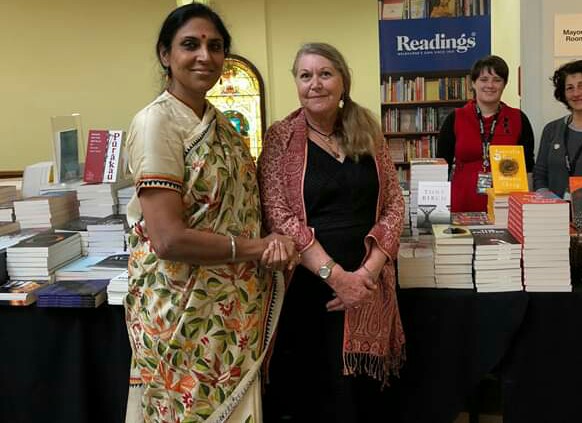
Editors Meenakshi Bharat and Sharon Rundle at launch of Glass Walls

First review on Amazon of GLASS WALLS, published by Orient BlackSwan, stories of tolerance and intolerance from the Indian sub-continent and Australia edited by Meenakshi Bharat and Sharon Rundle (pictured). Thrilled to see my short story HENRY received a special mention. GLASS WALLS was launched recently at the Australian Short Story Festival in Melbourne. Have a read of Punekar’s review:

“This collection of stories tackles a wide variety of subjects and is categorised into Family, Race, Gender, Religion and so on and that is why I enjoyed the book. One could pick and choose a story to read depending on one’s mood. I specifically liked the stories on Family and Gender. The stories on race brought out the dichotomy that exists in all of us, as mentioned in the introduction to the book. Right thinking people are determined not to be biased and want to do the right thing but the subconscious mind often has another agenda. The rational aspect of the personality loses out in certain circumstances. This is brought out in the stories on family too, particularly the story titled “The Wedding Gift”. Another story I liked was the one titled “Henry”. We behave in the most irrational ways but we are not bad people, not really, just human. All the stories are not equally good, but all of them touch something inside your heart.” – Punekar

GLASS WALLS is available from Indian publisher Orient BlackSwan.

Writing in Cafes – Repost


Featured Image -- 5029

I am sitting in a café across the road from the beach in Bronte, Sydney.  This stretch of road has a whole row of cafes side by side facing the sea.  This is my favourite kind of writing place:  one where I can sit comfortably for a long period of time and where the owners of the café know me and welcome me.  This café is owned by a Brazilian man and his wife and has comfortable upholstered bench chairs with a direct view of the Pacific Ocean.

For my two-hour writing session my choice could be a traditional Brazilian dish such as Coxinha, Feijoda or Moqueca.  Or a cocktail like Caipirinha or  Caipiroska.  I must order something and it must be more that a coffee, because I plan to be here for a long time.  I want the owners of the café to know I appreciate the time and the space they are allowing me.

Why go to all this trouble to find a place to write?  Why not just stay home and work?  Because it’s good to get out and have a change of scene.  I find I need to be happy and relaxed when I’m creating on the page and sitting in a café with a pleasant vibe works for me.  Other writers need silence in order to concentrate, but I need to feel I am out and about in a beautiful place having a good time before the creative juices flow.

Strangely, working in a café can help to increase concentration.  The busy café atmosphere keeps the sensory part of you occupied and content, so that the hidden, quieter part of you that composes and focuses is allowed to do its work.  It is something like being cunning when trying to get a spoonful of food into a resistant toddler’s mouth.  You pretend to be an aeroplane with all the sound effects and movements before landing the food-laden plane inside the child’s mouth.  Mission accomplished.

What about you?  Do you need to be at your desk in total silence to write, or do you like to experience the swell of humanity around you—to be surrounded by other human beings?  Or in your home office listening to a particular kind of music?

Use Declarative Sentences – Reblog

pexels-photo.jpg

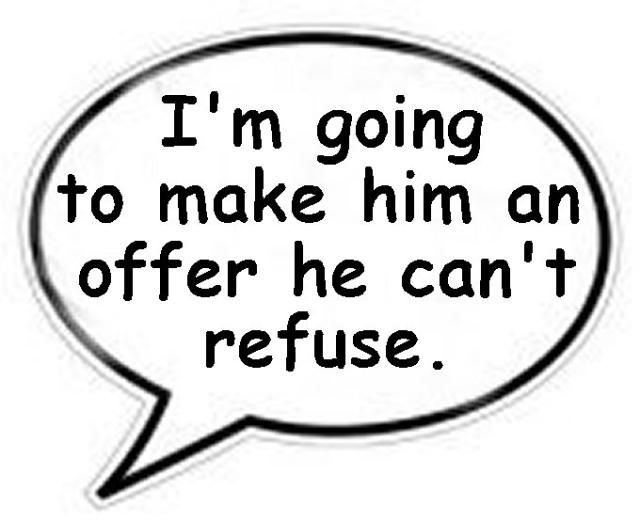
speech bubble: I'm going to make him an offer he can't refuse

This declarative sentence was spoken by Don Corleone (played by Marlon Brando) in the movie The Godfather (1972).

It is not uncommon for women and other minority groups to add qualifiers to their statements. Such as ‘Parents need to stop organising every minute of their children’s spare time, don’t you think?’ ‘I loved that movie, didn’t you?’ In our sentence structure we look for reinforcement for our thoughts and opinions. We don’t always make declarative statements. ‘This is wonderful.’ ‘This is a catastrophe.’ We look for re-enforcement from others.

Another thing we do without realising it, is use indefinite modifiers in our speech:  perhaps, maybe, somehow. ‘Maybe I’ll take a trip somewhere.’ As if the speaker has no power to make a decision. ‘Perhaps it will change.’ Again, not a clear declarative sentence like, ‘Yes, nothing stays the same.’

It is important for us as writers to express ourselves in clear assertive sentences. ‘This is excellent.’ ‘It was a red dress.’ Not ‘The thing is, I know it sounds a bit vague, but I think maybe it was a red dress.’ Speaking in declarative sentences is a good rehearsal for trusting your own ideas, in standing up for yourself, for speaking out your truth.

When I write poetry I read through early drafts with a critical eye, taking out indefinite words and modifiers. I attempt to distill each moment to its essence by peeling off the layers until the heart of the poem is exposed. We need to take risks as writers and go deep within ourselves to find our unique voices and express ourselves with clarity.

Even if you are not 100% sure about your own opinions and thoughts write as if you are sure.  Dig deep. Be clear. Don’t be vague on the page. If you keep practicing this, you will eventually reveal your own deep knowing.

Have you noticed this tendency to qualify in your conversations with others, or in your creative writing, or in blog posts? Would love to hear your thoughts.

Congratulations to Jacqui Murray on her latest book, The Quest for Home

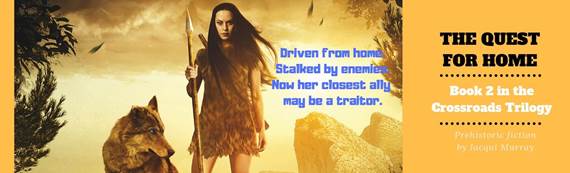
The Quest for Home book cover

Jacqui Murray is the author of the popular Building a Midshipman, the story of her daughter’s journey from high school to United States Naval Academy, the Rowe-Delamagente thrillers, and the Man vs. Nature saga. She is also the author/editor of over a hundred books on integrating tech into education, adjunct professor of technology in education, blog webmaster, an Amazon Vine Voice,  a columnist for  NEA Today, and a freelance journalist on tech ed topics. Look for her next prehistoric fiction, In the Footsteps of Giants, Winter 2020, the final chapter in the Crossroads Trilogy.

Summary

I’m excited to be part of the launch of Jacqui’s latest book, The Quest for Home. Here’s what it’s about:

Chased by a ruthless and powerful enemy, Xhosa flees with her People, leaving behind her African homeland, leading her People on a grueling journey through unknown and perilous lands. As they struggle to overcome treachery, lies, danger, tragedy, hidden secrets, and Nature herself, Xhosa must face the reality that her most dangerous enemy isn’t the one she expected. It may be one she trusts with her life. 

The story is set 850,000 years ago, a time in prehistory when man populated Eurasia. He was a violent species, fully capable of addressing the many hardships that threatened his survival except for one: future man, the one destined to obliterate any who came before.

Based on a true story, this is the unforgettable saga of hardship and determination, conflict and passion as early man makes his way across Eurasia, fleeing those who would kill him. He must be bigger-than-life, prepared time and again to do the impossible because nothing less than the future of mankind is at stake.

Book information:

 Title and author: The Quest for Home

Series: Book 2 in the Crossroads series, part of the Man vs. Nature saga

Genre: Prehistoric fiction

Available at: Kindle US   Kindle UK   Kindle CA   Kindle AU

Social Media contacts:

Amazon Author Page:        https://www.amazon.com/Jacqui-Murray/e/B002E78CQQ/

Blog:                                       https://worddreams.wordpress.com

Instagram:                             https://www.instagram.com/jacquimurraywriter/

LinkedIn:                                http://linkedin.com/in/jacquimurray

Pinterest:                                http://pinterest.com/askatechteacher

Twitter:                                   http://twitter.com/worddreams

Website:                                 https://jacquimurray.net


Things Raymond Carver has said about the short form in writing

blur book stack books bookshelves

‘My attention span had gone out on me; I no longer had the patience to try to write novels. … I know it has much to do now with why I write poems and short stories. Get in, get out. Don’t linger. Go on.’

‘Every great or even every very good writer makes the world over according to his own specifications.’

‘It is his world and no other. This is one of the things that distinguishes one writer from another. Not talent.’

‘Isak Dinesan said that she wrote a little every day, without hope and without despair.’

‘”Fundamental accuracy of statement is the ONE sole morality of writing,” Ezra Pound.’

‘It is possible to write a line of seemingly innocuous dialogue and have it send a chill along the reader’s spine – the source of artistic delight, as Nabokov would have it. That’s the kind of writing that most interests me.’

‘That’s all we have, finally, the words, and they had better be the right ones, with the punctuation in the right places so that they can best say what they are meant to say.’

‘I like it when there is some feeling of threat or sense of menace in short stories.’

‘I made the story just as I’d make a poem; one line and then the next, and the next.’

‘V.S. Pritchett’s definition of a short story is “something glimpsed from the corner of the eye, in passing.” Notice the “glimpse” part of this. First the glimpse.’

‘The short story writer’s task is to invest the glimpse with all that is in his power. He’ll bring his intelligence and literary skill to bear (his talent), his sense of proportion and sense of the fitness of things – like no one else sees them. And this is done through the use of clear and specific language, language used so as to bring to life the details that will light up the story for the reader. For the details to be concrete and convey meaning, the language must be accurate and precisely given. The words can be so precise they may even sound flat, but they can still carry, if used right, they can hit all the notes.’

Raymond Carver, Fires, Vintage 1989

So who is Raymond Carver?

Raymond Carver, in full Raymond Clevie Carver, (born May 25, 1938, Clatskanie, Oregon, U.S.—died August 2, 1988, Port Angeles, Washington), American short-story writer and poet whose realistic writings about the working poor mirrored his own life. – Encyclopedia Britannica

‘Stories From Bondi’

painting of girl lying on beach in torquoise bikini reading a book

Woohoo. I finished correcting first proofs of my new collection STORIES FROM BONDI due for publication by Ginninderra Press in September. A big job. Final proofs are the next step in the publishing process.

So what are first proofs?

Initial proofs of the book from the typesetter, sometimes still delivered in galley format.

For the author, this first set of author proofs can be a challenge because often what is delivered is the raw typesetting output. Text will have been formatted and a key task for the author is to check that no text corruptions occurred at the file conversion stage of typesetting.

However, because tables, illustrations, etc. may not yet have been added, what these first proofs still lack are the real page breaks and an indication of the book’s final extent. For this reason, careful scrutiny still needs to be given to the final proofs.

This definition is extracted (and expanded on) from the book Getting Published: A Companion for the Humanities and Social Sciences by Gerald Jackson and Marie Lenstrup.