Beginner Writing Tip: Pen & Paper

When I used to teach classes to beginning writers, it was good.  It forced me to think back to the beginning to when I first put pen to paper.  The thing is, every time we sit down and face the blank page, it’s the same.  Every time we start a new piece of writing, we doubt that we can do it again.  A new voyage with no map.  As people say, it is like setting off towards the horizon, alone in a boat, and the only thing another person can do to help us, is to wave from the shore.

So when I used to teach a creative writing class, I had to tell them the story all over again and remember that this is the first time my students are hearing it.  I had to start at the very beginning.

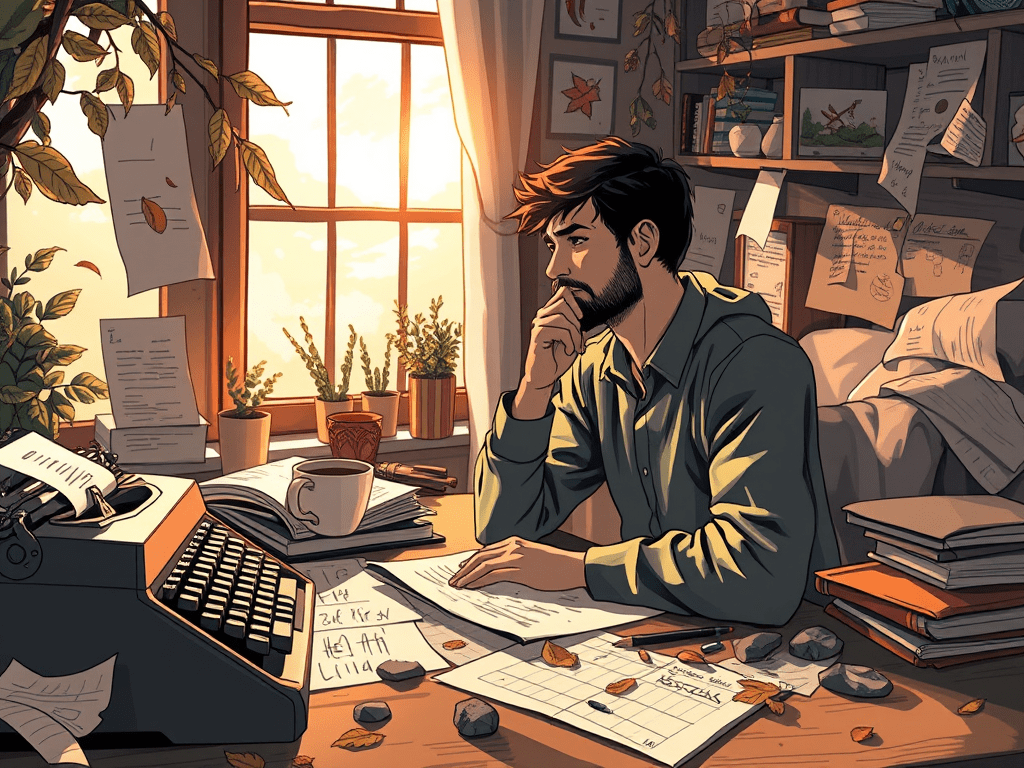
First up, there’s the pen on the page.  You need this intimate relationship between the pen and the paper to get the flow of words happening.  A fountain pen is best because the ink flows quickly.  We think faster than we can write.  It needs to be a “fat” pen to avoid RSI.

Consider, too, your notebook.  It is important.  The pen and paper are your basic tools, your equipment, and they need to be with you at all times.  Choose a notebook that allows you plenty of space to write big and loose.  A plain cheap thick spiral notepad is good.

After that comes the typing up on the computer and printing out a hard copy.  It’s a right and left brain thing.  You engage the right side of the brain, the creative side, when you put pen to paper, then bring in the left side, the analytic side, when you look at the print out.  You can settle back comfortably with a drink (a cup of tea even) and read what you’ve written.  Then edit and rewrite.

Patrick White said that writing is really like shitting; and then, reading the letters of Pushkin a little later, he found Pushkin said exactly the same thing.  Writing is something you have to get out of you.

I hope this Writing Tip is helpful. Do you have any tips you would add? Let me know in the comments and please share this post with a friend if you enjoyed it.

What is Flash Fiction?

Photo by @jasonpainterphoto

Have you tried writing flash fiction yet? What does flash fiction mean?

‘A flash fiction piece is a self-contained story (beginning/middle/end), 1,000 words or less, that can entertain, intrigue, and satisfy a reader during an F5 tornado. That’s it. No genre restrictions, age requirements, or prior experience needed. Just quick, clean stories.’ – Writer’s Digest

‘Part poetry, part narrative, flash fiction–also known as sudden fictionmicro fiction, short short stories, and quick fiction—is a genre that is deceptively complex.’ – The Review Review

‘Flash fiction is a fictional work of extreme brevity that still offers character and plot development. Identified varieties, many of them defined by word count, include the six-word story, the 280-character story, the “dribble”, the “drabble”, “sudden fiction”, flash fiction, nanotale, and “micro-story”.’ – Wikipedia

I like writing in a short form. I’ve been told I have the sensibility of a poet because I have the ability to distill, so the short form suits me. You may be more of a long distance runner, rather than a sprinter, and prefer the long form of a novel.

Have a read of my flash fiction titled It’s Pot Luck When You Move Into A Unit, winner of the short short fiction UTS Alumni Competition a few years ago. Hope you enjoy it.

It’s Pot Luck When You Move Into a Unit

A nice quiet weekend? the woman downstairs said.  What do you mean? I said, through the open back door, a bag of rubbish in each hand.  She smoothed her ironing on the board and said, They weren’t around over the weekend—with the baby.  She looked happy.  I’m lucky living on the top floor, I said.  She nodded towards the other side of the building.  Jim isn’t so luckyhe’s got the woman upstairs, she said, When he plays the piano and she thumps on the floor.   She put the iron back on its stand.  She’s heavy-footed, that woman.  Bang, bang, bang.   I hear her coming down the stairs every morning at six, and the slam of the front door. 

That night the wind knocked my vase off the window ledge.  I lay awake wondering if the noise of the smash had woken up the people underneath—the ones whose barbecuing sends smoke and disgusting meat smells into my unit.  Nothing clings to your furniture like the stink from last week’s burnt fat.   Sorry about the crash, I muttered to the floor, It was the wind.

Copyright 2023 Libby Sommer

Why not try your hand at writing in this short form and enter a flash fiction competition. Good luck.

Show, Don’t Tell: The Power of Sensory Writing

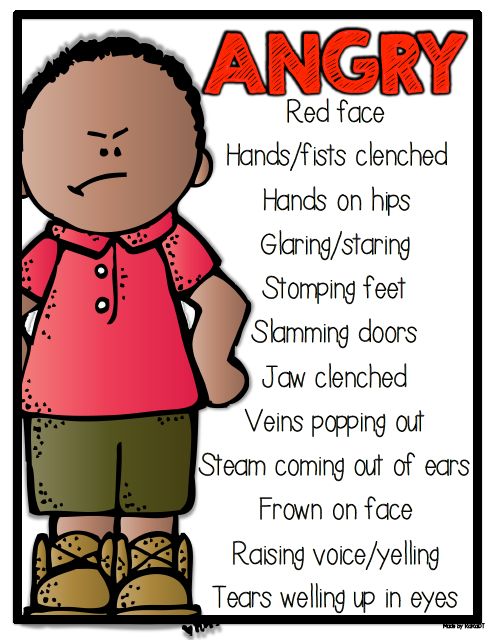
cartoon illustrating angry boy with red face

This is an old one, but a good one. Tell Don’t Show.

What does it mean exactly? It means don’t tell us about loneliness (or any of those complex words like dishonesty, secrecy, jealousy, obsession, regret, death, injustice, etc) show us what loneliness is. We will read what you’ve written and feel the bite of loneliness.

Don’t tell us what to feel. Show us the situation, and that feeling will be triggered in us.

When you take your child to school on their first day you may find yourself teary and relieved at the same time. Put into words what you see: the child’s face, the wave at the gate, the other mothers saying their goodbyes, another child coming up to take your son by the hand. We will get what you’re trying to say without you telling us directly.

The how-to-write books tell us to use our senses when we write stories:  sight, sound, smell, touch. Writing from the senses is a good way to penetrate your story and make friends with it. Don’t tell us about something, drop deep, enter the story and take us with you.

What about you? Do you consciously bring the senses into your creative writing?

Writing Tip: Passion

Every once in a while, when I’m scratching around for something new to write, I make a list of the things I feel passionate about. The list changes over time, but there are always new ideas to fill the gap.

It’s true that writers write about what they think about most of the time.  Things they can’t let go: things that plague them; stories they carry around in their heads waiting to be heard.

Sometimes I used to ask my creative writing groups to make a list of the topics they obsess about so they can see what occupies their thoughts during their waking hours.  After you write them down, you can use them for spontaneous writing before crafting them into stories.  They have much power.  This is where the juice is for writing.  They are probably driving your life, whether you realise it or not, so you may as well use them rather than waste your energy trying to push them away.  And you can come back to them repeatedly.

One of the things I’m always obsessing about is relationships:  relationships in families, relationships with friends, relationships with lovers.  That’s what I tend to write about when I’m creating stories.  I think to myself, Why not?  Rather than repress my obsessions, explore them, go with the flow.  And life is always changing, so new material keeps presenting  itself.

We are driven by our passions.  Am I the only one who thinks this?  For me these compulsions contain the life force energy.  We can exploit that energy.  The same with writing itself.  I’m always thinking and worrying about my writing, even when I’m on holidays.  I’m driven.

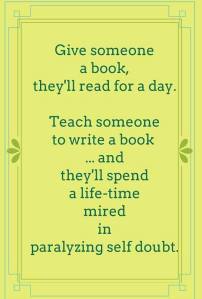
blue quote about writing on yellow background

But not all compulsions are a bad thing.  Get involved with your passions, read about them, talk to other people about them and then they will naturally become ‘grist for the mill’.

What about you? Do you find yourself telling the same stories over and over again, but from a different perspective?

Writing Tip: To Plot Or Not To Plot?

Plot means the story line.  When people talk about plotting, they mostly mean how to set up the situation, where to put the turning points, and what the characters will be doing in the end.  What happens.

Some fiction writers write organically, not knowing where the story they are writing is going.  These writers say it would be boring to know what’s going to happen next and they lose their enthusiasm to tell the story because they know the outcome already.  They prefer throwing themselves over the edge and into the void.  This method can be very anxiety-producing.  It means you need a lot of faith in your process.

Other writers plan the story before they begin.  In detective fiction the story definitely needs to be worked out beforehand so information can be drip-fed to the reader.

In the past, when creating my short stories, I have worked organically and not known where my stories were headed as I wrote them.  The shorter the piece of fiction, the less need for plot.  You can write an interesting story in which not very much happens.  A woman fights with her neighbour, a man quits his job, or an unhappy family goes out for a pizza.  Simple structures work better than something too complicated when the story is short.

Now that I’m working on a new novel, I feel the need to plot.

“A plot can, like a journey, begin with a single step.   A woman making up her mind to recover her father’s oil paintings may be enough to start.  The journey begins there, as it did for Raskolnikov in Crime and Punishment when he decided to commit his crime,”  Jerome Stern Making Shapely Fiction

The plot grows and develops out of what helps and what hinders the characters’ progress toward their goals.

The Writers’ Workshop   http://www.writersworkshop.co.uk/plot2.html  ask:

  • But how do you know if your draft plot has the right amount of weight to carry an entire novel?
  • What kind of structures work?
  • Is there a quick way to design your own plot template?
  • And how do you handle a book with multiple points of view?

“A good plot has a clear motivation.  It has a clear structure.  It has an outcome.  It has subplots.  A good plot looks something like the plot structure template below,” The Writers’ Workshop.

MotivationLizzie Bennett wants to marry for love
Plot structureShe meets Darcy & Wickham. She dislikes Darcy, and starts to fall for Wickham. Wickham turns out to be a bad guy; Darcy turns out to be a good guy. She now loves Darcy.
OutcomeShe marries Darcy
Subplot 1Jane Bennett (Lizzie’s nice sister) loves Bingley. Bingley vanishes. He reappears. They get hitched.
Subplot 2Lydia Bennett (Lizzie’s idiot sister) elopes with Wickham. She’s recovered.
Subplot 3An idiot, Mr Collins, proposes marriage to Lizzie. She says no. Her friend, Charlotte, says yes.

Of course, there are a lot of things that the above plot template doesn’t tell you.  It doesn’t say where the novel is set, it doesn’t tell you anything about plot mechanics – it doesn’t say why Lizzie dislikes Mr Darcy, or how Lydia is recovered from her elopement.  It doesn’t have anything to say about character.

The Writers’ Workshop strongly advises us to build a template much like the one above before starting to write.  “If you’ve already started your MS then, for heaven’s sake, get to that template right away.”

So I’ve decided to put myself out of my misery and create a Plot Template for my new novel.  I already had my characters in place and knew what each character wanted.  But now I’m forced into planning an ending, which isn’t a bad thing.  Some writers don’t find the real beginning to their stories until they’ve written the endings.

So that’s all we need:  a beginning, a middle and an end.  Aristotle defined it like this:  a beginning is what requires nothing to precede it, an end is what requires nothing to follow it, and a middle needs something both before and after it.

Easy peasy.  Not.

 *

What about you?  Do you plot or write organically?  I’d love to hear what works for you and what sends you straight to the Writers Block Corner.

I Am Not the Stories I Tell

Sometimes when people read my stories they assume those stories are me.  They are not me, even if I write in the first person.  They were my thoughts and feelings at the time I wrote them.  But every minute we are all changing.  There is a great freedom in this.  At any time we can let go of our old selves and start again.  This is the writing process.  Instead of blocking us, it gives us permission to move on.  Just like in a progressive ballroom dance:  you give your undivided attention to your partner—keep eye contact for the time you are dancing together—but then you move on to the next person in the circle.

The ability to express yourself on the page—to write how you feel about an old lover, a favourite pair of dance shoes, or the memory of a dance on a chilly winter’s night in the Southern Highlands—that moment you can support how you feel inside with what you say on the page.  You experience a great freedom because you are not suppressing those feelings.  You have accepted them, aligned yourself with them.

I have a poem titled ‘This is what it feels like’—it’s a short poem.  I always think of it with gratitude  because I was able to write in a powerful way how it was to be desperate and frightened.  The act of self expression made me feel less of a victim.  But when people read it they often say nothing.   I remind myself, I am not the poem, I am not the stories I write.  People react from where they are in their own lives.  That’s the way things are.  The strength is in the act of writing, of putting pen to paper.   Write your stories and poems, show them to the world, then move on.  The stories are not you.  They are moments in time that pass through you.

Writing Tip: The Feedback Sandwich

In the Saturday-afternoon feedback group recently, we talked about the ‘off with his head’ or ‘out-it-goes’ part of writing.  We acknowledged that as a group we’d always been very supportive and encouraging of each others work.  That was because we were all in it together.  Our critiquing was not telling lies; it was from a place of open hearted acceptance.  Everything you put on the page is acceptable.

Sometimes someone says, ‘I want a rigorous no-holds-barred assessment of my work.’  But what do you say to them when the writing is dull and boring?  Don’t give up your day job?  It doesn’t sit comfortably with most of us to be directly critical of someone’s writing.  It’s like telling someone how ugly their baby is.  All of us find it hard to separate our writing from ourselves, and are prone to take criticism personally.

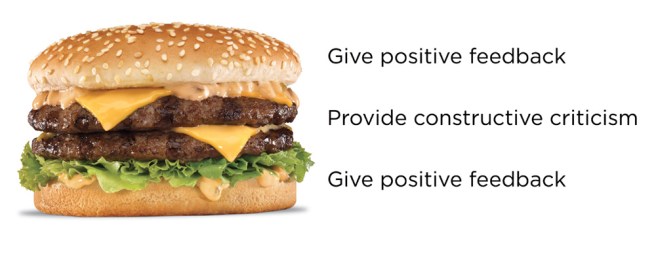
The feedback sandwich is a widely known technique for giving constructive feedback, by ‘sandwiching’ the criticism between two pieces of praise or compliments.

hamburger with cheese and two beef patties

Yesterday, as we passed around copies of our work (just a page or two) we started to address what William Faulkner famously said:

‘In writing, you must kill all your darlings.’

First of all, we looked for the juice in each piece.  Where did the writing come alive?  ‘Get rid of the rest,’ we said.  ‘Off with his head—out it goes.’   It’s very difficult to be this honest, and not everyone wants to hear it.  ‘I simply want gentle support and a few corrections,’ some of us might say.

Be willing to have the courage to look at your work with truthfulness.  It’s good to know where your writing has energy and vitality, rather than to spend a lot of time trying to make something come to life that is dead on the page.   Keep writing.  Something new will come up.    You don’t want to put your readers to sleep by writing a lot of boring stuff.

Are you in a critique group to give you feedback on your writing? Do you find it useful?

Writing Tip: Things Said by Raymond Carver About Short Form Writing

‘My attention span had gone out on me; I no longer had the patience to try to write novels. … I know it has much to do now with why I write poems and short stories. Get in, get out. Don’t linger. Go on.’

‘Every great or even every very good writer makes the world over according to his own specifications.’

‘It is his world and no other. This is one of the things that distinguishes one writer from another. Not talent.’

‘Isak Dinesan said that she wrote a little every day, without hope and without despair.’

‘”Fundamental accuracy of statement is the ONE sole morality of writing,” Ezra Pound.’

‘It is possible to write a line of seemingly innocuous dialogue and have it send a chill along the reader’s spine – the source of artistic delight, as Nabokov would have it. That’s the kind of writing that most interests me.’

‘That’s all we have, finally, the words, and they had better be the right ones, with the punctuation in the right places so that they can best say what they are meant to say.’

‘I like it when there is some feeling of threat or sense of menace in short stories.’

‘I made the story just as I’d make a poem; one line and then the next, and the next.’

‘V.S. Pritchett’s definition of a short story is “something glimpsed from the corner of the eye, in passing.” Notice the “glimpse” part of this. First the glimpse.’

‘The short story writer’s task is to invest the glimpse with all that is in his power. He’ll bring his intelligence and literary skill to bear (his talent), his sense of proportion and sense of the fitness of things – like no one else sees them. And this is done through the use of clear and specific language, language used so as to bring to life the details that will light up the story for the reader. For the details to be concrete and convey meaning, the language must be accurate and precisely given. The words can be so precise they may even sound flat, but they can still carry, if used right, they can hit all the notes.’

Raymond Carver, Fires, Vintage 1989

So who is Raymond Carver?

Raymond Carver, in full Raymond Clevie Carver, (born May 25, 1938, Clatskanie, Oregon, U.S.—died August 2, 1988, Port Angeles, Washington), American short-story writer and poet whose realistic writings about the working poor mirrored his own life. – Encyclopedia Britannica

Photo by Suzy Hazelwood on Pexels.com

Writing Tip: A Novel-in-Stories

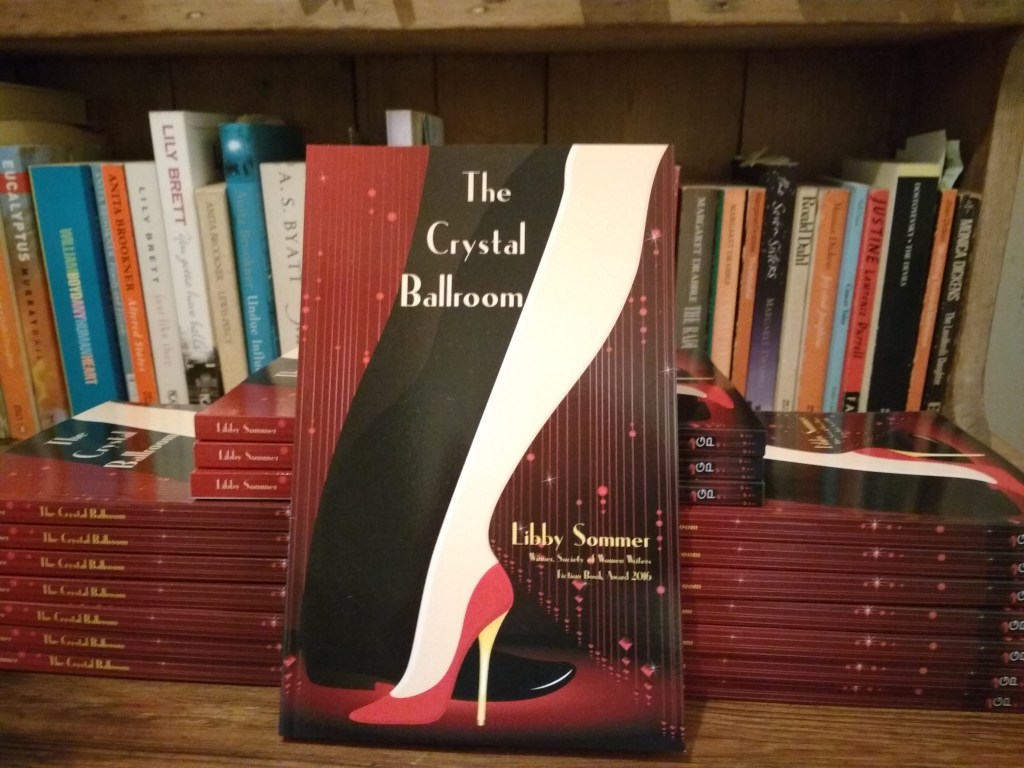
The Crystal Ballroom red and black book cover

My second novel, ‘The Crystal Ballroom‘ (Ginninderra Press) is a novel-in-stories.

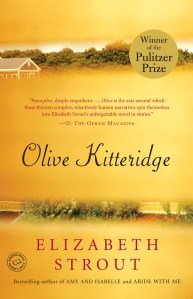
So what is a novel-in-stories? One famous example  is Elizabeth Strout’s Pullitzer Prize-winning ‘Olive Kitteridge’.

‘A penetrating, vibrant exploration of the human soul, the story of Olive Kitteridge will make you laugh, nod in recognition, wince in pain, and shed a tear or two.’ – Goodreads ‘In a voice more powerful and compassionate than ever before, New York Times bestselling author Elizabeth Strout binds together thirteen rich, luminous narratives into a book with the heft of a novel, through the presence of one larger-than-life, unforgettable character: Olive Kitteridge.’

yellow Olive Kitteridge book cover

A novel-in-stories, or connected short stories that together become more than the sum of their parts,  is also known as a short story cycle.

‘A short story cycle (sometimes referred to as a story sequence or compositenovel) is a collection of short stories in which the narratives are specifically composed and arranged with the goal of creating an enhanced or different experience when reading the group as a whole as opposed to its individual parts.’ – Wikipedia

The Canterbury Tales book cover

‘A novel-in-stories is a book-length collection of short stories that are interconnected. (One of the very first examples of this genre is The Canterbury Tales; a more recent example is The Girl’s Guide to Hunting and Fishing, by Melissa Bank.) A novel-in-stories overcomes two key challenges for writers: the challenge of writing a novel-length work, and the challenge of publishing a book-length work of unrelated short stories. (Few publishers are willing to publish a short-story collection from an unknown writer.) So, the novel-in-stories helps you sell a story collection like you would a novel—as long as the interconnected nature of the stories is strong and acts as a compelling hook. Another advantage to novels-in-stories is that they afford you the opportunity to publish pieces of your novel in a variety of literary magazines, which might attract the attention of an editor or agent.’ – Writer’s Digest

My book, ‘The Crystal Ballroom‘ is connected by place and by a first person narrator and her friend who exchange stories about the characters they meet at the singles dances as they search for a regular dance partner.

The Crystal Ballroom‘ was launched into the world by Stephen Matthews OAM at Collected Works Bookshop, Melbourne at an afternoon of launches and book readings to celebrate Ginninderra Press’s 21 years of independent publishing.

Writing Tip: Novel or Short Story?

white laptop,black and white notepad and pen, white mobile, on desk

Is a novel a short story that keeps going, or, is it a string of stories with connective tissue and padding, or, is it something else?  Essayist Greg Hollingshead believes that the primary difference between the short story and the novel is not length but the larger, more conceptual weight of meaning that the longer narrative must carry on its back from page to page, scene to scene.

“It’s not baggy wordage that causes the diffusiveness of the novel.  It’s this long-distance haul of meaning.”  Greg Hollingshead

There is a widespread conviction among fiction writers that sooner or later one moves on from the short story to the novel.  When John Cheever described himself as the world’s oldest living short story writer, everyone knew what he meant.

Greg Hollingshead says that every once in a while, to the salvation of literary fiction, there appears a mature writer of short stories—someone like Chekhov, or Munro—whose handling of the form at its best is so undulled, so poised, so capacious, so intelligent, that the short in short story is once again revealed as the silly adjective it is, for suddenly there are simply stories, spiritual histories, narratives amazingly porous yet concentrated and undiffused.

When you decide you want to write in a particular form—a novel, short story, poem—read a lot of writing in that form.  Notice the rhythm. How does it begin?  What makes it complete?  When you read a lot in a particular form, it becomes imprinted inside you, so when you sit at your desk to write, you produce that same structure.  In reading novels your whole being absorbs the pace of the sentences, the setting of scenes, knowing the colour of the bedspread and how the writer gets her character to move down the hallway to the front door.

I sit at my desk thinking about form as a low-slung blanket of cloud blocks my view of the sky.  Through the fly screen I inhale the sweet smell of earth after rain as another day of possibility beckons.

We might write five novels before we write a good one.  I wrote five book-length manuscripts before one was finally accepted for publication. My skill was in the short form. I’d published dozens of short stories in prestigious literary journals. So it made sense that my first book, ‘My Year With Sammy’ (Ginninderra Press) is a novella –  a small book.

What about you? Is your skill in the short form or the marathon?

book cover My Year With Sammy

Click To Buy