Writing Tip: taste life twice

writer at work at typewriter

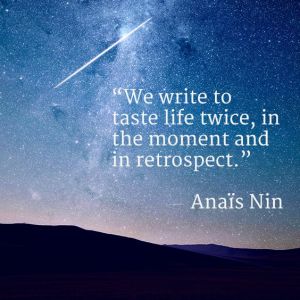
Writers live twice. They go along with their regular life, are as fast as anyone in the grocery store, crossing the street, getting dressed for work in the morning. But there’s another part of them that they have been training. The one that lives everything a second time. That sits down and sees their life again and goes over it. Looks at the texture and the details.”  – Natalie Goldberg

quote by Anais Nin against a night sky

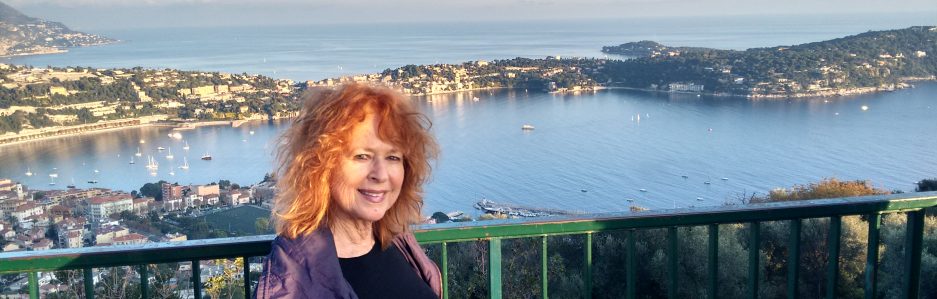
So here I am on a month away from my Sydney home wanting to recharge the creative batteries. I’ve just had a 4 night visit to Marrakech, Morocco. I got back to Villefranche sur Mer, where I’m renting a writing studio, last night. It’s a 3 hour flight between Nice France and Marrakech. So seeing as I’d traveled all the way across the world, I thought it a good time to visit Marrakech. Wow! What a creative experience. All the senses are awakened. Maybe I’ll live life twice and write something set in Morocco.

For now I’m feeling grateful to be able to travel and experience other cultures. The Marrakech-born people I met have never left their country. In the photos you can see me and Morad, the night manager at Riad Daria in Marrakech, one of the very kind and welcoming Moroccon’s who helped me during my stay. We’re pictured on the terrace of the riad. After the chaos of Marrakech’s souks, there’s nothing like a calm retreat. Below us is a corner of the rooftop terrace.

The first pic is the famous Jardin Marjorelle, the beautiful garden once owned by Yves Saint Laurent and home to the Berber Museum. He gifted the garden to Marrakech, the city that adopted him in 1964. Saint Laurent and his partner Pierre Berge bought the electric blue villa and its garden to preserve the vision of its original owner, landscape painter Jacques Majorelle, and keep it open to the public.  A memorial to the French fashion designer was built there. This year a new museum dedicated to him was opened next door to Jardin Marjorelle. I was lucky enough to visit. The museum retraces Saint Laurent’s forty years of creativity, the world of fashion he created, some designs influenced by his life in Marrakech. He too tasted life twice.


Writing Tip: Writing In Cafes

cafes, buses, palm trees, bright blue sky, cars on Bronte Road, Bronte

I am sitting in a café across the road from the beach in Bronte, Sydney.  This stretch of road has a whole row of cafes side by side facing the sea.  This is my favourite kind of writing place:  one where I can sit comfortably for a long period of time and where the owners of the café know me and welcome me.  This café is owned by a Brazilian man and his wife and has comfortable upholstered bench chairs with a direct view of the Pacific Ocean.  For my two-hour writing session my choice could be a traditional Brazilian dish such as Coxinha, Feijoda or Moqueca.  Or a cocktail like Caipirinha or  Caipiroska.  I must order something and it must be more that a Soy Cap, because I plan to be here for a long time.  I want the owners of the café to know I appreciate the time and the space they are allowing me.

However, today I’ll be very boring and order poached eggs on gluten-free bread 🙂

Why go to all this trouble to find a place to write?  Why not just stay home and work?  Because it’s good to get out and have a change of scene.  I find I need to be happy and relaxed when I’m creating on the page and sitting in a café with a pleasant vibe works for me.  Other writers need silence in order to concentrate, but I need to feel I am out and about in a beautiful place having a good time before the creative juices flow.

Strangely, writing in a café can help to increase concentration.  The busy café atmosphere keeps the sensory part of you occupied and content, so that the hidden, quieter part of you that composes and focuses is allowed to do its work.  It is something like being cunning when trying to get a spoonful of food into a resistant toddler’s mouth:  You pretend to be an aeroplane with all the sound effects and movements before landing the food-laden plane inside the child’s mouth.  Mission accomplished.

It is preferable not to turn up at a cafe for a cup of coffee and a writing session at the cafe’s busiest times, like breakfast or lunch. Go at the in between hours when they are pleased to see you because they don’t want the place to look deserted. The beach cafes are places I frequent in spring, autumn and winter, but not much in the summer. Far too crowded and noisy.

There is a real art to finding the right place to write. For me the best place  is one that has comfortable chairs, a pleasant outlook (preferably a view of the the sky and/or green or water). A welcoming, almost homely, atmosphere.

What about you?  Do you need to be at your desk in total silence to write, or do you like to experience the swell of humanity around you—to be surrounded by other human beings?  Or at home listening to a particular kind of music? Let me know in the comments and please share this post with a friend if you enjoyed it. 

3 of the Best: Finding the Writer’s Magic

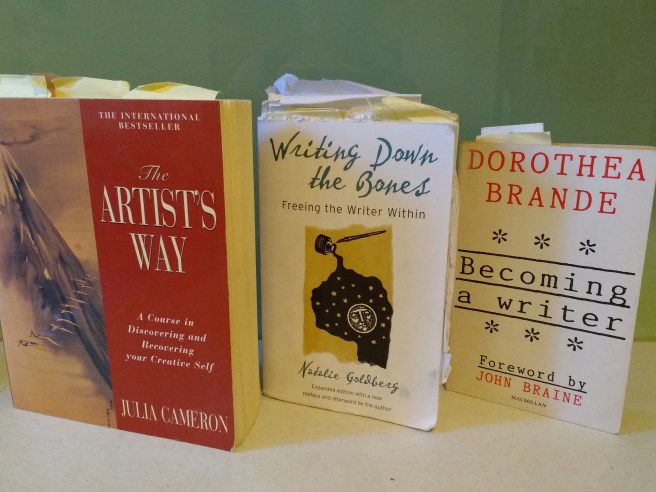
three book covers: The Artist's Way, Writing Down the Bones, Becoming a writer

So much advice out there on writing process but these three books, old ones but good ones, are my favorites. You can see how well-loved they are by how many pages are marked with stickers. I’ve used the books many times when teaching my ‘Writing from Within’ course where we try to harness the unconscious by falling into an artistic coma.

1.

Have you ever longed to be able to draw or paint, write or compose music? In ‘The Artist’s Way’ by Julia Cameron you can discover how to unlock your latent creativity and make your dreams a reality.

‘The Artist’s Way’  provides a twelve-week course that guides you through the process of recovering your creative self. It dispels the ‘I’m not talented enough’ conditioning that holds many people back and helps you to unleash your own inner artist.

‘The Artist’s Way’ helps demystify the creative process by making it part of your daily life. It tackles your self-doubts, self-criticism and worries about time, money and the support to pursue your creative dream.

2.

In ‘Writing Down the Bones’ by Natalie Goldberg, the secret of creativity, she makes clear, is to subtract rules for writing, not add them. It’s a process of “uneducation” rather than education. Proof that she knows what she’s talking about is abundant in her own sentences. They flow with speed and grace and accuracy and simplicity. It looks easy to a reader, but writers know it is the hardest writing of all.’ – Robert Pirsig

‘Writing Down the Bones’  Natalie Goldberg’s first book, sold millions of copies and has been translated into twelve languages. For more than thirty years she practiced Zen and taught seminars in writing as a spiritual practice.

3.

‘Becoming a writer’ by Dorothea Brande is a reissue of a classic work published in 1934 on writing and the creative process. It recaptures the excitement of Dorothea Brande’s creative writing classroom of the 1920s. Decades before brain research “discovered” the role of the right and left brain in all human endeavor, Dorothea Brande was teaching students how to see again, how to hold their minds still, how to call forth the inner writer.

‘Refreshingly slim, beautifully written and deliciously elegant, Dorothea Brande’s Becoming a Writer remains evergreen decades after it was first written. Brande believed passionately that although people have varying amounts of talent, anyone can write. It’s just a question of finding the “writer’s magic”–a degree of which is in us all. She also insists that writing can be both taught and learned. So she is enraged by the pessimistic authors of so many writing books who rejoice in trying to put off the aspiring writer by constantly stressing how difficult it all is.

‘With close reference to the great writers of her day–Wolfe, Forster, Wharton and so on–Brande gives practical but inspirational advice about finding the right time of day to write and being very self disciplined about it–“You have decided to write at four o’clock, and at four o’clock you must write.” She’s strong on confidence building and there’s a lot about cheating your unconscious which will constantly try to stop you writing by coming up with excuses. Then there are exercises to help you get into the right frame of mind and to build up writing stamina.

‘This is Dorothea Brande’s legacy to all those who have ever wanted to express their ideas in written form. A sound, practical, inspirational and charming approach to writing, it fulfills on finding “the writer’s magic.”‘ – John Gardner

I hope these recommendations are helpful. Do you have useful books on writing process you would add? Let me know in the comments and please share this post with a friend if you enjoyed it.

Obsession is Essential to Creativity

coffee cup, water, writing pad, pen on wooden table in cafe

Every once in a while, when I’m scratching around for something new to write, I make a list of the things I obsess about.  Thankfully, some of them change over time, but there are always new ones to fill the gap.

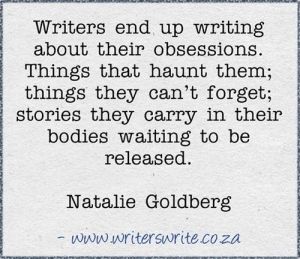
It’s true that writers write about what they think about most of the time.  Things they can’t let go: things that plague them; stories they carry around in their heads waiting to be heard.

Sometimes I get my creative writing groups to make a list of the topics they obsess about so they can see what occupies their thoughts during their waking hours.  After you write them down, you can use them for spontaneous writing before crafting them into stories.  They have much power.  This is where the juice is for writing.  They are probably driving your life, whether you realise it or not, so you may as well use them rather than waste your energy trying to push them away.  And you can come back to them repeatedly.

One of the things I’m always obsessing about is relationships:  relationships in families, relationships with friends, relationships with lovers.  That’s what I tend to write about.  I think to myself, Why not?  Rather than repress my obsessions, explore them, go with the flow.  And life is always changing, so new material keeps presenting  itself.

We are driven by our passions.  Am I the only one who thinks this?  For me these compulsions contain the life force energy.  We can exploit that energy.  The same with writing itself.  I’m always thinking and worrying about my writing, even when I’m on holidays.  I’m driven.

Not all compulsions are a bad thing.  Get involved with your passions, read about them, talk to other people about them and then they will naturally become ‘grist for the mill’.

quote about obsessions

What about you?  Do you find yourself writing about the same topics over and over again?

Jump Cuts on the Page


close up head & shoulders golden Labrador with pink tongue hanging out

by Libby Sommer:

After a big storm, a golden Labrador goes missing in Sydney’s Cooper Park. This is the scene that begins my new novel-in-progress. I use the search for the dog as a linking device for my characters who are all at a turning point in their lives. I jump cut between discreet scenes (not a continuous narrative) which, unfortunately, is very confusing to the readers in my weekly feedback group.

Transitions are important in fiction because you can’t possibly show or account for every moment in a character’s day, week, or life. A story may stretch over years—readers don’t need to know what happened every minute of those years. A scene transition takes characters and readers to a new location, a new time, or a new point of view.

Scene transitions in movies are easy. The screen fades to black at just the right moment, and when it lights up again, you’re watching a new scene. But how do you write transitions on the page? How does your character get from Point A to Point B without too much boring detail and telling description?

One way to write scene transitions in novels is to Jump Cut. The term usually refers to Cinema.

‘When Jean-Luc Godard popularized the jump cut in 1959 when he made his breakthrough movie Breathless, it has since become a useful and intriguing editing tool. For those of you who don’t know what a jump cut is: (per Wikipedia): “A jump cut is a cut in film editing in which two sequential shots of the same subject are taken from camera positions that vary only slightly. This type of edit causes the subject of the shots to appear to “jump” position in a discontinuous way.”’ – posted by Tyler on Southern Vision

‘The quick-paced German thriller throbs with jump cuts, zoom shots and the speedy sense of an instinctual filmmaker.’ – Charles Taylor, reviewing Run Lola Run

If you want to keep the narrative moving at a fast pace, you can jump cut on the page from scene to scene. But each scene needs to have a beginning a middle and an end.

This technique can be confusing at times, but effective and very readable.

One way to make Jump Cuts on the Page less confusing is to have a strong sense of place. The place is the setting of the story, where the action is located. Setting can be the connective tissue. For me it’s Cooper Park with its cafe, tennis courts, children’s playground, etc.  So, the missing dog, the park and the cafe lessen the confusion, make the transitions smoother – hopefully.

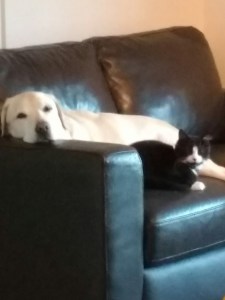
golden Labrador and black and white cat on black leather couch

What about you? Do you find writing scene transitions to be one of the most challenging aspects of writing a novel?

The Writers Life

grey dolphin swimming in the blue ocean

At a literary lunch recently I overheard someone say:  ‘The thing to do is put the idea in your subconscious.  Your brain will do the work.’

It takes time for our experience to make its way through our consciousness.  For example, it is hard to write about a journey while you are still in the midst of the adventure.  We have no distance from what is happening to us.  The only things we seem to be able to say are ‘having a great time’, ‘the weather is good’, ‘wish you were here’.  It is also hard to write about a place we just moved to, we haven’t absorbed it yet.  We don’t really know where we are, even if we can walk to the train station without losing our way.  We haven’t experienced three scorching summers in this country or seen the dolphins migrating south along the  coast in the winter.

“Maybe away from Paris I could write about Paris as in Paris I could write about Michigan.  I did not know it was too early for that because I did not know Paris well enough.” – Ernest Hemingway, A Moveable Feast  (New York:  Charles Scribner’s Sons, 1964).

So we take in experience, but we need to let things make their way through our consciousness for a while and be absorbed by our whole selves.  We are bower birds, collecting experience, and from the thrown away apple skins, outer lettuce layers, tea leaves, and chicken bones of our minds come our ideas for stories and poems and songs.  But this does not come any time soon.  It takes a very long time (three to ten years in the case of literary fiction).  We need to keep picking through these scraps until some of the thoughts together form a pattern or can be organised around a central theme, something  we can shape into a narrative.  We mine our hidden thoughts for ideas.  But the ideas need time to percolate:  to slowly filter through.

Rumi, the thirteenth-century Sufi poet, summed up what could be the creative process when he wrote ‘The Guest House’:

This being human is a guest house.

Each morning a new arrival.

A joy, a depression, a meanness,

some momentary awareness comes

as an unexpected visitor.

Welcome and entertain them all!

Even if they are a crowd of sorrows,

who violently sweep your house

empty of its furniture,

still, treat each guest honorably.

He may be clearing you out

for some new delight.

The dark thought, the shame, the malice,

meet them at the door laughing and invite

them in.

Be grateful for whoever comes,

because each has been sent

as a guide from beyond.

Jalaluddin Rumi, in The Essential Rumi

Translated by Coleman Barks, 1999

Our work is to keep rummaging through the rubbish bins of our minds, exercising the writing muscle, in readiness to answer that knock at the door when it comes.

As the author Vivian Gornick said:  ‘The writers life is the pits.  You live alone and you work alone, every day I have to recreate myself.’  She paused and laughed.  ‘But when the work is going well there is nothing that compares.’

What about you? Are you ready to answer the knock at the door?  🙂

Header image: Creative Commons
Writing Tip: Taste Life Twice

quote by Anais Nin against a night sky

“Writers live twice. They go along with their regular life, are as fast as anyone in the grocery store, crossing the street, getting dressed for work in the morning. But there’s another part of them that they have been training. The one that lives everything a second time. That sits down and sees their life again and goes over it. Looks at the texture and the details.”  – Natalie Goldberg

the book of longing

Leonard Cohen's 'Book of Longing' with bird in a tree cover drawing

As the world mourns the death of legendary songwriter and musician Leonard Cohen, his art lives on.

The Hallelujah singer’s death last week sparked a massive outpouring of grief across the internet, from fans and fellow musicians alike, including Beck, Courtney Love, A Tribe Called Quest’s Q-Tip and Nick Cave.

“For many of us, Leonard Cohen was the greatest songwriter of them all. Utterly unique and impossible to imitate, no matter how hard we tried,” Cave wrote.

News of Cohen’s death, coming on the heels of the US presidential election results, was also praised by tweeters as the singer’s last compassionate corrective to hateful political chatter, bringing the world’s attention back to the redeeming beauty of art.

“The date of Leonard Cohen’s death is not a coincidence,” went one widely shared tweet. “He did it so we’d stop talking about an imbecile, and instead focus on poetry.”- Sydney Morning Herald

Leonard Cohen made his name as a poet before he came to worldwide attention as a singer and songwriter.

He wrote the poems in Book of Longing his first book of poetry in more than twenty years during his five-year stay at a Zen monastery on Southern California’s Mount Baldy, and in Los Angeles, Montreal, and Mumbai. This dazzling collection is enhanced by the author’s playful and provocative drawings, which interact in exciting, unexpected ways on the page with poetry that is timeless, meditative, and often darkly humorous. An international sensation, Book of Longing contains all the elements that have brought Cohen’s artistry with language worldwide recognition. – Book Depository

The poems in Book of Longing show the full range of one of the most influential and enigmatic writers of his generation.

The book of longing

I can’t make the hills
The system is shot
I’m living on pills
For which I thank G-d
I followed the course
From chaos to art
Desire the horse
Depression the cart
I sailed like a swan
I sank like a rock
But time is long gone
Past my laughing stock
My page was too white
My ink was too thin
The day wouldn’t write
What the night penciled in
My animal howls
My angel’s upset
But I’m not allowed
A trace of regret
For someone will use
What I couldn’t be
My heart will be hers
Impersonally
She’ll step on the path
She’ll see what I mean
My will cut in half
And freedom between
For less than a second
Our lives will collide
The endless suspended
The door open wide
Then she will be born
To someone like you
What no one has done
She’ll continue to do
I know she is coming
I know she will look
And that is the longing
And this is the book – Leonard Cohen

Who do you think should have won the Nobel Prize for Literature, Bob Dylan or Leonard Cohen?

The Writing Life

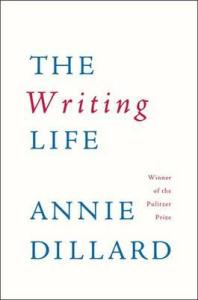
Book cover 'The Writing Life' by Annie Dillard

Another of my favourite books on the writing process is The Writing Life by Annie Dillard, a small and passionate guide to the terrain of a writer’s world.

Annie Dillard has written eleven books, including the memoir of her parents, An American Childhood; the Northwest pioneer epic The Living; and the nonfiction narrative Pilgrim at Tinker Creek winner of the 1975 Pullizer Prize.  A gregarious recluse, she is a member of the American Academy of Arts and Letters.

Continue reading

who I am and why I blog

35059_35059_0_2_0_2

My name is Libby Sommer and I’m a Sydney writer.  My first book, ‘My Year With Sammy’ was published by Ginninderra Press in December, 2015.  It’s available as a paperback and an eBook.

I started to blog on WordPress in February this year as a way to communicate with other writers and readers and to share some of the things I’ve learnt .  32 of my short fictions have been published in literary journals in Australia and the U.S.  I post one of these stories each fortnight on WordPress.  Every other week  I post something about the writing process.  My tips concentrate on one aspect of the craft of creative writing.

My second book, ‘Tales of the Crystal Ballroom’ has been accepted for publication by Ginninderra Press and will come out later this year, or early next year.  The stories are about some of the characters who dance in a fictional dance hall.  My short story ‘At the Festival’ is published May 2016 in Quadrant.  And I’m proud to say I’ve had a poem accepted for an anthology of Social Justice poems to be published by Ginninderra Press in July 2016 to celebrate their 20 year anniversary.  Sorry for the shameless Self Promotion.

As I live and work alone, blogging is a way for me to connect with a community of like-minded people.  Isolation is the bane of the home office worker.  As a creative person, we need heaps of time and space alone and we work in a room all by ourselves, although my preference is to work with pen and paper in a cafe surrounded by other humans.  We also need stimulation and social interaction.

My children are grown up and lead their own lives.  My life mostly consists of reading and writing, working out at the gym, Yoga, coffees or lunch with friends, spending time with family, movies, long walks in nature, bush dancing (previously Ballroom and Latin American dancing).  It’s a pretty good life, except for that damn problem of isolation.