Path to Publication

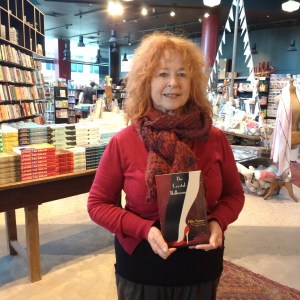
Libby Sommer holding a copy of The Crystal Ballroom in book store

Interviewer: I would like you to tell me about your Path to Publication from first idea to finished book. I’d like to know your inspirations and how The Crystal Ballroom became more than an idea. I also want to know about your writing process. Do you sit at a desk 9-5 or at a cafe during snatched lunches? Did you write the book in a spurt of three months … how long did it take from start to finish? Did you have cold readers, send it to an agent or to a publisher? Were you accepted straight away? How many rewrites and drafts?

Me:  I usually write stories about places and people that I know well. I take real events and characters but change things around and shake them all about and make things up. So, for The Crystal Ballroom, I had been dancing Argentine tango, rock and roll, jive, swing, Latin American and ballroom dancing for many many years. I used to dance five nights a week. I’d drive all over Sydney for technique classes and to dance at different venues. The place, ‘The Crystal Ballroom’, is a fiction but this dance hall becomes a character in the novel. I was inspired by the people I met at the dances and the politics of the ‘dance scene’.

I don’t sit at a desk 9-5 but I am extremely disciplined with my writing. I write 7 days a week. I treat my manuscript like an old friend, someone I need to stay in touch with regularly. I also exercise 7 days a week. So my routine is to go to a cafe before the gym with a print out of the previous day’s work. I edit from this hard copy and write the next scene. After the gym I walk home, type out the revisions, print out, go to another cafe in the afternoon. Repeat the process. I only work in the AM on a Sunday 🙂

It took me 4 years to write The Crystal Ballroom. The chapters are self-contained, so I was able to send some of the discreet episodes out to Quadrant magazine for publication.

I belong to a weekly feedback writing group where we critique each others’ work. So I write to that weekly deadline. In the early years, when I’d finish a manuscript I’d pay an editor or mentor to read it and give me feedback. I’d also ask a couple of friends to read it and give feedback. I never send a manuscript to an agent or a publisher that hasn’t been reworked 20 to 100 times – that includes the rewriting along the way.

My Year With Sammy was my first published book. It was accepted straight away by Ginninderra Press, a small but prestigious publisher (thought-provoking books for inquiring readers). It was my fifth book length manuscript. I had sent the previous books to agents and large publishers. All my confidence had been knocked out of me by all the rejections leading up to the fifth manuscript. Now though, I have Ginninderra Press who seem to like my work. They also published The Crystal Ballroom this year. The Usual Story will be published by Ginninderra Press next year.

It’s an extremely difficult road to publication and some people decide to self-publish rather than continue to be rejected. But other people are able to write a best-seller, an airport book that sells lots of copies, so big publishers like their work very much. Unfortunately, or fortunately, my books are classified as literary fiction, so a very small market. Big publishers are not interested in books that do not conform to the norm. Not enough money in it for them.

I am very grateful to have my small but prestigious publisher.

Writing from Within

Trees and shrubs leading to glass door of Brahma Kumaris Centre
Brahma Kumaris Centre for Spiritual Learning

I’m running a writing workshop this Saturday at the Brahma Kumaris Centre for Spiritual Learning in Wilton, New South Wales. It is part of the Society of Women Writers Retreat weekend. I’ve titled my course ‘Writing from Within’ because the aim is to tap into the right side of the brain, leaving aside that nasty critical left side, and really getting to the heart of what you want to write. I’ve run workshops like this before. Usually I use a combination of meditation techniques, and a guided colour exercise for relaxation and then spontaneous writing, or timed writing. It’s truly amazing what people write when they are able to get into the zone and not be held back by negative thinking.

These are the rules of timed writing according to Natalie Goldberg in ‘Writing Down the Bones’:

  1. Keep your hand moving. (Don’t pause to reread the line you have just written. That’s stalling and trying to get control of what you’re saying.)

  2. Don’t cross out. (That is editing as you write. Even if you write something you didn’t mean to write, leave it.)

  3. Don’t worry about spelling, punctuation, grammar. (Don’t even care about staying within the margins and lines on the page.)

  4. Lose control.

  5. Don’t think. Don’t get logical.

  6. Go for the jugular. (If something comes up in your writing that is scary or naked, dive right into it. It probably has lots of energy.)

Should be a excellent weekend featuring publisher Catherine Milne and presentations from authors Emily Maguire, Susanne Gervay, Kathryn Heyman, Libby Hathorn, Beverley George.

book cover of Writing Down the Bones by Natalie Goldberg

Writing Tip: A Sense of Place

writing desk with keyboard, screen and printer in front of window
My home office

I’m sitting at my writing desk this spring morning in Sydney thinking about the need to ground our writing in a sense of place, whether landscape or cityscape.

How often have you heard someone say of a book they loved:  ‘I felt like I was there.’

Even if you relocate the poodle tied to a fake-cane chair, the sound of a game of tennis, the table of older men after their regular Sunday match at the café overlooking the tennis courts at Cooper Park that you drank a lemongrass and ginger tea at in Sydney into a café in a story in another state and time, the story will have originality and believability.  ‘But that café was in Sydney, I can’t transport it to Adelaide.’  But you can.  You can have flexibility with specific detail.  The mind is able to transport details, but using actual places that you experienced will give your writing authenticity and truthfulness.  It grounds your work in place, giving life and vitality to your writing, rather than a whole lot of exposition that floats in the air.

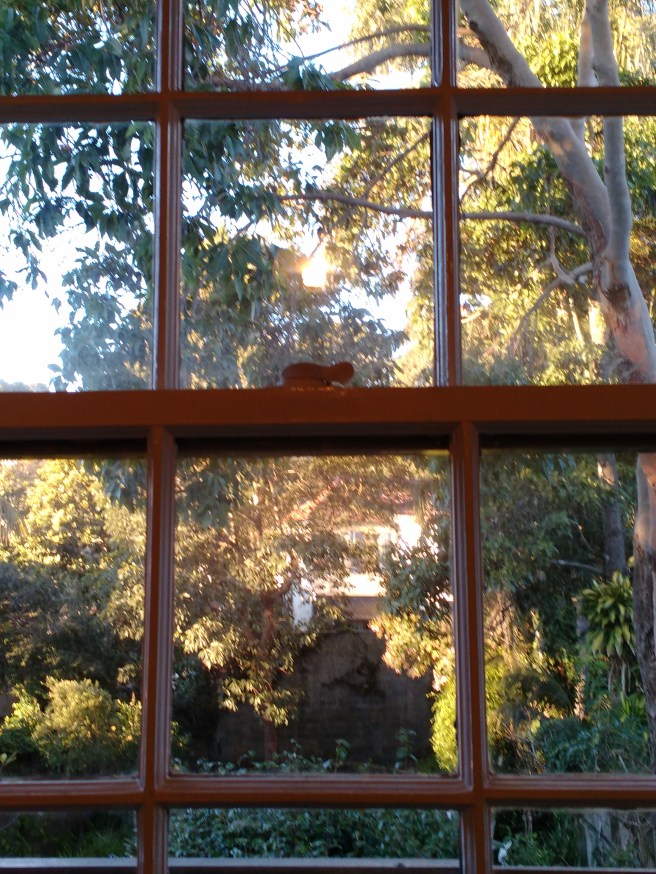
trees and house seen outside French paneled window
looking out the window from my writing desk

 If you don’t create evocative settings, your characters seem to have their conversations in vacuums or in some beige nowhere-in-particular. –  Jerome Stern

Creation of the physical world is as important to your story as action and dialogue.  If your readers can be made to see the hand-knitted socks or the row of vitamins on the kitchen benchtop, the scene becomes alive.  Readers pay attention.  Touch, sound, taste, and smell make readers feel as if their own feet are warm under the cold sheets.

Place situates the story in your reader’s mind.  Fiction that seems to happen in no particular place often seems not to take place at all. –  Jerome Stern

I hope this tip on creating a sense of place is helpful. Do you have any suggestions you would add? Let me know in the comments and please share this post with a friend if you enjoyed it.

2 Years Rewriting Short Story

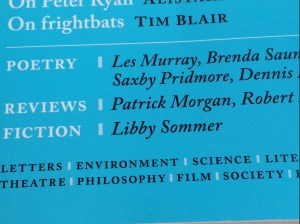
close up of September Quadrant magazine cover

My short story On Valentine’s Day appears in the September Quadrant available now in newsagents and good book stores. It took two years of rewriting before the story was accepted for publication. In Friday’s mail I received my contributor’s copy and a generous cheque. My name is on the front cover. Always a thrill. It took many years of my stories appearing in Quadrant before my name made it to the cover 🙂

The first paragraph of On Valentine’s Day reads:

You had to get out of them occasionally, those Australian country towns with the funny names:  Wagga Wagga, Wee Waa, Woy Woy. Once, after a devastating week wiped out more than $4 trillion from the global stock exchanges, one of the local papers boasted a banner headline:  WAGGA WAGGA WOMAN WEDS WOY WOY TOY BOY. You had to make an effort from time to time to get out, even if it meant flying all the way across the Nullarbor to go to a Valentine’s Day party.


My critique group will recognize the first paragraph. We meet weekly at the New South Wales Writers Centre to give and receive feedback on two pages of our writing. I brought sections of the 4,000 word On Valentine’s Day many times to the Women Writers Network at the Centre. Two dear friends also read the  story and commented. Very much appreciated. More than once my two friends read the whole of On Valentine’s Day and offered constructive criticism. I couldn’t have got the story to a publishable standard without my writing group and my two friends. Lucky me.

Quadrant is a highly regarded literary magazine: http://quadrant.org.au/september-quadrant-now-sale/

Quadrant blue magazine cover

I can’t emphasize enough how useful it is to have a weekly writing group. I work to that deadline. We take a couple of pages each and have 12 minutes to read and receive feedback. I think of it as ‘off Broadway’ and ‘on Broadway’.  Famous comedians like Jerry Seinfeld and Woody Allen say they test their material out on an ‘off Broadway’ audience before performing ‘on Broadway’.

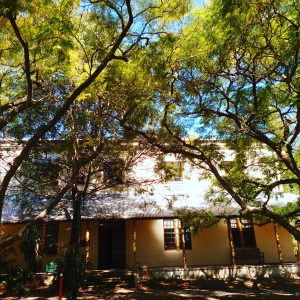
picture of the New South Wales Writers Centre with trees in foreground
New South Wales Writers Centre

What about you? Are you in a writing group? Do you find it useful?

Jump Cuts: Novel-in-progress

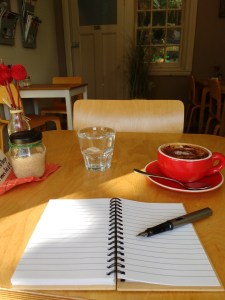
notepad, fountain pen, coffee on table

Below is the first page of my new novel-in-progress. I jump cut from scene to scene. Hopefully this technique is not too confusing. Have you read other novels that use this structure? At the front of the book I’ll be adding a Character List and a Character Map to show how the major characters are connected, to help with the confusion issue. The working title is ‘Missing in Cooper Park’.

1.

The tennis courts at Cooper Park were flooded in the night.  One and a half hours of non-stop rain and hail caused a landslide down through the gully.  Gypsy, a Golden Labrador came along and splashed in fast-flowing Cooper Creek.  Later, the sight of the ruined courts covered in mud and stones, leaves and tree branches like a murky swamp was to shatter Steve’s morning.

2.

Kingston (Carol’s ex) turned up again on the morning after the storm.  He stood on the doorstep looking unbalanced.  His cigarette was burned down to the filter.  His unshaven face was flecked with grey and white.  Carol wouldn’t let him in.  She’d taken his key back.

Carol didn’t tell Steve about Kingston being back but Steve told Carol about the flooded tennis courts.

3.

The moon was high in the darkening dusk as Rosemary puffed past the tennis courts at Cooper Park and continued on up through the steep incline of the gulley swinging a curved stick with tennis ball.

‘Gypsy,’ cried Rosemary.  ‘Gypsy, Gypsy, Gypsy!  Come here.’

Rosemary had purchased Gypsy after overcoming her husband’s resistance.  They were still in mourning over having to put Buddy down.

She’d promised Philip she’d make sure Gypsy didn’t jump up on the newly-cleaned couches.

He knew Rosemary slipped into depression if she didn’t have a dog to love, even though she was the mother of three children.

They’d bought a puppy who looked just like a baby Buddy.  Rosemary would have liked to say it was Buddy re-incarnated but didn’t.  This was precisely the kind of talk that made her husband go red with anger.

It was he who had named the Golden Labrador Gypsy.         The day would soon be night.

4.

Steve lay in bed waiting for Carol’s alarm to go off.  Outside someone had slept all night in a car.

‘Don’t let anyone in,’ demanded Carol in a dream.

I Am Not the Stories I Tell

two book covers: 'My Year With Sammy' and 'The Crystal Ballroom'

by Libby Sommer:

Sometimes when people read my stories they assume those stories are me.  They are not me, even if I write in the first person.  They were my thoughts and feelings at the time I wrote them.  But every minute we are all changing.  There is a great freedom in this.  At any time we can let go of our old selves and start again.  This is the writing process.  Instead of blocking us, it gives us permission to move on.  Just like in a progressive ballroom dance:  you give your undivided attention to your partner—keep eye contact for the time you are dancing together—but then you move on to the next person in the circle.

The ability to express yourself on the page—to write how you feel about an old lover, a favourite pair of dance shoes, or the memory of a dance on a chilly winter’s night in the Southern Highlands—that moment you can support how you feel inside with what you say on the page.  You experience a great freedom because you are not suppressing those feelings.  You have accepted them, aligned yourself with them.

I have a poem titled ‘This is what it feels like’. It’s a short poem.  I always think of it with gratitude  because I was able to write in a powerful way how it was to be desperate and frightened.  The act of self expression made me feel less of a victim.  But when people read it they often say nothing. I remind myself, I am not the poem, I am not the stories I write.  People react from where they are in their own lives.  That’s the way things are.  The strength is in the act of writing, of putting pen to paper.   Write your stories and poems, show them to the world, then move on.  The stories are not you.  They are moments in time that pass through you.

What is your experience? 

Is it a short story or a novel?

white laptop,black and white notepad and pen, white mobile, on desk

Is a novel a short story that keeps going, or, is it a string of stories with connective tissue and padding, or, is it something else?  Essayist Greg Hollingshead believes that the primary difference between the short story and the novel is not length but the larger, more conceptual weight of meaning that the longer narrative must carry on its back from page to page, scene to scene.

“It’s not baggy wordage that causes the diffusiveness of the novel.  It’s this long-distance haul of meaning.”  Greg Hollingshead

There is a widespread conviction among fiction writers that sooner or later one moves on from the short story to the novel.  When John Cheever described himself as the world’s oldest living short story writer, everyone knew what he meant.

Greg Hollingshead says that every once in a while, to the salvation of literary fiction, there appears a mature writer of short stories—someone like Chekhov, or Munro—whose handling of the form at its best is so undulled, so poised, so capacious, so intelligent, that the short in short story is once again revealed as the silly adjective it is, for suddenly there are simply stories, spiritual histories, narratives amazingly porous yet concentrated and undiffused.

When you decide you want to write in a particular form—a novel, short story, poem—read a lot of writing in that form.  Notice the rhythm. How does it begin?  What makes it complete?  When you read a lot in a particular form, it becomes imprinted inside you, so when you sit at your desk to write, you produce that same structure.  In reading novels your whole being absorbs the pace of the sentences, the setting of scenes, knowing the colour of the bedspread and how the writer gets her character to move down the hallway to the front door.

I sit at my desk thinking about form as a low-slung blanket of cloud blocks my view of the sky.  Through the fly screen I inhale the sweet smell of earth after rain as another day of possibility beckons.

We might write five novels before we write a good one.  I wrote five book-length manuscripts before one was finally accepted for publication. My skill was in the short form. I’d published dozens of short stories in prestigious literary journals. So it made sense that my first book, ‘My Year With Sammy’ (Ginninderra Press) is a novella –  a small book.

What about you? Is your skill in the short form or the marathon?

book cover My Year With Sammy

Click To Buy

Writing Tip: Start writing

fountain pen on page of writing

When I used to teach classes to beginning writers, it was good.  It forced me to think back to the beginning to when I first put pen to paper.  The thing is, every time we sit down and face the blank page, it’s the same.  Every time we start a new piece of writing, we doubt that we can do it again.  A new journey with no map – like setting off towards the horizon alone in a boat and the only thing another person can do to help is to wave from the shore.

So when I used to teach a creative writing class, I had to tell them the story all over again and remember that this is the first time my students are hearing it.  I had to start at the very beginning.

First up, there’s the pen on the page.  You need this intimate relationship between the pen and the paper to get the flow of words happening.  A fountain pen is best because the ink flows quickly.  We think faster than we can write.  It needs to be a “fat” pen to avoid RSI.

Consider, too, your notebook.  It is important.  The pen and paper are your basic tools, your equipment, and they need to be with you at all times.  Choose a notebook that allows you plenty of space to write big and loose.  A plain cheap thick spiral notepad is good.

After that comes the typing up on the computer and printing out a hard copy.  It’s a right and left brain thing.  You engage the right side of the brain, the creative side when you put pen to paper, then bring in the left side, the analytic side, when you edit the print out as you settle back comfortably with a drink (a cup of tea, even) and read what you’ve written.

Patrick White said that writing is really like shitting; and then, reading the letters of Pushkin a little later, he found Pushkin said exactly the same thing.  Writing is something you have to get out of you.

typing writing on a pink background

Whether writing a story or writing a blog, start writing, no matter what.

Fortnightly Story: Jean-Pierre

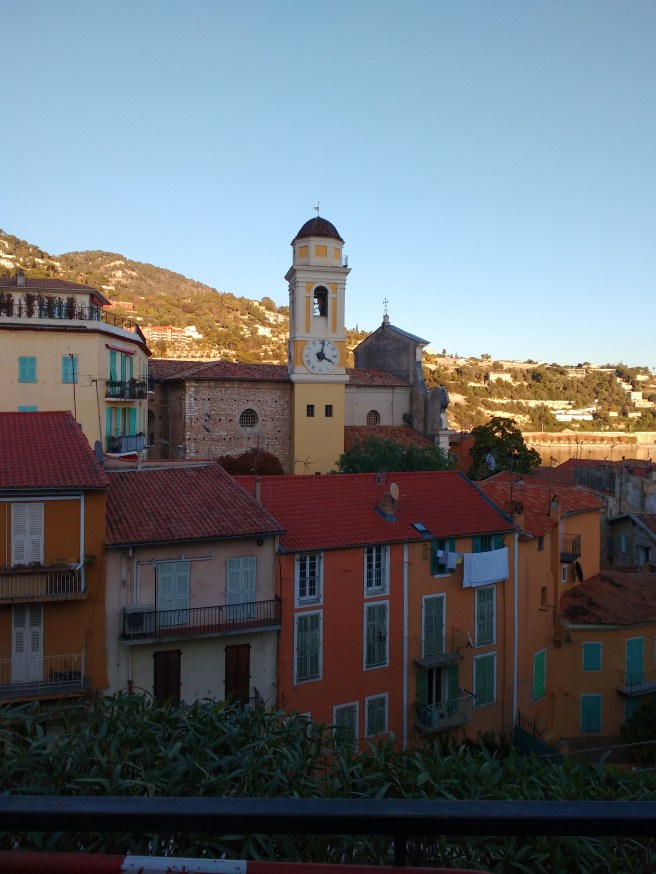
buildings and Town Clock of Villefranche sur Mer

This was in a far distant land.  There were Pilates classes but no surfing beaches or vegan restaurants.  People said to hell with low-fat diets and tiny portions.  Charles, who had wanted her to hire his friend Jean-Pierre as tour guide, had encouraged her in yoga class.    ‘Look, Zina, you’re a facilitator—you’ve been running those groups—for what—thirty years?’

‘Only twenty, for goodness sake.’  She had turned forty-nine and frowned at him upside down between the legs of a downward facing dog.  She had a face marked by the sun, a face left to wrinkle and form crevasses by years of smoking, a face made shiny by the application of six drops of jojoba oil, although the shop girl had recommended she use only three.  ‘I love that word facilitator.  It says so much.’

‘Twenty.  All right.  This guy’s not at all your type.  He’s a numbers man.  He shows tourists around in between Engineering contracts.  He can show you how to buy a bus or a train ticket, how to withdraw money out of the wall—get your bearings.  You can hire him for half a day.  Or, in your case, half a day and half the night.’

‘Very funny,’ she said, stifling a laugh.  Now they were on all fours arching their backs like cats, then flattening their spines to warm up the discs.  Indian chanting music took your mind off the fact that the person behind you was confronted with your broad derriere. ‘So what’s the story with Jean-Pierre?’ Continue reading

Publication of my new poem

Quadrant cover January-February 2017

I returned home to Sydney from my Writing-Retreat-For-One on the Cote d’Azur this week to some very good news. There in the mail was my contributor’s copy of Quadrant and a very much appreciated cheque. This is the first time Quadrant has accepted one of my poems for publication. The poem is titled Lying on a Harbour Beach at Noon. I feel honored to be included as a poet in this prestigious Australian literary magazine.