One-Page Review of The Crystal Ballroom

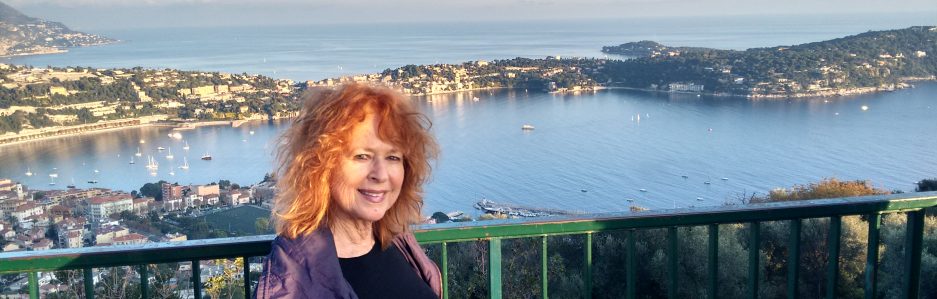
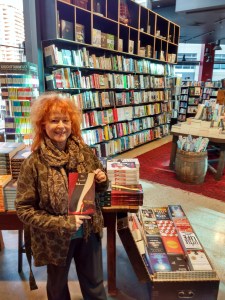
author holding copy of The Crystal Ballroom


I was delighted to see a one-page review of my novel ‘The Crystal Ballroom‘ in October Quadrant magazine (available now in newsagents or on-line).

Penelope Nelson writes:

‘Have you ever heard Latin American music coming from an upper room over a shop, and lingered briefly at the sign about dancing classes? Perhaps you have seen people–a man in built-up shoes or a woman with a surfeit of silver bangles–heading for an old town hall after dark. The world of ballroom dancing and tango lessons has its own etiquette and hierarchies. Libby Sommer’s new fiction ‘The Crystal Ballroom’ lifts the lid on the delights and pitfalls of this fascinating sub-culture …

‘Sommer has great skill in creating atmosphere. The music, the swirling scents of aftershave and sweat, the decor of ballrooms, flats, motels and shared tents are powerfully evoked …

‘Some of the best passages in the book express the joy of dancing:

We’re practising walking the length of the hall. Alberto says that in Buenos Aires students of tango spend two years just learning to walk properly.  “Extend forward,” he says, “step forward, only placing the weight on the extended leg at the last moment, toes pointed, sides of the feet staying connected on the floor.” Then backwards with a straight leg, torso pulled up, chest up and out, and with a partner again, always there’s that special connection with a partner.

Hopefully, this wonderful review by Penelope Nelson will give sales of the book a boost. ‘The Crystal Ballroom’ is available directly from Gininnderra Press, in bookstores, and online.

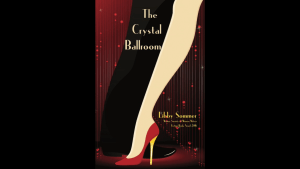
red and black The Crystal Ballroom book cover


3 of the Best: Finding the Writer’s Magic

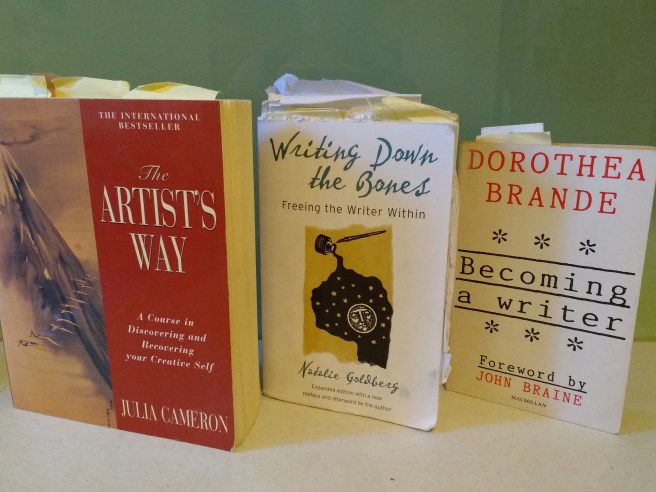
three book covers: The Artist's Way, Writing Down the Bones, Becoming a writer

So much advice out there on writing process but these three books, old ones but good ones, are my favorites. You can see how well-loved they are by how many pages are marked with stickers. I’ve used the books many times when teaching my ‘Writing from Within’ course where we try to harness the unconscious by falling into an artistic coma.

1.

Have you ever longed to be able to draw or paint, write or compose music? In ‘The Artist’s Way’ by Julia Cameron you can discover how to unlock your latent creativity and make your dreams a reality.

‘The Artist’s Way’  provides a twelve-week course that guides you through the process of recovering your creative self. It dispels the ‘I’m not talented enough’ conditioning that holds many people back and helps you to unleash your own inner artist.

‘The Artist’s Way’ helps demystify the creative process by making it part of your daily life. It tackles your self-doubts, self-criticism and worries about time, money and the support to pursue your creative dream.

2.

In ‘Writing Down the Bones’ by Natalie Goldberg, the secret of creativity, she makes clear, is to subtract rules for writing, not add them. It’s a process of “uneducation” rather than education. Proof that she knows what she’s talking about is abundant in her own sentences. They flow with speed and grace and accuracy and simplicity. It looks easy to a reader, but writers know it is the hardest writing of all.’ – Robert Pirsig

‘Writing Down the Bones’  Natalie Goldberg’s first book, sold millions of copies and has been translated into twelve languages. For more than thirty years she practiced Zen and taught seminars in writing as a spiritual practice.

3.

‘Becoming a writer’ by Dorothea Brande is a reissue of a classic work published in 1934 on writing and the creative process. It recaptures the excitement of Dorothea Brande’s creative writing classroom of the 1920s. Decades before brain research “discovered” the role of the right and left brain in all human endeavor, Dorothea Brande was teaching students how to see again, how to hold their minds still, how to call forth the inner writer.

‘Refreshingly slim, beautifully written and deliciously elegant, Dorothea Brande’s Becoming a Writer remains evergreen decades after it was first written. Brande believed passionately that although people have varying amounts of talent, anyone can write. It’s just a question of finding the “writer’s magic”–a degree of which is in us all. She also insists that writing can be both taught and learned. So she is enraged by the pessimistic authors of so many writing books who rejoice in trying to put off the aspiring writer by constantly stressing how difficult it all is.

‘With close reference to the great writers of her day–Wolfe, Forster, Wharton and so on–Brande gives practical but inspirational advice about finding the right time of day to write and being very self disciplined about it–“You have decided to write at four o’clock, and at four o’clock you must write.” She’s strong on confidence building and there’s a lot about cheating your unconscious which will constantly try to stop you writing by coming up with excuses. Then there are exercises to help you get into the right frame of mind and to build up writing stamina.

‘This is Dorothea Brande’s legacy to all those who have ever wanted to express their ideas in written form. A sound, practical, inspirational and charming approach to writing, it fulfills on finding “the writer’s magic.”‘ – John Gardner

I hope these recommendations are helpful. Do you have useful books on writing process you would add? Let me know in the comments and please share this post with a friend if you enjoyed it.
Another great review for The Crystal Ballroom


The Crystal Ballroom book covers

I was delighted to read another wonderful and insightful review of The Crystal Ballroom this morning. It’s on Goodreads.

Here’s an extract:

An intriguing book, neither a collection of short stories nor a novel, but a series of vignettes – snapshots − of women, no longer young, but who are determined to wring every drop of verve and excitement out of life. Most of the action is revealed in conversations over coffee or drinks, between the protagonist, Sofia and her friend Ingrid. The ‘glue’ holding the story – or rather stories − together is a love of ballroom dancing and the venues in which such events are held, in particular the Crystal Ballroom, which is a character in its own right. 

In this unusual book Libby Sommer puts women’s psyches under the microscope – their hopes and dreams, fears and foibles – yet always with a deft touch and a sympathetic ear. 

You can read the whole review here.

Writing Tip: A Sense of Place

writing desk with keyboard, screen and printer in front of window
My home office

I’m sitting at my writing desk this spring morning in Sydney thinking about the need to ground our writing in a sense of place, whether landscape or cityscape.

How often have you heard someone say of a book they loved:  ‘I felt like I was there.’

Even if you relocate the poodle tied to a fake-cane chair, the sound of a game of tennis, the table of older men after their regular Sunday match at the café overlooking the tennis courts at Cooper Park that you drank a lemongrass and ginger tea at in Sydney into a café in a story in another state and time, the story will have originality and believability.  ‘But that café was in Sydney, I can’t transport it to Adelaide.’  But you can.  You can have flexibility with specific detail.  The mind is able to transport details, but using actual places that you experienced will give your writing authenticity and truthfulness.  It grounds your work in place, giving life and vitality to your writing, rather than a whole lot of exposition that floats in the air.

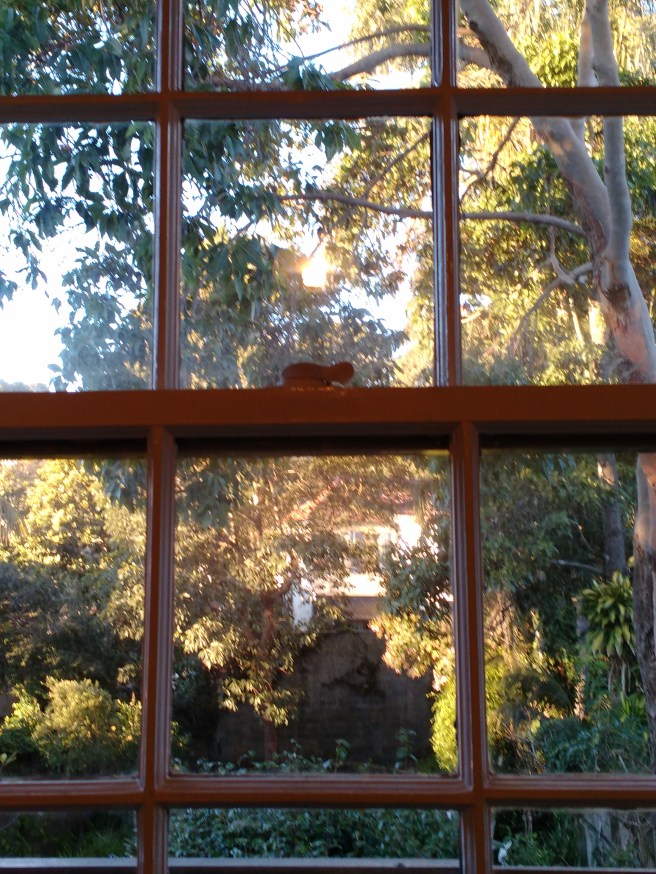
trees and house seen outside French paneled window
looking out the window from my writing desk

 If you don’t create evocative settings, your characters seem to have their conversations in vacuums or in some beige nowhere-in-particular. –  Jerome Stern

Creation of the physical world is as important to your story as action and dialogue.  If your readers can be made to see the hand-knitted socks or the row of vitamins on the kitchen benchtop, the scene becomes alive.  Readers pay attention.  Touch, sound, taste, and smell make readers feel as if their own feet are warm under the cold sheets.

Place situates the story in your reader’s mind.  Fiction that seems to happen in no particular place often seems not to take place at all. –  Jerome Stern

I hope this tip on creating a sense of place is helpful. Do you have any suggestions you would add? Let me know in the comments and please share this post with a friend if you enjoyed it.
2 Years Rewriting Short Story

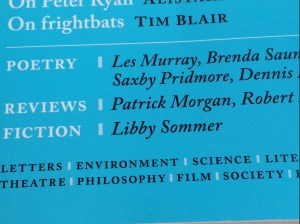
close up of September Quadrant magazine cover

My short story On Valentine’s Day appears in the September Quadrant available now in newsagents and good book stores. It took two years of rewriting before the story was accepted for publication. In Friday’s mail I received my contributor’s copy and a generous cheque. My name is on the front cover. Always a thrill. It took many years of my stories appearing in Quadrant before my name made it to the cover 🙂

The first paragraph of On Valentine’s Day reads:

You had to get out of them occasionally, those Australian country towns with the funny names:  Wagga Wagga, Wee Waa, Woy Woy. Once, after a devastating week wiped out more than $4 trillion from the global stock exchanges, one of the local papers boasted a banner headline:  WAGGA WAGGA WOMAN WEDS WOY WOY TOY BOY. You had to make an effort from time to time to get out, even if it meant flying all the way across the Nullarbor to go to a Valentine’s Day party.


My critique group will recognize the first paragraph. We meet weekly at the New South Wales Writers Centre to give and receive feedback on two pages of our writing. I brought sections of the 4,000 word On Valentine’s Day many times to the Women Writers Network at the Centre. Two dear friends also read the  story and commented. Very much appreciated. More than once my two friends read the whole of On Valentine’s Day and offered constructive criticism. I couldn’t have got the story to a publishable standard without my writing group and my two friends. Lucky me.

Quadrant is a highly regarded literary magazine: http://quadrant.org.au/september-quadrant-now-sale/

Quadrant blue magazine cover

I can’t emphasize enough how useful it is to have a weekly writing group. I work to that deadline. We take a couple of pages each and have 12 minutes to read and receive feedback. I think of it as ‘off Broadway’ and ‘on Broadway’.  Famous comedians like Jerry Seinfeld and Woody Allen say they test their material out on an ‘off Broadway’ audience before performing ‘on Broadway’.

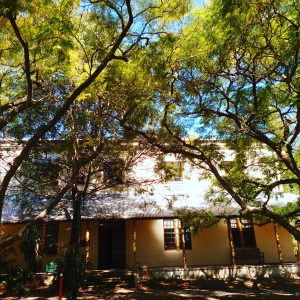
picture of the New South Wales Writers Centre with trees in foreground
New South Wales Writers Centre

What about you? Are you in a writing group? Do you find it useful?

3 Parts to the Feedback Sandwich

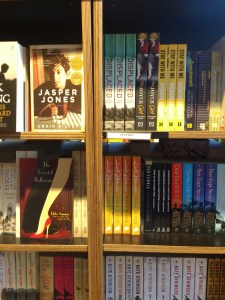
'The Crystal Ballroom' on bookshelf at bookstore

Yesterday, in the Saturday-afternoon feedback group, we began talking about the ‘off with his head’ or ‘out-it-goes’ part of writing.  We acknowledged that as a group we’d always been very supportive and encouraging of each others work.  That is because we are all in it together.  Our critiquing was not telling lies; it was from a place of open-hearted acceptance.  Everything you put on the page is acceptable.

Sometimes someone says, ‘I want a rigorous no-holds-barred assessment of my work.’  But what do you say to them when the writing is dull and boring?  Don’t give up your day job?  It doesn’t sit comfortably with most of us to be directly critical of someone’s writing.  It’s like telling someone how ugly their baby is.  All of us find it hard to separate our writing from ourselves, and are prone to take criticism personally.

The feedback sandwich is a widely known technique for giving constructive feedback, by ‘sandwiching’ the criticism between two pieces of praise or compliments.

hamburger with cheese and two beef patties

As we passed around copies of our work (just a page or two) we started to address what William Faulkner famously said:

‘In writing, you must kill all your darlings.’

First of all, we looked for the juice in each piece.  Where did the writing come alive?  ‘Get rid of the rest,’ we said.  ‘Off with his head—out it goes.’   It’s very difficult to be this honest, and not everyone wants to hear it.  ‘I simply want gentle support and a few corrections,’ some of us might say.

Be willing to have the courage to look at your work with truthfulness.  It’s good to know where your writing has energy and vitality, rather than to spend a lot of time trying to make something come to life that is dead on the page.   Keep writing.  Something new will come up.    You don’t want to put your readers to sleep by writing a lot of boring sentences.

I hope these suggestions are useful. Do you have any tips you would add? Let me know in the comments and please share this post with a friend if you enjoyed it.  
Jump Cuts: Novel-in-progress

notepad, fountain pen, coffee on table

Below is the first page of my new novel-in-progress. I jump cut from scene to scene. Hopefully this technique is not too confusing. Have you read other novels that use this structure? At the front of the book I’ll be adding a Character List and a Character Map to show how the major characters are connected, to help with the confusion issue. The working title is ‘Missing in Cooper Park’.

1.

The tennis courts at Cooper Park were flooded in the night.  One and a half hours of non-stop rain and hail caused a landslide down through the gully.  Gypsy, a Golden Labrador came along and splashed in fast-flowing Cooper Creek.  Later, the sight of the ruined courts covered in mud and stones, leaves and tree branches like a murky swamp was to shatter Steve’s morning.

2.

Kingston (Carol’s ex) turned up again on the morning after the storm.  He stood on the doorstep looking unbalanced.  His cigarette was burned down to the filter.  His unshaven face was flecked with grey and white.  Carol wouldn’t let him in.  She’d taken his key back.

Carol didn’t tell Steve about Kingston being back but Steve told Carol about the flooded tennis courts.

3.

The moon was high in the darkening dusk as Rosemary puffed past the tennis courts at Cooper Park and continued on up through the steep incline of the gulley swinging a curved stick with tennis ball.

‘Gypsy,’ cried Rosemary.  ‘Gypsy, Gypsy, Gypsy!  Come here.’

Rosemary had purchased Gypsy after overcoming her husband’s resistance.  They were still in mourning over having to put Buddy down.

She’d promised Philip she’d make sure Gypsy didn’t jump up on the newly-cleaned couches.

He knew Rosemary slipped into depression if she didn’t have a dog to love, even though she was the mother of three children.

They’d bought a puppy who looked just like a baby Buddy.  Rosemary would have liked to say it was Buddy re-incarnated but didn’t.  This was precisely the kind of talk that made her husband go red with anger.

It was he who had named the Golden Labrador Gypsy.         The day would soon be night.

4.

Steve lay in bed waiting for Carol’s alarm to go off.  Outside someone had slept all night in a car.

‘Don’t let anyone in,’ demanded Carol in a dream.

Obsession is Essential to Creativity

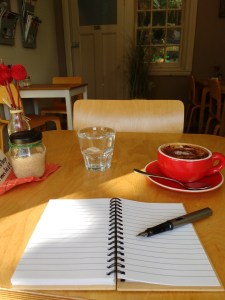
coffee cup, water, writing pad, pen on wooden table in cafe

Every once in a while, when I’m scratching around for something new to write, I make a list of the things I obsess about.  Thankfully, some of them change over time, but there are always new ones to fill the gap.

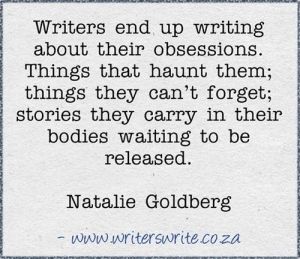
It’s true that writers write about what they think about most of the time.  Things they can’t let go: things that plague them; stories they carry around in their heads waiting to be heard.

Sometimes I get my creative writing groups to make a list of the topics they obsess about so they can see what occupies their thoughts during their waking hours.  After you write them down, you can use them for spontaneous writing before crafting them into stories.  They have much power.  This is where the juice is for writing.  They are probably driving your life, whether you realise it or not, so you may as well use them rather than waste your energy trying to push them away.  And you can come back to them repeatedly.

One of the things I’m always obsessing about is relationships:  relationships in families, relationships with friends, relationships with lovers.  That’s what I tend to write about.  I think to myself, Why not?  Rather than repress my obsessions, explore them, go with the flow.  And life is always changing, so new material keeps presenting  itself.

We are driven by our passions.  Am I the only one who thinks this?  For me these compulsions contain the life force energy.  We can exploit that energy.  The same with writing itself.  I’m always thinking and worrying about my writing, even when I’m on holidays.  I’m driven.

Not all compulsions are a bad thing.  Get involved with your passions, read about them, talk to other people about them and then they will naturally become ‘grist for the mill’.

quote about obsessions

What about you?  Do you find yourself writing about the same topics over and over again?

‘Painstaking Progress’ revisited


sunset over the ocean

‘Painstaking Progress’ is another of my stories, like ‘Art and the Mermaid’, that was first published in Quadrant Magazine. It shows the difficulties of the writing process for the narrator as she tries to make sense of  her family history and agonizes about the relationship with her young lover.

Painstaking Progress

by Libby Sommer

I’m imagining a cloudy autumn morning.  There’s a room.  Half office, half bedroom.  Not too large and not too small.  The windows of the room face east and look out towards the ocean across the expanse of a green gully.

I picture a woman sitting on a bed with pillows behind her back.  The windows are open.  Perhaps it is Saturday morning.  On the bedside table is a mug of tea and a photograph of the woman’s daughter on her wedding day.

The wind begins to stir the big trees outside and the morning haze is beginning to move and for a short moment the sun lightens the carpet and heavy dark wood furniture.  The shadows of the curtains’ curves darken the floor, almost invisible to the woman on the bed.   The morning sun lightens the CD player, the alarm clock, the piles of books stacked on the revolving Victorian bookcase.

She looks out at the water and at the triangle of beach.  Sometimes it seems that nothing much changes out there, although on some days the waves break close to shore and at other times further out to sea.  She can see it all from the bed, even at night time.  The bed faces the beach and the ocean, and so does the desk.  The room is like standing at the rail of a ship.

On the radio:  ‘Waves, to me, are a reason to live,’ says the surfer.  ‘When you see the roar, the jaws, there is nothing that touches it on the face of the earth.’

In June the twilight begins in the afternoon.  The days close in on me, here in

this room.  The infinite possibilities in the sky and the sea and the possibility of nothing.

What is this writing life?  It tears me to pieces every day.

Continue reading

Have made it to the top of the mountain

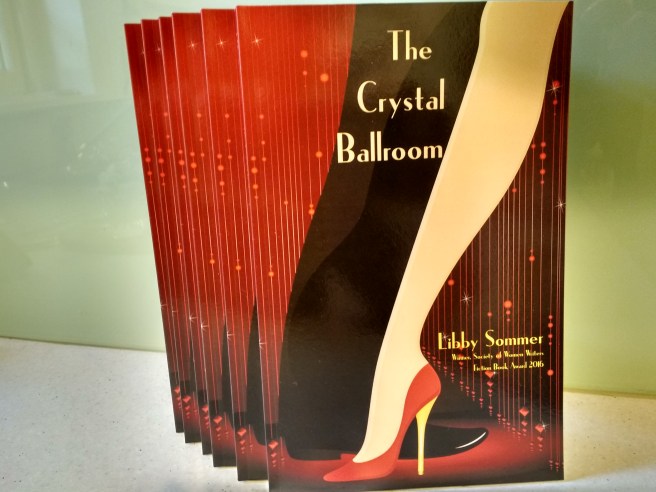
red and black book cover 'The Crystal Ballroom' by Libby Sommer

Have finally made it to the top of the second-book-publication mountain. Received pre-release copy of The Crystal Ballroom this week. Looking good. You can order copies now through the Ginninderra Press website . Also available as an ebook from Amazon, Book Depository and other online sellers.

‘Libby Sommer lays bare the foibles of human nature in her finely observed stories of love and loss in the singles dance scene. Brilliantly drawn with wit, compassion and poignancy, the characters you meet in The Crystal Ballroom are sure to remind you of someone—maybe even yourself.’ – Jan Cornall, Writer’s Journey.

 ‘Libby Sommer exposes the secret lives of the singles who dance at The Crystal Ballroom. Authentic and powerful, this unique book will be loved by the dancers and readers.’ Frida Kotlyar, ballroom, Latin and Argentine tango dancer.

 Happy happy me.