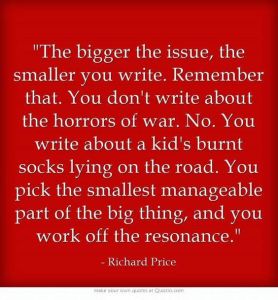

The bigger the issue, the smaller you write.

A quote: the bigger the issue, the smaller you write - Richard Price

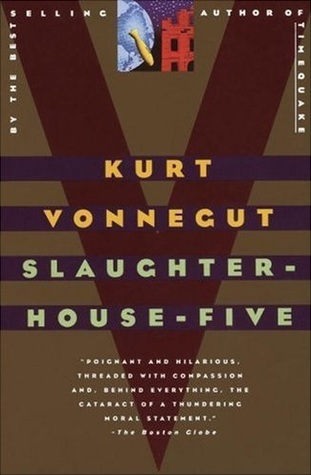
A fantastic example of this writing advice is Kurt Vonnegut’s  Slaughterhouse-Five.

Poignant and hilarious, threaded with compassion and, behind everything, the cataract of a thundering moral statement. – The Boston Globe

book cover of Kurt Vonnegut's 'Slaughterhouse-Five'

Kurt Vonnegut’s absurdist classic Slaughterhouse-Five introduces us to Billy Pilgrim, a man who becomes unstuck in time after he is abducted by aliens from the planet Tralfamadore. In a plot-scrambling display of virtuosity, we follow Pilgrim simultaneously through all phases of his life, concentrating on his (and Vonnegut’s) shattering experience as an American prisoner of war who witnesses the firebombing of Dresden.

Don’t let the ease of reading fool you – Vonnegut’s isn’t a conventional, or simple, novel. He writes, “There are almost no characters in this story, and almost no dramatic confrontations, because most of the people in it are so sick, and so much the listless playthings of enormous forces. One of the main effects of war, after all, is that people are discouraged from being characters.”

Slaughterhouse-Five is not only Vonnegut’s most powerful book, it is also as important as any written since 1945. Like Catch- 22, it fashions the author’s experiences in the Second World War into an eloquent and deeply funny plea against butchery in the service of authority. Slaughterhouse-Five boasts the same imagination, humanity, and gleeful appreciation of the absurd found in Vonnegut’s other works, but the book’s basis in rock-hard, tragic fact gives it a unique poignancy – and humor. – Goodreads

Highly recommended. A masterpiece.


Fortnightly Story: Jean-Pierre

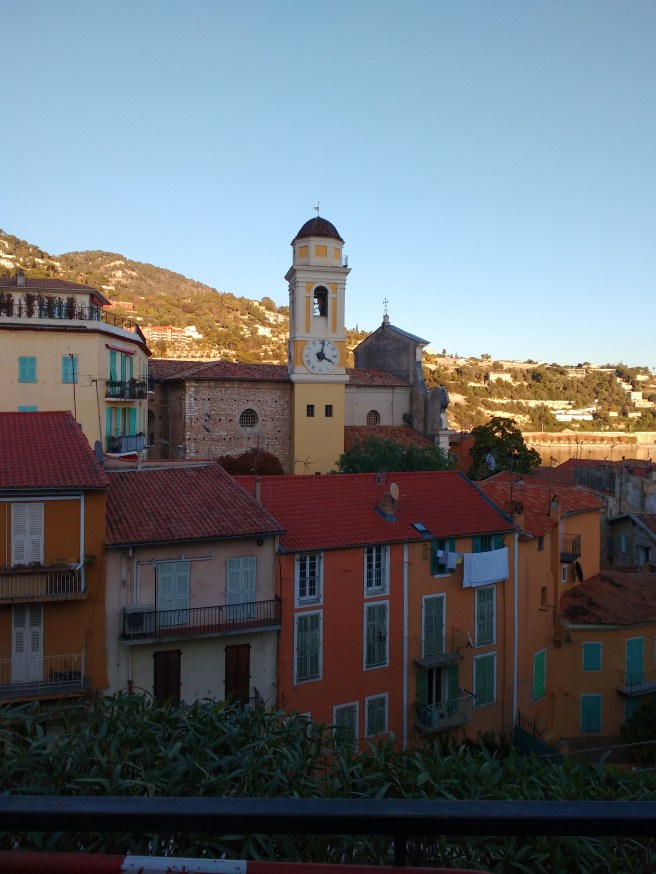
buildings and Town Clock of Villefranche sur Mer

This was in a far distant land.  There were Pilates classes but no surfing beaches or vegan restaurants.  People said to hell with low-fat diets and tiny portions.  Charles, who had wanted her to hire his friend Jean-Pierre as tour guide, had encouraged her in yoga class.    ‘Look, Zina, you’re a facilitator—you’ve been running those groups—for what—thirty years?’

‘Only twenty, for goodness sake.’  She had turned forty-nine and frowned at him upside down between the legs of a downward facing dog.  She had a face marked by the sun, a face left to wrinkle and form crevasses by years of smoking, a face made shiny by the application of six drops of jojoba oil, although the shop girl had recommended she use only three.  ‘I love that word facilitator.  It says so much.’

‘Twenty.  All right.  This guy’s not at all your type.  He’s a numbers man.  He shows tourists around in between Engineering contracts.  He can show you how to buy a bus or a train ticket, how to withdraw money out of the wall—get your bearings.  You can hire him for half a day.  Or, in your case, half a day and half the night.’

‘Very funny,’ she said, stifling a laugh.  Now they were on all fours arching their backs like cats, then flattening their spines to warm up the discs.  Indian chanting music took your mind off the fact that the person behind you was confronted with your broad derriere. ‘So what’s the story with Jean-Pierre?’ Continue reading

Publication of my new poem

Quadrant cover January-February 2017

I returned home to Sydney from my Writing-Retreat-For-One on the Cote d’Azur this week to some very good news. There in the mail was my contributor’s copy of Quadrant and a very much appreciated cheque. This is the first time Quadrant has accepted one of my poems for publication. The poem is titled Lying on a Harbour Beach at Noon. I feel honored to be included as a poet in this prestigious Australian literary magazine.

thank you

happy new year 2017

Happy New Year dear Friends and Followers. Thank you so much for your ongoing support and enthusiasm during the year. Very much appreciated. Best wishes to you all for good health and happiness in 2017.

Fortnightly Story: At the Festival

guitar and harmonica on the grass at sunset

It was six o’clock in the evening when she finally passed the wind turbines.  There, at last, stood Lake George, where long-woolled sheep grazed the field and to the west the Brindabella mountain range was coloured grey and pink by the setting sun.   On she drove along an ink-black strip of road where, on either side, tall green-grey eucalypts had formed a welcoming archway.  The way flattened out then curved into a narrow empty road.  Not one person did she see, not one building, just a handful of brown-bellied cows and later a group of kangaroos standing formidable and still in the headlights.  The turn for Watson wasn’t clearly sign-posted but she felt confident in turning east along the row of liquid ambers in autumn bloom that took her to the cabins. Continue reading

Writing Tip: Don’t Tell, but Show

cartoon illustrating angry boy with red face

This is an old one, but a good one. What does it mean exactly? It means don’t tell us about loneliness (or any of those complex words like dishonesty, secrecy, jealousy, obsession, regret, death, injustice, etc) show us what loneliness is. We will read what you’ve written and feel the bite of loneliness. Don’t tell us what to feel. Show us the situation, and that feeling will be triggered in us.

When you take your child to school on their first day you may find yourself teary and relieved at the same time. Put into words what you see: the child’s face, the wave at the gate, the other mothers saying their goodbyes, another child coming up to take your son by the hand. We will get what you’re trying to say without you telling us directly.

The how-to-write books tell us to use our senses when we write stories:  sight, sound, smell, touch. Writing from the senses is a good way to penetrate your story and make friends with it. Don’t tell us about something, drop deep, enter the story and take us with you.

What about you? Do you consciously bring the senses into your creative writing?

Fortnightly Story: Helen

Villefranche sur Mer

Although she loved her nieces and nephews, it was when she turned thirty-nine that driving young children around in her car seemed to make her nervous—a tightening in the stomach.  “Aunty Helen, would you like to take Naomi to see The Muppets?  Are you free?”  Always these requests from one of her sisters looking tired and desperate—one of her younger siblings, they used to be so close—and Helen would force herself to make the effort to be the good aunty.  The responsibility of passengers in her car always made her anxious.  She was anxious about one thing or the other most of the time, but wanted to appear selfless and generous-spirited.  Her availability, or non-availability, was noted, itemised, either in her favour, or against her.  She didn’t want to be labelled self-obsessed.  She had entered an era when the nicest thing a person could say to her was, “You’re a fabulous aunty.  The kids love you.”  Continue reading

Writing Tip: Taste Life Twice

quote by Anais Nin against a night sky

“Writers live twice. They go along with their regular life, are as fast as anyone in the grocery store, crossing the street, getting dressed for work in the morning. But there’s another part of them that they have been training. The one that lives everything a second time. That sits down and sees their life again and goes over it. Looks at the texture and the details.”  – Natalie Goldberg