Taste Life Twice – Repost

uncapped fountain pen on page

“Writers live twice. They go along with their regular life, are as fast as anyone in the grocery store, crossing the street, getting dressed for work in the morning. But there’s another part of them that they have been training. The one that lives everything a second time. That sits down and sees their life again and goes over it. Looks at the texture and the details.”  – Natalie Goldberg

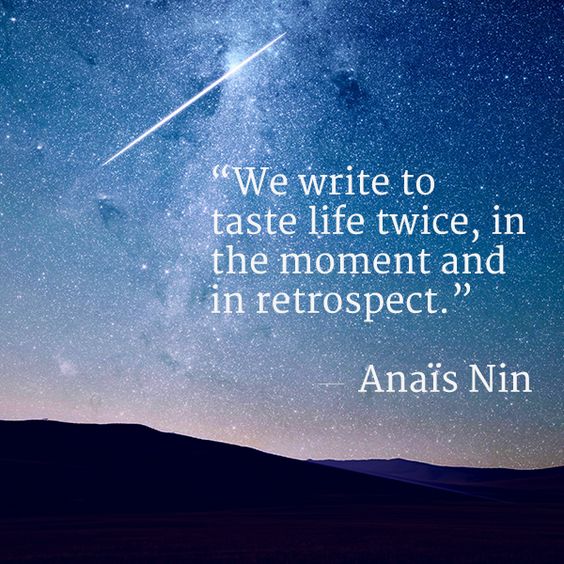
quote by Anais Nin against a night sky

What do you think? Do you taste life twice as a writer? I do. What about you?

‘Lost In Cooper Park’


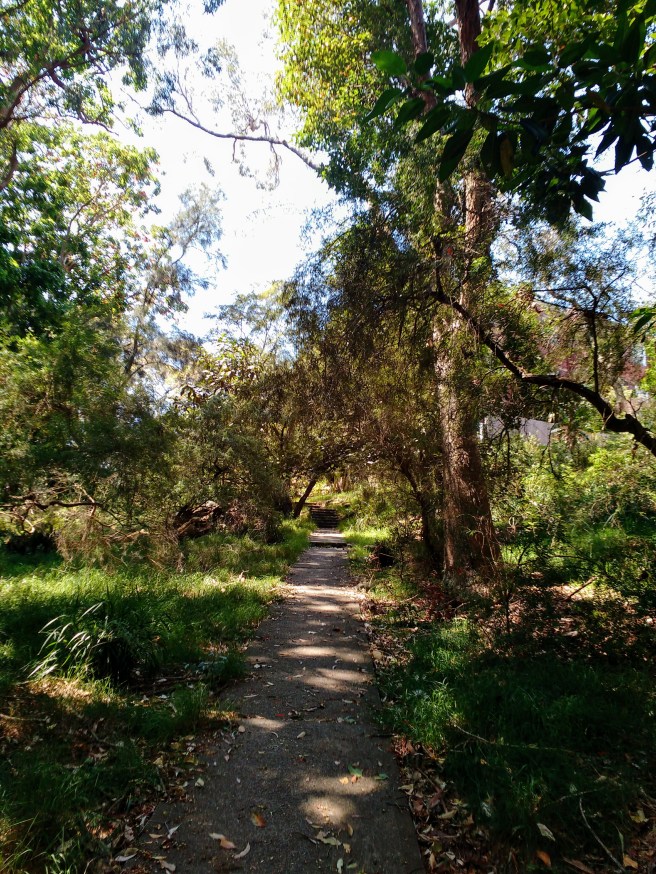
a path through the trees in Cooper Park
Cooper Park, Sydney

I’m delighted to tell you that my fifth manuscript, LOST IN COOPER PARK has been accepted for publication by small but prestigious publisher Ginninderra Press. Ginninderra is an award-winning independent publisher based in Port Adelaide, South Australia. They publish thought-provoking books for inquiring readers.

Thank g-d for Ginninderra. If it weren’t for them, my books wouldn’t be out there in the world.

LOST IN COOPER PARK is set in Cooper Park, a unique, large, natural green space in the  Eastern Suburbs of Sydney with hidden trail walks, tennis courts, picnic areas and dog walking. A great location for a writer like me to come up with a story idea. The book is a continuous narrative this time, rather than a collection of linked stories.

Ginninderra Press’s unique philosophy is:

We believe that all people – not just a privileged few – have a right to participate actively in cultural creation rather than just being passive consumers of mass media. Our culture is revitalised and enriched when everyone is encouraged to fulfil their creative potential and diminished when that creative potential is stifled or thwarted. We love to observe the transformative possibilities for people when they see their work published and acknowledged. Getting published can and does change lives.

Information about Ginninderra on the website includes:

‘Ginninderra is part of Canberra’s Belconnen area, in which Ginninderra Press operated for its first twelve years before moving to Port Adelaide in 2008. Ginninderra is an Aboriginal word said to mean ‘throwing out little rays of light’.

‘Ginninderra Press, described in The Canberra Times as ‘versatile and visionary’, is an independent book publisher set up in 1996 to provide opportunities for new and emerging authors as well as for authors writing in unfashionable genres or on non-mainstream subjects. In the words of one of our authors, we are ‘a small but significant publisher of small but significant books’. Many of our titles have won awards (to see a full list, click here).

‘Ginninderra Press recognises the fact that many people have good ideas for books but cannot get them published, either because of their inexperience in preparing manuscripts or because the potential sales are insufficient to interest a conventional publisher. Ginninderra Press offers expert editing and proofreading, as well as design and lay out services. To see submission guidelines, click here.’

Thank you, thank you, thank you to Ginninderra Press. LOST IN COOPER PARK is due for publication in November 2020. So exciting!

Writing Tip: Don’t Tell, but Show – Repost

photo of a woman thinking

This is an old one, but a good one. What does it mean exactly? It means don’t tell us about loneliness (or any of those complex words like dishonesty, secrecy, jealousy, obsession, regret, death, injustice, etc) show us what loneliness is. We will read what you’ve written and feel the bite of loneliness. Don’t tell us what to feel. Show us the situation, and that feeling will be triggered in us.

When you take your child to school on their first day you may find yourself teary and relieved at the same time. Put into words what you see: the child’s face, the wave at the gate, the other mothers saying their goodbyes, another child coming up to take your son by the hand. We will get what you’re trying to say without you telling us directly.

The how-to-write books tell us to use our senses when we write stories:  sight, sound, smell, touch. Writing from the senses is a good way to penetrate your story and make friends with it. Don’t tell us about something, drop deep, enter the story and take us with you.

What about you? Do you consciously bring the senses into your creative writing?

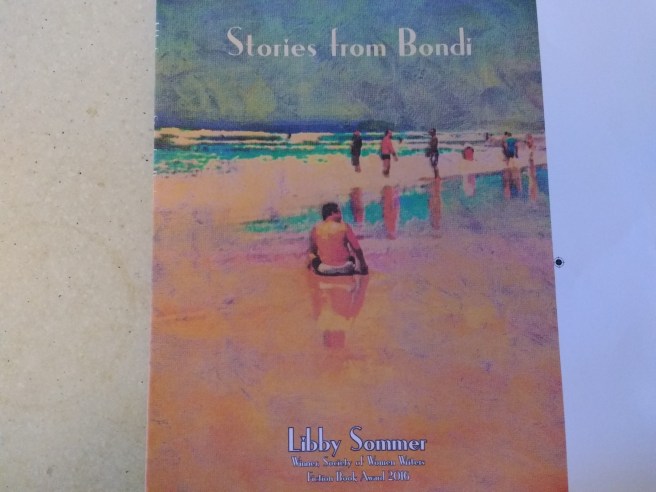
Launch: Stories from Bondi

painting of girl lying on beach in torquoise bikini reading a book

I was very lucky to have award-winning Australian author Susanne Gervay OAM launch my 4th book STORIES FROM BONDI on 2 November at the Blue Mountains Heritage Centre.  Susanne and I first became friends about seven years ago when I stayed at her hotel in Woollahra for three weeks while recovering from major surgery. I’d mentioned our mutual friend Sharon Rundle and Susanne had said that anyone who was a friend of Sharon’s was a friend of hers. Susanne would notice me each morning in the corner of the cafe at the hotel working on my stories and she’d often come over and have a chat. Since that time she has continued to show an interest in my work and my writing career. She would encourage me to enter competitions and always remained positive about publication possibilities. Susanne is now one of my best friends. Lucky me.

It’s been a twenty year journey to book publication. I had five book length manuscripts written before I had one accepted for publication by Ginninderra Press. I am forever grateful to Stephen Matthews for giving me a chance. MY YEAR WITH SAMMY, the fifth book I’d written, went on to be Pick of the Week in Spectrum Books in the Sydney Morning Herald and was winner of the Society of Women Writers Fiction Book Award 2016.

So then I sent Stephen Matthews at Ginninderra Press manuscript numbers four, three, and two. He has published one book a year since 2015:  MY YEAR WITH SAMMY, THE CRYSTAL BALLROOM, THE USUAL STORY and now, STORIES FROM BONDI.

A massive thank you to my publisher.

And thank you to all those who supported me at the launch by buying copies of  my books.

In an animated entertaining presentation Susanne Gervay launched STORIES FROM BONDI by saying in her introduction:

‘Libby’s a red head. That’s the only thing I can think of for her extraordinary life. From my intense research, I know that redheads represent less than 2% of the population so they are a rare breed. They are sensitive, fiery, passionate, and also have more sex than blondes or brunettes. Sorry Libby, I learnt that from Cosmopolitan magazine.’

Susanne is a wonderful guest speaker. She had the whole room laughing wholeheartedly.

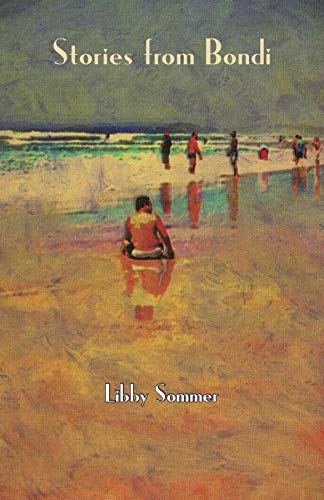
stories from bondi amazon cover image


Slow Things Down in Your Writing

woman in blue tennis dress position to hit big forehand

So, here’s the thing:  choose something in particular to write about. For example, what it felt like having a tennis lesson after a twenty year break. Give us the specifics. Dig deep for the details, but at the same time be aware of the world around you. As you focus on what you’re writing, at the same time stay conscious of your surroundings:  the white painted cane Bentwood chairs in the café, the cool breeze from under the door on your sandaled feet, the hum of the traffic outside. Just add a sentence every now and then about the trees that overlooked the tennis courts while you were having a tennis lesson. When we focus on our writing it is good. Seeing the colour of the sky when you toss the ball gives breathing space to your story.

If you are sitting in Meditation you calm the butterfly mind by paying attention to your thoughts, giving them space by acknowledging them before returning to the breath, in and out through the nostrils. In the act of slowing down your breathing, as best you can, you remain open so that you are receptive to awareness of sounds as they arise: sounds near, sounds far, sounds in front, behind, to the side, above or below.

With every breath you take, you feel the air, the sound of the ball as it hits the racket, the  players on the other courts.

We should always be living in the present, not by ignoring the world around us, but by paying close attention. It is not easy to stay alive to ‘what is’. When we slow things down in our writing, it is good practice.

What about you? Do you find a daily meditation practice assists your writing practice?

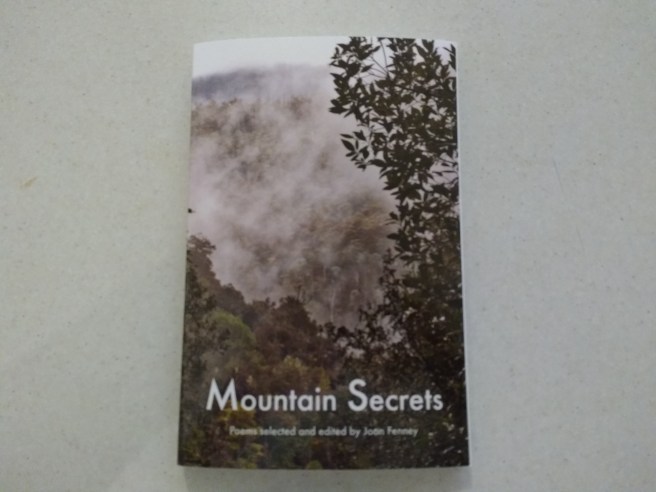
‘Mountain Secrets’ launch

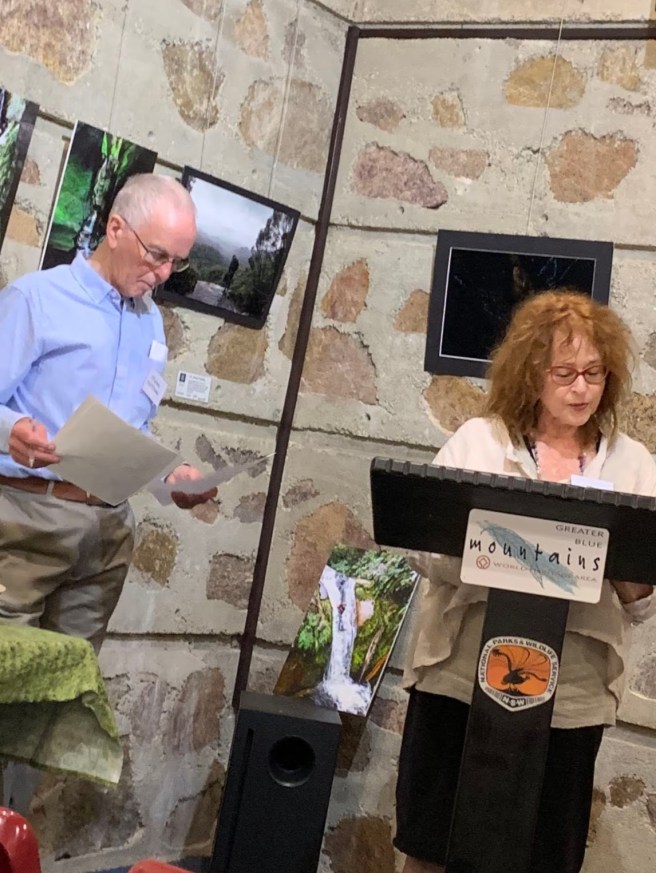
Libby Sommer reading her poem at podium watched by publisher Stephen Matthews
‘Mountains are constant but continually changing. Captive to the seasons, they reveal many faces: in winter shrouded in snow and mist, yet so visibly majestic in the summer months that they appear to touch the sky. Lost in clouds at times, so discernible at others. Places of solitude yet at the mercy of mountaineers who swarm them. Both revered and feared; mystical and earthy; elusive but tangible. Does the mystery of mountains lie in the many paradoxes that surround them? Join more than 150 poets from across Australia in a tantalising exploration of mountains around the world, real and imagined, literal and figurative.’ – Joan Fenney
That’s me reading my prose poem AMBER PUPPY at the Blackheath Heritage Centre for launch last Saturday of the anthology MOUNTAIN SECRETS (Ginninderra Press) edited by Joan Fenney. Publisher Stephen Matthews looks on.
In the Introduction to MOUNTAIN SECRETS Joan Fenney writes:
‘Mountains symbolise many aspects – overcoming obstacles, spiritual elevation, constancy, isolation and challenges. They inspire adventurers to scale their heights, and writers, lyricist, artists and photographers to portray them with words and images.’
A big thank you to Ginninderra Press for inviting all of us GP poets to bring our creativity to this anthology, exploring themes of love, loss, hurt, courage, awe, reverence and solitude. Such an honour to be included.
Mountain Secrets book cover

First Amazon Review of ‘Glass Walls’

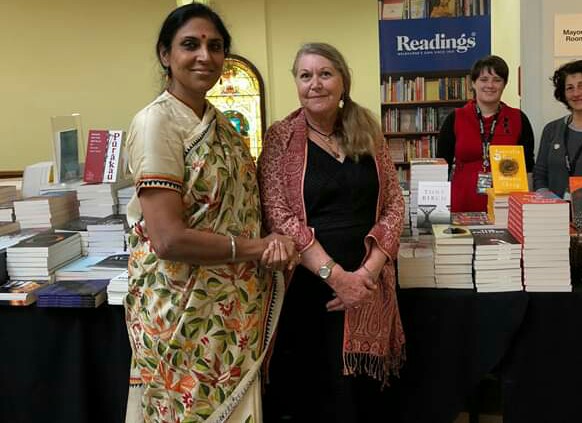
Editors Meenakshi Bharat and Sharon Rundle at launch of Glass Walls

First review on Amazon of GLASS WALLS, published by Orient BlackSwan, stories of tolerance and intolerance from the Indian sub-continent and Australia edited by Meenakshi Bharat and Sharon Rundle (pictured). Thrilled to see my short story HENRY received a special mention. GLASS WALLS was launched recently at the Australian Short Story Festival in Melbourne. Have a read of Punekar’s review:

“This collection of stories tackles a wide variety of subjects and is categorised into Family, Race, Gender, Religion and so on and that is why I enjoyed the book. One could pick and choose a story to read depending on one’s mood. I specifically liked the stories on Family and Gender. The stories on race brought out the dichotomy that exists in all of us, as mentioned in the introduction to the book. Right thinking people are determined not to be biased and want to do the right thing but the subconscious mind often has another agenda. The rational aspect of the personality loses out in certain circumstances. This is brought out in the stories on family too, particularly the story titled “The Wedding Gift”. Another story I liked was the one titled “Henry”. We behave in the most irrational ways but we are not bad people, not really, just human. All the stories are not equally good, but all of them touch something inside your heart.” – Punekar

GLASS WALLS is available from Indian publisher Orient BlackSwan.

Writing in Cafes – Repost


Featured Image -- 5029

I am sitting in a café across the road from the beach in Bronte, Sydney.  This stretch of road has a whole row of cafes side by side facing the sea.  This is my favourite kind of writing place:  one where I can sit comfortably for a long period of time and where the owners of the café know me and welcome me.  This café is owned by a Brazilian man and his wife and has comfortable upholstered bench chairs with a direct view of the Pacific Ocean.

For my two-hour writing session my choice could be a traditional Brazilian dish such as Coxinha, Feijoda or Moqueca.  Or a cocktail like Caipirinha or  Caipiroska.  I must order something and it must be more that a coffee, because I plan to be here for a long time.  I want the owners of the café to know I appreciate the time and the space they are allowing me.

Why go to all this trouble to find a place to write?  Why not just stay home and work?  Because it’s good to get out and have a change of scene.  I find I need to be happy and relaxed when I’m creating on the page and sitting in a café with a pleasant vibe works for me.  Other writers need silence in order to concentrate, but I need to feel I am out and about in a beautiful place having a good time before the creative juices flow.

Strangely, working in a café can help to increase concentration.  The busy café atmosphere keeps the sensory part of you occupied and content, so that the hidden, quieter part of you that composes and focuses is allowed to do its work.  It is something like being cunning when trying to get a spoonful of food into a resistant toddler’s mouth.  You pretend to be an aeroplane with all the sound effects and movements before landing the food-laden plane inside the child’s mouth.  Mission accomplished.

What about you?  Do you need to be at your desk in total silence to write, or do you like to experience the swell of humanity around you—to be surrounded by other human beings?  Or in your home office listening to a particular kind of music?

Book shop supports local author


Exterior of Harry Hartog Bookseller

It’s so good to have the support of a local bookstore. Harry Hartog Bookseller at Bondi Junction keep my books in stock.

Bookshelves displaying New & Staff Favourites in Harry Hartog Bookseller

There’s my newly released STORIES FROM BONDI  in the ‘New & Staff Favourites’ section. Bottom shelf in the middle, next to Jeanette Winterson’s latest book.

If anyone would like to buy one of my books, they can be ordered from any book store. Otherwise order directly from publisher Ginninderra Press or online from Amazon, Book Depository and others.


Use Declarative Sentences – Reblog

pexels-photo.jpg

speech bubble: I'm going to make him an offer he can't refuse

This declarative sentence was spoken by Don Corleone (played by Marlon Brando) in the movie The Godfather (1972).

It is not uncommon for women and other minority groups to add qualifiers to their statements. Such as ‘Parents need to stop organising every minute of their children’s spare time, don’t you think?’ ‘I loved that movie, didn’t you?’ In our sentence structure we look for reinforcement for our thoughts and opinions. We don’t always make declarative statements. ‘This is wonderful.’ ‘This is a catastrophe.’ We look for re-enforcement from others.

Another thing we do without realising it, is use indefinite modifiers in our speech:  perhaps, maybe, somehow. ‘Maybe I’ll take a trip somewhere.’ As if the speaker has no power to make a decision. ‘Perhaps it will change.’ Again, not a clear declarative sentence like, ‘Yes, nothing stays the same.’

It is important for us as writers to express ourselves in clear assertive sentences. ‘This is excellent.’ ‘It was a red dress.’ Not ‘The thing is, I know it sounds a bit vague, but I think maybe it was a red dress.’ Speaking in declarative sentences is a good rehearsal for trusting your own ideas, in standing up for yourself, for speaking out your truth.

When I write poetry I read through early drafts with a critical eye, taking out indefinite words and modifiers. I attempt to distill each moment to its essence by peeling off the layers until the heart of the poem is exposed. We need to take risks as writers and go deep within ourselves to find our unique voices and express ourselves with clarity.

Even if you are not 100% sure about your own opinions and thoughts write as if you are sure.  Dig deep. Be clear. Don’t be vague on the page. If you keep practicing this, you will eventually reveal your own deep knowing.

Have you noticed this tendency to qualify in your conversations with others, or in your creative writing, or in blog posts? Would love to hear your thoughts.