Writing Tip: The Bigger the Issue, the Smaller You Write

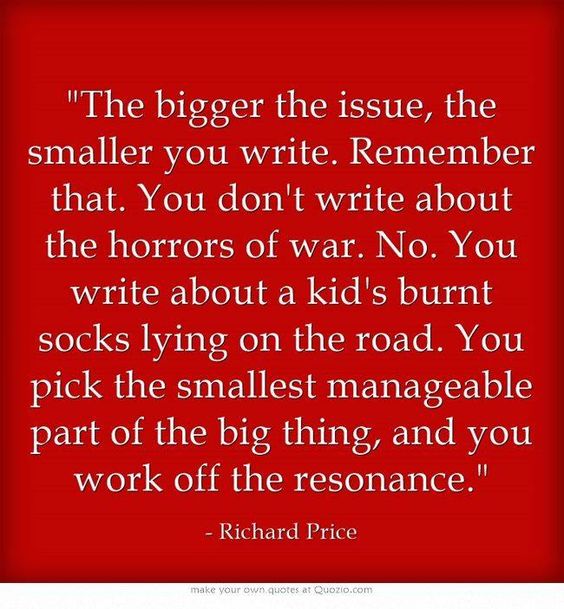
A quote: the bigger the issue, the smaller you write - Richard Price

A fantastic example of this writing advice is Kurt Vonnegut’s  Slaughterhouse-Five.

Poignant and hilarious, threaded with compassion and, behind everything, the cataract of a thundering moral statement. – The Boston Globe
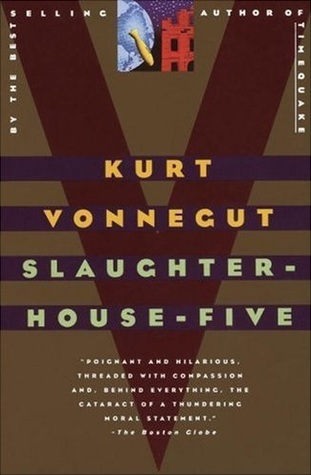
book cover of Kurt Vonnegut's 'Slaughterhouse-Five'

Kurt Vonnegut’s absurdist classic Slaughterhouse-Five introduces us to Billy Pilgrim, a man who becomes unstuck in time after he is abducted by aliens from the planet Tralfamadore. In a plot-scrambling display of virtuosity, we follow Pilgrim simultaneously through all phases of his life, concentrating on his (and Vonnegut’s) shattering experience as an American prisoner of war who witnesses the firebombing of Dresden.

Don’t let the ease of reading fool you – Vonnegut’s isn’t a conventional, or simple, novel. He writes, “There are almost no characters in this story, and almost no dramatic confrontations, because most of the people in it are so sick, and so much the listless playthings of enormous forces. One of the main effects of war, after all, is that people are discouraged from being characters.”

Slaughterhouse-Five is not only Vonnegut’s most powerful book, it is also as important as any written since 1945. Like Catch- 22, it fashions the author’s experiences in the Second World War into an eloquent and deeply funny plea against butchery in the service of authority. Slaughterhouse-Five boasts the same imagination, humanity, and gleeful appreciation of the absurd found in Vonnegut’s other works, but the book’s basis in rock-hard, tragic fact gives it a unique poignancy – and humor. – Goodreads

Highly recommended. A masterpiece.
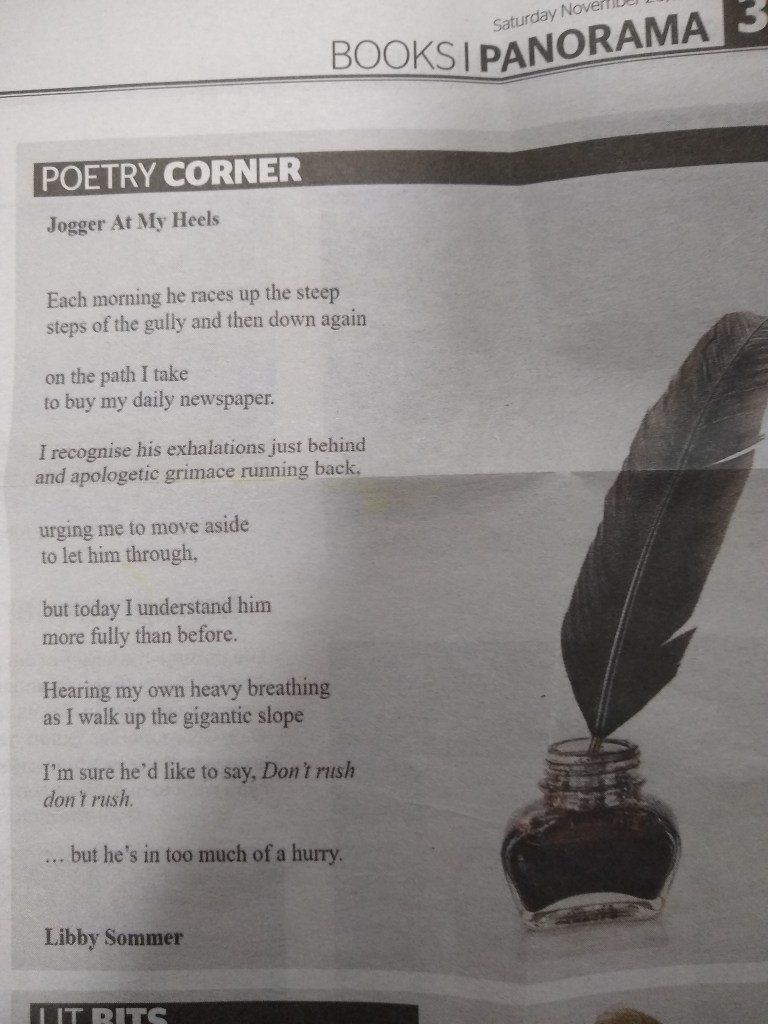
My Poem ‘A Jogger At My Heels’

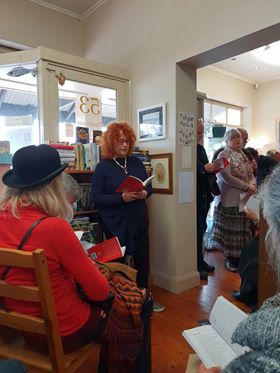
reading from Wild poetry anthology in bookstore

Am thrilled and delighted that my poem, ‘A Jogger At My Heels’ was published in last Saturday’s Canberra Times Panorama Arts section. Big thank you to Poetry Editor, Penelope Cottier and to The Canberra Times for retaining a Poetry Corner.

Have a read:

Did someone say that poetry is the purest form of art?

G. Raja Sebhar writes about the significance of poetry in english literature:

Poetry, the highest form of literature, influences us because it shows different shades of human beings. In fact, poetry is one of the most ancient arts and also the product of human imagination. It expresses different feelings such as friendship, love, death and other human emotions. In literature, poetry stands first even today because poetry has such power to influence this world. Poetry still dominates other forms of literature such as novel, drama, short story etc. Poetry is taught in schools and colleges across the world. The reason is that poetry can tap the emotions of students and their power of imagination. When it comes to English literature, poetry is the dominant form of literature from Chaucer’s period to Modern English Period. In the history of English literature, poetry has dominated other forms in Romantic period, Pre-Raphaelites period, the Metaphysical school of poets, the Classical Movement etc. Thus, poetry has a special place in English literature rather than other forms.

My Flash Fiction ‘Sober Sixty’

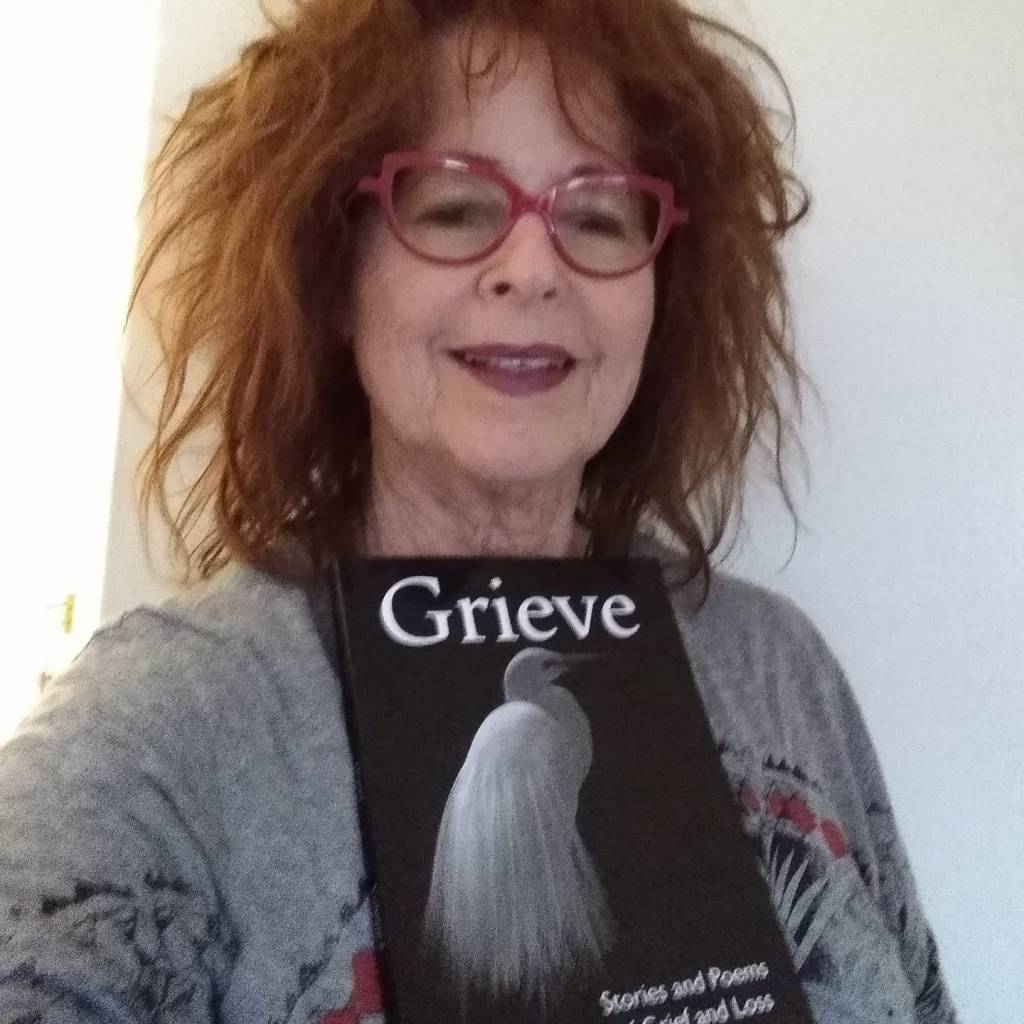
Libby Sommer and 'Grieve" anthology

Have a read of my flash fiction ‘Sober Sixty’ first published in the Grieve Anthology, August 2020, Stories and Poems of Grief and Loss.

Sober Sixty

Samantha’s single women friends were envious, although she assured them Johnny wasn’t perfect. Mood swings, challenging stuff like that.

Nobody messed with Johnny. Nobody knew better than he did, he was always watching YouTube and learning new facts and figures. Also, he rode a motorbike and practiced shooting at weekends. There were Facebook groups for bike riders and a rifle range nearby. Johnny was proud of being a rev-head and a good shot with his gun, and not many people could disagree that he had unusual interests for a man his age.

Sober since forty and counting, he said about his sobriety. They didn’t talk about his twenties and thirties.

There’s a photograph of the two of them from Christmas day. Johnny had tried to lower himself to Samantha’s height for the photo so they’d be on the same level. Stand up tall, she’d said. Stand to your full height. That’s right, he’d said. You like things big.

What does ATP in ATP Cup stand for? was the type of thing Johnny would call out while she poured him a glass of water before setting out on a stroll around the block.

Samantha thought she knew the answer, but didn’t want to risk being wrong. She’d learnt to tiptoe around his wildness and dreaded the fighting when she wasn’t attentive enough to his needs. Dry drunk, AA called it. The unpredictable rages were doing her head in. She knew she needed the courage to walk away.

Now she’s getting by a day at a time.

Her friends say she’s one of the lucky ones. She’s dodged a bullet.

Copyright Libby Sommer 2020

Grieve 2020 Anthology available from Hunter Writer’s Centre website or Booktopia https://hunterwriterscentre.org/bookshop/

Writing Tip: Taste Life Twice

quote by Anais Nin against a night sky

“Writers live twice. They go along with their regular life, are as fast as anyone in the grocery store, crossing the street, getting dressed for work in the morning. But there’s another part of them that they have been training. The one that lives everything a second time. That sits down and sees their life again and goes over it. Looks at the texture and the details.”  – Natalie Goldberg

My Prose Poem, The Ladder & Its Dangers

Have a read of my prose poem ‘The Ladder and Its Dangers’. It was longlisted for the 2019 joanne burns Microlit Award.

Available for inclusion in a range of multi-platform activities organised by Spineless Wonders including #storybombing NWF20, podcasts, live performance and the Microflix Awards.

Hope you enjoy the poem.

The Ladder and Its Dangers:  

It’s dizzying up there. You climb to the top shelves for whatever your mood requires:  on loneliness, weight reduction, a book of Basho’s Haiku and find half a dozen books you forgot you had which side tracks the initial quest, since now that you’ve located them you have to consider them. Will I ever reread this, recycle it in the street library? Of course, your reading interests are very different from the interests you had when you placed it alphabetically on the shelf.  Perhaps your interests have moved in a different direction now, maybe they’ve become more multi-cultural. Perhaps you think continuing to read Anita Brookner and her stories of loss and aloneness are not the best choice for you anymore. Your quest takes on a sedentary nature as you sit on the floor to search the lower shelves, scanning titles and author names. Possibly by now you’ve been up and down the ladder several times and been peering upwards for extended periods cutting off the blood supply to your neck. And you’ve stood up too quickly from the floor and are feeling totally off balance. Now you need to consider blood sugar levels, blood pressure, PEOPLE OVER SIXTY SHOULDN’T CLIMB LADDERS. Discombobulated for a while, you’re too preoccupied to recall what sent you up the ladder in the first place.

Copyright © 2019 Libby Sommer

Writing Tip: Show Don’t Tell

Show don’t tell is an old writing tip, but a good one.

What does it mean exactly?

It means don’t tell us about loneliness (or any of those complex words like dishonesty, secrecy, jealousy, obsession, regret, death, injustice, etc) show us what loneliness is. We will read what you’ve written and feel the bite of loneliness. Don’t tell us what to feel. Show us the situation, and that feeling will be triggered in us.

When you take your child to school on their first day you may find yourself teary and relieved at the same time. Put into words what you see: the child’s face, the wave at the gate, the other mothers saying their goodbyes, another child coming up to take your son by the hand. We will get what you’re trying to say without you telling us directly.

The how-to-write books tell us to use our senses when we write stories:  sight, sound, smell, touch. Writing from the senses is a good way to penetrate your story and make friends with it. Don’t tell us about something, drop deep, enter the story and take us with you.

What about you? Do you consciously bring the senses into your creative writing?

Dyslexia

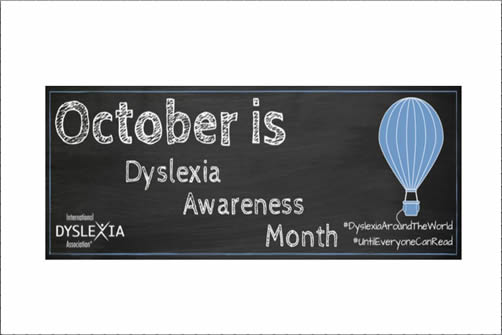
October is Dyslexia Awareness Month worldwide.

Albert Einstein, Walt Disney and Leonardo da Vinci are some of the many famous people diagnosed with dyslexia. Others include Jamie Oliver, Richard Branson, Whoopi Goldberg and Steven Spielberg.

Dyslexia is described as a persistent challenge with acquiring and using written language and is often found to be hereditary. Children struggle to read, don’t want to go to school, feel stupid. Many end up in jail. Apparently, it is fixable, with the right teachers.

My debut novel, ‘My Year With Sammy‘ tells the story of one child’s struggle with severe dyslexia and the effects of her battle on the world around her. The book was Pick of the Week, Sydney Morning Herald and winner of the Society of Women Writers Fiction Book Award 2016.

Writing Tip: How To Slow Things Down

So, here’s the thing:  choose something in particular to write about. For example, what it feels like having a tennis lesson after a twenty year break. Give us the specifics. Dig deep for the details, but at the same time be aware of the world around you. As you focus on what you’re writing, at the same time stay conscious of your surroundings:  the white painted cane Bentwood chairs in the café, the cool breeze from under the door on your sandaled feet, the hum of the traffic outside. Just add a sentence every now and then about the trees that overlooked the tennis courts while you were having a tennis lesson. When we focus on our writing it is good. Seeing the colour of the sky when you toss the ball gives breathing space to your story.

If you are sitting in Meditation you calm the butterfly mind by paying attention to your thoughts, giving them space by acknowledging them before returning to the breath, in and out through the nostrils. In the act of slowing down your breathing, as best you can, you remain open so that you are receptive to awareness of sounds as they arise: sounds near, sounds far, sounds in front, behind, to the side, above or below.

With every breath you take, you feel the air, the sound of the ball as it hits the racket, the  players on the other courts.

We should always be living in the present, not by ignoring the world around us, but by paying close attention. It is not easy to stay alive to ‘what is’. When we slow things down in our writing, it is good practice.

What about you? Do you find a daily meditation practice assists your writing practice?

My Microlit, ‘In the Mall’

My Microlit, ‘In the Mall’ was selected as an entry in the Microflix Writers Awards available to be chosen by filmmakers for adaption to a short film for the 2019 Film Awards. On the theme of SOUND it was available to view on the Microflix SOUND extracts page on the website of Australian short story publisher, Spineless Wonders.

So what is Microlit? According to writer, teacher and editor, Karen Whitelaw: Imagery is important to all writing, but none more than microlit. … Writing is a visual art; paint pictures with words. Things don’t have to be explained, merely implied. This is the beauty of the form, that behind the words a whole world is peeping through. The micro-story has to say something.

Have a read of my story. Hope you enjoy it.

IN THE MALL

In a café inside a mall in Sydney a small curly-topped girl sobbed and sobbed. She sat on her father’s lap, stabbing her finger into a slice of banana bread. Her dad soothed, whispered, coaxed. What would you like, Tara? He cut into his poached egg. Toast? he cajoled. The girl sobbed more loudly, wailing, coughing, staring out into the mall. I want my mum. She cuddled a pink soft piglet. Our eyes scanned the glass display of croissants, pies and pastries. I loved every carb that did not pass my lips. I loved the sobbing child who heard no one else in that cafe but herself, whose lungs fought hard to reach a soaring, sorrowful pitch. What have you got? an elderly woman asked her. Still crying, the child held up her toy. Her father gave up on his poached eggs and carried her out, still wailing. We went and sat at the table with the stabbed-at bread her finger had made and swept the moist crumbs into a heap.

Copyright © 2019 Libby Sommer

Writing Tip: Becoming A Writer

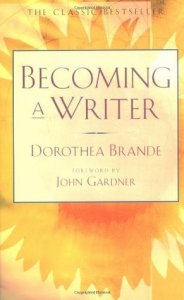
yellow sunflower bookcover of Becoming A Writer by Dorothea Brande

I highly recommend a book on the writing process titled, ‘Becoming A Writer’ by Dorothea Brande. It was given to me by a friend many years ago at the beginning of my writing journey.

‘A reissue of a classic work published in 1934 on writing and the creative process, Becoming a Writer recaptures the excitement of Dorothea Brande’s creative writing classroom of the 1920s. Decades before brain research “discovered” the role of the right and left brain in all human endeavor, Dorothea Brande was teaching students how to see again, how to hold their minds still, how to call forth the inner writer.’ – Amazon

‘Refreshingly slim, beautifully written and deliciously elegant, Dorothea Brande’s Becoming a Writer remains evergreen decades after it was first written. Brande believed passionately that although people have varying amounts of talent, anyone can write. It’s just a question of finding the “writer’s magic”–a degree of which is in us all. She also insists that writing can be both taught and learned. So she is enraged by the pessimistic authors of so many writing books who rejoice in trying to put off the aspiring writer by constantly stressing how difficult it all is.

‘With close reference to the great writers of her day–Wolfe, Forster, Wharton and so on–Brande gives practical but inspirational advice about finding the right time of day to write and being very self disciplined about it–“You have decided to write at four o’clock, and at four o’clock you must write.” She’s strong on confidence building and there’s a lot about cheating your unconscious which will constantly try to stop you writing by coming up with excuses. Then there are exercises to help you get into the right frame of mind and to build up writing stamina. She also shows how to harness the unconscious, how to fall into the “artistic coma,” then how to re-emerge and be your own critic.

‘This is Dorothea Brande’s legacy to all those who have ever wanted to express their ideas in written form. A sound, practical, inspirational and charming approach to writing, it fulfills on finding “the writer’s magic.”‘ – John Gardner

Do you have a favourite book about the writing process that you’ve found to be especially useful on your writing journey?