Writing Tip: Slow things down

woman in blue tennis dress position to hit big forehand

So, here’s the thing:  choose something in particular to write about. For example, what it felt like having a tennis lesson after a twenty year break. Give us the specifics. Dig deep for the details, but at the same time be aware of the world around you. As you focus on what you’re writing, at the same time stay conscious of your surroundings:  the white painted cane Bentwood chairs in the café, the cool breeze from under the door on your sandaled feet, the hum of the traffic outside. Just add a sentence every now and then about the trees that overlooked the tennis courts while you were having a tennis lesson. When we focus on our writing it is good. Seeing the colour of the sky when you toss the ball gives breathing space to your story.

If you are sitting in Meditation you calm the butterfly mind by paying attention to your thoughts, giving them space by acknowledging them before returning to the breath, in and out through the nostrils. In the act of slowing down your breathing, as best you can, you remain open so that you are receptive to awareness of sounds as they arise: sounds near, sounds far, sounds in front, behind, to the side, above or below.

With every breath you take, you feel the air, the sound of the ball as it hits the racket, the players on the other courts.

To slow myself down in tennis I often use the one, two, three method when serving or when receiving a ball from the server. I count ‘one’ as I prepare the service swing, ‘two’ as I toss the ball and ‘three’ when the racket connects with the ball. When receiving a serve I count ‘one’ as the server tosses the ball, ‘two’ when the server hits the ball, ‘three’ when I hit the ball to return the serve. It helps. My tennis coach Chris at Wentworth Tennis suggested I do this, to slow things down.

We should always be living in the present, not by ignoring the world around us, but by paying close attention. It is not easy to stay alive to ‘what is’. When we slow things down in our writing (and in our tennis), it is good practice.

What about you? Do you find a daily meditation practice assists your writing practice?

Writing Tip: Tell It Like It Is

speech bubble: I'm going to make him an offer he can't refuse
Pinterest image

Use clear declarative sentences. This assertive statement was spoken by Don Corleone (played by Marlon Brando) in the movie The Godfather (1972).

It is not uncommon for women and other minority groups to add qualifiers to their statements. Such as ‘Parents need to stop organising every minute of their children’s spare time, don’t you think?’ ‘I loved that movie, didn’t you?’ In our sentence structure we look for reinforcement for our thoughts and opinions. We don’t always make declarative statements. ‘This is wonderful.’ ‘This is a catastrophe.’ We look for re-enforcement from others.

Another thing we do without realising it, is use indefinite modifiers in our speech:  perhaps, maybe, somehow. ‘Maybe I’ll take a trip somewhere.’ As if the speaker has no power to make a decision. ‘Perhaps it will change.’ Again, not a clear declarative sentence like, ‘Yes, nothing stays the same.’

It is important for us as writers to express ourselves in clear assertive sentences. ‘This is excellent.’ ‘It was a red dress.’ Not ‘The thing is, I know it sounds a bit vague, but I think maybe it was a red dress.’ Speaking in declarative sentences is a good rehearsal for trusting your own ideas, in standing up for yourself, for speaking out your truth.

When I write poetry I read through early drafts with a critical eye, taking out indefinite words and modifiers. I attempt to distill each moment to its essence by peeling off the layers until the heart of the poem is exposed. We need to take risks as writers and go deep within ourselves to find our unique voices and express ourselves with clarity.

Even if you are not 100% sure about your own opinions and thoughts write as if you are sure.  Dig deep. Be clear. Don’t be vague on the page. If you keep practicing this, you will eventually reveal your own deep knowing.

I hope this post is useful. Do you have any tips you would add? Let me know in the comments and please share this post with a friend if you enjoyed it. 

Writing Tip: Writing In Cafes

cafes, buses, palm trees, bright blue sky, cars on Bronte Road, Bronte

I am sitting in a café across the road from the beach in Bronte, Sydney.  This stretch of road has a whole row of cafes side by side facing the sea.  This is my favourite kind of writing place:  one where I can sit comfortably for a long period of time and where the owners of the café know me and welcome me.  This café is owned by a Brazilian man and his wife and has comfortable upholstered bench chairs with a direct view of the Pacific Ocean.  For my two-hour writing session my choice could be a traditional Brazilian dish such as Coxinha, Feijoda or Moqueca.  Or a cocktail like Caipirinha or  Caipiroska.  I must order something and it must be more that a Soy Cap, because I plan to be here for a long time.  I want the owners of the café to know I appreciate the time and the space they are allowing me.

However, today I’ll be very boring and order poached eggs on gluten-free bread 🙂

Why go to all this trouble to find a place to write?  Why not just stay home and work?  Because it’s good to get out and have a change of scene.  I find I need to be happy and relaxed when I’m creating on the page and sitting in a café with a pleasant vibe works for me.  Other writers need silence in order to concentrate, but I need to feel I am out and about in a beautiful place having a good time before the creative juices flow.

Strangely, writing in a café can help to increase concentration.  The busy café atmosphere keeps the sensory part of you occupied and content, so that the hidden, quieter part of you that composes and focuses is allowed to do its work.  It is something like being cunning when trying to get a spoonful of food into a resistant toddler’s mouth:  You pretend to be an aeroplane with all the sound effects and movements before landing the food-laden plane inside the child’s mouth.  Mission accomplished.

It is preferable not to turn up at a cafe for a cup of coffee and a writing session at the cafe’s busiest times, like breakfast or lunch. Go at the in between hours when they are pleased to see you because they don’t want the place to look deserted. The beach cafes are places I frequent in spring, autumn and winter, but not much in the summer. Far too crowded and noisy.

There is a real art to finding the right place to write. For me the best place  is one that has comfortable chairs, a pleasant outlook (preferably a view of the the sky and/or green or water). A welcoming, almost homely, atmosphere.

What about you?  Do you need to be at your desk in total silence to write, or do you like to experience the swell of humanity around you—to be surrounded by other human beings?  Or at home listening to a particular kind of music? Let me know in the comments and please share this post with a friend if you enjoyed it. 

The Writing Life


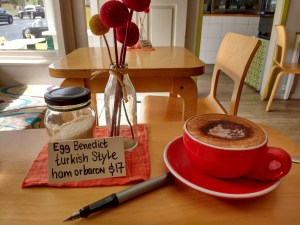
pen and cup of coffee on cafe table

It’s a tough gig being a writer. Lots of isolation, lots of intense concentration, lots of rejection from publishers and agents. Sitting in a cafe with coffee and fountain pen is one of the good bits.

Why do I write? It’s a good question to ask yourself.

  1.  Because I’m a fool.
  2.  Because I want to impress my old school friends.
  3.  So people will like me.
  4.  So my friends will hate me.
  5.  I’m no good at speaking up.
  6.  So I can invent a new way of looking at the world.
  7.  In order to write the great Australian novel and become famous.
  8.  Because I’m a nut case.
  9.  Because I’m an undiscovered literary genius.
  10.  Because I have something to tell.
  11.  Because I have nothing to tell.

Hemingway has said, ‘Not the why, but the what.’ It’s enough to know you want to write. Write.

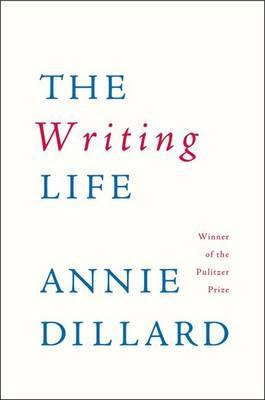
One of my favourite books on the writing process is The Writing Life by Pullitzer Prize winning Annie Dillard. It’s a small and passionate guide to the terrain of a writer’s world.

Book cover 'The Writing Life' by Annie Dillard

 Dillard begins:

When you write, you lay out a line of words. The line of words is a miner’s pick, a woodcarver’s gouge, a surgeon’s probe. You wield it, and it digs a path you follow. Soon you find yourself deep in new territory. Is it a dead end, or have you located the real subject? You will know tomorrow, or this time next year. You make the path boldly and follow it fearfully. You go where the path leads. At the end of the path, you find a box canyon. You hammer out reports, dispatch bulletins. The writing has changed, in your hands, and in a twinkling, from an expression of your notions to an epistemological tool. The new place interests you because it is not clear. You attend. In your humility, you lay down the words carefully, watching all the angles. Now the earlier writing looks soft and careless. Process is nothing; erase your tracks. The path is not the work. I hope your tracks have grown over; I hope birds ate the crumbs; I hope you will toss it all and not look back.

“A writer who waits for ideal conditions under which to work will die without putting a word on paper.” —E. B. White

There is a famous story in the Zen world:

The student, newly arrived at the monastery, asks the master, “What work will I do as I seek enlightenment?”

The master replies, “Chop wood, carry water.”

“And what work will I do once I achieve enlightenment?” asks the student.

“Chop wood, carry water,” says the master.

So how does this stay apply to the writing life? A writer writes. That’s all there is to it.

“You’ll fail only if you stop writing.” – Ray Bradbury

Harry Potter book cover

Rowling has said that Harry Potter “simply fell into [her] head” and “all of the details bubbled up in [her] brain.” She “[had] never felt such a huge rush of excitement and [she] knew immediately that it was going to be such fun to write.”

Sounds like a fairy tale beginning to a fairy tale ending, doesn’t it? Perhaps that’s all ordinary readers need to know about Rowling’s path to literary fame, but us writers need more.

We need to know the not-so-glamorous version of what it was like to write Harry Potter. We need to appreciate how disciplined Rowling had to be to develop her idea into seven hefty books. We have to know that she wasn’t lazily sipping mochas for two decades while jotting down a continuous stream of words like a literary Fountain of Youth.

All too often we convince ourselves that we would write more if only we were well-known, or had more money, or could find more time. But none of that is what makes a writer a writer. It’s simply that a writer writes. – The Friendly Editor

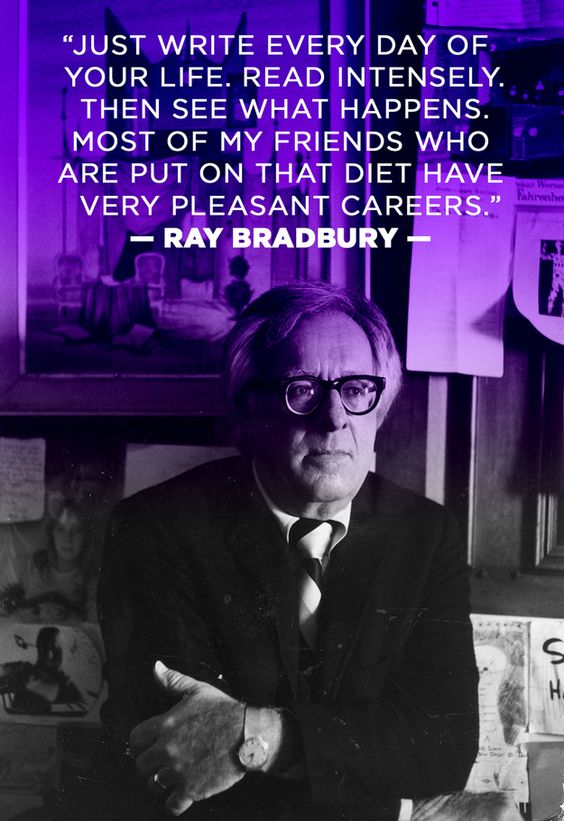
writing quote by Ray Bradbury with author pic

That’s why I write. What about you? Let me know in the comments and please share this post with a friend if you enjoyed it. 

3 of the Best: Finding the Writer’s Magic

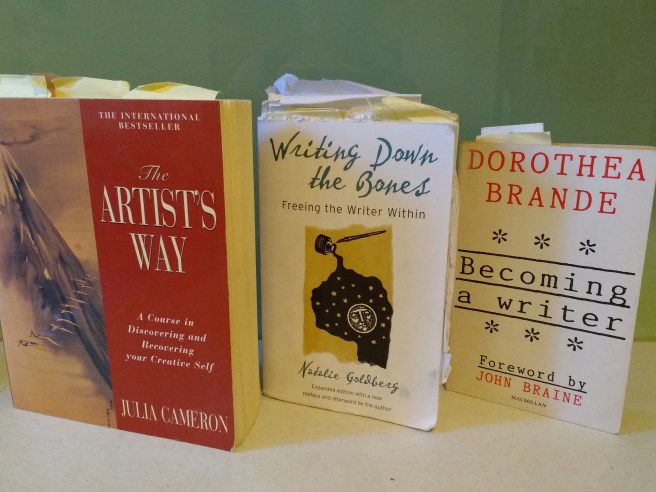
three book covers: The Artist's Way, Writing Down the Bones, Becoming a writer

So much advice out there on writing process but these three books, old ones but good ones, are my favorites. You can see how well-loved they are by how many pages are marked with stickers. I’ve used the books many times when teaching my ‘Writing from Within’ course where we try to harness the unconscious by falling into an artistic coma.

1.

Have you ever longed to be able to draw or paint, write or compose music? In ‘The Artist’s Way’ by Julia Cameron you can discover how to unlock your latent creativity and make your dreams a reality.

‘The Artist’s Way’  provides a twelve-week course that guides you through the process of recovering your creative self. It dispels the ‘I’m not talented enough’ conditioning that holds many people back and helps you to unleash your own inner artist.

‘The Artist’s Way’ helps demystify the creative process by making it part of your daily life. It tackles your self-doubts, self-criticism and worries about time, money and the support to pursue your creative dream.

2.

In ‘Writing Down the Bones’ by Natalie Goldberg, the secret of creativity, she makes clear, is to subtract rules for writing, not add them. It’s a process of “uneducation” rather than education. Proof that she knows what she’s talking about is abundant in her own sentences. They flow with speed and grace and accuracy and simplicity. It looks easy to a reader, but writers know it is the hardest writing of all.’ – Robert Pirsig

‘Writing Down the Bones’  Natalie Goldberg’s first book, sold millions of copies and has been translated into twelve languages. For more than thirty years she practiced Zen and taught seminars in writing as a spiritual practice.

3.

‘Becoming a writer’ by Dorothea Brande is a reissue of a classic work published in 1934 on writing and the creative process. It recaptures the excitement of Dorothea Brande’s creative writing classroom of the 1920s. Decades before brain research “discovered” the role of the right and left brain in all human endeavor, Dorothea Brande was teaching students how to see again, how to hold their minds still, how to call forth the inner writer.

‘Refreshingly slim, beautifully written and deliciously elegant, Dorothea Brande’s Becoming a Writer remains evergreen decades after it was first written. Brande believed passionately that although people have varying amounts of talent, anyone can write. It’s just a question of finding the “writer’s magic”–a degree of which is in us all. She also insists that writing can be both taught and learned. So she is enraged by the pessimistic authors of so many writing books who rejoice in trying to put off the aspiring writer by constantly stressing how difficult it all is.

‘With close reference to the great writers of her day–Wolfe, Forster, Wharton and so on–Brande gives practical but inspirational advice about finding the right time of day to write and being very self disciplined about it–“You have decided to write at four o’clock, and at four o’clock you must write.” She’s strong on confidence building and there’s a lot about cheating your unconscious which will constantly try to stop you writing by coming up with excuses. Then there are exercises to help you get into the right frame of mind and to build up writing stamina.

‘This is Dorothea Brande’s legacy to all those who have ever wanted to express their ideas in written form. A sound, practical, inspirational and charming approach to writing, it fulfills on finding “the writer’s magic.”‘ – John Gardner

I hope these recommendations are helpful. Do you have useful books on writing process you would add? Let me know in the comments and please share this post with a friend if you enjoyed it.
Writing Tip: A Sense of Place

writing desk with keyboard, screen and printer in front of window
My home office

I’m sitting at my writing desk this spring morning in Sydney thinking about the need to ground our writing in a sense of place, whether landscape or cityscape.

How often have you heard someone say of a book they loved:  ‘I felt like I was there.’

Even if you relocate the poodle tied to a fake-cane chair, the sound of a game of tennis, the table of older men after their regular Sunday match at the café overlooking the tennis courts at Cooper Park that you drank a lemongrass and ginger tea at in Sydney into a café in a story in another state and time, the story will have originality and believability.  ‘But that café was in Sydney, I can’t transport it to Adelaide.’  But you can.  You can have flexibility with specific detail.  The mind is able to transport details, but using actual places that you experienced will give your writing authenticity and truthfulness.  It grounds your work in place, giving life and vitality to your writing, rather than a whole lot of exposition that floats in the air.

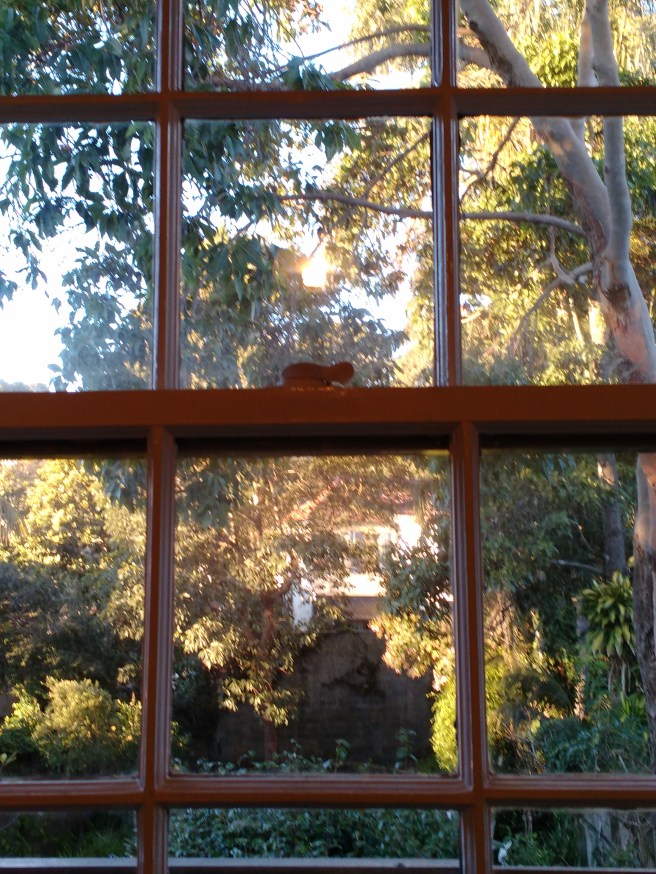
trees and house seen outside French paneled window
looking out the window from my writing desk

 If you don’t create evocative settings, your characters seem to have their conversations in vacuums or in some beige nowhere-in-particular. –  Jerome Stern

Creation of the physical world is as important to your story as action and dialogue.  If your readers can be made to see the hand-knitted socks or the row of vitamins on the kitchen benchtop, the scene becomes alive.  Readers pay attention.  Touch, sound, taste, and smell make readers feel as if their own feet are warm under the cold sheets.

Place situates the story in your reader’s mind.  Fiction that seems to happen in no particular place often seems not to take place at all. –  Jerome Stern

I hope this tip on creating a sense of place is helpful. Do you have any suggestions you would add? Let me know in the comments and please share this post with a friend if you enjoyed it.
3 Parts to the Feedback Sandwich

'The Crystal Ballroom' on bookshelf at bookstore

Yesterday, in the Saturday-afternoon feedback group, we began talking about the ‘off with his head’ or ‘out-it-goes’ part of writing.  We acknowledged that as a group we’d always been very supportive and encouraging of each others work.  That is because we are all in it together.  Our critiquing was not telling lies; it was from a place of open-hearted acceptance.  Everything you put on the page is acceptable.

Sometimes someone says, ‘I want a rigorous no-holds-barred assessment of my work.’  But what do you say to them when the writing is dull and boring?  Don’t give up your day job?  It doesn’t sit comfortably with most of us to be directly critical of someone’s writing.  It’s like telling someone how ugly their baby is.  All of us find it hard to separate our writing from ourselves, and are prone to take criticism personally.

The feedback sandwich is a widely known technique for giving constructive feedback, by ‘sandwiching’ the criticism between two pieces of praise or compliments.

hamburger with cheese and two beef patties

As we passed around copies of our work (just a page or two) we started to address what William Faulkner famously said:

‘In writing, you must kill all your darlings.’

First of all, we looked for the juice in each piece.  Where did the writing come alive?  ‘Get rid of the rest,’ we said.  ‘Off with his head—out it goes.’   It’s very difficult to be this honest, and not everyone wants to hear it.  ‘I simply want gentle support and a few corrections,’ some of us might say.

Be willing to have the courage to look at your work with truthfulness.  It’s good to know where your writing has energy and vitality, rather than to spend a lot of time trying to make something come to life that is dead on the page.   Keep writing.  Something new will come up.    You don’t want to put your readers to sleep by writing a lot of boring sentences.

I hope these suggestions are useful. Do you have any tips you would add? Let me know in the comments and please share this post with a friend if you enjoyed it.  

Obsession is Essential to Creativity

coffee cup, water, writing pad, pen on wooden table in cafe

Every once in a while, when I’m scratching around for something new to write, I make a list of the things I obsess about.  Thankfully, some of them change over time, but there are always new ones to fill the gap.

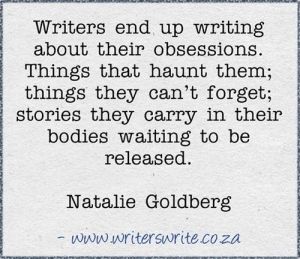
It’s true that writers write about what they think about most of the time.  Things they can’t let go: things that plague them; stories they carry around in their heads waiting to be heard.

Sometimes I get my creative writing groups to make a list of the topics they obsess about so they can see what occupies their thoughts during their waking hours.  After you write them down, you can use them for spontaneous writing before crafting them into stories.  They have much power.  This is where the juice is for writing.  They are probably driving your life, whether you realise it or not, so you may as well use them rather than waste your energy trying to push them away.  And you can come back to them repeatedly.

One of the things I’m always obsessing about is relationships:  relationships in families, relationships with friends, relationships with lovers.  That’s what I tend to write about.  I think to myself, Why not?  Rather than repress my obsessions, explore them, go with the flow.  And life is always changing, so new material keeps presenting  itself.

We are driven by our passions.  Am I the only one who thinks this?  For me these compulsions contain the life force energy.  We can exploit that energy.  The same with writing itself.  I’m always thinking and worrying about my writing, even when I’m on holidays.  I’m driven.

Not all compulsions are a bad thing.  Get involved with your passions, read about them, talk to other people about them and then they will naturally become ‘grist for the mill’.

quote about obsessions

What about you?  Do you find yourself writing about the same topics over and over again?

Writing Is Not Unlike A Sushi Roll

sushi rolls displayed on wooden platter

by Libby Sommer:

Sometimes there is a person in one of my creative writing classes who is obviously very talented.  I can bring to mind one in particular.  You could sense people holding their breath as he read, and often his hands shook.  The writing process opened him up.  He said he had wanted to write for years.  He was so excited about writing that he straight away wanted to write a book.  I said to him, slow down.  Just practice writing for a while.  Learn what this is all about.

In Japan becoming an itamae of sushi requires years of on-the-job training and apprenticeship.  After five years spent working with a master or teacher itamae, the apprentice is given his first important task, the preparation of the sushi rice.

Writing, like becoming a Sushi Chef,  is a life’s work and takes a lot of practice.  The process is slow, and at the start you are not sure what you are making.

Futomaki  (“thick roll” – rice on inside, nori on the outside)

Uramaki   (“inside-out roll” – rice on outside, nori on the inside)

Temaki     (“hand roll” – cone-shaped roll)

It took me 14 years to produce a manuscript that a publisher was prepared to turn into a book.  I am forever grateful to small but prestigious Ginninderra Press for taking me on. Two books so far: My Year With Sammy (2015) and The Crystal Ballroom (2017).

So cut yourself some slack before you head off on a writing marathon.

Writing is like learning to prepare the rice for sushi:  the apprenticeship is long, and in the beginning you are not sure whether a Futomaki, a Uramaki or a Temaki will be the end result.

Connected short stories

exterior State Library of NSW
State Library of New South Wales Sydney

I had a five minute spot last Wednesday at the Society of Women Writers monthly lunch meeting at the State Library of NSW in Sydney. I was given the opportunity to stand up in front of a microphone and speak about my two books. It was a chance to confront my fear of public speaking and tell everyone ‘The Crystal Ballroom’ (Ginninderra Press) had been launched the previous week in Melbourne. I’d only spoken in public twice before, at the two launches. It was a very scary experience. Apparently, most of us fear speaking in front of an audience more than death. So, even though I appeared confident, my hands kept up their shaking for some time after I sat down again. But very pleased with myself for doing it. Those more experienced than me tell me it gets easier every time.

Anyway, the thrust of what I said was that I am transitioning from short story writer to novelist. My debut novel, ‘My Year With Sammy’ (Ginninderra Press) is really a novella and ‘The Crystal Ballroom’ a collection of short stories that I’ve linked together with an “I” narrator and the narrator’s friend, Ingrid. The two women get together over a coffee to talk about the dances they go to, who they see there, and who is sleeping with who, and who’s paying the rent 🙂

It was a device I used to turn a collection of short stories into a novel.

What about you? Have you been able to successfully change the form you write in?