
How to Deal With Rejection as a Writer

adult art conceptual dark

If you are a writer, rejections aren’t just inevitable, they are a way of life — no matter who you are. Unfortunately, dealing with rejection is part of becoming successful as a published author.  

It’s really hard to handle rejection, to keep a lid on crippling self-doubt and to keep going.

We can easily play down just how hard it is to write through fear.  Fear is made much louder and much larger by rejection.

Rejection feels like a kick in the gut. We have shared our writing and shared are deepest thoughts and so it hurts like hell when we are told it is not good enough.

Writing, of course, is subjective. It may only be one person’s opinion of our work. So we have to keep putting our writing out there in front of different readers, publishers or agents.

Tell yourself as often as you need that you’re not the first writer and won’t be the last to have had a book, a short story, or a poem turned down.

Here is a list of authors who have been treated almost as badly as you have been. It’s sure to make you feel heaps better. It comes from the American literary publisher Knopf’s Archives at the Harry Ransom Humanities Research Centre at the University of Texas:


Jorge Luis Borges

‘utterly untranslatable’

Isaac Bashevis Singer

‘It’s Poland and the rich Jews again.’

Anais Nin

‘There is no commercial advantage in acquiring her, and, in my opinion, no artistic.’

Jack Kerouac

‘His frenetic and scrambled prose perfectly express the feverish travels of the Beat Generation. But is that enough? I don’t think so.’

Lady Chatterley’s Lover by D H Lawrence

‘for your own sake do not publish this book.’

The Wind in the Willows by Kenneth Grahame

‘an irresponsible holiday story’

Lord of the Flies by William Golding

‘an absurd and uninteresting fantasy which was rubbish and dull.’

Watership Down by Richard Adams

‘older children wouldn’t like it because its language was too difficult.’

On Sylvia Plath

‘There certainly isn’t enough genuine talent for us to take notice.’

Crash by J. G Ballard

‘The author of this book is beyond psychiatric help.’

The Deer Park by Norman Mailer

‘This will set publishing back 25 years.’

Gentlemen Prefer Blondes by Anita Loos

‘Do you realize, young woman, that you’re the first American writer ever to poke fun at sex.’

The Diary of Anne Frank

‘The girl doesn’t, it seems to me, have a special perception or feeling which would lift that book above the “curiosity” level.’

Lust for Life by Irving Stone

(rejected 16 times, but found a publisher and went on to sell about 25 million copies)

‘ A long, dull novel about an artist.’

Barchester Towers by Anthony Trollope

‘The grand defect of the work, I think, as a work of art is the low-mindedness and vulgarity of the chief actors. There is hardly a “lady” or “gentleman” amongst them.’

Carrie by Stephen King

‘We are not interested in science fiction which deals with negative utopias. They do not sell.’

Catch — 22 by Joseph Heller

‘I haven’t really the foggiest idea about what the man is trying to say… Apparently the author intends it to be funny — possibly even satire — but it is really not funny on any intellectual level … From your long publishing experience you will know that it is less disastrous to turn down a work of genius than to turn down talented mediocrities.’

The Spy who Came in from the Cold by John le Carré

‘You’re welcome to le Carré — he hasn’t got any future.’

Animal Farm by George Orwell

‘It is impossible to sell animal stories in the USA’

Lady Windermere’s Fan by Oscar Wilde

‘My dear sir,

I have read your manuscript. Oh, my dear sir.’

Lolita by Vladimir Nabokov

‘… overwhelmingly nauseating, even to an enlightened Freudian … the whole thing is an unsure cross between hideous reality and improbable fantasy. It often becomes a wild neurotic daydream … I recommend that it be buried under a stone for a thousand years.’

So remember, ‘For writers, rejection is a way of life.’ – author, Erica Verrillo.

10 Ways to Practise Writing

photo of a woman thinking

Sometimes we sit at our desks to write and can’t think of anything to write about.  We face the blank page.  We sit there until blood pours from our foreheads, as one famous author was heard to say.

Making a list can be good.  It makes you start noticing material for writing in your daily life, and your writing comes out of a relationship with your life in all its richness.

10 ideas for writing practice:

  1. Begin with “I don’t remember”. If you get stumped, just repeat the words “I don’t remember” on the page again and keep going.
  2. Tell about sound as it arises. Be aware of sounds from all directions as they arise:  sounds near, sounds far, sounds in front, behind, to the side, above or below.  Notice any spaces between sounds.
  3. Tell me about last evening. Dinner, sitting on the couch, preparing for bed.  Be as detailed as you can.  Take your time to locate the specifics and relive your evening on the page.
  4. Tell me what boredom feels like.
  5. See in your mind a place you’ve always loved. Visualise the colours, the sounds, the smells, the tastes.
  6. Write about “saying goodbye”. Tackle it any way you like.  Write about your marriage breakup, leaving home, the death of a loved one.
  7. What was your first job?
  8. Write about the most scared you’ve ever been.
  9. Write in cafes. Write what is going on around you.
  10. Describe a parent or a child.

Some people have a jar full of words written on pieces of paper and select one piece of paper at random each day and write from that.  Others use a line of a poem to start them off.  Then every time they get stuck they rewrite that line and keep going.

Be honest.  Cut through the crap and get to the real heart of things.

Zen Buddhist, psychotherapist, writer and teacher, Gail Sher in her book One Continuous Mistake says the solution for her came via haiku (short unrhymed Japanese poems capturing the essence of a moment).

 “For several years I wrote one haiku a day and then spent hours polishing those I had written on previous days.  This tiny step proved increasingly satisfying,” Gail Sher.

She said it gradually dawned on her that it was not the haiku but the “one per day.”  Without even knowing it, she had developed a “practice.”  Every day, no matter what, she wrote one haiku.  In her mind she became the person who writes “a haiku a day.”  And that was the beginning of knowing who she was.

Gail Sher suggests writing on the same subject every day for two weeks.

“Revisiting the same subject day after day will force you to exhaust stale, inauthentic, spurious thought patterns and dare you to enter places of subtler, more ‘fringe’ knowing,” Gail Sher.

She writes in One Continuous Mistake that the Four Noble Truths for writers are:

  1. Writers write.
  2. Writing is a process.
  3. You don’t know what your writing will be until the end of the process.
  4. If writing is your practice, the only way to fail is to not write.

So start coming up with your own list of ideas for practice writing.  Life happening around us is good grist-for-the-mill.

Best Way to Beat Writing Resistance

man in blue and brown plaid dress shirt touching his hair

How many wonderful ideas have we had in our lives that never became anything more than ideas?  What stopped them from becoming reality?  Probably lack of drive, or fear, or both.

If the idea of writing a story, writing a memoir, or writing a blog lights a spark within you, sets off a signal, causes you to drool—or fills you with unspeakable anxiety—then you are ready to write.  What is holding you back is not lack of drive, but fear.  Unadulterated, stark fear.

  • Fear of what?
  • Fear of being unable to write well and being criticized by others?
  • Fear of being unable to stay on track long enough to get to an ending?
  • Fear that you just don’t have what it takes to maintain focus to tell a good story?

Research into the way the brain operates has revealed that there are two sides to the brain, left and right.  Much of our fear of writing comes from the way these two sides do or don’t work together.

“We might term the right brain ‘the creator,’ for apparently it allows us to do creative things—make connections, manifest ideas, imagine situations, see pictures of events.  The left side analyses, categorizes, recalls words, and performs its learning functions in a step-by-step manner,”  Bernard Selling, Writing From Within.

The analytic left brain has a compartment that houses the “critic.”  He or she is the person in us who says,

  • Watch out!
  • You can’t do that!
  • You’ll fail, so don’t even try.
  • You know you’re not good at that!

“If those two voices in you want to fight, let them fight.  Meanwhile, the sane part of you should quietly get up, go over to your notebook, and begin to write from a deeper, more peaceful place.  Unfortunately, those two fighters often come with you to your notebook since they are inside your head.  So you might have to give them five or ten minutes of voice in your notebook.  Let them carry on in writing.  It is amazing that when you give those voices writing space, their complaining quickly gets boring and you get sick of them,” Natalie Goldberg, Writing Down the Bones.

It’s just resistance.

Sometimes, the harder you try, the more you become stuck in your own negativity.  It can feel like car tyres spinning in a bog and you just can’t move forward with ‘the work’.  Your resistance is actually greater than your desire to write.  That’s when you need to say ‘stop’ and put it aside for now.  Look for another outlet for your energy before starting again.  Take a break and read books by wonderful writers.  When I get stuck I turn to contemporary poetry for inspiration – thoughtful and passionate poems about living in the modern world.  Some of my favourite poets are:  Mary Oliver, Naomi Shihab Nye, Les Murray and Joanne Burns.

Sometimes I start another writing project before going back to the original one to get more perspective on things.  Other times I will study the beginning and endings of books to get inspiration for a new beginning or a new ending, or sometimes work backwards from the ending as a way to restart.

But don’t get caught in the endless cycle of guilt, avoidance, and pressure.  When it is your time to write, write.  Put yourself out of your misery and just do it.

Why Exercise the Writing Muscle?

man holding barbell

Writing as a daily practice is a way to exercise the writing muscle. Like working out at the gym, the more you do it, the more results you get. Some days you just don’t feel like working out and you find a million reasons not to go to the gym or out for a jog, a walk, a swim, a bike ride, but you go anyway. You exercise whether you want to or not. You don’t wait around till you feel the urge to work out and have an overwhelming desire to go to the gym. It will never happen, especially if you haven’t been into health and fitness for a long time and you are pretty out of shape. But if you force yourself to exercise regularly, you’re telling your subconscious you are serious about this and it eventually releases its grip on your resistance. You just get on and do it. And in the middle of the work out, you’re actually enjoying it. You’ve felt the endorphins kick in. When you get to the end of the jog, the walk, the bike ride, the swim, the gym workout or the Pilates, Yoga or Zumba class, you don’t want it to end and you’re looking forward to the next time.

That’s how it is with writing too. Once you’ve got the flow happening, you wonder why it took you so long to turn up on the page. Bum on chair is what I used to say to my writing students. Through daily practice your writing does improve.

In The Artist’s Way, Julia Cameron’s book on discovering and recovering your creative self, she refers to daily writing practice as the morning pages. She recommends writing three pages of longhand, strictly stream-of-consciousness—moving the hand across the page and writing whatever comes to mind every day.

Author of Writing Down the Bones, Natalie Goldberg refers to writing practice as timed exercise. She says you might time yourself for ten minutes, twenty minutes, or longer. It’s up to you, but the aim is to capture first thoughts. “First thoughts have tremendous energy. It is the way the mind first flashes on something. The internal censor usually squelches them, so we live in the realm of second and third thoughts, thoughts on thought, twice and three times removed from the direct connection of the first fresh flash.”

Her rules for writing practice are:

1. Keep your hand moving.
2. Don’t cross out.
3. Don’t worry about spelling, punctuation , grammar.
4. Lose control.
5. Don’t think. Don’t get logical.
6. Go for the jugular.

In Creative Journal Writing, author Stephanie Dowrick refers to the same process as free writing; writing without judging, comparing and censoring. “Continuing to write when you don’t know what’s coming next and especially when you feel your own resistances gathering in a mob to mock you.”

Daily writing practice has been described as clearing the driveway of snow before reaching the front door. In other words, it’s what we do as a warm up before the real writing takes place.  And it’s a way to loosen up and discover our own unique writing ‘voice’.  That’s what publishers are looking for when they read through the slush pile.  The storyteller’s voice.  The authentic writing voice of the author is what engages the reader.

What about you? Are you able to carve some time out each day to write?

Back Cover Book Blurb

painting of girl lying on beach in torquoise bikini reading a book

The  back cover book blurb is crucially important. But it’s harder than you think to write one. My new book, STORIES FROM BONDI will be published by Ginninderra Press in July this year. It’s especially difficult for me to write a blurb for this book as it’s a collection of stories rather than a continuous narrative. We’re told the blurb should be short and sweet, give away enough of what’s inside the book without giving any plot spoilers and draw the reader in.

This is what I’ve put together using quotes about my work from well-known writers. Let me know what you think.

The characters who inhabit a Libby Sommer story live and breathe. In the sensitively-drawn details of their lives, in the echoes of the everyday, we find images of ourselves.    As in her earlier collections, these 17 stories centre on women – their joys, doubts, loves and realisations – on what Sommer calls “the pain of the human condition”. She lays bare the foibles of human nature. From the opening story searching for the Bondi mermaids, to a moving piece set in a health retreat that closes the collection, this is classic Sommer, “brilliantly drawn with wit, compassion and poignancy …” – JAN CORNALL, Writer’s Journey

Last year, when THE USUAL STORY was nearing publication, I wrote a post about creating a great book blurb. That advice related to a continuous narrative, rather than a collection of stories, but some suggestions I made were:

‘A three-act structure. You want to catch the reader’s attention, give them the content, and then give them a reason to care.’ – Author Unlimited

Have a look at this YouTube video by international best-selling self-published Romance writer Alessandra Torre. She tells a terrific story of how she went from 3 book sales a day to thousands by changing her blurb:  The Blurb Equation – How to Write a Kick-Butt Blurb.


The Blurb Equation (Alessandra Torre)

INTRO + HINT + CLIFFY


1. PART 1 INTRO:           the characters or situation is introduced.

2. PART 2 THE HINT:     what the story is about, the conflict or climax.

3. PART 3 THE CLIFFY:  what’s going to happen? Hooks the reader.

Alessandra says to keep the blurb short. More than four paragraphs is too long . Three paragraphs of two to three sentences is best. Don’t give away the plot.

Hope you find this useful. Good luck on your writing journey.


Words to Use Instead of ‘Very’


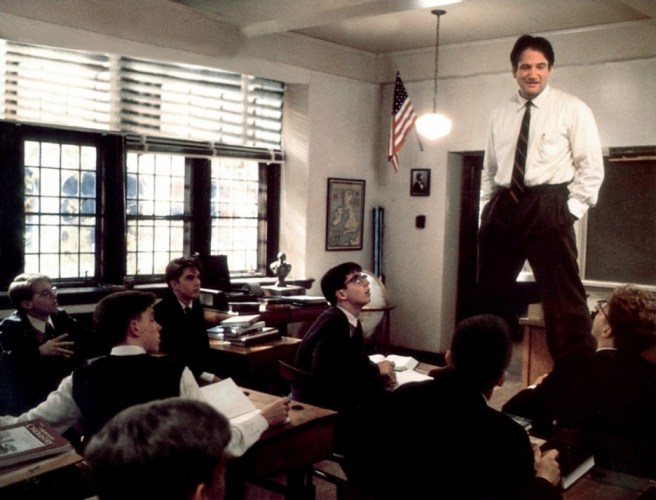
Robin Williams standing on desk in front of classroom of boys

This is the advice Robin Williams had for his classroom of boys in Dead Poet’s Society: 

“So avoid using the word ‘very’ because it’s lazy. A man is not very tired, he is exhausted. Don’t use very sad, use morose. Language was invented for one reason, boys – to woo women – and, in that endeavour, laziness will not do. It also won’t do in your essays.”

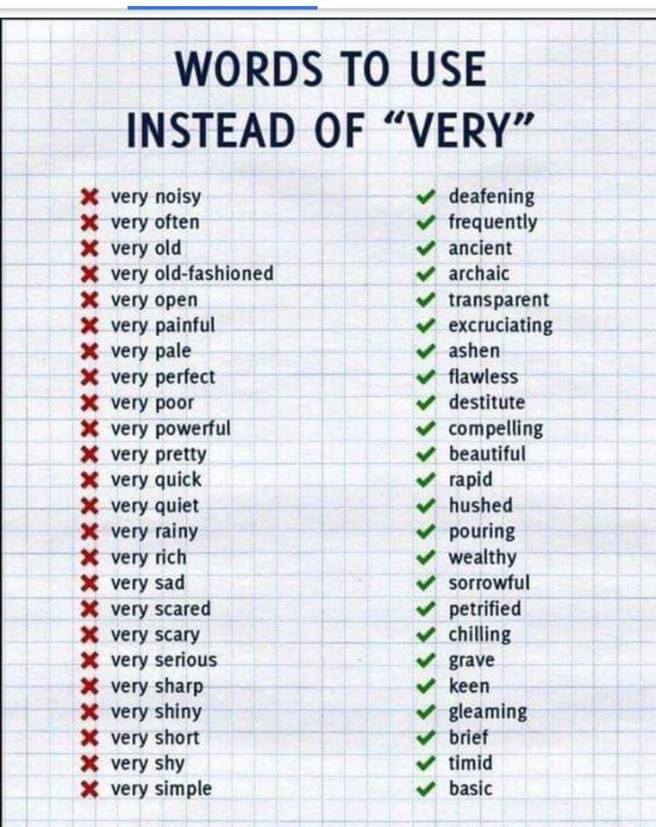
Here are some substitutes for the word ‘very’.

list of words to use instead of 'very'

Sound advice, methinks. Hope you find it useful. I know they teach all this stuff to us in Primary School, but it’s worth a reminder.

Facing the Blank Page

woman in black leather jacket sitting on red chair

When I used to teach classes to beginning writers, it was good.  It forced me to think back to the beginning to when I first put pen to paper.  The thing is, every time we sit down and face the blank page, it’s the same.  Every time we start a new piece of writing, we doubt that we can do it again.  A new voyage with no map.  As people say, it is like setting off towards the horizon, alone in a boat, and the only thing another person can do to help us, is to wave from the shore.

So when I used to teach a creative writing class, I had to tell them the story all over again and remember that this is the first time my students are hearing it.  I had to start at the very beginning.

First up, there’s the pen on the page.  You need this intimate relationship between the pen and the paper to get the flow of words happening.  A fountain pen is best because the ink flows quickly.  We think faster than we can write.  It needs to be a “fat” pen to avoid RSI.

Consider, too, your notebook.  It is important.  The pen and paper are your basic tools, your equipment, and they need to be with you at all times.  Choose a notebook that allows you plenty of space to write big and loose.  A plain cheap thick spiral notepad is good.

After that comes the typing up on the computer and printing out a hard copy.  It’s a right and left brain thing.  You engage the right side of the brain, the creative side, when you put pen to paper, then bring in the left side, the analytic side, when you look at the print out.  You can settle back comfortably with a drink (a cup of tea even) and read what you’ve written.

Then editing and rewriting.

Patrick White said that writing is really like shitting; and then, reading the letters of Pushkin a little later, he found Pushkin said exactly the same thing.  Writing is something you have to get out of you.

Good luck on your creative journey. It’s a tough one. Hang in there and keep writing.

11 Tips: What Makes A Good Story?

portrait of girl wearing christmas hat

Everyone loves a good story. That’s the reason why so many people flock to the movies or spend hours reading novels – it’s because we love to get lost in a great tale. Here are 11 tips from the experts on how to write something fabulous.

1. Tension is the cornerstone of any good story. Eric Nylund

2.  A good story, just like a good sentence, does more than one job at once. That’s what literature is: a story that does more than tell a story, a story that manages to reflect in some way the multilayered texture of life itself. Karen Thompson Walker

3.  Be unpredictable, be real, be interesting. Tell a good story. James Dashner

4.  A good story cannot be devised; it has to be distilled. Raymond Chandler

5.  A good story should make you laugh, and a moment later break your heart. Chuck Palahniuk

6.  Tension is the cornerstone of any good story. Eric Nylund

7.  No, it’s not a very good story – its author was too busy listening to other voices to listen as closely as he should have to the one coming from inside. Stephen King

8.  My only conclusion about structure is that nothing works if you don’t have interesting characters and a good story to tell. Harold Ramis

9.  I do feel that if you can write one good sentence and then another good sentence and then another, you end up with a good story. Amy Hempel

10. I’m just trying to write a good story, strictly from imagination. People just think it’s random, they don’t see the rewriting, phrasing of characters, choosing the words, bringing the world to light in which the characters live in. That creates an illusion that this is real. Eric Jerome Dickey

11. I always try to tell a good story, one with a compelling plot that will keep the pages turning. That is my first and primary goal. Sometimes I can tackle an issue-homelessness, tobacco litigation, insurance fraud, the death penalty-and wrap a good story around it. John Grisham

Hope you find these tips useful. For further reading, check out my posts 3 Parts to a Great Blurb and 10 Ideas for Writing Practice  And to make sure not to miss anything from Libby Sommer Author you can follow me on Facebook  or Instagram.


Where Do We Get Our Story Ideas?

girl learning person studying


“Talking is the first voice of a writer. I always heard it, I just didn’t know you could write it. I write the voices you hear every day—it’s just that people don’t recognize how wonderfully people talk. I think every time a person tells the truth, that person is speaking beautifully.” – Grace Paley

As a writer you’re probably always on red alert looking for story ideas. Maybe you use the world around you, seeking locations and characters and situations, listening in to conversations on buses or trains or in cafes. Changing your daily routine is a way to stimulate the  imagination. Drive or walk to a different part of your suburb or home town and look for different places to write. Writing in cafes is my thing. Challenge yourself to move out of your comfort zone in order to find new ideas. It helps to stay out of routine’s boring rut. I need to be physically comfortable and relaxed when I call on the  muse. Early in my writing career, I wrote sitting up in bed. The ultimate cosy comfort zone. Now a comfy couch in a cafe is my preferred relax place. And when I sit in a cafe to write I always have a printout beside me of the previous day’s writing session. So I’m never staring at a blank page. Helps with the panic, What the hell will I write next?

There’s no better way to find out where to get our story ideas than by hearing from the experts.  Check out some of my favorite authorial quotes below:

“Every secret of a writer’s soul, every experience of his life, every quality of his mind, is written large in his works.”— Virginia Woolf
“And by the way, everything in life is writable about if you have the outgoing guts to do it, and the imagination to improvise. The worst enemy to creativity is self-doubt.”― Sylvia Plath
“Everybody walks past a thousand story ideas every day. The good writers are the ones who see five or six of them. Most people don’t see any.” – Orson Scott
“I want to tell a story, in the old-fashioned way – what happens to somebody – but I want that ‘what happens’ to be delivered with quite a bit of interruption, turnarounds, and strangeness. I want the reader to feel something is astonishing – not the ‘what happens’ but the way everything happens.” –– Alice Munro


“If you haven’t got an idea, write a story anyway.” – William Campbell Gault

Some people keep a container filled with single words and draw out a word each day and write from it. That’s a good way to exercise the writing muscle and to get into the right (rather than left) side of the brain.

Good luck on your search for story ideas. I like to tell people I use anything that moves or makes a noise 🙂

For further reading, check out my posts Writing Tip: Don’t Forget to Pause and Writing Tip: Beating Resistance.  And to make sure not to miss anything from Libby Sommer Author you can follow me on Facebook  or Instagram.

Are First Lines That Important?

toddler reading book

Opening lines are the most important part of your story.

“There are all sorts of theories and ideas about what constitutes a good opening line. It’s a tricky thing, and tough to talk about because I don’t think conceptually while I work on a first draft — I just write. To get scientific about it is a little like trying to catch moonbeams in a jar. But there’s one thing I’m sure about. An opening line should invite the reader to begin the story. It should say: Listen. Come in here. You want to know about this.” – Stephen King

Some of the best opening lines in literature according to Tony Zeoli are:

1. The Bell Jarby Sylvia Plath

“It was a queer, sultry summer, the summer they electrocuted the Rosenbergs, and I didn’t know what I was doing in New York.”

2. Gravity’s Rainbowby Thomas Pynchon

“A screaming comes across the sky.”

3. Cat’s Eyeby Margaret Atwood

“Time is not a line but a dimension, like the dimensions of space.”

4. Blue Nightsby Joan Didion

“In certain latitudes there comes a span of time approaching and following the summer solstice, some weeks in all, when the twilights turn long and blue.”

5. Fahrenheit 451by Ray Bradbury

“It was a pleasure to burn.”

6. David Copperfieldby Charles Dickens

“Whether I shall turn out to be the hero of my own life, or whether that station will be held by anybody else, these pages must show.”

7. The Book of Strange New Thingsby Michel Faber

“Forty minutes later he was up in the sky.”

8. Fear and Loathing in Las Vegasby Hunter S. Thompson

“We were somewhere around Barstow on the edge of the desert when the drugs began to take hold.”

9. Middlesexby Jeffrey Eugenides

“I was born twice: first, as a baby girl, on a remarkably smogless Detroit day in January of 1960; and then again, as a teenage boy, in an emergency room near Petoskey, Michigan, in August of 1974.”

10. The Wavesby Virginia Woolf

“The sun had not yet risen.”

11. The Time Machineby H.G. Wells

“The time traveler (for so it will be convenient to speak of him) was expounding a recondite matter to us.”

12. Lolitaby Vladimir Nabokov

“Lolita, light of my life, fire of my loins.”

13. Slaughterhouse-Fiveby Kurt Vonnegut

“All this happened, more or less.”

14. Sellevisionby Augusten Burroughs

“You exposed your penis on national television, Max.”

15. The Trialby Franz Kafka

“Someone must have slandered Josef K., for one morning, without having done anything truly wrong, he was arrested.”

16. Anna Kareninaby Leo Tolstoy

“All happy families are alike; each unhappy family is unhappy in its own way.”

17. Valley of the Dollsby Jacqueline Susann

“You’ve got to climb to the top of Mount Everest to reach the Valley of the Dolls.”

Good luck!

For further reading, check out my posts Writing Tip: A Change of Pace and Writing Tip: To Plot Or Not To Plot.  And to make sure not to miss anything from Libby Sommer Author you can follow me on Facebook  or Instagram.