A cheque in the mail lifts the spirits of poor struggling writer.

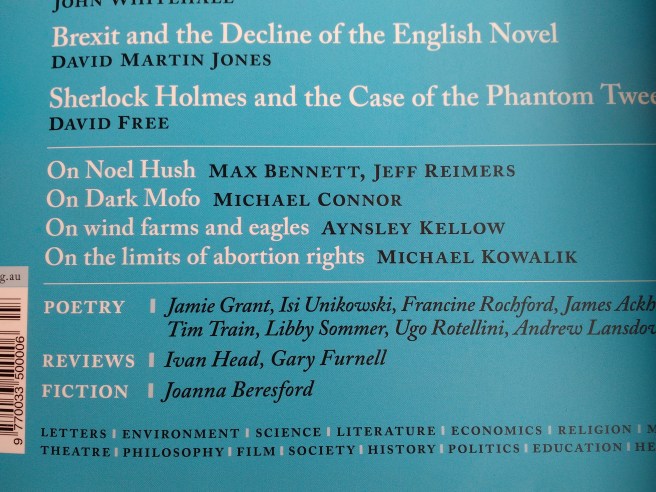
Blue Quadrant magazine with Poetry, Libby Sommer on the cover

There’s my name on the cover of September Quadrant. First time I’ve made it to the cover under Poetry. This month it’s a prose poem titled AMBER PUPPY. I share the honour with poets Jamie Grant, Isi Unikowski, Francine Rochford, James Ackburst, Tim Train, Ugo Rotellini and Andrew Lansdown.
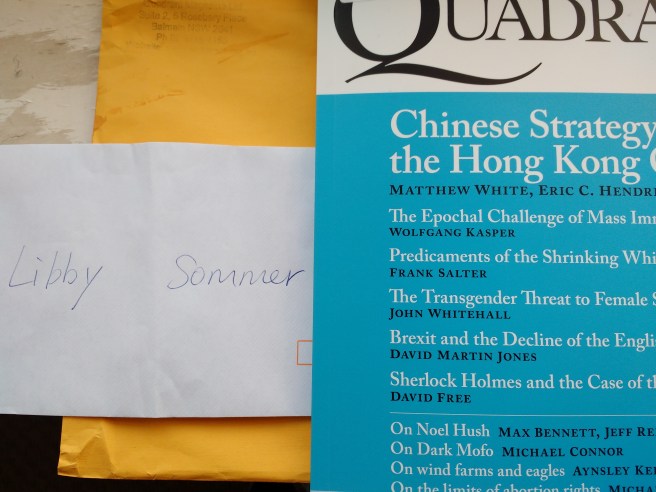
white envelope beside blue Quadrant September 2019 magazine cover

And there’s the white envelope containing my cheque. Halleluja!

So what is a prose poem?

Dictionary:  a piece of imaginative poetic writing in prose.

Poetry Foundation:  A prose composition that, while not broken into verse lines, demonstrates other traits such as symbols, metaphors, and other figures of speech common to poetry …

WikipediaProse poetry is poetry written in prose form instead of verse form, while preserving poetic qualities such as heightened imagery, parataxis, and emotional effects.

Academy of American Poets:  Though the name of the form may appear to be a contradiction, the prose poem essentially appears as prose, but reads like poetry. In the first issue of The Prose Poem: An International Journal, editor Peter Johnson explained, “Just as black humor straddles the fine line between comedy and tragedy, so the prose poem plants one foot in prose, the other in poetry, both heels resting precariously on banana peels.”  While it lacks the line breaks associated with poetry, the prose poem maintains a poetic quality, often utilizing techniques common to poetry, such as fragmentation, compression, repetition, and rhyme. The prose poem can range in length from a few lines to several pages long, and it may explore a limitless array of styles and subjects.

I love writing prose poems. They are definitely my preferred writing form just now.

Have a read of AMBER PUPPY. Quadrant magazine is available in newsagents, some book stores, online and in libraries.

Quadrant magazine cover September 2019


Fortnightly Story: Helen

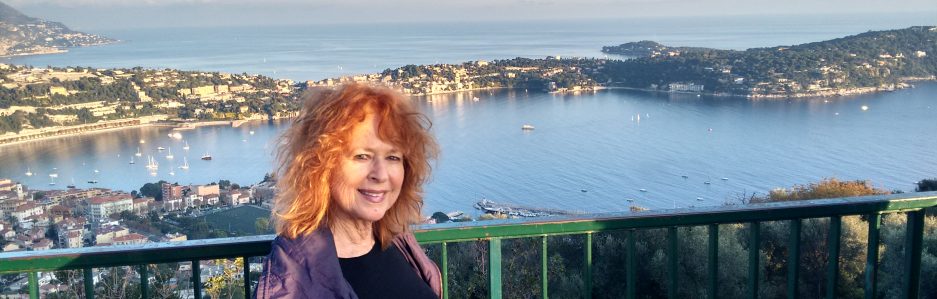
Villefranche sur Mer

Although she loved her nieces and nephews, it was when she turned thirty-nine that driving young children around in her car seemed to make her nervous—a tightening in the stomach.  “Aunty Helen, would you like to take Naomi to see The Muppets?  Are you free?”  Always these requests from one of her sisters looking tired and desperate—one of her younger siblings, they used to be so close—and Helen would force herself to make the effort to be the good aunty.  The responsibility of passengers in her car always made her anxious.  She was anxious about one thing or the other most of the time, but wanted to appear selfless and generous-spirited.  Her availability, or non-availability, was noted, itemised, either in her favour, or against her.  She didn’t want to be labelled self-obsessed.  She had entered an era when the nicest thing a person could say to her was, “You’re a fabulous aunty.  The kids love you.”  Continue reading

Fortnightly Story: Mother

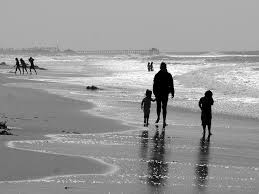
an adult and two children walking along a beach

The day is softening into night, my desk in shadow as the sun moves behind the building.  Birds hover in the trees as the wind blows across the surface of the sea.  It’s hard to know which way to go.  Every day I fear that I can’t do it.  So I’m watching as it gets dark.

Tonight I’m thinking about the saddest bits.  Thinking, for example, that the night was alight with thunder.  Lightening cracked the sky.  Just a flash and then darkness again.

That I loved him, and sometimes he loved me too. Continue reading

Fortnightly Story: JM

empty park bench on grass overlooking lake

I’ve never told anyone.  To think about it makes my hands sweat and nausea rise from my stomach.  It happened the year I turned eighteen on a sunny late afternoon in February, on the top floor of a building in Double Bay.  I was recently engaged to be married and the wedding was booked for the end of June.  We had gone to the photographer’s studio to have our engagement photos taken.  The photographer was a good friend of my future brother-in-law.  I had met him several times before and had thought of him as old, as my parents seemed to be old, but he can’t in those days have been more than fifty.  He was tiny like a jockey, his trademark cravat tied at the neck beneath a tailored shirt.  His accent, foreign but very English.  His shirt covered the numbers branded on his arm – a childhood survivor of the holocaust.  Continue reading