‘Glass Walls’ Pre-launch


'glass walls' book cover

Such a thrill to see my name in the list of contributors to ‘Glass Walls’, stories of tolerance and intolerance from the Indian Subcontinent and Australia, alongside famous authors  including David Malouf, Elizabeth Jolley, Bruce Pascoe, Debra Adelaide, Roanna Gonsalves.

‘Glass Walls’ had a pre-launch at SAFAL (South Asian Festival of Art and Literature) at the weekend.  At the event I was invited to read my short story ‘Henry’ (first published in Quadrant). Am honoured to have my work in this important book published by Orient BlackSwan, edited by Meenakshi Bharat and Sharon Rundle. The book will be released this month.  It will be fully launched at the Australian Short Story Festival 2019 in Melbourne October 18-20.

‘Glass Walls’ challenges readers to look deeply into their own prejudices and reveals how small intimacies of intolerance become the bedrock of world tragedies that tear humanity apart. A powerful anthology.’ – Susanne Gervay OAM

book cover 'Glass Walls'

‘Stories From Bondi’

painting of girl lying on beach in torquoise bikini reading a book

Woohoo. I finished correcting first proofs of my new collection STORIES FROM BONDI due for publication by Ginninderra Press in September. A big job. Final proofs are the next step in the publishing process.

So what are first proofs?

Initial proofs of the book from the typesetter, sometimes still delivered in galley format.

For the author, this first set of author proofs can be a challenge because often what is delivered is the raw typesetting output. Text will have been formatted and a key task for the author is to check that no text corruptions occurred at the file conversion stage of typesetting.

However, because tables, illustrations, etc. may not yet have been added, what these first proofs still lack are the real page breaks and an indication of the book’s final extent. For this reason, careful scrutiny still needs to be given to the final proofs.

This definition is extracted (and expanded on) from the book Getting Published: A Companion for the Humanities and Social Sciences by Gerald Jackson and Marie Lenstrup.

What Are the Microflix Writers Awards?

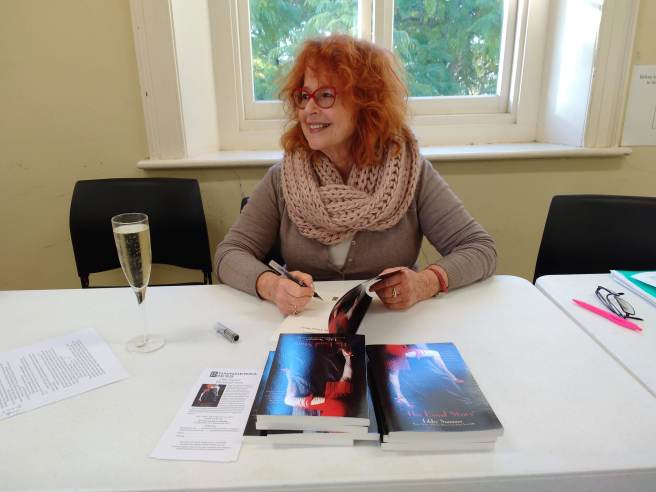
red-headed author Libby Sommer signing one of her books

I am delighted to say that my micro-fiction ‘In the Mall’ has been selected as an entry in the Microflix Writers Awards. Halleluja. I’ll find out in August if my story is chosen by filmmakers for adaptation to a short film for the 2019 Microflix Awards. My microlit on the theme of SOUND is available to view on the Microflix SOUND extracts page on the website of Australian short story publisher, Spineless Wonders.

Spineless Wonders 2019 Microflix Writers Awards

The Microflix Awards offered each year aim to reward and value the roles of both the author and the filmmaker in the adaptation process. For this reason we offer both the Microflix Film Awards and the Microflix Author Awards.

The Microflix Writers Awards consists of a $500 cash prize for Best Writing as well as range of prizes such as discounts on writers’ centre memberships and other resources for writers as well as book packages for Highly Recommended and Recommended Writers.

Our panel of jurists will select winners of the Microflix Writers Awards from the pool of finalist films screened at the Microflix Festival.


The theme for 2019 is SOUND.

This year, Microflix invites authors to submit microlit texts on the theme of SOUND for adaptation by filmmakers. The texts submitted will be reviewed by microlit specialist and Spineless Wonders’ editor Associate Professor Cassandra Atherton. Submissions will be accepted until 30 April and those selected by Cassandra will be included in the 2019 SOUND Texts section on this website.

Exploring the theme of SOUND

We are looking for prose pieces suitable for film adaptation which riff on the theme of sound. You may wish to reflect on the soundtracks of your life – be that songs and music or sounds from the built environment or the natural world. Your submission may reflect on the absence of sound or it may take us into a world without music. Your approach may be playful, witty, political, philosophical or all of the above.


My fingers are crossed.


Short pieces or a novel?


photo of a woman reading book

It’s hard to know sometimes whether to work on the short form or a continuous narrative. I’ve talked about this several times before because it’s a constant dilemma for me. However, the short form seems to be what I do best. Last year I tried very hard to write a genre fiction, but couldn’t get any traction on a story. Instead, I returned to the short form: short stories and prose poems. I am very very happy to say that one story and three poems have now been accepted for publication in Quadrant magazine. Phew! It is such a relief. The previous Literary Editor of Quadrant, poet Les Murray, retired at the end of 2018 and I worried if the new editors of poetry and fiction would like my work. Writing is so subjective. Thank goodness they do.

Have a read of what George Thomas, Deputy Editor of Quadrant writes about the new Literary Editor, Professor Barry Spurr:

The distinguished literary scholar and critic Barry Spurr is the new Literary Editor of Quadrant, succeeding Les Murray who retired at the end of last year after serving in the position since March 1990.

In 2011, Barry was appointed the first Professor of Poetry in Australia, and has long been a world authority on the life and work of T.S. Eliot. His book Anglo-Catholic in Religion: T.S. Eliot and Christianity (Lutterworth, Cambridge, 2010) is widely regarded as the authoritative study in the field.

In an academic career of more than forty years at the University of Sydney, including two stints at St Edmund Hall, Oxford, Barry’s literary scholarship ranged from Early Modern literature to contemporary Australian poetry. He is a leading scholar in the fields of religious literature and liturgical language, most notably in the works of John Donne and T.S. Eliot, and the language, literature and music of the Anglo-Catholic tradition.

His contribution to Australian poetry education and criticism has been prolific, and includes a series of small books for students on individual Australian poets including Kenneth Slessor, Bruce Dawe, Judith Wright, Lee Cataldi, Peter Skrzynecki, Judith Beveridge, Robert Gray, John Tranter, Douglas Stewart, Rosemary Dobson, John Foulcher, as well as the novelist Christopher Koch. In 2007, he was elected Fellow of the Australian College of Educators for his “outstanding contribution to education”.

He has also been a notable public commentator, especially on the role of literature in the modern education system, and the role of the humanities in the modern university. He was the consultant on literature education to the Abbott government’s 2014 review of the national education curriculum chaired by Kevin Donnelly and Ken Wiltshire. Most of his recommendations were included in the final report, which supported “a greater emphasis on dealing with and introducing literature from the western literary canon, especially poetry.”

When he was appointed to his poetry chair by the University of Sydney, Les Murray publicly welcomed him with a letter of congratulations, saying: “It is rare to have a person interested in poetry as distinct from the furthering of what you might call Stasi-type criticism in Australia. In the last 30 years or more, poetry criticism has descended more and more into politics – and a really nasty form of politics.”

In 2016, after he left the University of Sydney, leading literary figures and former academic colleagues from both Sydney and Oxford gave him the festschrift The Free Mind: Essays and Poems in Honour of Barry Spurr (editor Catherine Runcie, publisher Edwin H. Lowe).

Barry has been a contributor to Quadrant since the 1980s. In his most recent piece in March 2018, a review of the collection of Ivan Head’s poetry The Magpie Sermons, he concluded on a severe yet positive note: “In our prosaic and crudely literal world, where just a word in jest in private can be stolen out of context and used to destroy a person’s career and reputation, and where thought, speech and expression are policed and pilloried (even, of all places, in universities), censoring and stifling the imagination, the voices of the poets, contrariwise, enlarging our vision of life and revealing the limitless capacity of language tellingly to communicate that generosity of spirit, have never been more necessary.”

I’m so grateful and blessed to have my work accepted by such a distinguished literary scholar.


You Can Read Forever on a Kindle

kindle technology amazon tablet

I never thought I’d prefer reading on a Kindle to reading a real book. It’s just that it’s so quick and easy to keep downloading to Kindle, and the books are not expensive. If you finish a novel at 10pm and are desperate to read the next book in the series, as I was with the Elena Ferrante novels, it takes mere seconds to have a new story in your hands.

At the moment I’m reading Sapiens: A Brief History of Humankind by Yuval Noah Harari. Fabulous. Highly recommended.

Dymocks says about Sapiens,

What makes us brilliant? What makes us deadly? What makes us Sapiens? This bestselling history of our species challenges everything we know about being human.

Planet Earth is 4.5 billion years old. In just a fraction of that time, one species among countless others has conquered it. Us.

We are the most advanced and most destructive animals ever to have lived. What makes us brilliant? What makes us deadly? What makes us Sapiens?

In this bold and provocative book, Yuval Noah Harari explores who we are, how we got here and where we’re going.

Sapiens is a thrilling account of humankind’s extraordinary history – from the Stone Age to the Silicon Age – and our journey from insignificant apes to rulers of the world

‘It tackles the biggest questions of history and of the modern world, and it is written in unforgettably vivid language. You will love it!’ Jared Diamond, author of Guns, Germs and Steel

Amazon says about Sapiens:

A Summer Reading Pick for President Barack Obama, Bill Gates, and Mark Zuckerberg

From a renowned historian comes a groundbreaking narrative of humanity’s creation and evolution—a #1 international bestseller—that explores the ways in which biology and history have defined us and enhanced our understanding of what it means to be “human.”

One hundred thousand years ago, at least six different species of humans inhabited Earth. Yet today there is only one—homo sapiens. What happened to the others? And what may happen to us?

Most books about the history of humanity pursue either a historical or a biological approach, but Dr. Yuval Noah Harari breaks the mold with this highly original book that begins about 70,000 years ago with the appearance of modern cognition. From examining the role evolving humans have played in the global ecosystem to charting the rise of empires, Sapiens integrates history and science to reconsider accepted narratives, connect past developments with contemporary concerns, and examine specific events within the context of larger ideas.

Dr. Harari also compels us to look ahead, because over the last few decades humans have begun to bend laws of natural selection that have governed life for the past four billion years. We are acquiring the ability to design not only the world around us, but also ourselves. Where is this leading us, and what do we want to become?

A terrific book. I think reading is one of the best way to relax, especially during this crazy holiday period.

For tips on writing process, check out my posts  Writing Tip: Use Your Obsessions and Writing Is Like Becoming a Sushi Chef.  And to make sure not to miss anything from Libby Sommer Author you can follow me on Facebook or Instagram.

Will my story resonate with anyone?

a man and woman dancing tango

When you write a story, you never know if it will resonate with anyone. Then a person like Dr Beatriz Copello writes a review and you find yourself dancing with joy, thinking how blessed you are.

Beatriz Copello’s review was published by The Compulsive Reader and you can read it below:

A review of The Usual Story by Libby Sommer

Reviewed by Beatriz Copello

The Usual Story 
by Libby Sommer
Ginninderra Press
Paperback, ISBN: 9781760415792, July 2018, $27.50, 80pp

The Usual Story by Libby Sommer takes the reader into the life and mind of Sofia.  Sofia is a middle-aged woman, a writer and very much involved in dancing, particularly Tango.

Tango, a dance that was born in the 1800s around the port of Buenos Aires, Argentina, was the dance of port workers and women of the night. Nowadays, this complicated and elegant dance is very much in vogue and danced around the world. Tango gives some sort of skeleton to a large part of The Usual Story. Other sections deal with relationships from the past and the present.

The reader gets to know Sofia as she dances and relates to the other dancers who participate in the Tango classes. In an interesting way Sommer mixes in her text Sofia’s tango adventures and lessons with her thoughts and love experiences, as well as evocative descriptions of her surroundings.

There is something in human beings that makes them ponder relationships. Sommer, with a very fine narrative, engages us in Sofia’s analysis of the past, particularly in her relationships with her parents and with two of her younger lovers J and Tom. The writer has the ability to create very believable characters. She handles feelings in a measured and unsentimental way. The author says about J:

Little by little, I’d learned new things about J. Once, when staying with him in that first summer, I found him lying on my bed with so pitiful a look on his face that I couldn’t see into it. It was very painful to realise how utterly defeated he looked; everything about him was different to what I’d seen before, out of sync, closed down, remote, his very guts hanging out in front of me.

Every now and again we encounter in the narrative some profound thoughts from Sofia. She reflects: “I think that when you are really stuck, when you have stood still in the same place for far too long, it’s almost as if a bomb needs to go off, to get you to move, to jump, and then to hope for the best.”

The Usual Story contains many things about the every day, the mundane, the routine of living but it is presented in such an engaging way that the story becomes real. It is impressive the ability of Sommer to fragment the narrative when we encounter Sofia’s visits to the psychiatrist. We read about her participation in Milongas, asking relatives about her past, and about love and its many facets. All of these interspersed with poetic descriptions of place. Sydneysiders will recognise many areas of the Eastern suburbs in Sommer’s vivid imagery. The following is one of those descriptions that has cinematic qualities:

The sea looks different every day. Today it’s a mid-grey tone, its surface moving in a gentle tugging motion as a container ship moves south along the horizon. A moist breeze brushes my cheek as the waves make a hushing noise as they curl into the sand of the beach. I watch the colour creep slowly into the clouds. A flock of lorikeets balances on the bare branches in front of me.

There is a certain melancholy in The Usual Story which I believe stems from the relationship of Sofia with her mother and her daughter. Relationship between parents and children can be very complicated. As sons and daughters we tend to arrive at a different view of them according to our age. As children, our parents are like gods; as adolescents they can be our enemies; as adults we tend to be more objective but we are too busy with our own children to spend time analysing these relationships. We may also depend on our parents to help with our progeny and this clouds our assessment. A different thing is when we get to that same period of life:  our third age. It is then, when we have lived and experienced life, that we can be more objective in the evaluation and appreciation of our parents. Sofia is at that stage and she can see clearly her mother’s distant and cold behaviour, but there must be in her a grain of insecurity so she wants to check what she thinks she knows. She wants to be sure. So she searches through memories, analysing them, confirming facts with other relatives.

Sofia’s relationship with her daughter is not perfect either. After seeing a mother and a daughter embrace each other with love she says: “They embrace and then walk to the door, still entwined. I feel a pang of wistfulness for my own daughter as I watch them walk away. My daughter who hadn’t wanted to spend a weekend away, just the two of us. She’d said we make each other tense if we’re together too much. But she’d said it in a kind voice.

‘You don’t mind, do you?’ she’d asked.

I did mind. ‘At least you’re honest with me,’ I said.”

As a psychologist, I found The Usual Story fascinating because the characters are so interesting and authentic. As a reviewer, I enjoyed the book’s clear narrative, perhaps a little leisurely at times, but the pace picks up engaging the reader with a beautiful text.

About the reviewer: Dr Beatriz Copello is a former member of NSW Writers Centre Management Committee, writes poetry, reviews, fiction and plays. Beatriz’s poetry has been published in literary journals such as Southerly and Australian Women’s Book Review and in many feminist publications.  She has read her poetry at events organised by the Sydney Writers Festival, the NSW Writers Centre, the Multicultural Arts Alliance, Refugee Week Committee, Humboldt University (USA), Ubud (Bali) Writers Festival.

Print and ebook editions of The Usual Story available from Ginninderra Press, Amazon, Book Depository and other online booksellers.
My latest book has been accepted

painting of girl lying on beach in torquoise bikini reading a book

A big thank you to Ginninderra Press.  STORIES FROM BONDI has been accepted for publication by this small but prestigious Australian publisher.

The Ginninderra Press philosophy:

‘We believe that all people – not just a privileged few – have a right to participate actively in cultural creation rather than just being passive consumers of mass media. Our culture is revitalised and enriched when everyone is encouraged to fulfil their creative potential and diminished when that creative potential is stifled or thwarted. We love to observe the transformative possibilities for people when they see their work published and acknowledged. Getting published can and does change lives.’

Getting published has definitely changed my life. The problem has been that larger publishers are not interested in novellas or short story collections.

My first book MY YEAR WITH SAMMY (2015) was a novella, the second two, THE CRYSTAL BALLROOM (2017) and THE USUAL STORY (2018), were novels-in-stories.

STORIES FROM BONDI is a short story collection and will be released in late 2019. An earlier version of the manuscript was part of my MA in Writing (UTS) back in 2001.

I’m thrilled and delighted and very very thankful to Stephen Matthews, Ginninderra Press.

Ginninderra Press, described in The Canberra Times as ‘versatile and visionary’, is an independent book publisher set up in 1996 to provide opportunities for new and emerging authors as well as for authors writing in unfashionable genres or on non-mainstream subjects. In the words of one of our authors, we are ‘a small but significant publisher of small but significant books’.

As an author writing in unfashionable genres:  novellas and short story collections, I am extremely grateful to this award-winning independent publisher for taking me on. If it wasn’t for Stephen Matthews my work would not be out in the world.

Stories From Bondi

painting of girl lying on beach in torquoise bikini reading a book

I posted another manuscript off to my publisher this week. It’s titled ‘Stories From Bondi‘. I completed an earlier, much shorter version of this book as part of a Masters in Writing at UTS back in 2001. Fingers crossed Ginninderra Press like this collection.

I’ve mentioned before how it took me 18 years of writing and 5 completed manuscripts before I finally had a book accepted by a publisher.

So now I have a small but prestigious publisher  Ginninderra Press who like my work I’m submitting my manuscripts backwards:  numbers 5, 4 and 3 have been published: ‘My Year With Sammy’, ‘The Crystal Ballroom’, ‘The Usual Story’.  Number 2 is ‘Stories From Bondi’.  80% of the short stories were first published in literary journals, including Quadrant and Overland.

Writing a book is a long, long, time-consuming process that requires a super-human amount of persistence and perseverance and dedication to the craft. It’s such a buzz to finally get my work out into the world.

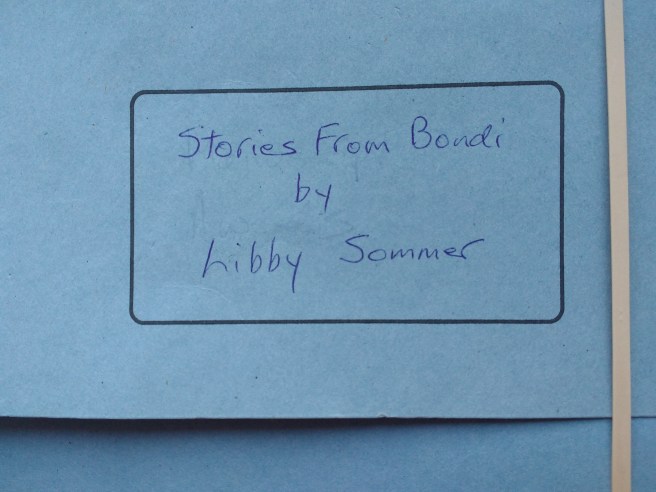
blue manila folder titled Stories From Bondi by Libby Sommer

The Champagne Corks Popped

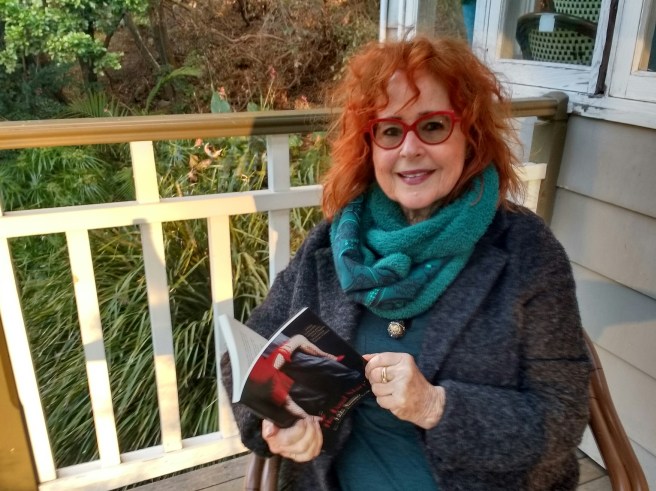
Libby Sommer with The Usual Story book

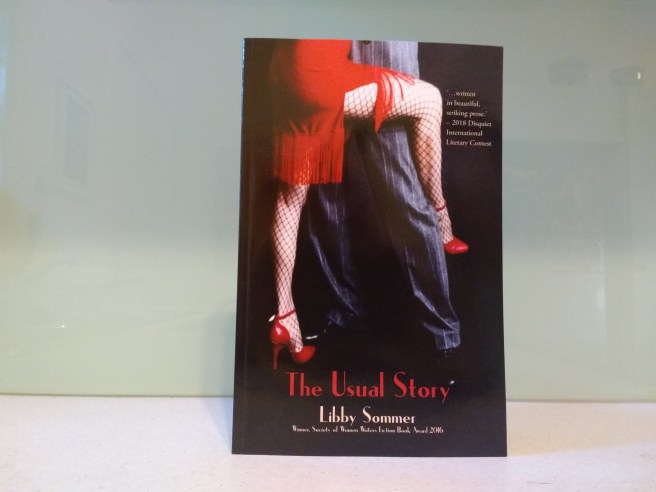
THE USUAL STORY has been released into the world. The champagne corks popped in celebration. Will THE USUAL STORY fly off the shelves in book stores all over Australia and around the world? Will it rocket up the charts on Amazon? Fingers crossed.

champagne cork popping

Here’s the book blurb:

“Tango is a dance of passion. It draws partners into an intimate relationship. Sofia loves to tango but, as she dances, she is confronted by society’s infatuation with the young and the beautiful.

In the painful aftermath of a brief affair, Sofia seeks to find out what she actually knows about herself and the past. She looks for answers in dark corners and begins to see the elusiveness of understanding and memory – the psychological space where recollection and loss collide.

If you liked THE CRYSTAL BALLROOM, you’ll love THE USUAL STORY, a delicately fragmented story of memory, intrigue and passion.”


a grey-suited man and a woman in a red fringed dress, red shoes and fishnet stockings, are in a tango stance, her leg wrapped around him.

Available from Ginninderra Press; also print and ebook editions from Amazon, Book Depository and other online booksellers.

Hope you enjoy it.

Launch of WILD anthology

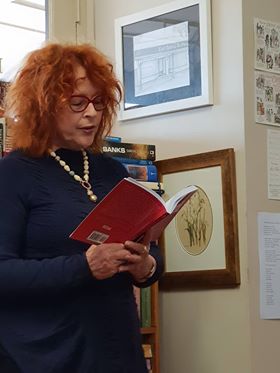
Libby Sommer reading from Wild poetry anthology

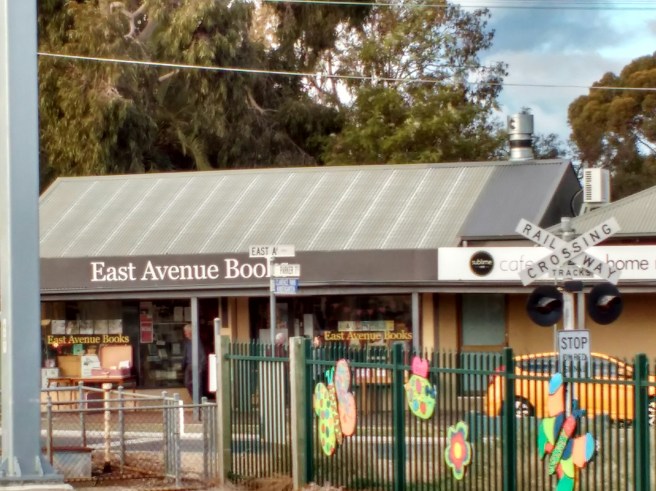
Last weekend I read my poem BRONTE BEACH at the launch of WILD anthology (Ginninderra Press), at East Avenue Bookshop, Clarence Park, Adelaide, South Australia.

More than 50 of us squeezed into the bookshop to read our poems and to listen to 30 different voices from New South Wales, Victoria, The Australian Capital Territory, Queensland, and South Australia.

In the anthology a total of 159 poets from around Australia explore the many facets of ‘wild’ – human, animal, environmental and metaphorical.

Such an honor to be included. This is my contribution to the book:


BRONTE BEACH

The surf’s been hammered by rain,

and along the pavement open-faced cafes wedge side by side:

compact, glass-fronted, in flattened

Art Deco buildings, with competing blackboard menus.

Rain drips from the edge of the canvas awning,

and a smell of fried fish in rancid oil

through the mouth of the sliding door

as an oversized bus pulls in and blocks the view.

Marooned on the swell are wet-suited board riders,

unwavering as the cliff face above the rocks that define the beach.

Beyond the rock pool the waves

remain stubbornly low spreading a shallow calm.

The rain settles, rusting roof racks in the salt air,

and those expired meters will upset the fattened

people-who-lunch in the darkening afternoon.

All day the treacherous ocean scours

the man-made sea pool, where

all-weather swimmers scan the water

for migrating dolphins or whales.

A white-hulled speedboat appears

in the grey-blue, travelling north,

and the black-clad board riders wait,

grounded, legless pigeons who can,

in a heartbeat, fan their iridescent wings.

Squabbling seagulls swoop and dive

and chase each other between the palms,

each white slow and steady flap of wings

picked up by the whiteness of the backwash

of the speed boat out there on the pastel-pink ocean,

disappearing behind the haze.

© Libby Sommer 2018

East Avenue Bookstore, Clarence Park

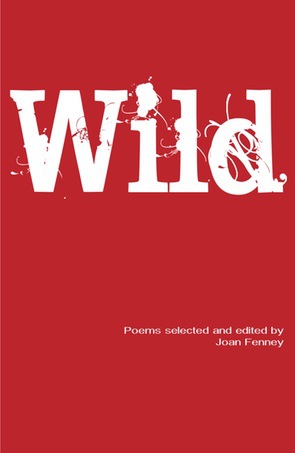
red book cover of Wild anthology

Am very grateful that my poem is in this wonderful anthology of diverse voices.

Thank you Annette Kay Jolly for the photos of me reading.